Intro:
I reviewed the original AR5000 earlier and thought it was a strong first effort from Aune. Excellent sub-bass extension, sensible mid and treble tuning, and a comfortable fit made it a credible alternative to the long-standing Sennheiser HD6X0 series at a similar price point. A solid debut overall.
That said, one issue surfaced in the community over time: the plastic hinge on the headband cracking under prolonged use. My own unit held up fine, but the pattern was hard to ignore.
That brings us to the AR5000 MKII. The headband has been redesigned in full metal, and Aune says they have revised the tuning as well. As it turns out, the changes go further than a typical ‘MK2’ refresh. Let’s get into it.
Detailed measurements can be found in the final section of this article.
Disclaimer: This unit was provided by Aune for review. I was not paid for this review, and everything written here reflects my own thoughts. There are no strings attached, and no affiliate links are used.
Purchase link: Aune kindly asked if I could include their Amazon link, so I am adding it here for reader convenience since I appreciate them sending the unit over for review. This is not an affiliate link, and I do not earn anything from clicks or sales: https://www.amazon.com/dp/B0GXHMFCMB
Pros:
+ Punchy, impactful bass
+ Precise imaging and open stage; impressive clarity and air
+ Updated metal headband
Cons:
– Treble runs a bit hot out of the box
– Upper midrange slightly recessed versus the OG
– Benefits meaningfully from EQ or a pad swap
Specs & Comfort
RRP: $339 USD / $539 AUD
Design: open-back, over-ear
Driver: 50 mm DD (‘MLD diaphragm’)
Sensitivity: 113 dB / 1 Vrms @1kHz
Impedance: 28 Ω at 1kHz
Connector: dual 3.5 mm TRS
Weight: 365 grams, excluding cable
Clamping force: light
Accessories: 1.5m cable with interchangeable plugs (3.5 mm, 6.35 mm, 4.4 mm)
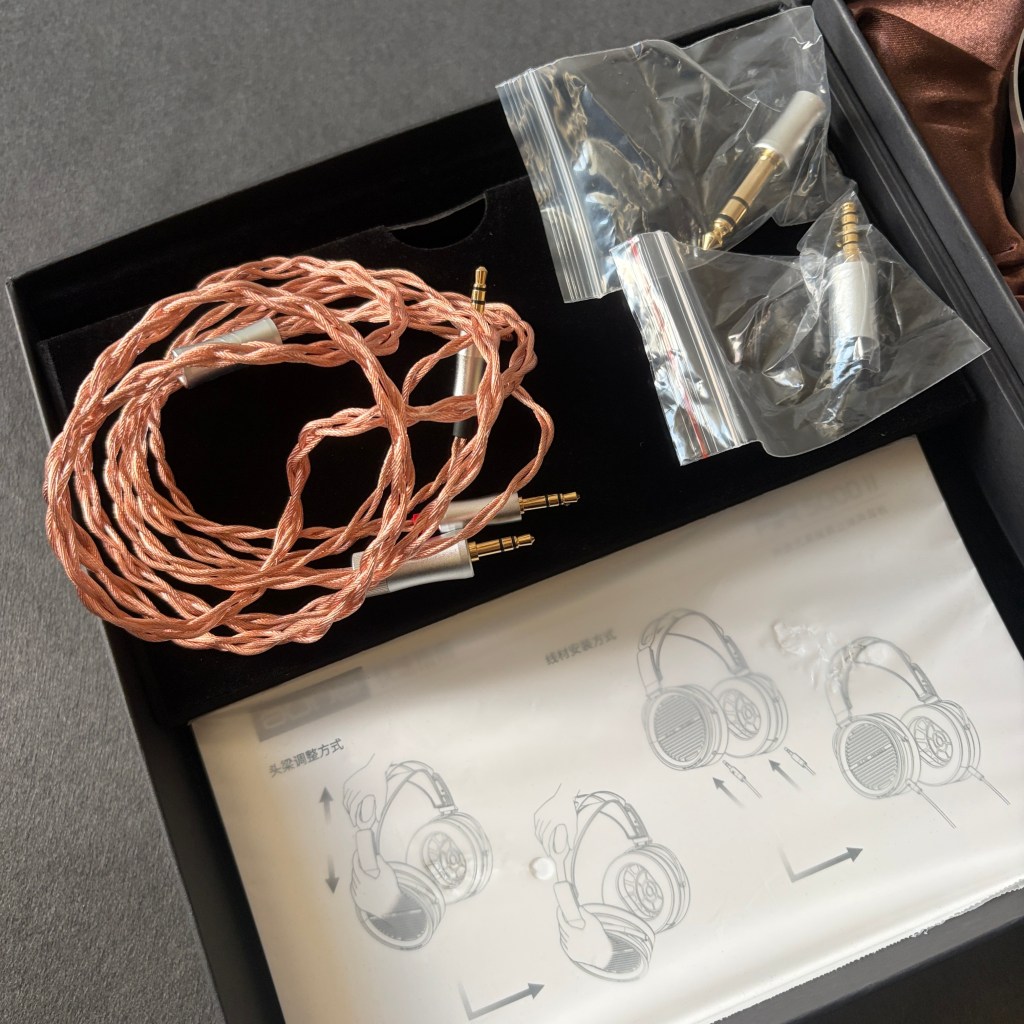
Build and Comfort:
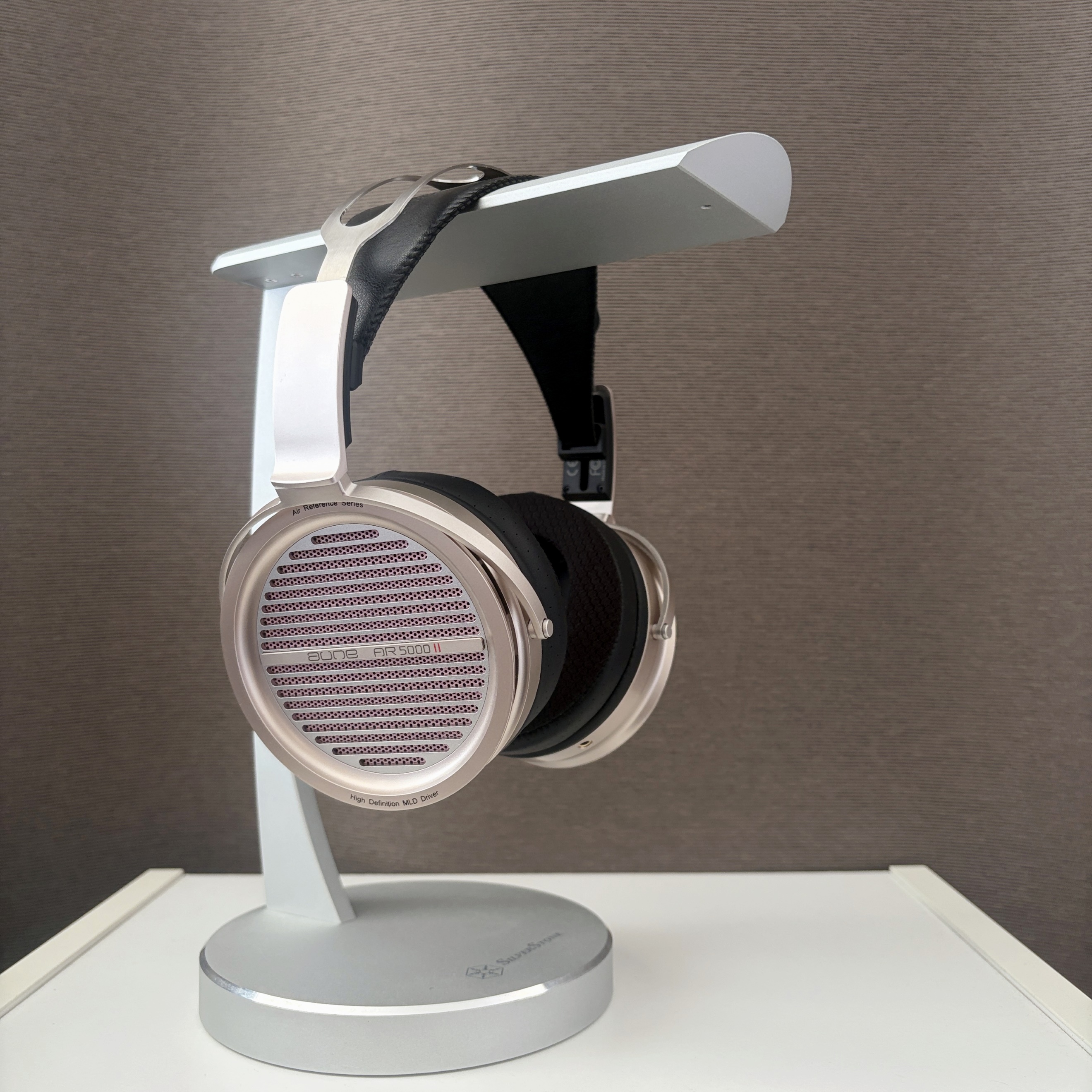
Build quality is excellent. The headphone looks premium, and the new metal headband gives it a more solid, planted feel in the hand. It is a meaningful improvement over the OG, and it addresses the most common durability concern with the previous model in one move.
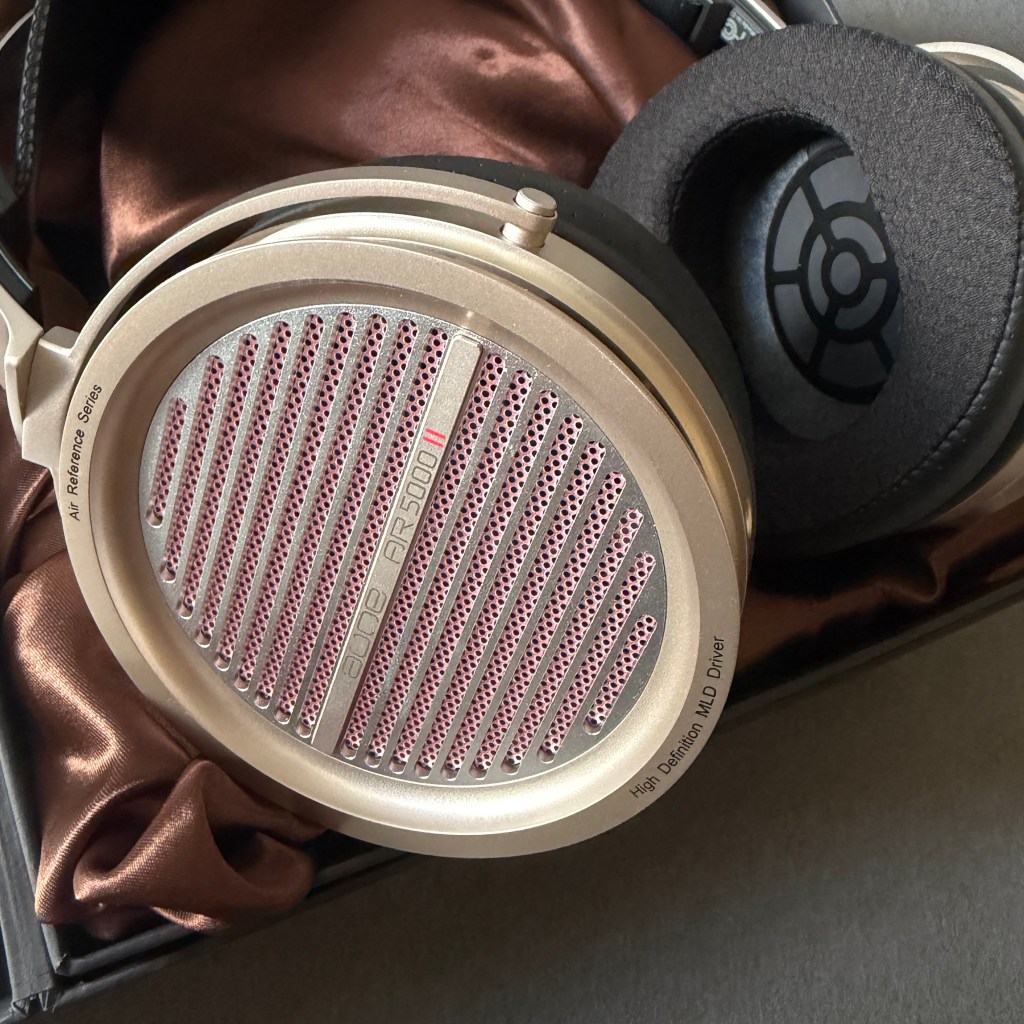
There is another change worth flagging. On the OG, my ears would occasionally brush against the inside of the ear cup baffle, making a faint scratchy feel against the mesh. Not a dealbreaker, just occasionally distracting. On the MK2, this is no longer an issue. Aune has switched the baffle cover material and added a touch more clearance between the ear and the driver.
Comfort remains a strong suit. The suspension headstrap distributes weight well, clamp force is gentle, and the headphone is light enough to wear all day without fatigue. Easily one of the more comfortable over-ears I have used.
Sound
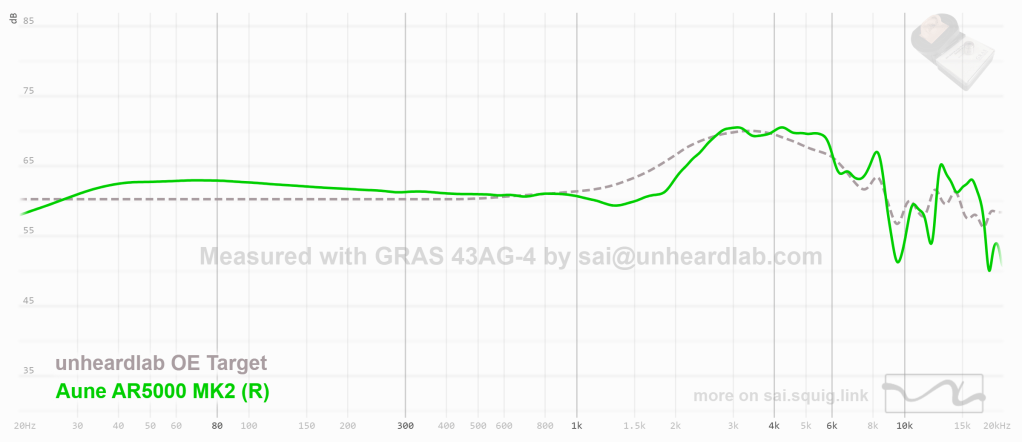
For more comparisons, visit my squiglink database.
Overall impression
The AR5000 MK2 sounds notably different from the OG, and the shift is obvious from the first track. Where the OG aimed for a slightly warm, largely neutral tuning, the MK2 leans into a mild V-shape. The sub-bass and mid-bass are more elevated, and the treble sits noticeably brighter across the board.
It is the kind of revision that almost reads as a different product rather than an iteration. If you found the OG a bit short on excitement, this is the rework you were probably hoping for.
Bass
This is where the MK2 makes its strongest case. There is a touch more warmth than the OG, but it does not come through as muddy or overly thick. Bass is dynamic and punchy, cleanly elevated from the sub-bass through to around 250Hz without bleeding much into the mids.
The OG had excellent extension on paper, but in practice it felt a bit soft and loose, short on mid-bass slam. This may be caused by the high f0 frequency on the OG. The MK2 fixes that. It hits with proper authority, while the texture stays tight and well controlled. The character reminds me of Focal’s dynamic drivers, with their physical and immediate bass impact. That is high praise for an open-back dynamic at this price, and arguably above it.
Midrange
The midrange is articulate and well-bodied, though less linear than the OG and slightly recessed through 1-3kHz. This appears to be a deliberate tuning decision. Aune has increased the front cavity depth by adding clearance between the driver and the ear, which is also what fixes the ear-touching-baffle issue from earlier. Subjectively, that creates a larger sense of space, but it also softens the forwardness of midrange instruments. In some ways, this reminds me of the tuning logic of Hifiman headphones, like the Susvara.
Timbre stays largely correct, and midrange tonality is still well judged. It gives the MK2 a broader, grander presentation at the expense of some bite and immediacy. But if you specifically valued the OG’s linearity, this moves in a different direction.
Treble
This is the most divisive part of the tuning. Treble is clearly brighter than the OG. There are no major peaks to single out, so the brightness feels as broadly elevated rather than sharp or peaky. There is no serious timbral fault, but the overall treble level sits above what many listeners will be comfortable with. This also sounds consistent with a lighter front-damping approach compared to the OG, though I would not want to overstate that without teardown confirmation.
Well-mastered tracks generally hold up fine. Push it with something hot, though, and the limits show. “White Dress” by Lana Del Rey is a useful stress test, and the MK2 does not do well with it: the accentuated highs tip into uncomfortable territory. On better-recorded female vocals with a more restrained top end, it pulls back to merely borderline, with sibilance sitting right at the edge of sounding irritating.
For reference, think Sennheiser HD800S or Hifiman HE1000 V2 level for brightness. If that range already pushes your tolerance, the MK2 will too. The upside is that the sense of air and clarity is noticeably stronger than on the OG, making the MK2 feel like a headphone of a higher calibre.
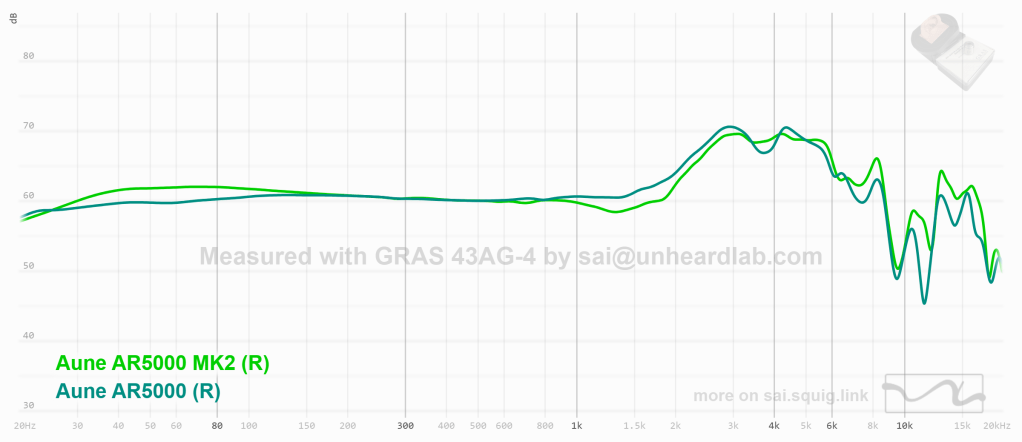
For more comparisons, visit my squiglink database.
Other impressions:
Spatial presentation
Staging is very good and a step up from the OG. Width and depth both feel more expansive than before, and the overall presentation comes across as open rather than congested. Like the OG, the angled driver design gives the MK2 a strong sense of directionality, making instruments easy to place across the field. For a mid-fi open-back, it is an impressive performer, and one of the areas where the new tuning pays off. For gaming, the clear positional cues also make it a strong option, somewhat reminiscent of the Beyerdynamic T1 Gen 1.
Clarity
Clarity is excellent and clearly improved. Some of that follows naturally from the brighter treble, since added energy up top tends to lift perceived detail. But because there are no major peaks driving it, the clarity feels broadly natural rather than forced or artificially etched. Small details in upper harmonics, room cues and percussion decay are easier to pick out than on the OG, though the trade-off is that poor recordings and sharp mixes are more exposed.
Dynamics
Dynamics are another standout. Compared to the OG, this almost feels like a muscle-car of a headphone: authoritative impact when the music calls for it, paired with enough contrast to render quieter shifts and nuances. It handles both ends of that scale better than most at the price. It comfortably outperforms the Sennheiser HD6 series and the HD490 Pro here, and only falls just shy of the Focal Clear, which is a very high bar to measure against.
Conclusion:
At $339 USD/$539 AUD, the AR5000 MK2 is an impressive performer in a lot of categories. It takes the OG’s blueprint but takes the tuning to a different direction. The bass is impactful and hard-hitting, staging and clarity are both clear steps up, and the build now feels as solid as the sound. Aune has taken real, considered swings here, and most of them land.
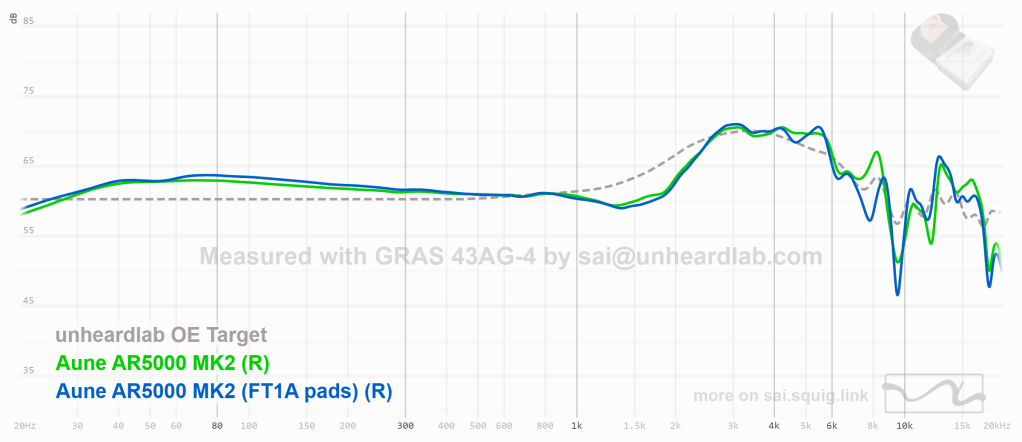
The sticking point is treble. It is bright enough that I cannot see it suiting everyone out of the box, and for treble-sensitive listeners it will likely be a dealbreaker. The good news is that this seems fixable. I have suggested to Aune that they include a second set of pads, which would let buyers dial the brightness back to a more neutral balance while keeping most of the other performance intact. EQ is also a simple option here. As it is, the potential is high, it just needs a bit more polish to fully realise that potential.
So the recommendation comes with a condition. If you want something that sounds smooth and enjoyable out of the box, this might not be ideal. But if you are comfortable with EQ or pad swaps, or you simply enjoy a mildly V-shaped tuning, the MK2 is a strong offering. Fit and comfort are excellent, and once tuned to taste, it is an easy headphone to live with.
If there are other comparisons you would like to see, let me know in the comments.
Value Grade:
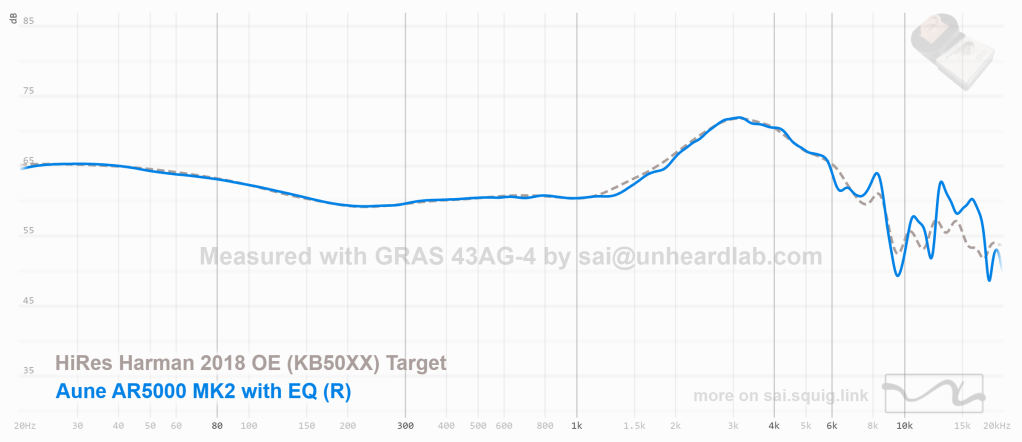
Recommended EQ setting
Copy and paste the below into a TXT file, then import it to EqualizerAPO or similar apps. It is advisable to adjust the bass and treble filters to your own taste (i.e. below 300Hz and above 3kHz):
Preamp: -7.0 dB
Filter 1: ON PK Fc 20 Hz Gain 6.5 dB Q 0.800
Filter 2: ON PK Fc 210 Hz Gain -2.5 dB Q 0.900
Filter 3: ON PK Fc 960 Hz Gain -1.0 dB Q 3.000
Filter 4: ON PK Fc 1800 Hz Gain 3.5 dB Q 1.500
Filter 5: ON PK Fc 3600 Hz Gain 2.0 dB Q 3.000
Filter 6: ON PK Fc 5400 Hz Gain -3.0 dB Q 2.000
Filter 7: ON PK Fc 8200 Hz Gain -2.0 dB Q 3.000
Filter 8: ON PK Fc 15000 Hz Gain -2.0 dB Q 1.000
If your goal is to EQ the response to match the Harman Target, consider the AutoEQ function provided by Squiglink as a convenient starting point. I personally recommend customising the filters to better suit your own hearing, especially in the treble. While the AutoEQ provides a useful baseline, individual adjustments can often significantly improve your listening experience.
If you’re new to EQ, I’d recommend checking out this video by Resolve from The Headphone Show — it’s a really solid intro and walks through the basics in a clear, no-nonsense way. Great place to start!
Measurements
Frequency Response:
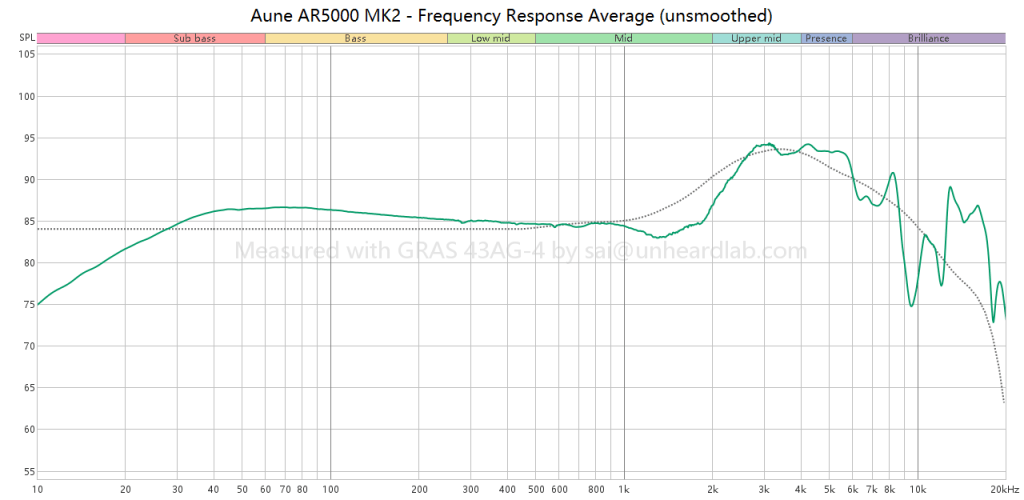
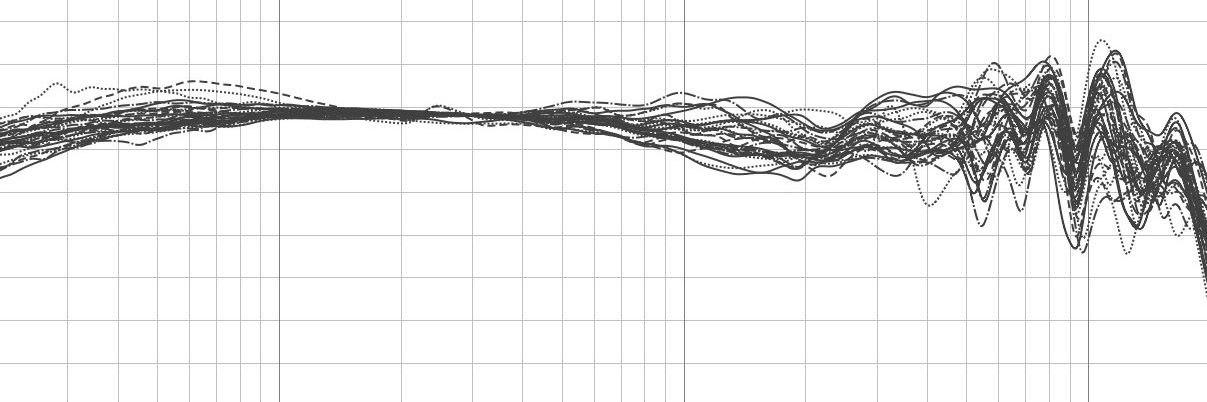
The response is obtained by an average of 5-6 positional variations. The FR shown on the graph is unsmoothed.
Comment: Bass extension is excellent for an open-back. The main departures are a mild 1-3 kHz recession and elevated energy from 6 kHz upward, both consistent with the brighter, more V-shaped character described above.
Positional Variation:
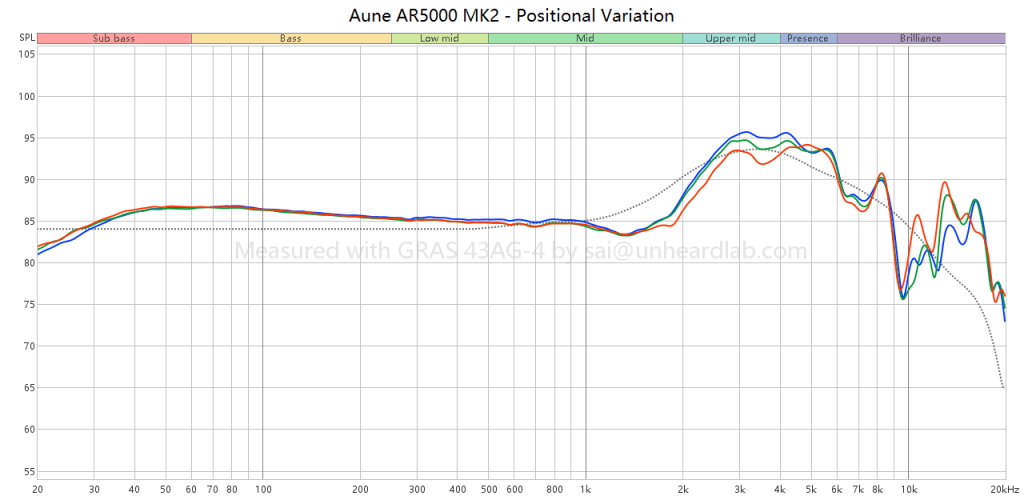
This graph illustrates how headphone placement on the head affects perceived tonal balance: with the ear positioned at the front (blue), centre (green), and back (red) of the headphone. The FRs shown on the graph are 1/24 octave smoothed.
Comment: Positional sensitivity is moderate, with variation concentrated in the upper midrange and brilliance region.
Leakage Tolerance:
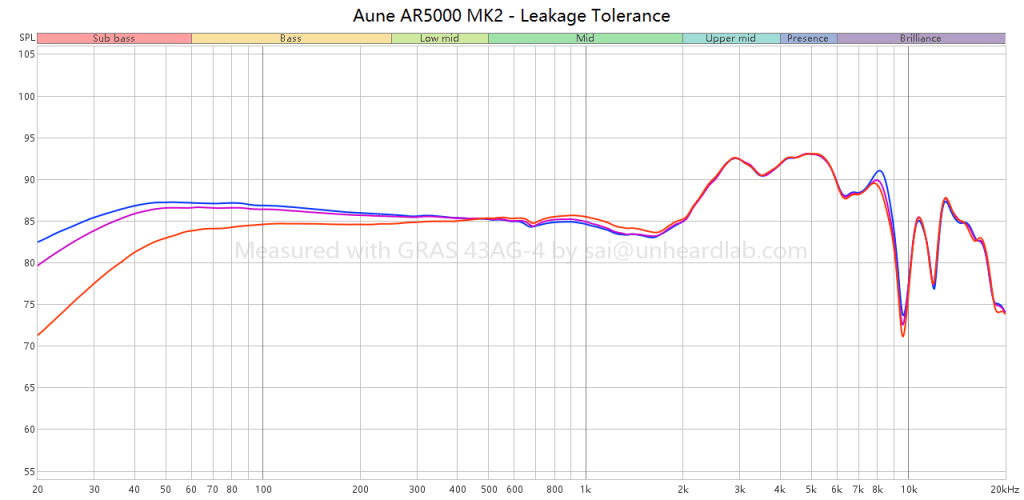
This graph demonstrates how leakages to the front volume can result in FR change: blue (good seal), purple (thin arm glasses), red (thick arm glasses). The FRs shown on the graph are 1/12 octave smoothed.
Comment: Typical open-back behaviour, where bass below 100 Hz is the most sensitive to seal disruption. Glasses wearers may notice some sub-bass loss, especially with thicker frames.
Linearity and Compression:
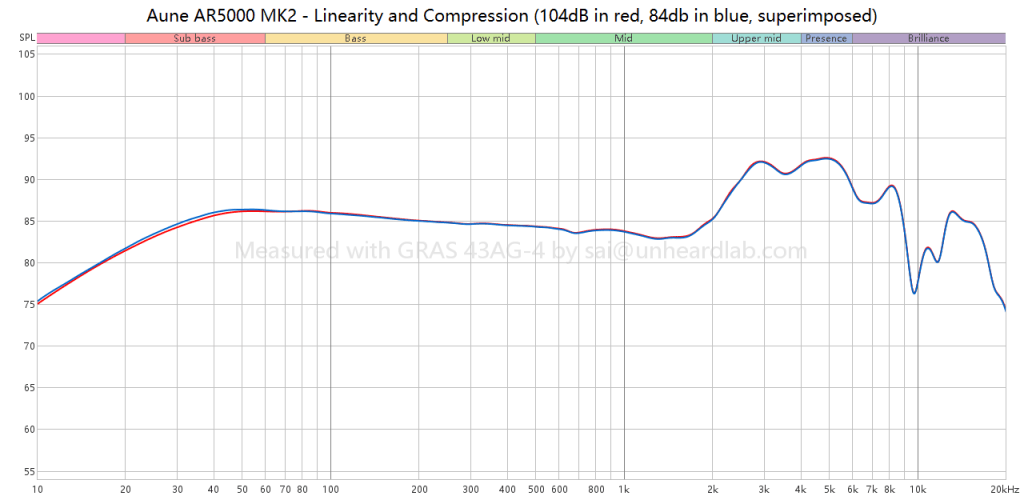
Linearity and dynamic compression testing plots the headphone’s frequency response at two input levels to show how it reproduces signals as loudness changes. Any divergence between the high-level and low-level curves points to where the transducer’s dynamic range begins to compress or distort. Here, the measurements are superimposed to allow direct comparison. The FRs shown on the graph are 1/6 octave smoothed.
Comment: Essentially no compression visible at 104 dB. The driver handles high SPL well, which leaves comfortable headroom for bass EQ.
Impulse Response:
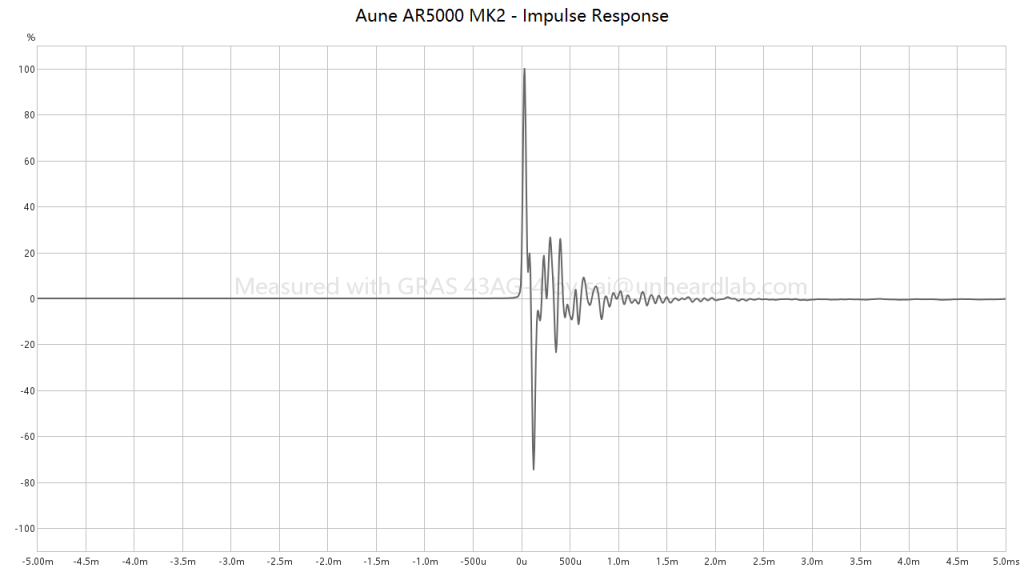
The impulse response test measures the initial response, overshoot, and decay of a transducer upon receiving a signal. An initial upshoot indicates a normal/non-inverted polarity, vice versa.
Comment: Normal, non-inverted polarity with a clean initial response and reasonably controlled decay, characteristic of a well-damped dynamic driver.
Total Harmonic Distortion (THD% 2nd-9th) & Excess Group Delay (94 dB):
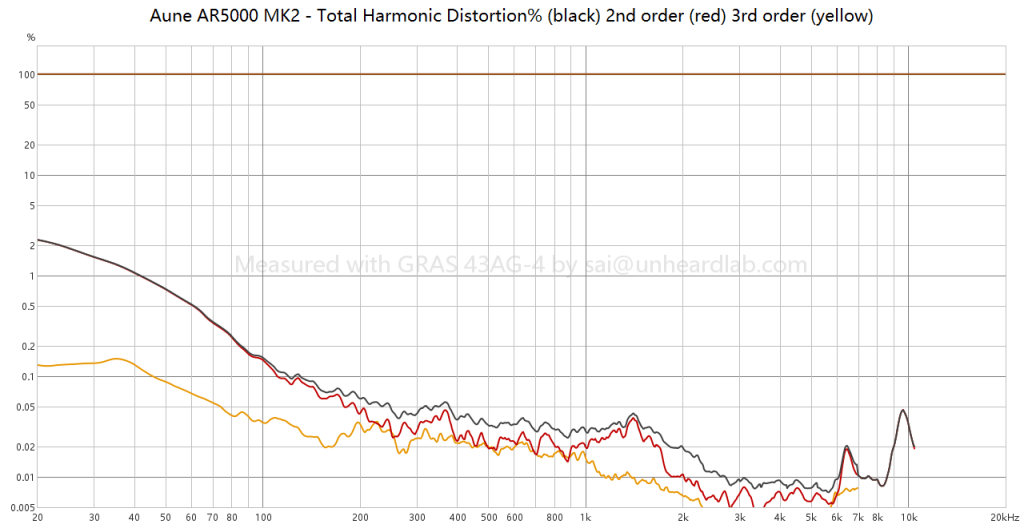
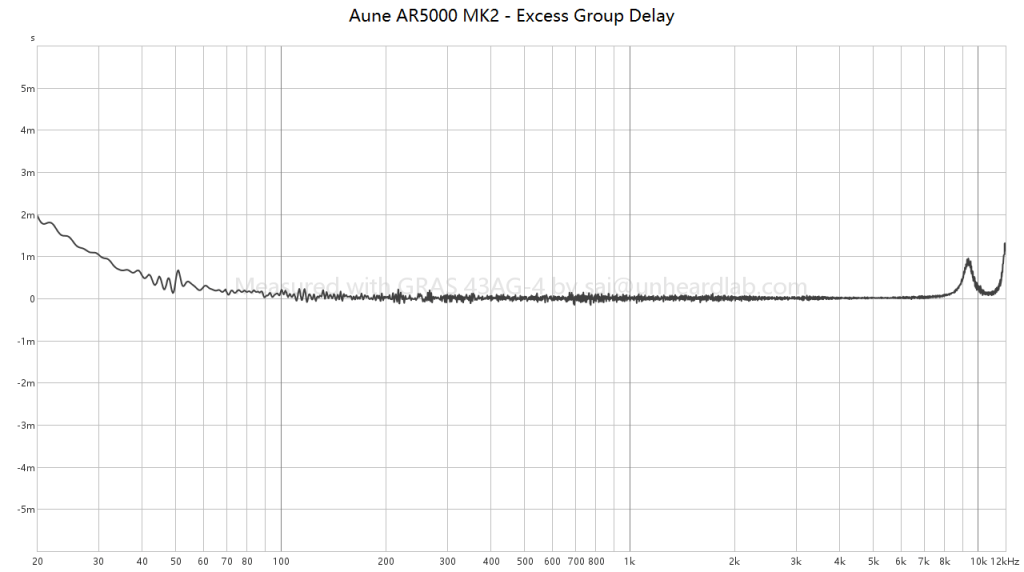
These measurements are conducted in quiet, normal room conditions (as opposed to an anechoic chamber), meaning there may be some influence from ambient room and external noise. These results should be considered a preliminary assessment of performance, primarily for identifying major issues, and do not reflect the best-case performance scenario. Any peaks or dips around 9 kHz are likely artefacts from pinna interaction or phase cancellation, rather than inherent features of the device under test.
Comment: Distortion is low across the spectrum, with no concerning peaks. Excess group delay is clean once the usual ~9 kHz artefact is accounted for.
Channel Matching:
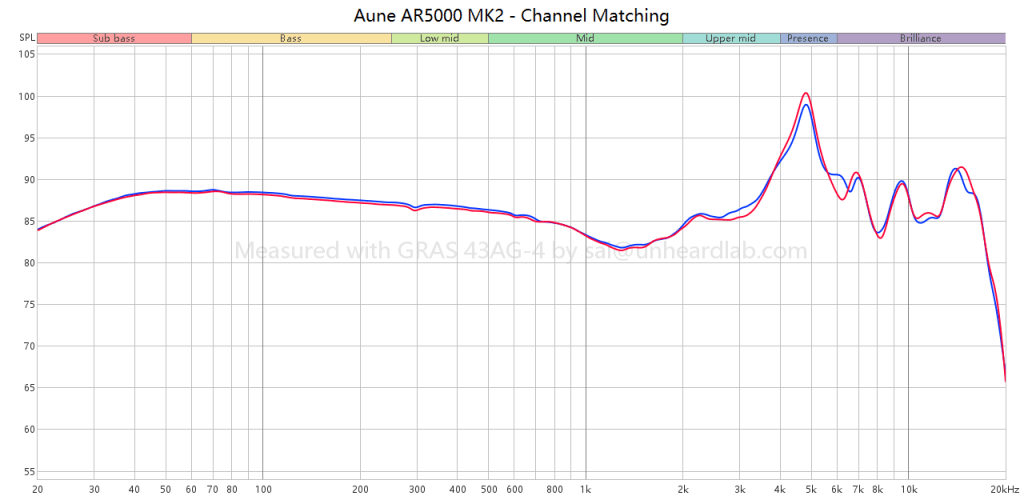
Channel matching graphs are intended for quality control checks and do not relate to the perceived sound profile. A specialised configuration is used in this test to capture differences between channels, mitigating interference from positioning on the rig and the asymmetry in the GRAS pinnae design, a legacy of KEMAR. The left (blue) and right (red) channels are measured using a flat plate coupler with an IEC60318-4 ear simulator.
Comment: Channel matching is excellent.
Electric Phase & Impedance:
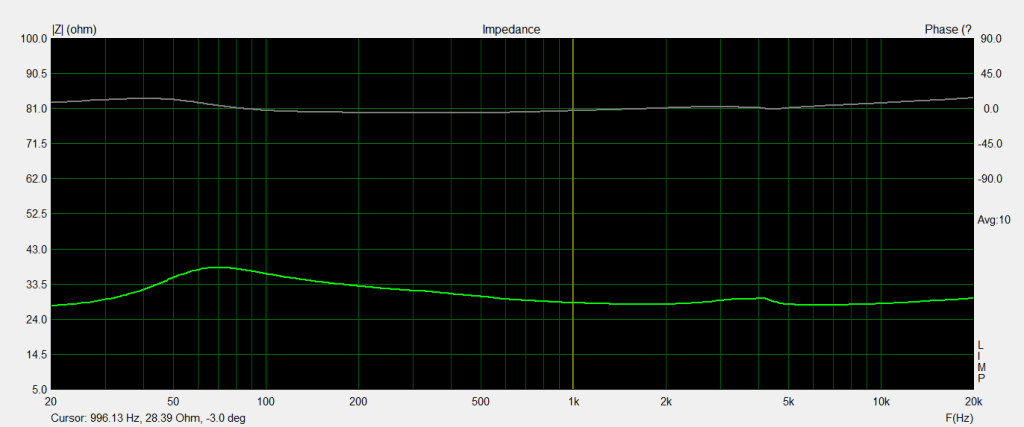
The above graph shows the measured impedance (green) and electric phase (grey), measured under free-air condition (minimal front volume coupling).
Comment: Typical moving-coil behaviour, with a resonance peak around 70 Hz. This f0 sits lower than the OG, which lines up with the improved bass impact noted earlier.
END OF THE ARTICLE
Disclaimer: This review was not sponsored by any company or affiliated entity. Any links or product references are provided for informational purposes only and are not associated with any financial compensation or affiliate arrangement.

How does this headphone compare to the HD 490 Pro from Sennheiser?
LikeLike
I think they are pretty different headphones. Both are very comfy. The AR5000 MK2 is more of a music type of headphone, whereas with the 490 Pro you can switch between a more studio reference sound and a more laid back consumer reference sound. Neither is bad at all, but overall I think they are in the same grade for sound quality, just depends on what you’re after. The AR5000 MK2 is actually a bit better in areas that some people prefer for music, like bass and staging.
LikeLike
What a massive disappointment! can’t stand bright cans at all they hurt my ears and they could have given us an option for XL ear pads. For the majority of people who can’t stand brightness stay away from this fail.
LikeLike
The stock sound doesn’t seem like it will bother me.
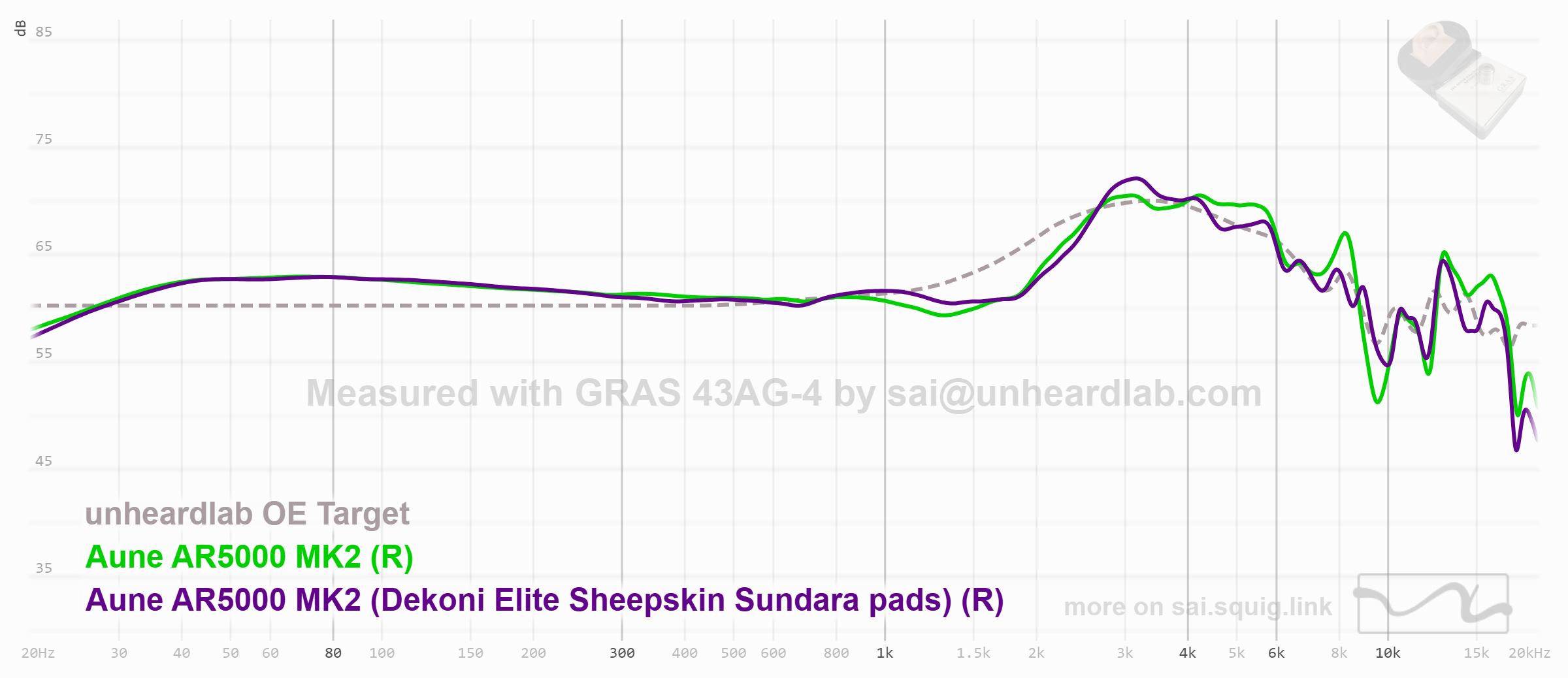
AR5000mk2 (with Dekoni Sheepskin Sundara pads) looks perfect on graph. Very excited!
I wonder how it sounds in real listening though.
LikeLiked by 1 person
Well if you tend to hate bright cans then yeah these are probably not for you, whereas the original AR5000 is definitely more to your taste. That is why in part I thought this might be better off called the AR6000 or something just to make that difference clear. It is less like an iteration and more of a differentiation. Iam with you 100% on a second set of pads though. The good thing is the pads just slip on, so it is an easy change if anyone wants to swap them.
LikeLike
A very nice review, as usual! Many thanks.
From the graph, the bass of AR5000mk2 extends to 40hz before rolling off noticeably. Insane! Overall tuning seems pretty reasonable as well, if a bit bright and cymbal-heavy.
I’m especially interested in Dekoni Sheepskin Sundara pads – with those, the headphone measures too good to be true.
LikeLiked by 1 person
I think that bass roll off should be read along with the elevation in the bass as a whole. Overall it just sounds much more powerful and dynamic than the OG. That’s why I consider the bass department to be a major upgrade. The OG extends a bit better but unless you are listening to something like EDM the majority of bass content is normally above that. The gain in bass quantity on the MK2 is just massive by comparison.
Indeed I have been loving them with the Dekonis. That is why I also suggested Aune see if they can come up with something similar. Hopefully they do.
LikeLiked by 1 person
I tried this headphone at a local store today and I was surprised by how detailed it is given the price. One thing I forgot to test was if there are any resonances in the treble, because I went home and suspect that might have caused what I think the headphone is so detailed. Base on your measurement it seems that it is fine?
LikeLike
I don’t think there are at least not on my head or on my measurement rig. You are probably thinking of something like the Beyerdynamic DT990 where you get sharp treble spikes between 7-10kHz but that is not really the case here. The AR5000 MK2 treble just feels a bit elevated as a whole above 5kHz or so.
LikeLike
do you have any zmf oval pads to test? round pads aren’t comfortable for me sadly.
LikeLike
How do you mean by oval – do you mean the overall outer shape of the pads? If so I do not really have any, but I do have a few with oval front cutouts like the ZMF Auteur and Universe series. Let me know what specific kind you are looking for.
LikeLike
Yeah I mean the opening being taller and oval shaped as opposed to just a round opening.
LikeLike
Gotcha. In that case I do have a few. See if I can get around to it this weekend. Will get back to you when I have them measured.
LikeLike
Awesome thanks! I like the graph with those Sundara pads. Maybe aune will make a replacement.
LikeLike
I just received my unit and am enjoying it so far! I’m guessing rotating the pads wouldn’t affect the FR too much? I’d love to see some zmf oval pads still. My ears are very large and I’ve had some success with them before. The bass is definitely punchy coming from an Arya stealth.
LikeLike
If you had the ZMF ori hybrid that would be great. It would keep the angled pad for extra depth.
LikeLike
Hey, been pretty busy lately so excuse my delayed reply. Glad to hear you got your unit and are enjoying it.
Unfortunately I do not have the ZMF Sundara pads. They also come with glued-on plastic clips for the Sundara, so I do not think they will fit on the Aune anyway.
I have tested a few more options including some ZMF Universe, Auteur, and BE2 variants (I don’t have the Ori ones sadly), but none of them are a good match. ZMF pads tend to be quite a bit bigger, which typically means extra treble and a different tuning compared to the stock pads. Since the AR5000 MK2 already has quite a bit of treble, I do not see the ZMF pads working well. The only viable option might be the Universe Lambskin Perforated pads, and I have included that measurement on my squiglink. As you can see, they do not sound good. The other ZMF pads basically just destroy the tuning. They also do not fit well on the Aune because the dimensions are different, so they end up very loose. I’d recommend going for something like the Dekoni Elite Hybrid or Sheepskin Sundara pads if the size works for you, or using extensive EQ if you really want to stick with large pads.
LikeLike
Thanks for the review. I think I’ll wait for the AR3000 since the early reviews have been making waves. I returned my previous AR5000 because it sounded a lil thin, glad they gave it more body. Another company making decent headphones, love it 🙂
LikeLike
Yeah early comments got me all excited as well. If they really sound like what people have been saying they would be a killer.
LikeLike
Hello,
How would you compare them to the Fiio FT7 ? Mostly on a technical level (soundstage/imaging) and more genrally is the Fiio FT7 a good level above for that price difference ?
Thank’s a lot !
LikeLike
Hey, that is a bit of a tricky one as they are at very different price points. The FT7 is Fiio’s flagship planar right now and costs about two to three times as much. Except for the sense of bass dynamics which I find the AR5000 MK2 does very nicely, the FT7 is an upgrade in pretty much every way.
LikeLike
Greetings!
I was wondering about the W5000 Lambskin or Sheepskin pads – do they sound good with the AR5000 MK2? Are they vocal centric? Do you have a link to them?
LikeLike
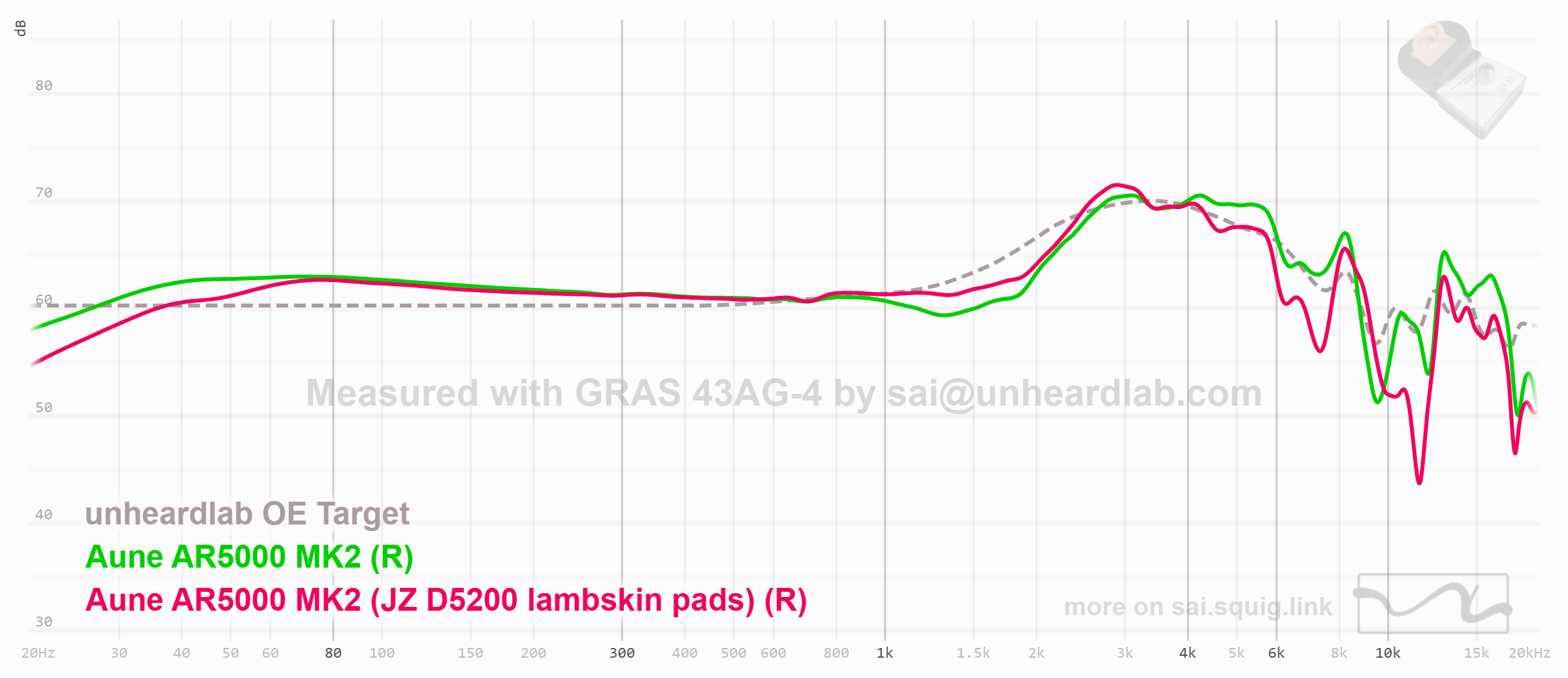
Hi mate, yes, they sound quite good to me. The overall tuning becomes smoother with more emphasis on the bass and midrange. They do, however, reduce the sense of airiness and spaciousness in exchange. But if you want a more well-rounded presentation, they are quite good for that.
Here is a link to the ear pads (from JZ/Jingzhi’s new aliexpress store): https://www.aliexpress.com/item/1005010766273068.html
LikeLike
Would you say you prefer the Dekoni Sheepskin Sundara pads though?
And do the Dekoni Sheepskin Sundara pads offer a more refined experience of the intended stock-sound of AR5000 MK2 would you say? Treble on the graph looks super smooth with those, is that noticeable upon listening?
Appreciate you.
LikeLike
Yeah I do prefer the Dekoni ones over the stock pads. At least for my preferences, they offer a smoother more balanced treble presentation that tames much of the excess energy above 8kHz, which can sometimes get a bit overbearing with certain genres. They sound less V-shaped and maybe less exciting, but they work really well for me.
LikeLike
From your measurements, the MK2s pad-swapped to FT1C pads seem to have a similar midrange and (albeit peakier) treble profile to the HD600s, but with much better bass extension and rumble. The same could be said for the D5000 protein pads, but perhaps with less overall bass, though better treble. Would you say this is the case?
LikeLike
Broadly speaking I think that’s a fair way to look at it, but I also think the differences are bigger than the graph might suggest. With the FT1C pads, the midrange tonality does improve quite significantly. The trade-off is that the treble is less smooth and still a bit forward.
The D5000 protein pads are probably the more balanced option of the two. As you said, a little less bass but smoother treble. I still wouldn’t quite call either of them an HD600 with sub-bass though, as I think the actual coupling on everyone’s ear is still going to be different especially in the treble. So the delta could be bigger or smaller for different people. But if you’re happy with a bit more treble than the HD600, the AR5000MK2 has that more spacious and dynamic presentation.
LikeLike
A little EQ (which I’d use anyway to my preference) and you get a mini Focal Clear? Sign me up! A lot of makers have been doing wonders with bass on open-backs recently and I love it
LikeLike
Yeah the bass and the sense of immediacy are probably the most Focal-like thing about the MK2, and with some EQ the overall tuning can get even closer too. The Clear is still a more refined and complete headphone to me, but considering the price difference the MK2 does surprisingly well. And they are also much lighter and comfier on the head!
LikeLike
I kinda like a little extra treble, a lá Hifiman. If they get that without all the QC problems reports from XS to Arya Organics, it’s a pretty nice option for me.
LikeLike
If you enjoy that slightly brighter Hifiman-style presentation, I think the stock tuning might actually suit you better than it does me. The treble is elevated fairly broadly rather than having a few nasty sharp peaks, so it still sounds quite clean and open, and in this sense, the AR5000MK2 does remind me of Hifimans. Build feels reassuring with the new metal headband. Obviously it’s still too early for me to say much about long-term QC, but my unit has been completely fine so far.
LikeLike
Great review. I recently got these and do agree the stock tuning is a bit too bright. The Dekoni Sundara sheepskin pads look pretty decent on a graph, but to my knowledge they use a clip on system. How did you attach them to the Aunes?
LikeLike
Thanks! Yep you can still use them. The mounting rings/clips on the Dekoni Sundara pads aren’t glued to the pads themselves, so you can just remove them and use the pads like regular slip-on pads. They slide onto the Aune pretty easily.
LikeLike