Intro:
The Ananda OG has a special place in my heart. It was the headphone that pulled me back into the hobby after a long stretch of dormancy, and it remains one of my favourite Hifiman planars. Its bright yet smooth tuning made it a unique, pleasant listen. That said, it has never been perfect. The fit suffers without cup swivel, and the bass has always been a bit lacklustre, lacking the punch you’d want for genres that lean on the low end.
Hifiman’s more recent ‘Unveiled’ series has been an interesting turn. I have covered a few of them now, including the flagship Susvara Unveiled and the Arya Unveiled. Overall, I think the series points towards a more mature style of tuning, with better tonal balance and naturalness. Still, the results have varied. The Susvara Unveiled sounded brighter than the original Susvara to my ears, while the Arya Unveiled turned out to be the smoothest Arya so far.
So going into the Ananda Unveiled, I was not entirely sure where it would land. Would it preserve the charm of the original Ananda? Would the Unveiled design make it brighter? Let’s find out.
Detailed measurements can be found in the final section of this article.
Disclaimer: This unit was kindly provided by HIFIMAN for review. I was not paid for this review, there are no strings attached, and no affiliate links are used. Everything written here reflects my own thoughts.
Pros:
+ Most refined midrange and the best bass of the Ananda lineup to date
+ Open, airy staging without the treble glare of some older models
+ Updated headband with generous cup swivel
Cons:
– Subtle mid-treble lift may bother some treble-sensitive listeners
– Bass is improved but still not slam-focused
– Safe tuning may feel a touch reserved to those wanting a wow factor
Specs & Comfort
RRP: $549 USD / $925 AUD
Driver size: ~80*60 mm (active area)
Driver type: Planar Magnetic
Sensitivity: 93.5 dB SPL @ 1 mW
Impedance: 24 Ω at 1kHz (measured)
Connector: dual 3.5 mm TRS
Weight: 449 grams, excluding magnetic veils and cable
Clamping force: medium
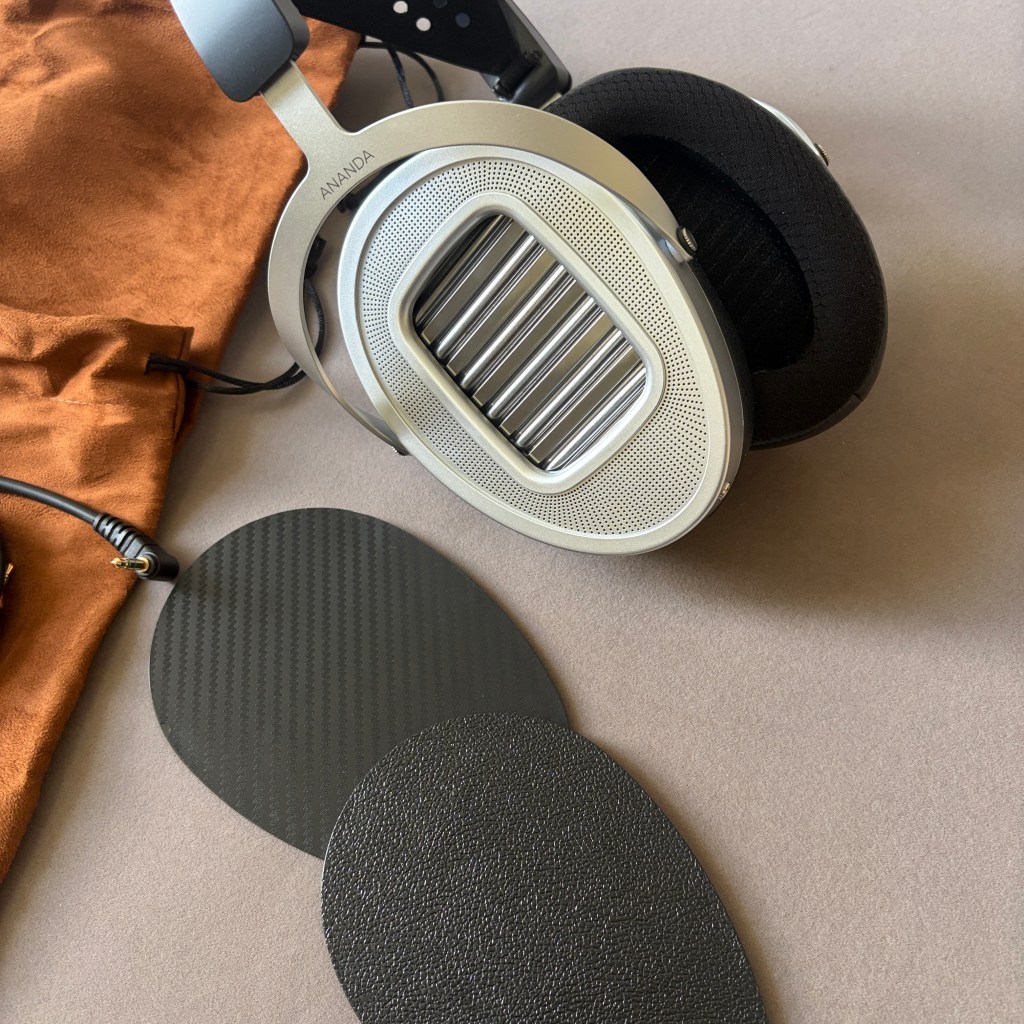
Accessories: 1.5m cable, 6.35mm adapter, magnetic veils, storage pouches
Build and Comfort:
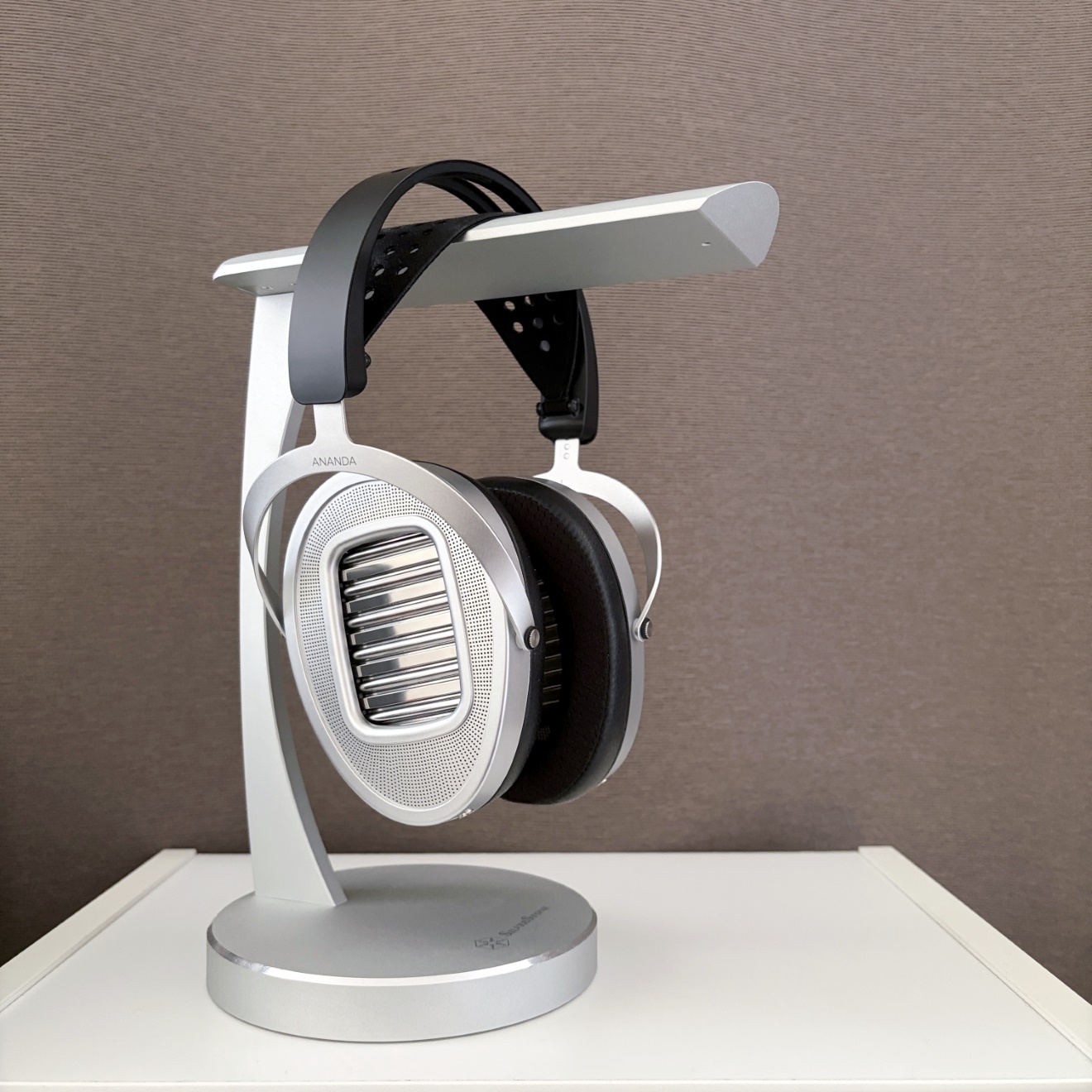
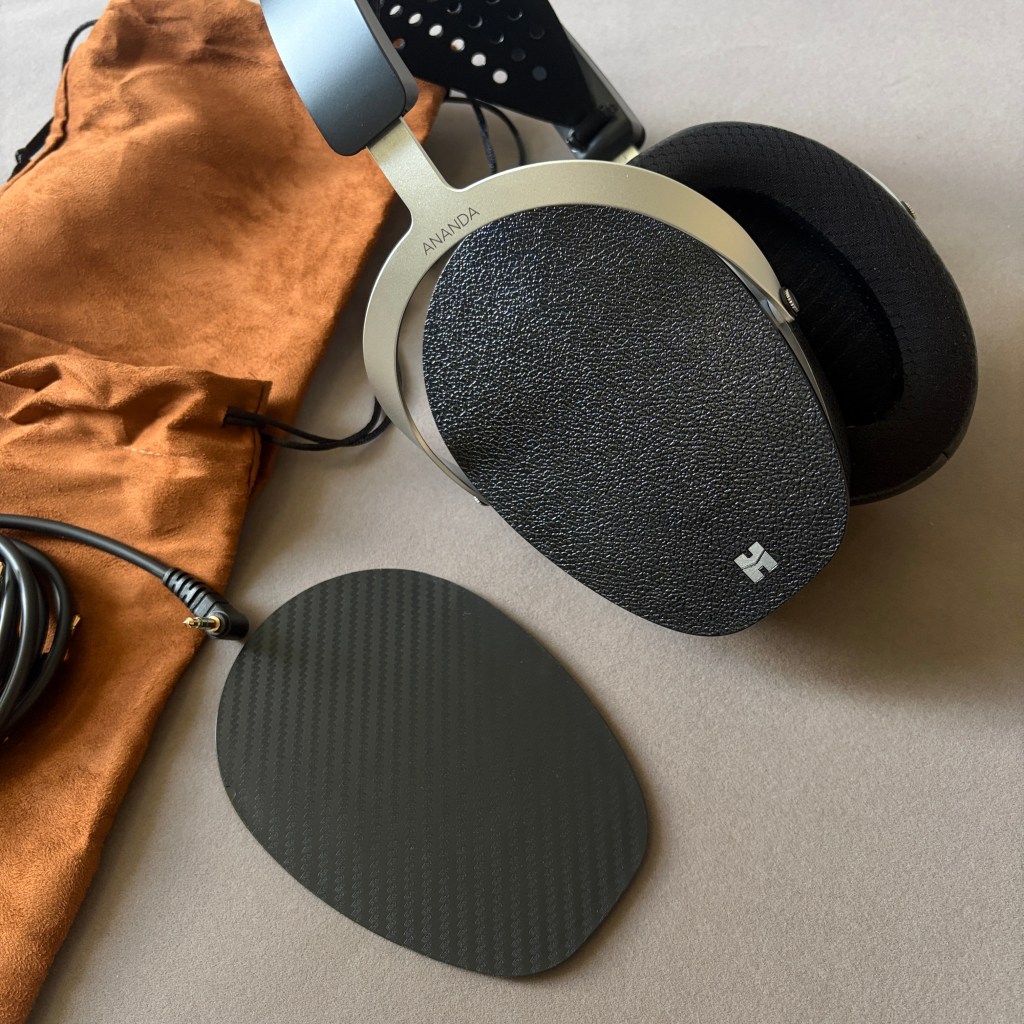
Build is nicely done. The finish and overall presentation feel more premium than previous egg-shaped Hifimans, and to my eye it’s also the better-looking of the bunch. The main thing to watch out for, as with the rest of the Unveiled lineup, is the exposed driver rear. Be careful around magnetisable objects, and use the magnetic ‘veils’ included in the accessories when the headphones are not in use.
Comfort is a noticeable step up from the Ananda OG. Weight is roughly similar, which is reasonable for a planar of this size and easy enough for a few hours at a stretch. The biggest improvement is in the headband. Cup swivel here appears to be closer to 20-25 degrees.
Sound
For more comparisons, visit my squiglink database.
Tonal balance:
Overall impression
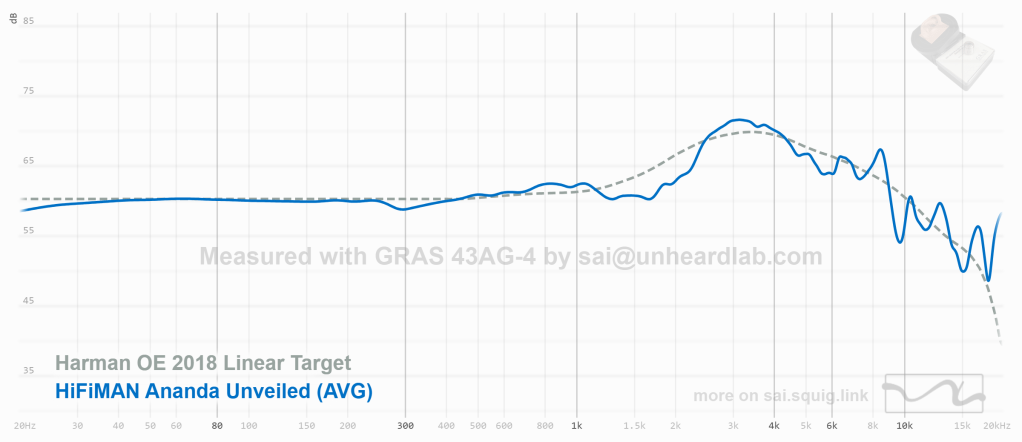
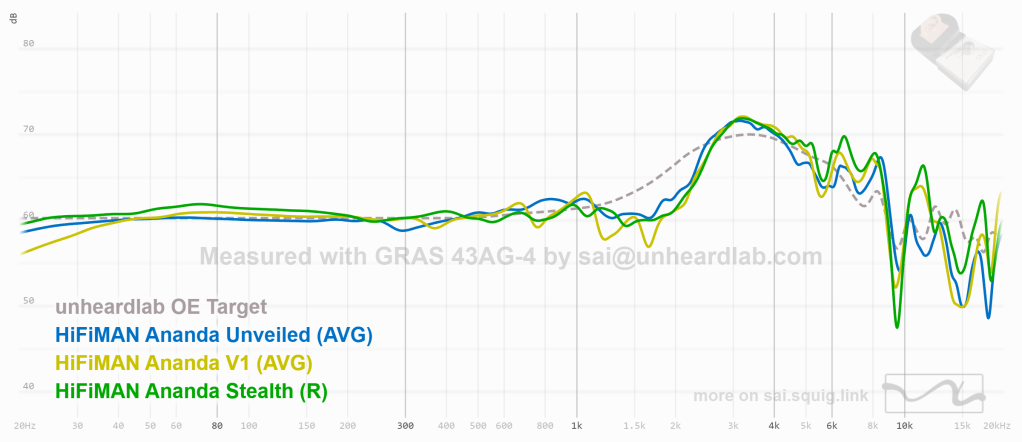
The Ananda Unveiled has a smooth, slightly bright and airy presentation. It still sounds recognisably like an Ananda in spirit, but the tuning is more polished. The OG had a light, open, almost ethereal quality. The Unveiled keeps much of that charm, while improving overall tonal balance. It sounds livelier and more grounded than the OG, yet it avoids the sharper, more metallic edge I heard from the Ananda Stealth.
Bass
The bass is solid but unremarkable. It’s a bit more lively, better extended, and noticeably more tactile than the Ananda OG. But bass was the weak point of the OG, so that’s a low bar to clear. What you get here is typical eggshaped Hifiman planar bass: clean and well-extended, but leaning slightly to the fuzzy side rather than delivering hard, solid macro impact. On Massive Attack’s “Angel”, the sub-bass rolls in smoothly and the layered build-up holds together cleanly, though the climactic hits don’t carry the weight you’d get from something like the Hifiman HE6se.
If bass punch and impact are your main priorities, this would not be my first recommendation. The Ananda Unveiled improves on the old weakness of the line (by quite a big margin, actually), but still it does not fully turn the Ananda into a slam-focused headphone.
Midrange
This is where the Ananda Unveiled shines. The midrange feels more lively and engaging than on previous Anandas, with less of the classic Hifiman 1-2 kHz dip that some people find off-putting.
It’s still subtly recessed, but in actual listening, especially with acoustic music, the difference is really not that noticeable. Electric guitar bite and female vocal presence come through more directly, with a noticeable sense of immediacy. Gregory Porter’s “No Love Dying” comes through with good clarity, chest weight and warmth, though his voice sits a step further back than it would on some Harman-inspired headphones.
Upper mids are also more polished than on previous Anandas, particularly the Ananda Stealth. Body and articulation feel well-balanced, with a tad of colouration that adds a subtle sense of space. Overall, the Ananda Unveiled works well across vocals and instrumental recordings.
Treble
The treble is quite enjoyable, and probably the area where the Ananda Unveiled shows its biggest improvement over some previous Hifiman models. The top end is airy and extended, while staying smooth.
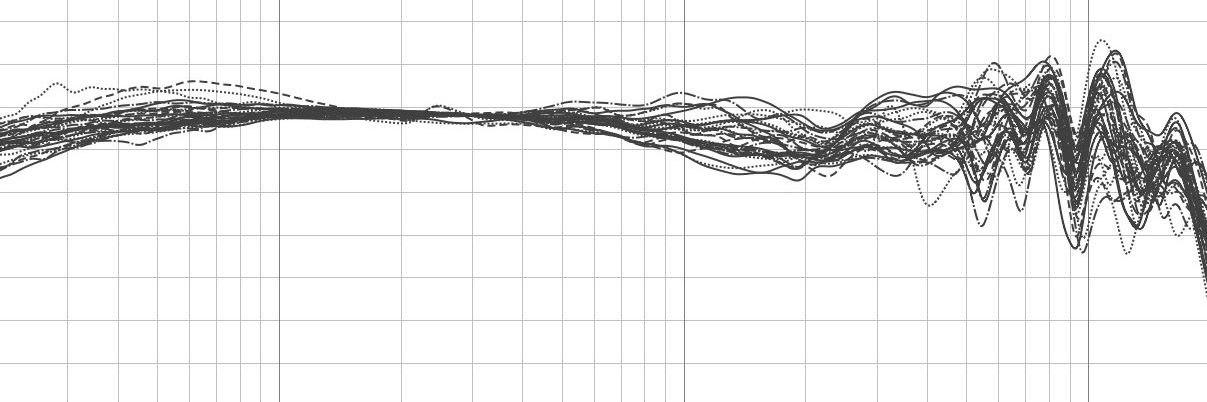
Yes, this is still a bright-leaning headphone. There is a slight lift in the mid-treble, which shows up in the frequency response around the 7–9kHz region and lines up reasonably well with what I hear on my head. This gives cymbals, violins, and upper vocal harmonics a bit of extra energy.
But it does not sound overdone. The Ananda Unveiled does not have the spicy treble of the Ananda Stealth. It also avoids the more aggressive upper-treble glare that could show up on models like the Edition XS or Arya Stealth. Patricia Barber’s “The Wing Song” is a useful stress test here. The Ananda Unveiled does bring out the sharp consonants and upper-harmonic bite in the vocal. But it stops short of becoming piercing.
The original Ananda was already known as one of the more balanced and smooth egg-shaped Hifimans. The Unveiled is smoother still. Compared to the Edition XV, the Ananda Unveiled sounds clearer and more open. The XV is warmer, softer, and more relaxed. For acoustic music, the Ananda Unveiled is the stronger performer. It gives violins more life, cymbals more shimmer, and recordings more space in general.
For more comparisons, visit my squiglink database.
Other qualities:
- Spatial presentation
The soundstage is very good, though not extravagant. It doesn’t quite reach the scale of something like the Arya Organic or HE1000se, but it also avoids the tonal quirks those models carry. What you get is a natural and open stage that doesn’t take anything away from the music, while adding a subtle sense of distance and expansiveness. Width and depth feel evenly distributed, and imaging holds together well without the slight haziness that can creep into larger planar designs. It feels natural rather than showy.
- Clarity
Clarity is solid. The Ananda Unveiled is well-resolving across the spectrum while remaining smooth in presentation. Different elements in the mix feel nicely balanced, with no part of the spectrum pushed forward unnaturally. Microdetails come through clearly without being spotlighted, which makes longer listening sessions easier on the ear. It gets surprisingly close to what the Arya Unveiled offers, at a fraction of the cost.
- Dynamics
Dynamics aren’t the strongest part of the package. Macro impact is a clear step up from the Ananda OG. It’s still not in the same league as the HE6se in terms of slam and punch, but it does outperform both the Edition XV and the Ananda OG in this regard. The sense of contrast is decent too, with small shifts in vocal expression and instrumental decay rendered with reasonable nuance, even if not at the level of higher-end planars like the HE1000 Unveiled. For a mid-tier egg-shaped planar, the performance feels well-judged.
Conclusion:
At $549 USD / $925 AUD, the Hifiman Ananda Unveiled is a well-finished offering. Hifiman has addressed the two longstanding weaknesses of the Ananda line, fit and bass, while preserving the smooth, airy character that made the original likeable. The mid-treble retains a subtle lift, which is the main thing to note for treble-sensitive listeners, but it’s nowhere near the level the Edition XS or Ananda Stealth.
Overall, the tuning is on the safe side, with no real party tricks. But that’s also the point. It’s easy-going and consistently enjoyable across a wide range of music, just like the OG. If you want extra warmth and body with a more relaxed top end, the Edition XV is still the go-to option. The Ananda Unveiled offers a step up in air and clarity, staying closer to the traditional Hifiman sound. If your library spans a bit of everything, and you want a bit of extra openness and clarity, the Ananda Unveiled is an easy pick. It feels like a quiet return to what made the original Ananda so appealing.
If there are other comparisons you would like to see, let me know in the comments.
Value Grade:
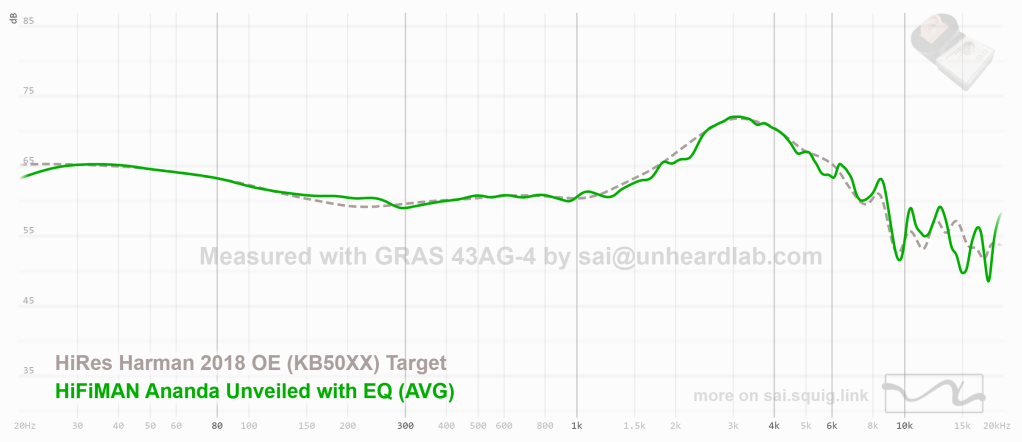
Recommended EQ setting
Copy and paste the below into a TXT file, then import it to EqualizerAPO or similar apps; adjust the bass and treble filters to taste:
Preamp: -5.5 dB
Filter 1: ON PK Fc 30 Hz Gain 5.5 dB Q 0.500
Filter 2: ON PK Fc 80 Hz Gain 0.7 dB Q 2.000
Filter 3: ON PK Fc 920 Hz Gain -2.5 dB Q 2.100
Filter 4: ON PK Fc 1800 Hz Gain 3.5 dB Q 2.000
Filter 5: ON PK Fc 5500 Hz Gain 1.0 dB Q 2.000
Filter 6: ON PK Fc 8250 Hz Gain -4.5 dB Q 2.000
If your goal is to EQ the response to match the Harman Target, consider the AutoEQ function provided by Squiglink as a convenient starting point. I personally recommend customising the filters to better suit your own hearing, especially in the treble. While the AutoEQ provides a useful baseline, individual adjustments can often significantly improve your listening experience.
If you’re new to EQ, I’d recommend checking out this video by Resolve from The Headphone Show — it’s a really solid intro and walks through the basics in a clear, no-nonsense way. Great place to start!
MEASUREMENTS
Frequency Response:
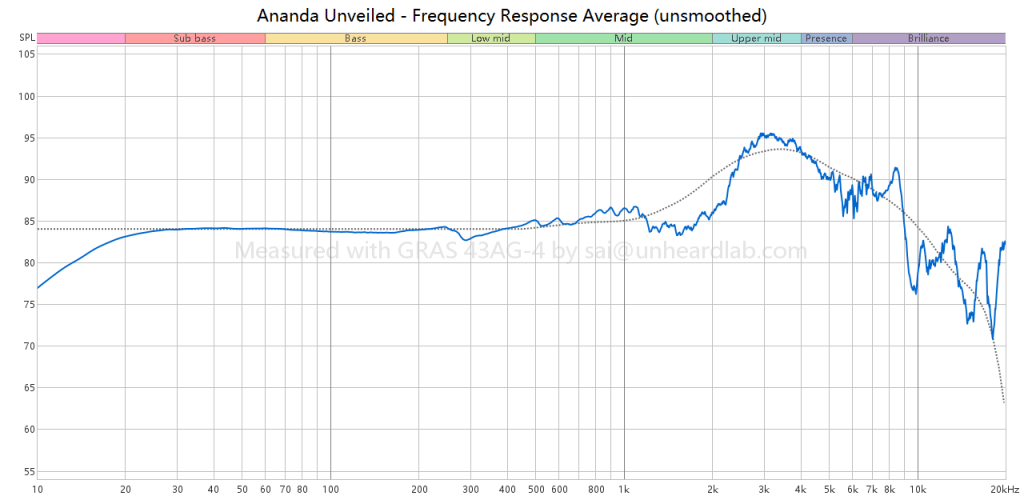
The response is obtained by an average of 5-6 positional variations. The FR shown on the graph is unsmoothed.
Positional Variation:
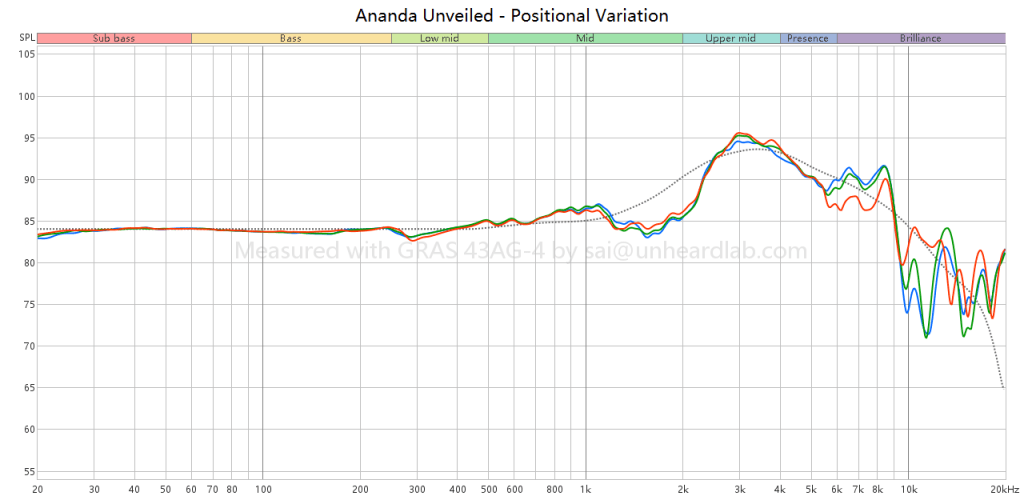
This graph illustrates how headphone placement on the head affects perceived tonal balance: with the ear positioned at the front (blue), centre (green), and back (red) of the headphone. The FRs shown on the graph are 1/24 octave smoothed.
Leakage Tolerance:
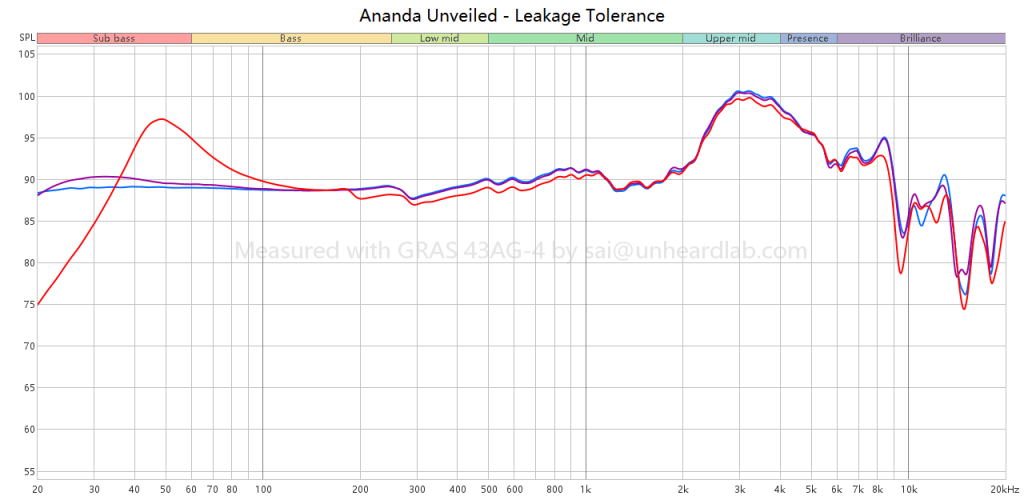
This graph demonstrates how leakages to the front volume can result in FR change: blue (good seal), purple (thin arm glasses), red (thick arm glasses). The FRs shown on the graph are 1/12 octave smoothed.
Linearity and Compression:
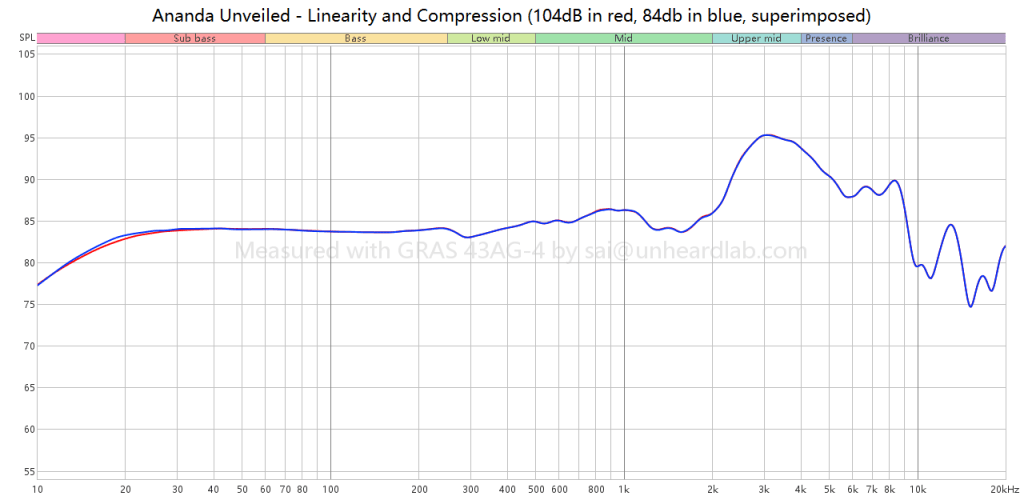
Linearity and dynamic compression testing plots the headphone’s frequency response at two input levels to show how it reproduces signals as loudness changes. Any divergence between the high-level and low-level curves points to where the transducer’s dynamic range begins to compress or distort. Here, the measurements are superimposed to allow direct comparison. The FRs shown on the graph is 1/6 octave smoothed.
Impulse Response:
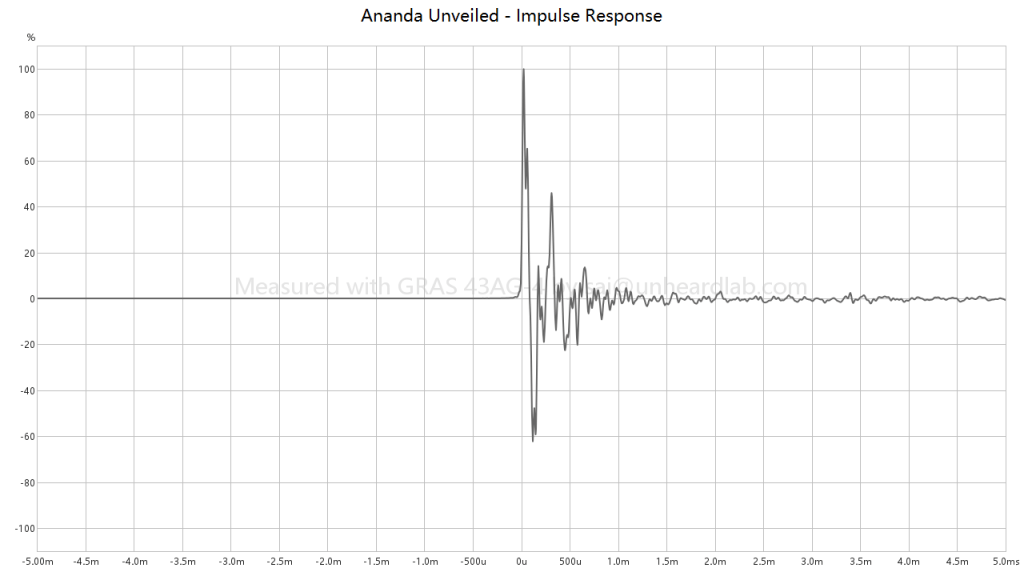
The impulse response test measures the initial response, overshoot, and decay of a transducer upon receiving a signal. An initial upshoot indicates a normal/non-inverted polarity, vice versa.
HpTF Variations (uncompensated):
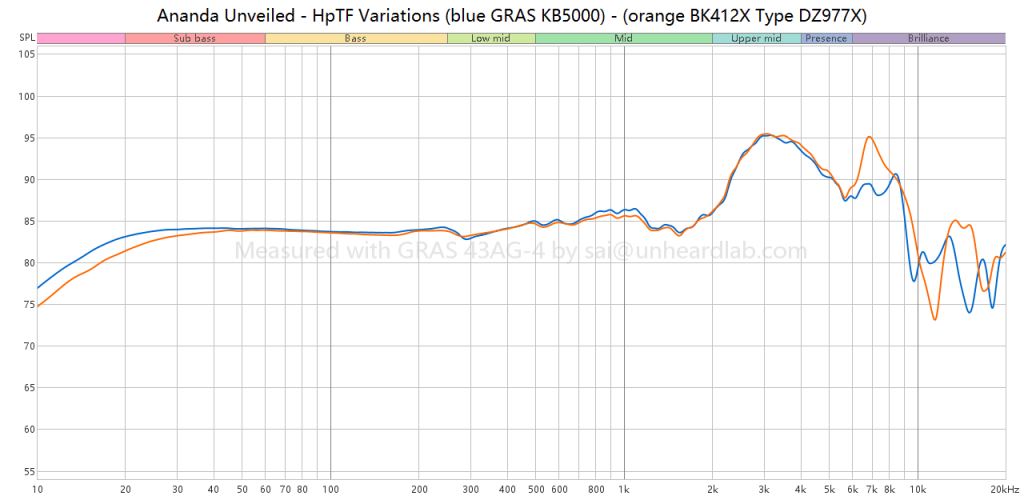
Headphone Transfer Function (HpTF) describes how sound is shaped by headphone design and ear anatomy before reaching the eardrum. Different measurement rigs (with varying pinnae designs) introduce unique reponses/resonances and potential deviations from actual human perception. Understanding HpTF helps translate measured data into real-world listening experiences.
Total Harmonic Distortion (THD% 2nd-9th) & Excess Group Delay (94 dB):
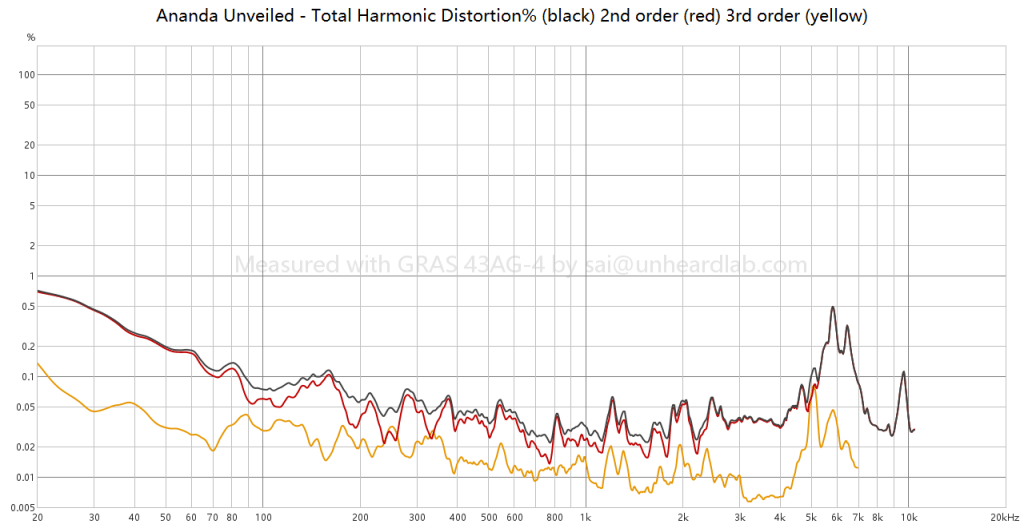
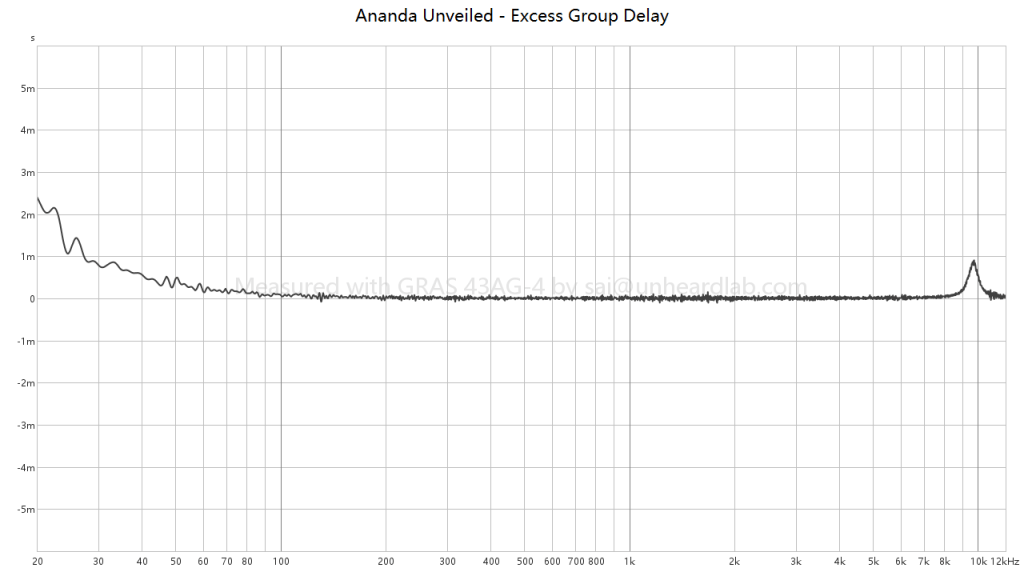
These measurements are conducted in quiet, normal room conditions (as opposed to an anechoic chamber), meaning there may be some influence from ambient room and external noise. These results should be considered a preliminary assessment of performance, primarily for identifying major issues, and do not reflect the best-case performance scenario. Any peaks/dips around 9 kHz are likely artifacts from pinna interaction/phase cancellation, rather than inherent features of the device under test.
Channel Matching:
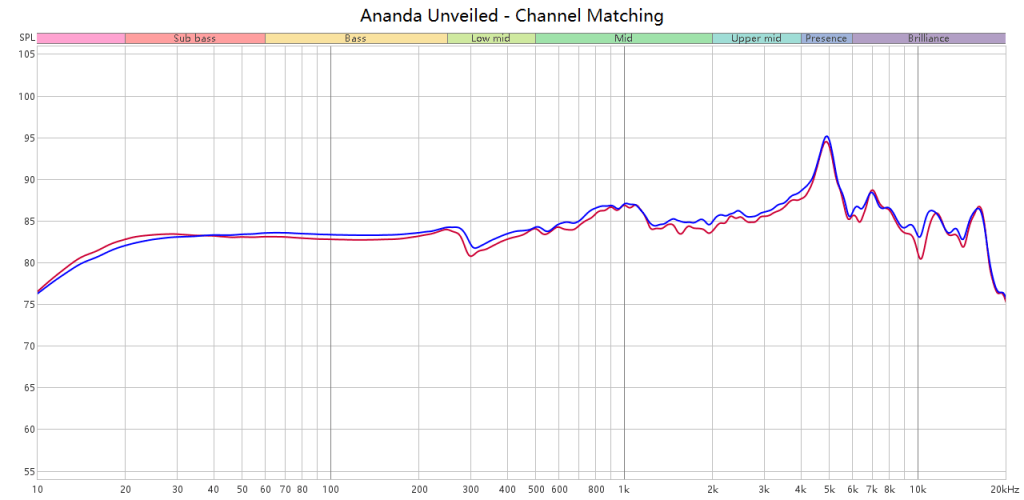
Channel matching graphs are intended for quality control checks and do not relate to the perceived sound profile. A specialised configuration is used in this test to capture differences between channels, mitigating interference from positioning on the rig and the asymmetry in the GRAS pinnae design, a legacy of KEMAR. The left (blue) and right (red) channels are measured using a flat plate coupler with an IEC60318-4 ear simulator.
Electric Phase & Impedance:
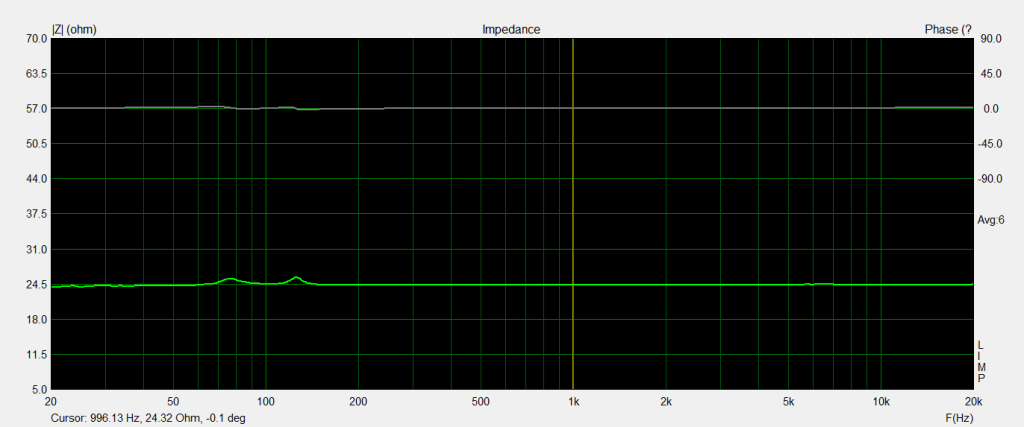
The above graph shows the measured impedance (green) and electric phase (grey), measured under free-air condition (minimal front volume coupling).
END OF THE ARTICLE
Disclaimer: This review was not sponsored by any company or affiliated entity. Any links or product references are provided for informational purposes only and are not associated with any financial compensation or affiliate arrangement.

Thank you for your comment. How do the Nan7, the Ananda U, and the HE600 compare with each other? Could you please provide some reference suggestions?
LikeLike
This is a tough one as they are tuned for different preferences. To put it quickly, the HE600 is the most neutral/uncoloured. Some might find it a bit bland but the bass impact and treble refinement are significantly better than something like the Sundara. The NAN-7 is on the bassier, meatier, and punchier side, while the Ananda Unveiled is on the more flavourful, brighter, and airier side. The NAN 7 is definitely the best overall headphone here, but it really depends on what you are after.
LikeLike
Dumb question maybe but if I leave these sitting exposed on my desk, are they gonna turn into a giant magnet? I know planars are made with strong magnets. I’m dying to try these out but my workd esk is chaotic and I’m terrified of ruining them.
LikeLike
There’s no dumb questions. The magnetic strength drops off very quickly once you move a few centimeters away from the cups. So as long as you don’t place them on top of loose paperclips, staples etc., they’ll be fine.
LikeLike
Hi Sai, could you test the dekoni pads on the Ananda Unveiled? I know they use a new mounting system, but is there any way that the old pads could fit? If not, I wonder if the Kithara pads fit? I assume they are also new so the mounting system is the same. Sorry many questions. Thank you. Pak
LikeLike
Hey Pak, sadly the Unveiled series mounting won’t allow Dekoni pads to fit as the headphone rings are smaller than the rings on the Dekonis. The Kithara pads have their own unique dimensions which make them incompatible with either.
LikeLike
Excellent unbiased review as usual. Thanks. We are spoiled. So much choice out there, and as long as one can afford the expenditure, there is no shortage of options.
Furthermore with a bit of EQ, or a lot of EQ, the shortcomings of headworn listening devices, from issues with their EQ, or our own personal preference or hearing, can be addressed.
We now have tools that enable most of us, with certain caveats such as issues like unit variations, from the sample device measured, to use the kinds of measurements you have loaded to squig.link, to tailor any device in that database of measurements, to our preferred target FR.
It is even better and easier to achieve, now that more DACs are including as many as 10 parametric EQ filters.
Thank for pointing out the squig.link AutoEQ feature. I have used this to EQ an IEM, to a target, and the results were much better than anything I could have achieved by ear. I did tailor the autocomputed EQ, by deploying less severe gain values, to retain some of the character of the unequalised IEM.
I am now curious. If as some state – a headphone or IEM is a minimum phase device, and there is no point examining the time domain, cos according to some this time domain will be in step with the frequency response, I do wonder, is this true?
If FR is all that matters when analysing head worn devices, that would imply that as long as we can modify the FR of any device via EQ, to the same target, they would all sound identical. But is that true? My gut feeling says, no, that cannot be true. What happened to resonances or absorptions, by the shell/casing, filters, meshes, pads, and the transient response of the drivers.
The transient response of different kinds of drivers, are not identical, even if we can in theory equalise the devices to the same FR target, so I would not expect them to sound the same, even when EQ’s to the same FR target.
The point is FR curves are now somewhat academic, cos we have the power to change them as end users, so what really distinguishes one listening device – acoustically., from another, when both of them have been EQ’d to the same target.
Will their impulse response become identical, further to being EQ’d to the same FR target. Or will their impulse responses still show a difference that we can hear?
Apologies for my long winded post. Took a while to get it off my chest.
Your section on Dynamics, seemed to answer this curiosity of mine, and be the most closely related to what I would call the transient response. How does one measure this? Would this be the impulse response. Can imagine even if we could EQ the Ananda Unveiled to the same FR as a Hifiman HE1000 Unveiled, it still would NOT deliver the same level of micro and macro resolution of audio.
I am keen to discover, beyond FR alone, what really makes headphones and IEMs sound different, from other headphones and IEMs. Cos if its FR that achieve all we need, we could just buy the cheapest device, and EQ it to mimic the most expensive device !! I suspect it is not as simple as just emulating FR via EQ correction.
If only we could know within the measurements, beyond FR, which can now be so easily modified, what else makes for a superior transducer, we can focus on these other distinguishing factors, in our choice of listening devices, even when the FR is not ideal, cos FR is now such an easy thing to correct, or adjust to our own hearing or listening preferences.
I give an example. In speakers, soft dome and metal tweeters do not sound the same, even when the speakers may have similar FR, or have been corrected to the same FR target.. I know cos I’ve done this to speakers with different kinds of tweeters. I remain curious.
LikeLike
Thank you for the kind words! You’re hitting on probably biggest debates in the hobby. I think your approach to EQ is very sensible. If FR at the actual eardrum were truly identical, then two headphones would likely sound the same. But achieving that is almost impractical right now. Measuring at the drum reference point is highly complicated, and you’d need data for your own specific HRTFs to make sense of that.
The FR we measure on a rig captures a snapshot of acoustic pressure at the microphone, but it can’t fully display complex real world acoustic behaviours. Things like pad leakage, positional variations, and even ambient temperature all affect the outcome. It also depends heavily on methodological factors like the degrees of graph smoothing and corrections used. That’s why we try to provide a more complete set of measurements to reveal those hidden aspects. Like for dynamics, we can look at indicators like compression, linearity, aside from bass extension to get a better picture.
Minimum phase doesn’t mean the time domain is meaningless. It just means time domain info is contained within the FR. Headphone manufacturers and modders know this well since things like damping and tensioning on planars affect the frequency response significantly. Looking at time domain graphs is definitely handy for guiding those tuning decisions.
For consumers though, FR is defintely a lot more intuitive and easier to engage with. EQ can actually fix time domain problems too even if it gets difficult in some cases. The best way to enhance it further is to figure out the positioning and leakage effects on your own head with manual sine sweeps and actual music. e.g. If you have a target headphone and want a cheaper alternative, find one that’s similar in acoustic design. To mimic the HE1000se you’d want to use something like the Ananda instead of something like the HD560S. So in short, I’d say your experience makes a lot of sense.
LikeLike
Hi.
Do you have a review of the SKYLAND planned for the future?
LikeLike
Yep, stay tuned. 😉
LikeLiked by 1 person
Thank you so much for your measurements they helped me equalize my Arya with Dekoni pads.
I noticed you measured the Stax SR-X1 as well as some pads, are you planning on writing a review? I’d like to know which pad keeps the original sound the most.
Looks like it’s the ECOS X1 Leather Hybrid pads but I don’t know which pad is this.
LikeLike
I’d like to know if there’s a pad that increases the comfort but keeps the same sound profile.
LikeLike
I assume you’re still referring to the SR-X1 here. If you’re looking for ear pads that are larger/roomier, they would normally change the sound meaningfully as that’s how physics works when you increase the front volume. If I end up reviewing them I’ll measure a few more ear pads, and if I come across any, I’ll report back.
LikeLike
Glad it helped! Yeah I was planning to write someting about the SR-X1, just never got around to it. Maybe I should still do it.
ECOS refers to Ear Cushion Official Store on Aliexpress, which is an onseller of Qianyin ear pads (OEM for a lot of brands). I suspect they are the OEM for the SR-X1 ear pads too. Here’s the link to their SR-X1 pads: aliexpress.com/item/1005010378356541.html?
I refer to their sheepskin variant as leather hybrid pads because they are made with cloth on the inside.
LikeLike
A review would be nice, it’s a “entry-level” electrostatics, I assume there’re people curious about it’s performance. I don’t see that many reliable reviews about it around.
Thanks for the link, I still haven’t decided if I should buy the Stax or not. Maybe if you decide on making the review that will help me decide.
LikeLike
That makes sense. I think I’ll do an SR-X1 review (maybe it’ll be the next one or the one after). If you want a quick summary now, it is a decent entry-level option for anyone curious about electrostatic headphones at a reasonable price.
The sound is very typical of an estat setup. It is fast, clean, and detailed, with a bit of pad leakage to generate some bass punch, alongside a sparkly, airy treble response. The midrange is classic Stax with elevated upper mids that add color and push vocals more forward. The downside is that the soundstage isn’t great. Vocal harmonics are right upfront, and while instruments are well separated, the staging feels very closed in. In many ways, it is a replication of the classic pre-2000s Stax sound from their smaller over-ear designs like the SR-80 Pro.
The main alternatives around this price are the Koss ESP95X, which sounds warm and relaxed like an etats version of HD6XX, and the Stax L300, which leans more trebly but also more spacious. If you want a real step up, keep an eye on the Halo Acoustics EH-1 system. It has a mature, spacious, HD600-like tuning that easily competes with the higher-end L500 and L700, and I already have measurements for it on my squiglink if you want to check them out. However, the EH-1 is currently facing supply shortages so the official global launch date remains unclear (might be months if not another year)..
LikeLike
Thanks for the review!
I have similar impressions with the Ananda Unveiled. Overall it’s a very good performer for the price. I didn’t find it to be bright at all – but I did find the XV to be warm and dark-ish so it’s probably a “me” thing.
One thing I noticed was the soundstage on the Ananda Unveiled – spacious but not wide, and depth portrayal is not great. Very similar to the HE1000 Unveiled, just flatter. Probably something to do with the unveiling tech and decay profile… (I’m not well versed in audio mumbo jumbo lol.) I prefer the presentation of HE1000 Stealth over these two.
Tough competition from the Skyland! I’m looking forward to your next review.
LikeLiked by 1 person
Yeah actually I was thinking if I should call it smooth bright. It is definitely a bit bright to me in the mid-treble, but that doesn’t really come across as aggressive or irritating for the most part unless for some really poorly mastered stuff. To me the staging is quite good. I don’t really find many issues with the projection of depth but it is arguably less precise/holographic than something like the HE1000 Stealth for sure.
The Skyland retails for much more than this though. I will have mine in about a week, and I do plan to have a review out in maybe a few more weeks.
LikeLiked by 1 person
Oh you’re right, the Ananda Unveiled is quite a bit cheaper now!
It was hovering around $800 for a few weeks upon release, at my place at least.
LikeLike
Yeah we know their RRP tends to drop over time, which is probably a strategy to keep their stuff competitive. If the treble works for you they are a really good option.
LikeLike
Hello.
Do you have a review of the Sennheiser HD 550 planned for the future?
LikeLike
I know you reviewed the HD 505
LikeLike
Hey Alain, I had the HD 550 for a while. I planned to review them but ended up thinking they are just too similar to the HD 505 so I am not sure if I’ll do a full review at all.
But here is a quick rundown instead. If you only want one headphone, the HD 550 is probably the more versatile pick, with slightly better clarity and detail. By comparison, the HD 505 is more easygoing, with relaxed treble and a bit more bass. The upper mids is a bit more laid back on the 550, but the difference is quite minute. It really comes down to what you are after. Personally I find the HD 550 treble a bit hot around 8-10kHz, whereas the HD 505 is more relaxed, if a bit bland in the air and sparkle region.
The HD 550 might be the slightly better headphone overall, but I personally enjoy the HD 505 more. I also think they should be priced the same, or at least within a 10-20 dollar difference.
Hope that helps.
LikeLiked by 1 person
Thanks, that helps a lot. One last question: which one would you choose between the HD 550 and the 6XX?
LikeLike
No worries mate. I would say 6XX if you have the amp for it and you’re happy to EQ. The 550 has better stock response in the bass, and a bit less warm/thick in the mids, but those are things you can easily EQ. The 550 also is a bit more spacious, but not by a lot, and the differences become much smaller after EQ. I would go for the 550 if I can only keep one headphone (better stock tuning for me) and I would be driving it off a laptop/phone dongle.
LikeLiked by 1 person
Thank you. I think I’ll go for the HD 550. Greetings from Havana.
LikeLike
Hello, thank you for the review. I’m torn between this one and the edition XV, I mostly listen to ambient and ethereal music like øneheart – apathy and the like, movie and game soundtrack and EDM, I also play single player games a lot and watch movies. I do have the Denon D7200 and I really like them for most things because of their detail retrieval but their soundstage doesn’t have depth at all for that extra bit of immersion in games, not to mention the right cup started to rattle unfortunately. I wonder which of these 2 is the right one for me ?
LikeLike
Hey! Given what you listen to and what you’re missing from the D7200, I’d lean towards the Ananda Unveiled here.
The Edition XV is warmer, fuller and more relaxed, so it’s the safer pick if you mainly want an easy-going tuning. The Ananda Unveiled is noticeably airier and more open, with better spatial precision and a more even sense of width/depth. I think that would matter quite a bit for ambient/ethereal music, soundtracks, movies and single-player games where immersion is part of the appeal.
It also has a bit more clarity and dynamic contrast than the XV. For EDM the XV does sound fuller in the bass, but the Ananda U still extends well and actually has a bit more immediacy to me.
Since you already have the D7200 for that denser, more intimate presentation, and depth is specifically what you feel you’re missing, I think the Ananda Unveiled would complement it better.
LikeLike