Intro:
Adam Audio is a name people in the studio world will recognise. The company has built a reputation for their studio monitors, particularly their ribbon tweeter designs. Headphones, however, are not their usual territory.
I first came across the H200 at a local store during what was admittedly a very brief visit — I was on my way to yakitori, so I only had a few minutes with it. But it was good enough that I wanted to spend more time with it properly. Since this is also ADAM Audio’s first in-house headphone design, I reached out to see if they would be willing to send one over for testing.
So, does the H200 bring a studio-monitoring sound into headphone form? Let’s find out.
Detailed measurements can be found in the final section of this article.
Disclaimer: This unit was kindly sent over by ADAM Audio for review. There are no strings attached to the content. No affiliate links, no money was paid.
Pros:
+ Clean, articulate tuning suited to monitoring
+ Strong clarity, well-suited for catching mix issues
+ Solid build with metal headband yoke
Cons:
– Vocal body can sound thin and slightly nasal
– Mid-treble emphasis can accentuate sibilance
– Not ideal for casual listening
Specs & Comfort
RRP: $149 USD/ $249 AUD
Driver size: 40mm dia.
Driver type: Dynamic, PEEK diaphragm
Sensitivity: 112.5 dB SPL @ 1 Vrms / 97.5 dB SPL @ 1 mW
Impedance: 36 Ω at 1kHz (measured)
Connector: single-sided 2.5 mm TRS to either earcup, 3.5 mm TRS source plug
Weight: 252 grams (excl. cable)
Clamping force: strong
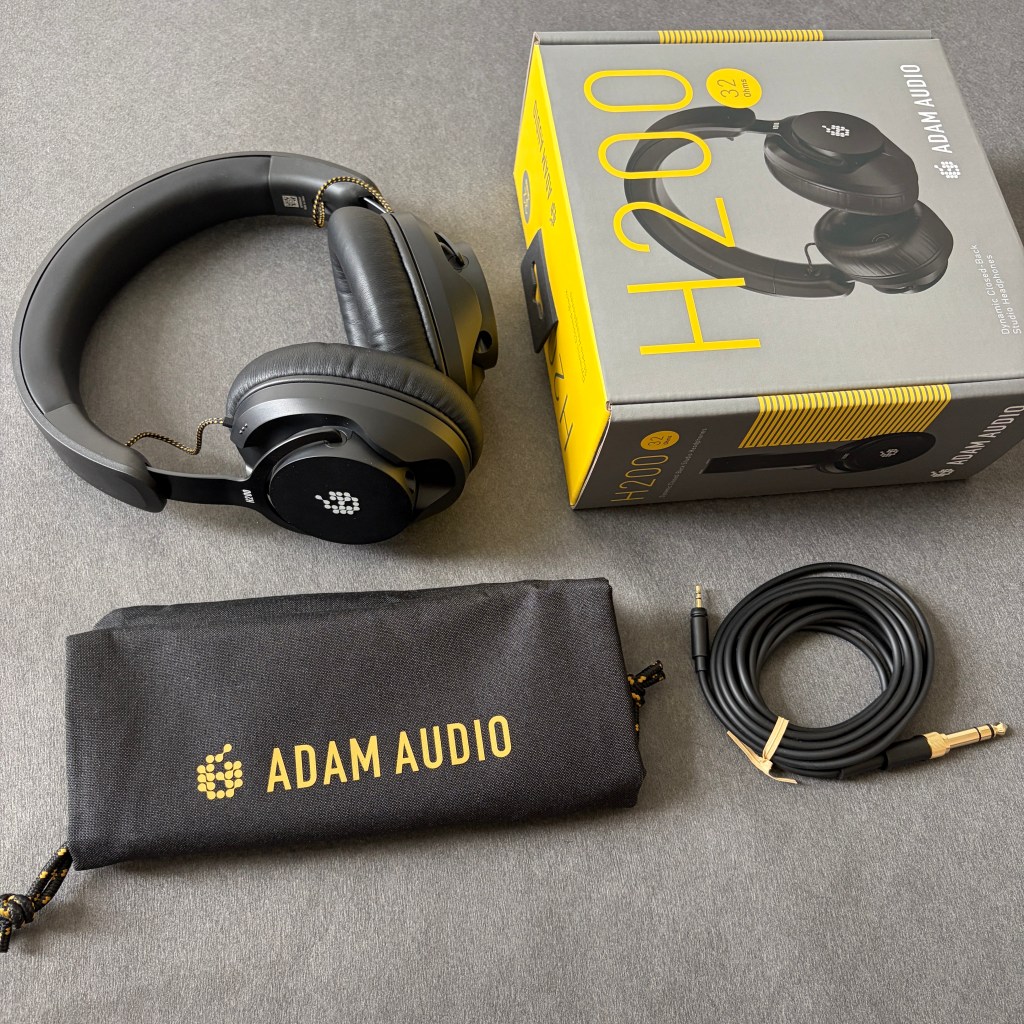
Accessories: 3 M straight cable, 3.5 mm to 6.3 mm adapter, soft carry bag, documentation, ADAM Audio Headphone Utility plug-in
Build and Comfort:
Build quality is decent. The headphone feels sturdy and well-made overall. The protein leather is soft, and the ear foam is plush, with what feels like a memory foam insert. The headband yoke is metal, which is reassuring, while the rest of the chassis is mainly ABS plastic. No creaks or squeaks to report.
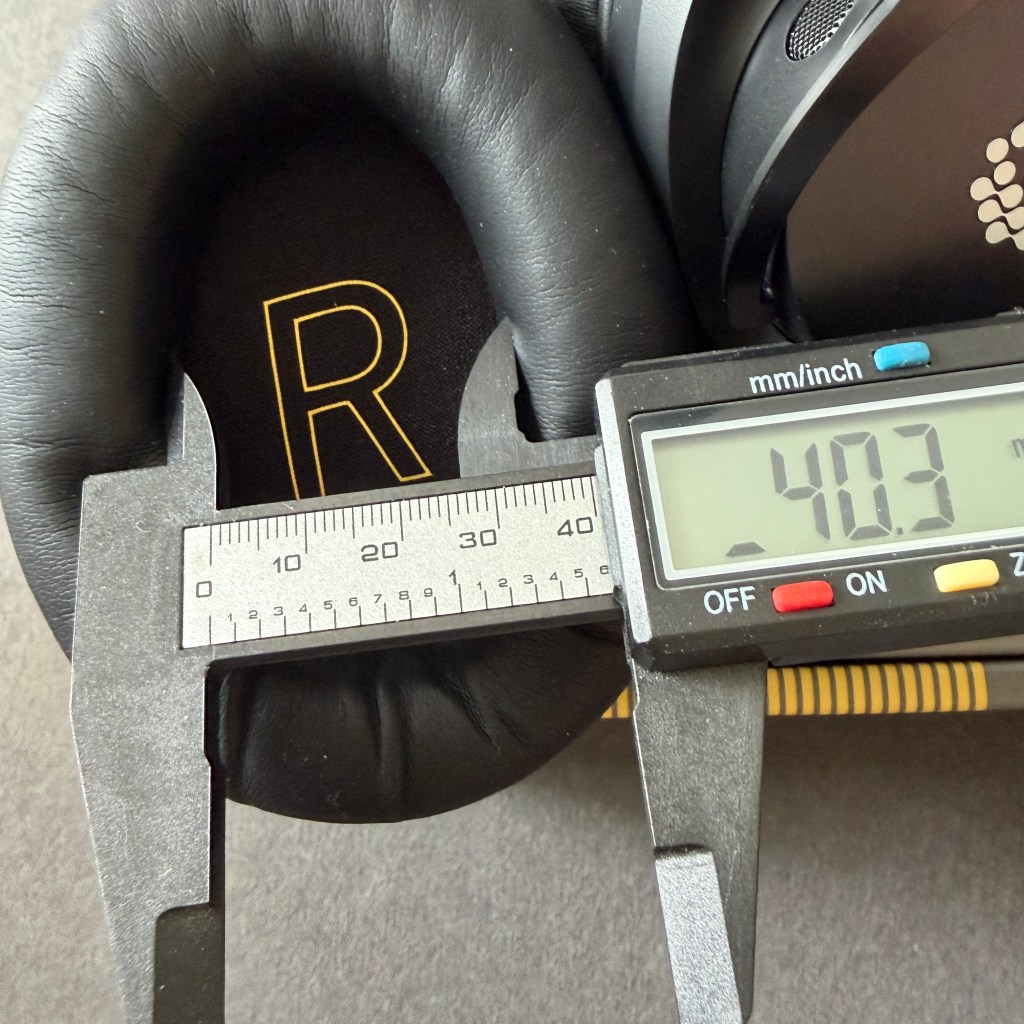
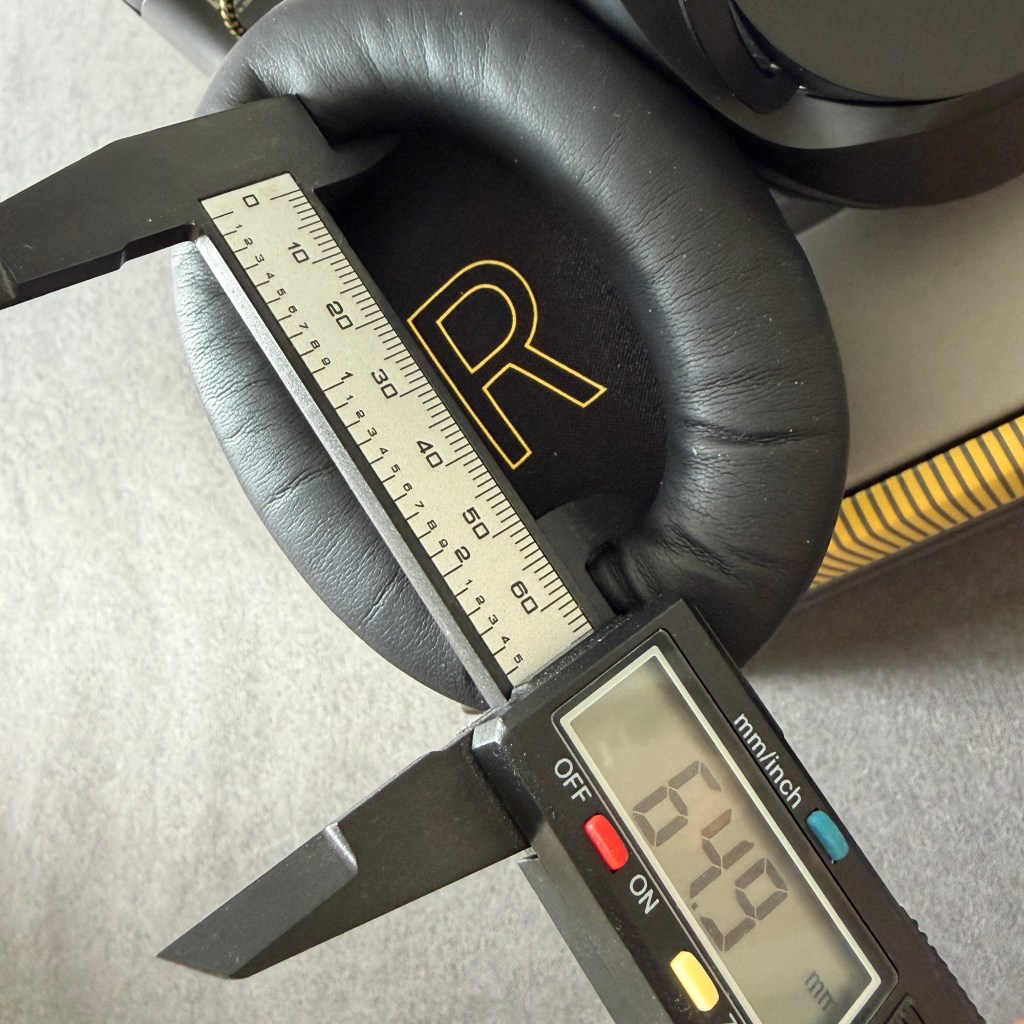
Comfort is acceptable. Clamping force is on the firmer side, which is fairly typical for a studio monitoring headphone. The earpads are just large enough to qualify as over-ear, as you can see in the photos. If you plan on extended sessions, you could gently bend the headband yoke outward slightly. It noticeably reduces the clamp and makes the fit more manageable.
Sound
For more comparisons, visit my squiglink database.
Tonal balance:
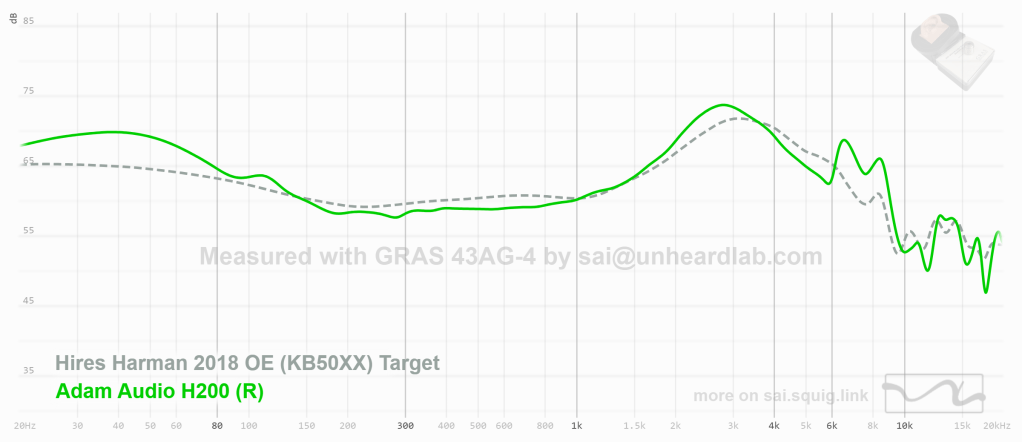
In short, the H200 sounds very much like what you would expect from a closed-back studio headphone: clean, articulate, with an elevated upper-midrange and lower-treble to sharpen detail retrieval, though a bit lean in overall tonal balance. It calls to mind a Beyer-style tuning, but without the notorious treble spike.
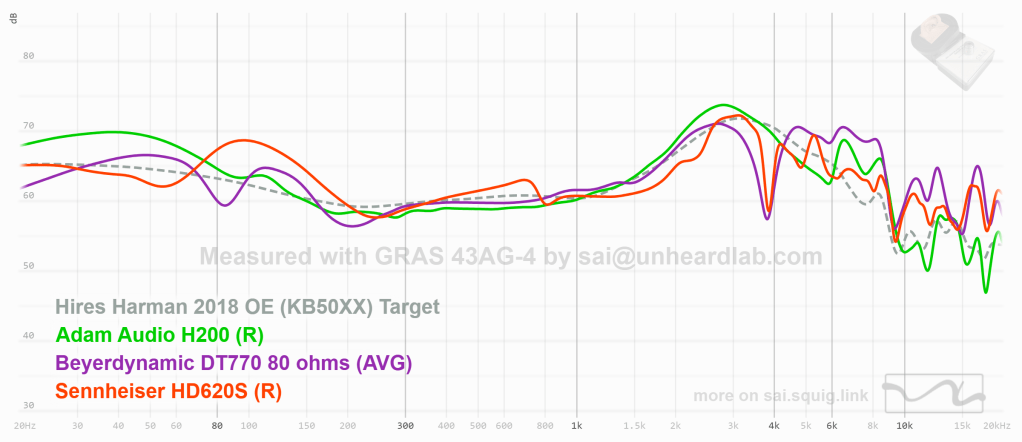
Bass is very good. There is no bloat or muddiness, which is preferrable for a studio set. The punch is comparable to what you would expect from nearfield monitors, but without the added warmth and bloom that room acoustics typically introduce. This puts it well ahead of the Sennheiser HD 620S, which carries an awkward amount of upper-bass bloat. Compared to the Beyerdynamic DT 770 Pro, the H200 delivers more impact and better low-end extension.
Midrange is where the H200 can be a little divisive. Timbral accuracy is quite good, and the overall sense of fidelity across vocals and instruments holds up well. The issue is balance: the midrange leans noticeably thin. Male vocals, for example, come across with less chest and body, and more of a nasal, forward quality. It is not a glaring problem, more like a 2 dB upward tilt across the region rather than specific peaks or dips.
You could argue that this is a studio monitoring headphone doing its job. The leaner presentation makes it easier to identify flaws and issues in a mix. In practice, the end result of your work will likely trend slightly warmer and more polished, as you compensate for the reduced vocal body and tame the grain and breathiness you hear more clearly on this headphone.
Treble is decent. There is a slight emphasis in the mid-treble around 6–8 kHz, which is visible in the frequency response and audible in listening. Sibilance can be slightly accentuated, but it does not become grating unless the source material is poorly mastered. Overall, the treble comes across as clear and articulate.
The upper treble is straightforward. No added splash, no harshness, and no obvious air boost. It is a touch restrained, especially compared to the DT 770 Pro and the DT 700 Pro X. The sense of extension and air is not lacking, but there is nothing here that impresses on its own terms. Safe is probably the right word.
On the more subjective qualities, the H200 is unremarkable. The soundstage is not large or particularly open, which is expected given the closed-back design and studio-oriented tuning. The DT 770 Pro has a wider presentation by comparison. That said, I find the H200 more natural than the HD 620S, which tends to sound hollow and disjointed. Clarity is a strong suit here, making it well-suited for catching flaws in a mix. Dynamics are also respectable for the price: bass is punchy without sacrificing cleanliness. Do not expect the effortless extension of an open-back planar, though.
Conclusion:
At $149 USD / $249 AUD, the H200 is a modest investment for a studio headphone, and one of the more sensibly tuned options at this price. Out of the box, it is tuned much more reasonably than most of its studio-oriented peers. The result is a headphone that is clean, detailed, and broadly balanced in a way that serves professional use cases well.
For casual listening, I would not rank it highly. The clamping force is fairly firm, and the tuning is not the kind of easy-going presentation you would reach for at the end of a long day. There are simply better options for that purpose in this price range, like the FiiO FT1 or the Sennheiser HD58X. That said, as studio headphones go, the H200 is still more listenable than established options like the DT 770 Pro, DT 700 Pro X, or the Sony MDR-7506.
One other thing worth mentioning: the H200 comes bundled with a DAW plugin. It offers the usual features like crossfeed to bring the presentation closer to a speaker-listening experience. If that is useful to you, consider it a bonus.
If there are specific comparisons you would like to see, let me know in the comments.
Value Grade:
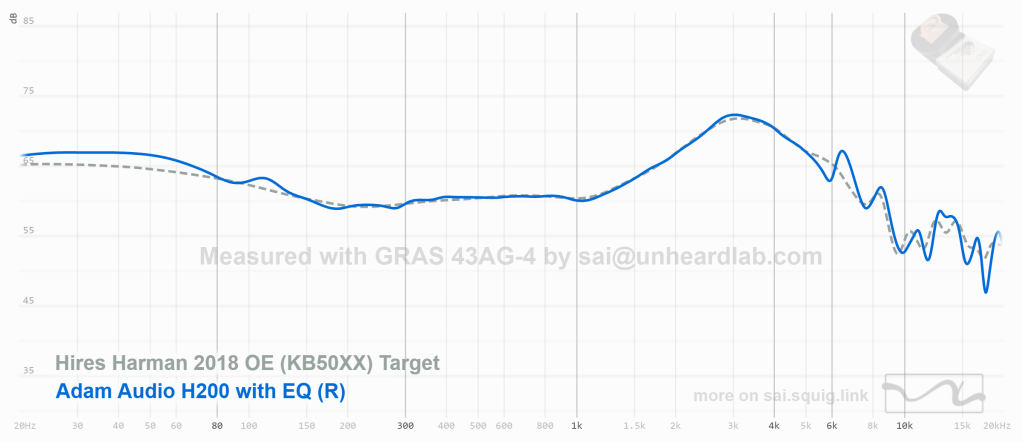
Recommended EQ setting
Copy and paste the below into a TXT file, then import it to EqualizerAPO or similar apps; adjust the bass and treble filters to taste:
Preamp: -3.0 dB
Filter 1: ON PK Fc 39 Hz Gain -3.0 dB Q 0.700
Filter 2: ON PK Fc 380 Hz Gain 1.5 dB Q 0.500
Filter 3: ON PK Fc 890 Hz Gain 1.0 dB Q 1.000
Filter 4: ON PK Fc 1100 Hz Gain -2.0 dB Q 3.000
Filter 5: ON PK Fc 2400 Hz Gain -3.5 dB Q 2.000
Filter 6: ON PK Fc 4900 Hz Gain 3.5 dB Q 1.500
Filter 7: ON PK Fc 7800 Hz Gain -6.0 dB Q 2.500
Filter 8: ON PK Fc 12000 Hz Gain 1.5 dB Q 2.500
If your goal is to EQ the response to match the Harman Target, consider the AutoEQ function provided by Squiglink as a convenient starting point. I personally recommend customising the filters to better suit your own hearing, especially in the treble. While the AutoEQ provides a useful baseline, individual adjustments can often significantly improve your listening experience.
If you’re new to EQ, I’d recommend checking out this video by Resolve from The Headphone Show — it’s a really solid intro and walks through the basics in a clear, no-nonsense way. Great place to start!
MEASUREMENTS
Frequency Response:
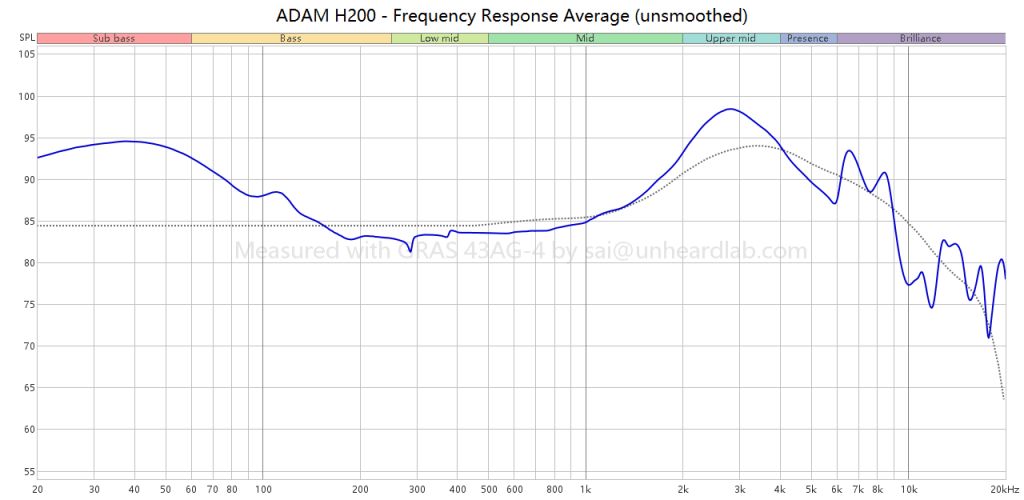
The response is obtained by an average of 5-6 positional variations. The FR shown on the graph is unsmoothed.
Positional Variation:
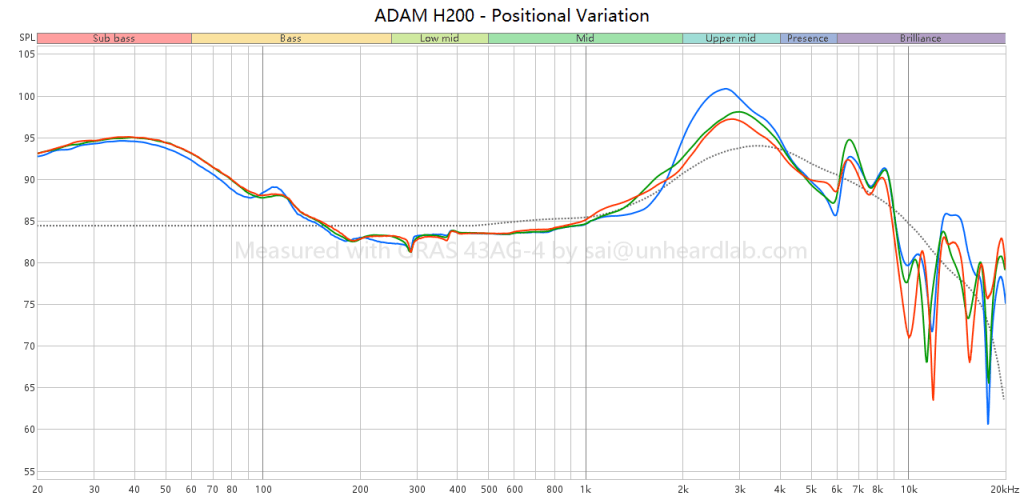
This graph illustrates how headphone placement on the head affects perceived tonal balance: with the ear positioned at the front (blue), centre (green), and back (red) of the headphone. The FRs shown on the graph are 1/48 octave smoothed.
Leakage Tolerance:
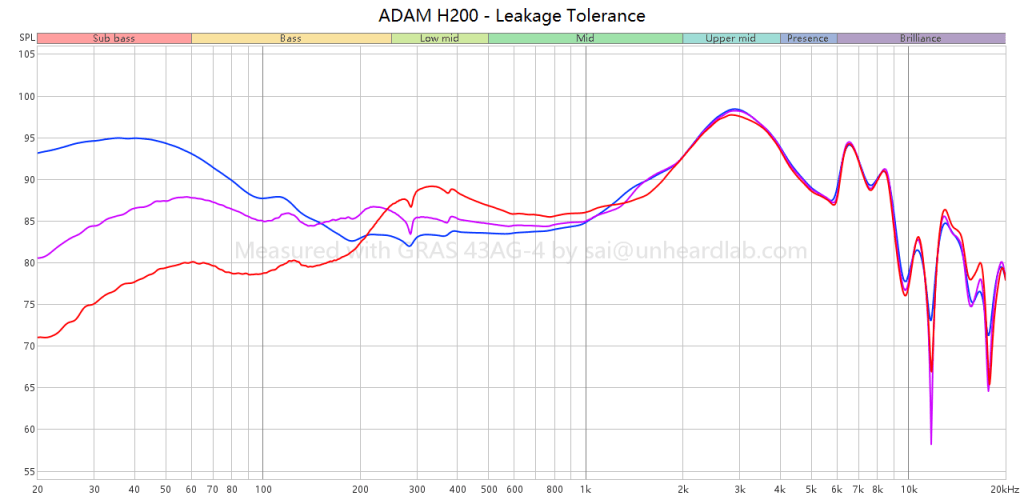
This graph demonstrates how leakages to the front volume can result in FR change: blue (good seal), purple (thin arm glasses), red (thick arm glasses). The FRs shown on the graph is 1/12 octave smoothed.
Linearity and Compression:
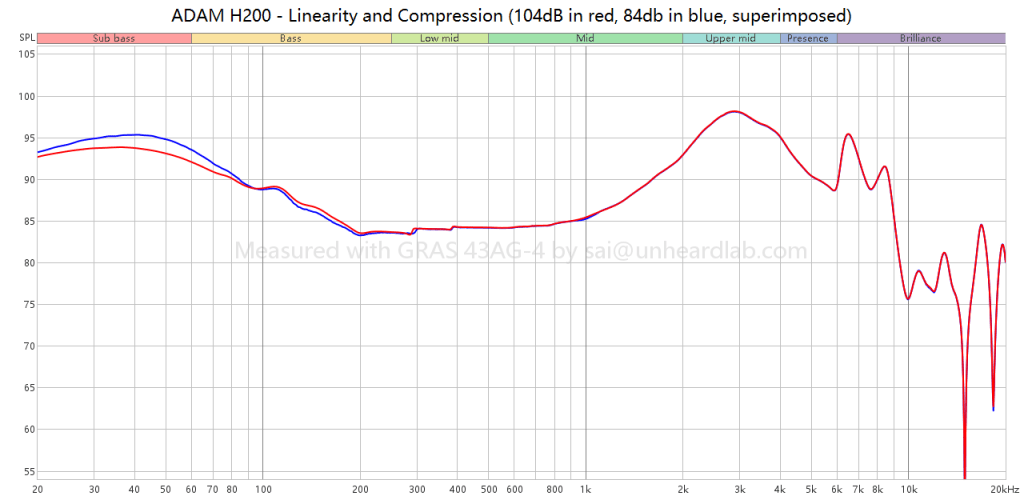
Linearity and dynamic compression testing plots the headphone’s frequency response at two input levels to show how it reproduces signals as loudness changes. Any divergence between the high-level and low-level curves points to where the transducer’s dynamic range begins to compress or distort. Here, the measurements are superimposed to allow direct comparison. The FRs shown on the graph is 1/6 octave smoothed.
Impulse Response:
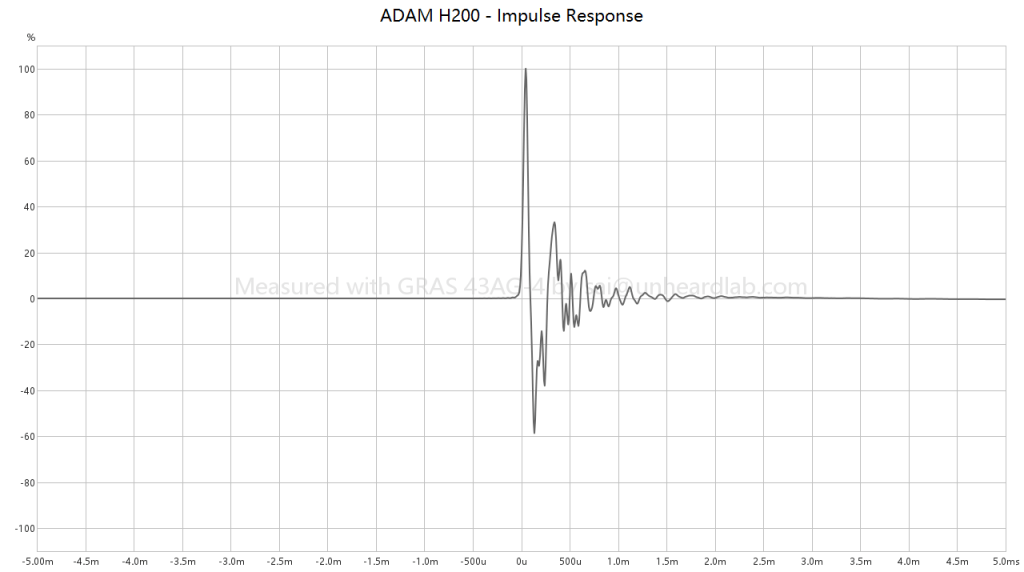
The impulse response test measures the initial response, overshoot, and decay of a transducer upon receiving a signal. An initial upshoot indicates a normal/non-inverted polarity, vice versa.
HpTF Variations (raw/uncompensated):
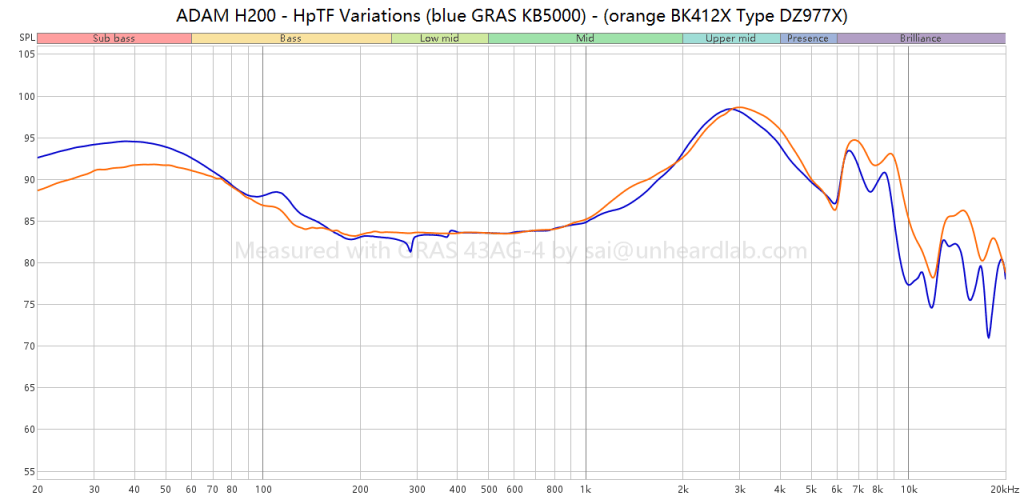
Headphone Transfer Function (HpTF) describes how sound is shaped by headphone design and ear anatomy before reaching the eardrum. Different measurement rigs (with varying pinnae designs) introduce unique reponses/resonances and potential deviations from actual human perception. Understanding HpTF helps translate measured data into real-world listening experiences.
Total Harmonic Distortion (THD% 2nd-9th) & Excess Group Delay (94 dB):
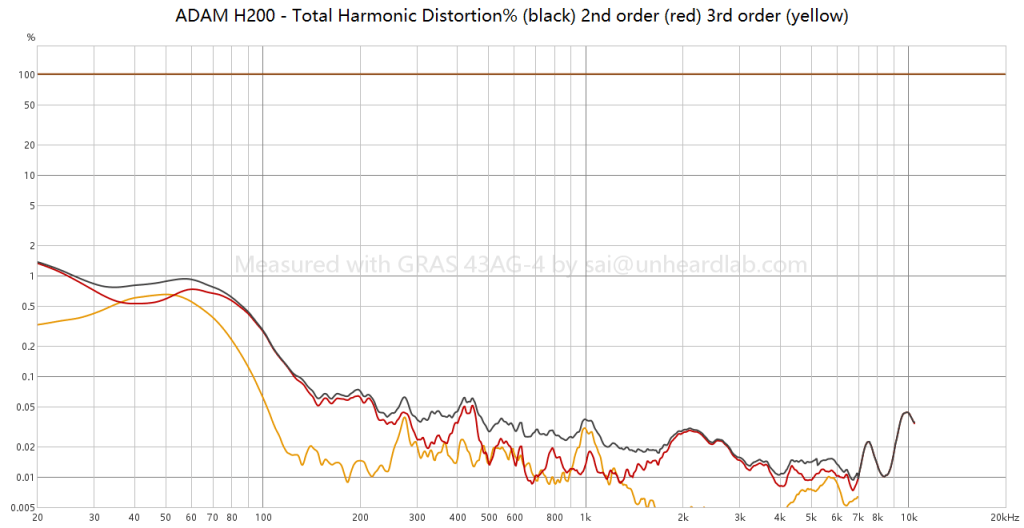
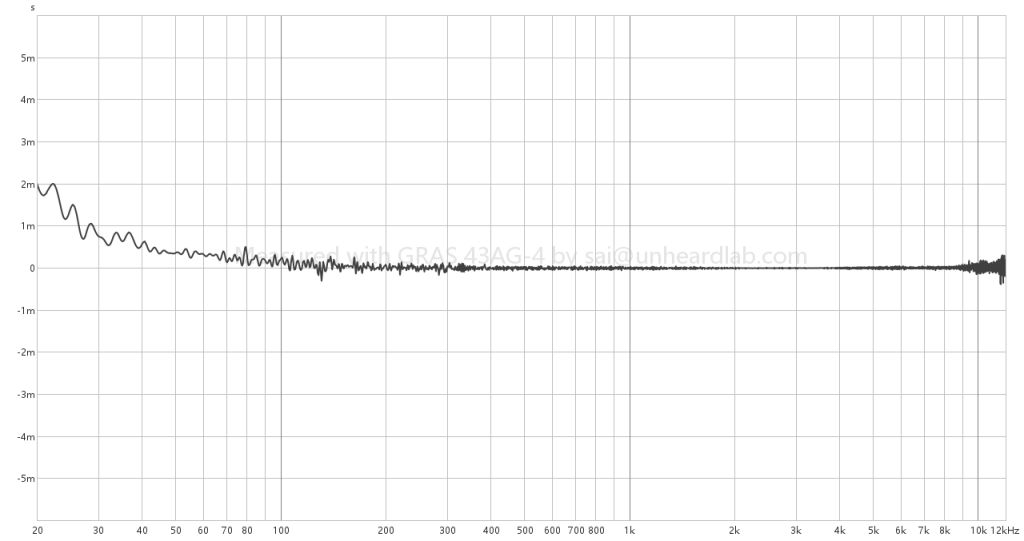
These measurements are conducted in quiet, normal room conditions (as opposed to an anechoic chamber), meaning there may be some influence from ambient room and external noise. These results should be considered a preliminary assessment of performance, primarily for identifying major issues, and do not reflect the best-case performance scenario. Any peaks/dips around 9 kHz are most likely artifacts from pinna interaction/phase cancellation, rather than inherent features of the device under test.
Channel Matching:
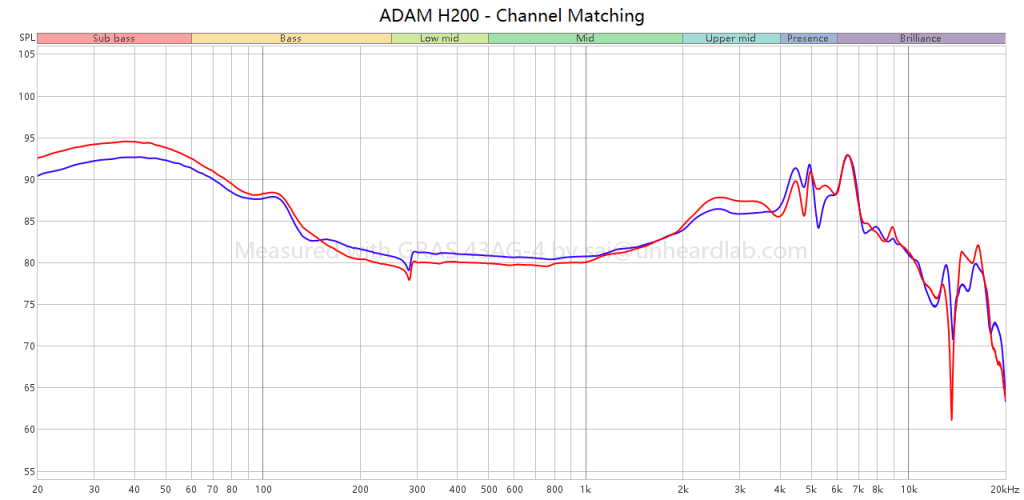
Channel matching graphs are intended for quality control checks and do not relate to the perceived sound profile. A specialised configuration is used in this test to capture differences between channels, mitigating interference from positioning on the rig and the asymmetry in the GRAS pinnae design, a legacy of KEMAR. The left (blue) and right (red) channels are measured using a flat plate coupler with an IEC60318-4 ear simulator.
Electric Phase & Impedance:
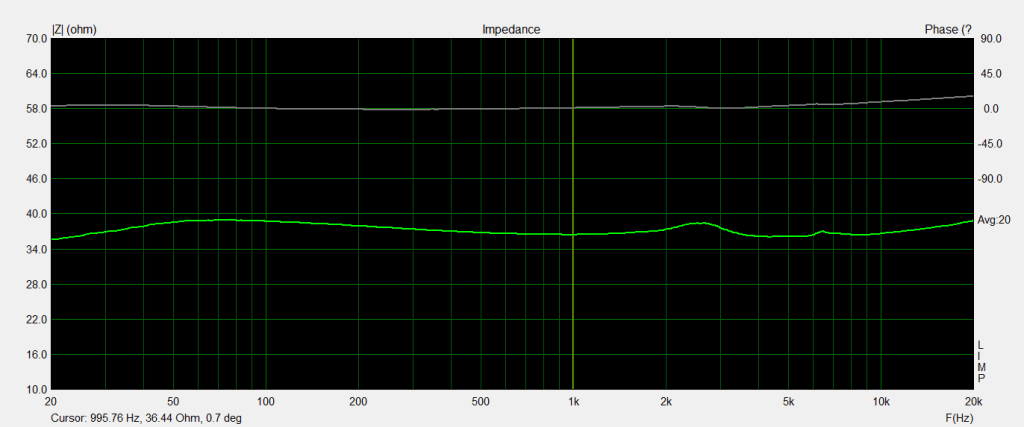
The above graph shows the measured impedance (green) and electric phase (grey), measured under free-air condition (minimal front volume coupling).
Comment: The impedance curve is fairly flat, which is expected from a straightforward dynamic-driver design with no unusual electrical behaviour. It should be easy to drive from most interfaces and headphone outputs.
END OF THE ARTICLE
Disclaimer: This review is independent and was not sponsored or endorsed by any company or affiliated entity. All headphones reviewed are purchased for review unless otherwise stated. Any links or product references are provided for informational purposes only and are not associated with any financial compensation or affiliate arrangement.

I think they are the ultimate sleeper underdog. No one seems to be paying attention to them because they’re too busy getting brain-washed by marketing hype for overpriced plastic “lifestyle” cans that sound like a muddy diaper.
LikeLike
Well yeah.. I agree they are not getting the attention they deserve.
LikeLike
Took me a good while to realize this headphone comes from the Adam the speaker company. Really like their D3V! It’s nice to see they branch out into other types of audio gear.
LikeLike
Hey! They actually released the SP5 a few years back but that was a collab with Ultrasone but yeah it’s definitely cool to see them branching out.
LikeLike
The new Sennheiser HD 480 Pro looks very good. Will you be reviewing it?
LikeLike
Yep that one is coming up soon!
LikeLike