
Intro:
Since Sonova took over Sennheiser’s consumer electronics division, the company’s professional arm has been relatively quiet. Launched in early 2024, the HD490 Pro stands out as one of its main entries into the studio space.
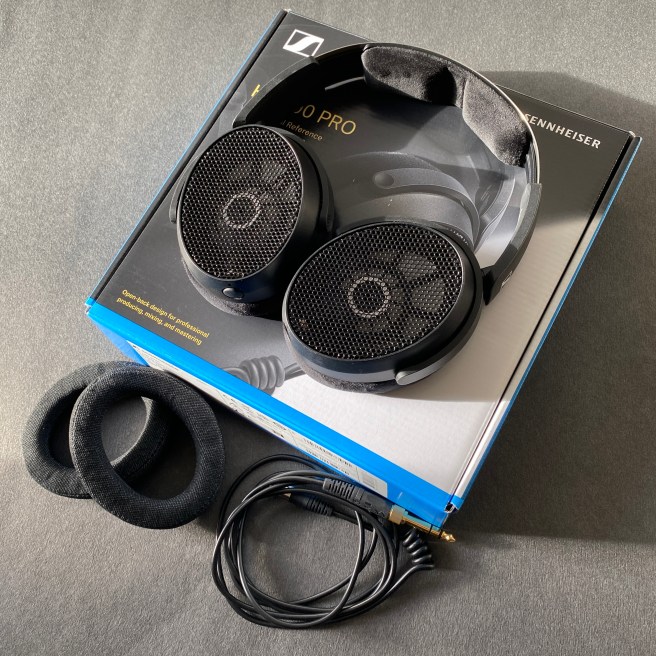
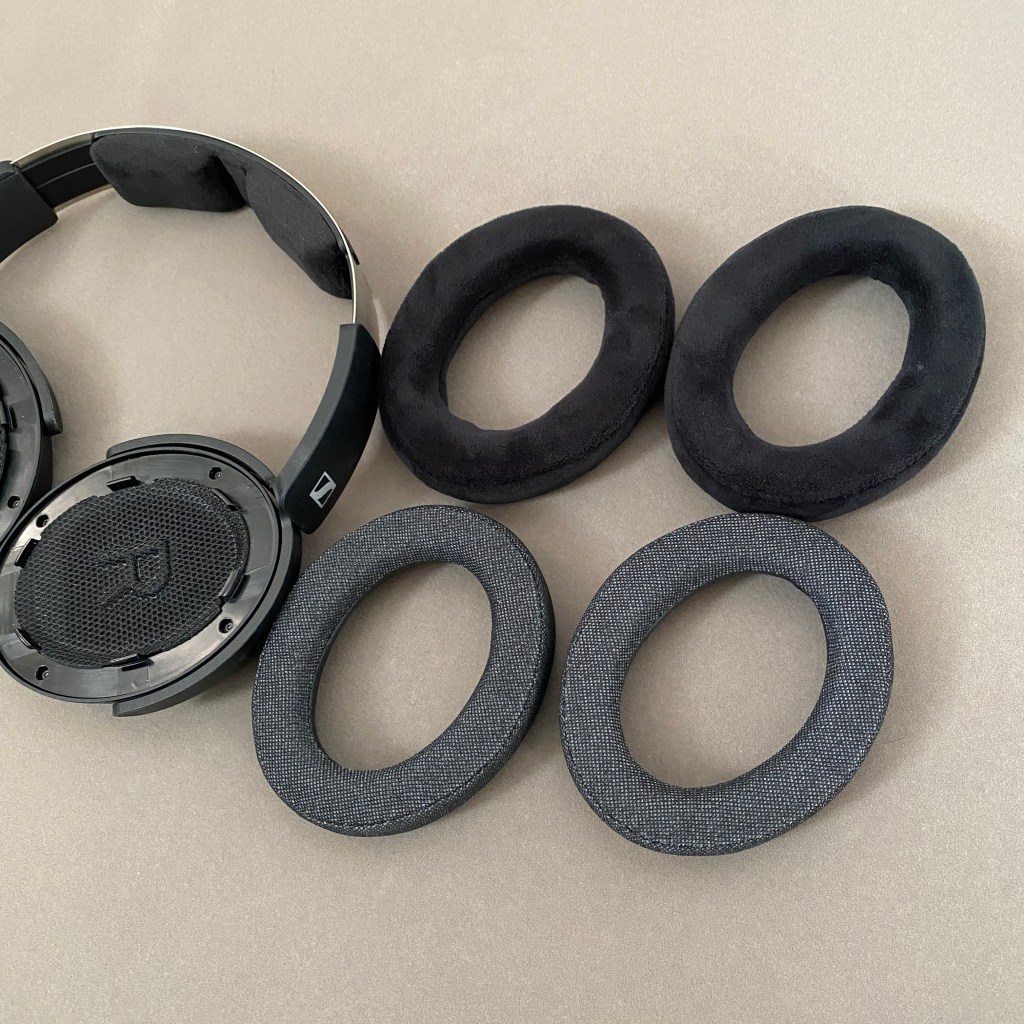
Marketed as a professional studio headphone, the HD490 Pro includes two sets of earpads: a set of “Producer pads” made of velour, and a set of “Mixing pads” made of fabric. According to Sennheiser, the dual-pad system is meant to give creators two distinct sound profiles: one neutral and accurate for mixing, another fuller and more engaging for producing.
But does this approach make sense? And how does it perform for casual listening? Let’s find out.
Detailed measurements can be found in the final section of this article.
Disclaimer: This unit was purchased for the purpose of testing and review.
Specs:
RRP: $399 USD/ $749 AUD
Driver size: 38 mm dia.
Driver type: Moving Coil
Sensitivity: 105 dB/Vrms @1kHz
Impedance: 140 Ω at 1kHz
Connector: single 4-pin mini-XLR
Weight: 261 grams (excl. cable)
Clamping force: light-medium
Accessories: 1.8M cable; paperwork; two sets of ear pads.
Build, comfort, and other things:
As expected from Sennheiser, the HD490 Pro is well built. Most of the structure is plastic, yet it feels solid and dependable. The headband uses a metal reinforcement, so there is no worry about it snapping under pressure.
Comfort is generally excellent. At just 261 grams, the headphone is light enough for long sessions without fatigue. The pads sit softly and distribute pressure evenly around the head. The only caveat is for those with larger ears, as they may touch the inner mesh of the earcups.
Sound
For more comparisons, visit my squiglink database.
Producer pads: consumer lens?
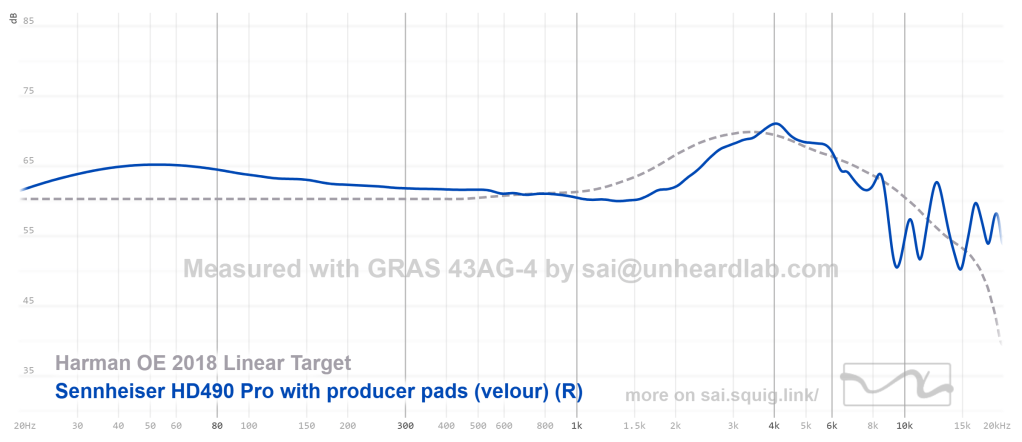
With the producer pads, the HD490 Pro presents a warm tuning with elevated bass that gives vocals and midrange instruments a rich, full tone. The low end carries a decent sense of weight and rumble, though it is not particularly dynamic or hard-hitting.
The midrange feels slightly restrained. It is not recessed, but it comes across as a bit rounded and lacking in definition compared to reference models like the HD600. The treble sits broadly within neutral territory, though the top end rolls off audibly, which limits air and sparkle.
Overall, this tuning fits its intended purpose. The Producer pads offer a sound signature that helps producers judge how their music might translate on everyday playback systems. Many producers prefer this kind of “vibe check” tuning that mirrors what listeners hear on typical consumer setups.
For casual listening, the Producer pads make the HD490 Pro easy to enjoy. The added bass and gentle warmth complement most genres, while the slightly laid-back mids create a more open sense of space and an effortless presentation. The trade-off is that it lacks a real “wow” factor. Staging and resolution are respectable, but not particularly impressive at this price.
Mixing pads: neutral reference?
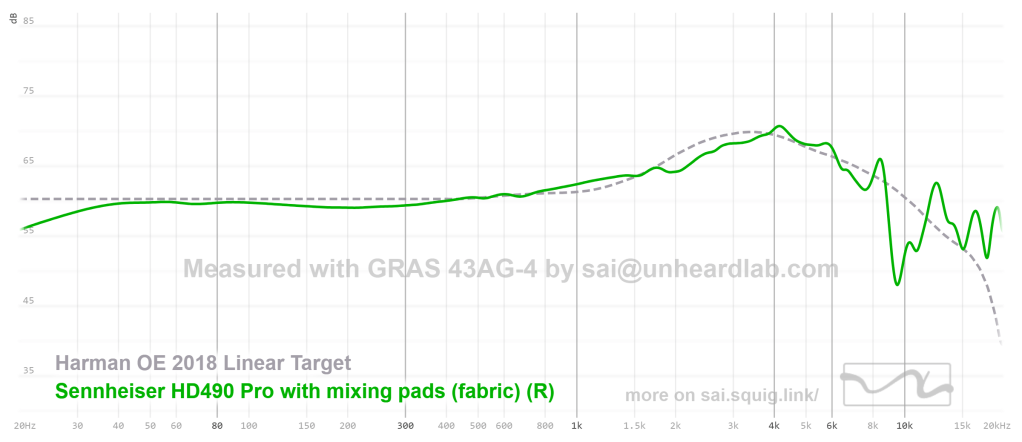
With the mixing pads, the HD490 Pro shifts to a cleaner, leaner, and more articulate sound, much like the Sennheiser HD560S. The main differences are that the HD490 Pro sounds a bit more spacious and open, with slightly fuller mids. Minor variations in bass and treble also speak in favour of the HD490 Pro; but the gap is small, perhaps ten to twenty percent at most.
In theory, this tuning should give creators a reliable, translation-ready reference. It should essentially be the headphone equivalent of nearfield monitors in a treated room.
The actual sound is on the leaner side compared to typical two-channel monitors, sitting closer to what most people associate with classic “studio” headphones that favour brightness and precision over fullness and warmth. Because of this, the Mixing pads can be useful for spotting flaws and fine details in recordings, but they may not provide the kind of truly neutral reference that engineers ideally want.
For casual music listening, the Mixing pads are not ideal. They are fine on their own, but since the Producer pads exist, there is little reason to choose the more analytical option for enjoyment. If you prefer this type of tuning, the HD560S or the newer HD505/HD550 offer similar performance at a lower price.
Conclusion:
At $399 USD / $749 AUD, the HD490 Pro falls a bit short in pure sound quality for the price. What it offers instead is flexibility. The inclusion of two pad sets makes it adaptable to different workflows, and it could appeal to indie producers who want a single headphone that can switch between reference-style and consumer-style listening without extra gear.
Sennheiser deserves credit for this idea of pad-based tuning options, even if the execution is not perfect. Ideally, for critical work like mixing and mastering, a single, consistent reference is usually more reliable. In that sense, the HD490 Pro’s dual identity might cause more confusion than clarity. A tuning somewhere between the two existing profiles might have achieved a more ideal balance.
As such, the HD490 Pro feels like a flexible tool rather than a definitive all-in-one solution. It is a smart choice for creators who value practicality and comfort, though audiophiles seeking maximum fidelity may expect more at this price. The concept shows promise, but Sennheiser still has room to refine it into something truly complete.
If there are specific comparisons you would like to see, let me know in the comments.
Pros:
+ Versatile tuning via two earpads
+ Solid build quality and low distortion
+ Great comfort for long sessions
Cons:
– Sound quality trails cheaper competitors
– Dual-pad concept can be confusing for strict reference use
– Potentially loose fit on smaller heads
Value Grade:
Notes on Earpads and EQ
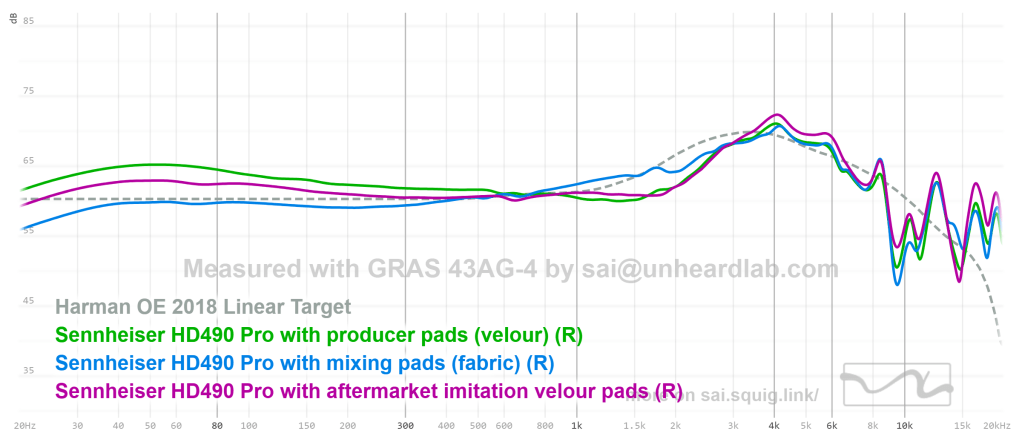
The HD490 Pro pads attach using plastic clips that snap onto the headphone’s chassis. Because of this design, finding aftermarket replacements can be a bit tricky. That said, a few compatible options are available on AliExpress and Ebay.
These third-party pads look and feel similar to the stock Producer pads, though the material is closer to micro suede than velour. In sound, they strike a balance between the two stock options. Bass is slightly reduced compared to the Producer pads, while treble gains some brightness and openness. The result is a more “hifi” type of tuning, with less bass bleed and greater treble clarity, yet still free from harshness or excessive brightness.
Considering their low cost, these pads make a worthwhile upgrade for HD490 Pro owners who want an alternative tuning that sits comfortably between the Producer and Mixing profiles.
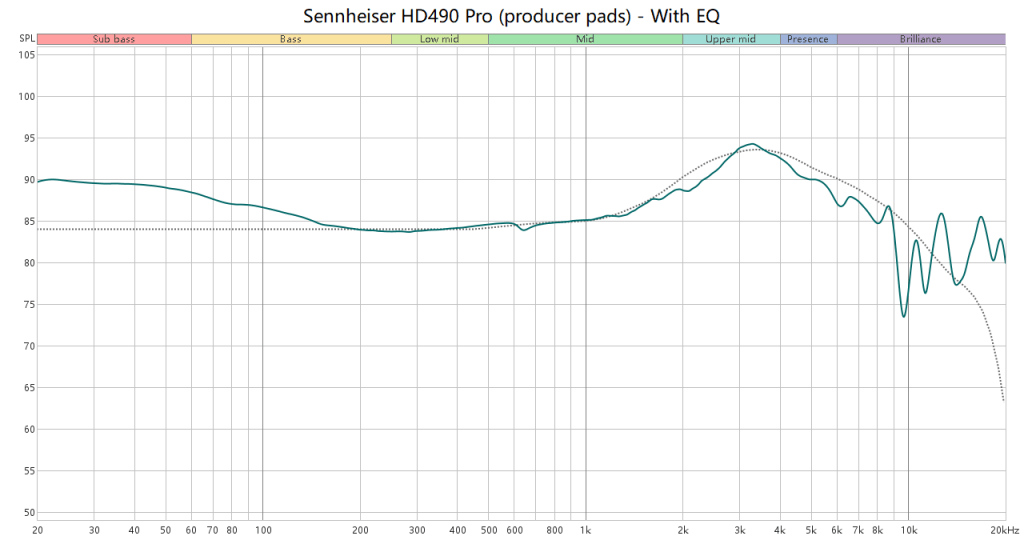
In terms of EQ, this headphone needs some adjustements to sound well-balanced.
Recommended EQ setting for this headphone (adjust the bass and treble filters to taste):
Preamp: -3.9 dB
Filter 1: ON PK Fc 20 Hz Gain 3.5 dB Q 1.500
Filter 2: ON PK Fc 200 Hz Gain -2.5 dB Q 0.600
Filter 3: ON PK Fc 1800 Hz Gain 4.0 dB Q 1.200
Filter 4: ON PK Fc 4200 Hz Gain -2.0 dB Q 3.000
Filter 5: ON PK Fc 5800 Hz Gain -1.0 dB Q 3.000
Filter 6: ON PK Fc 10500 Hz Gain 2.0 dB Q 2.500
If your goal is to EQ the response to match the Harman Target, consider the AutoEQ function provided by Squiglink as a convenient starting point. I personally recommend customising the filters to better suit your own hearing, especially in the treble. While the AutoEQ provides a useful baseline, individual adjustments can often significantly improve your listening experience.
If you’re new to EQ, I’d recommend checking out this video by Resolve from The Headphone Show — it’s a really solid intro and walks through the basics in a clear, no-nonsense way. Great place to start!
MEASUREMENTS
Frequency Response:
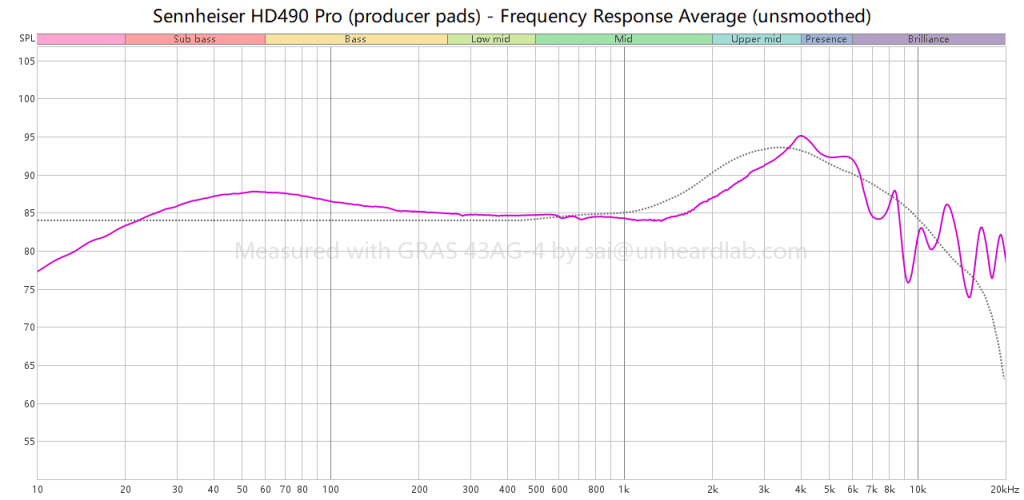
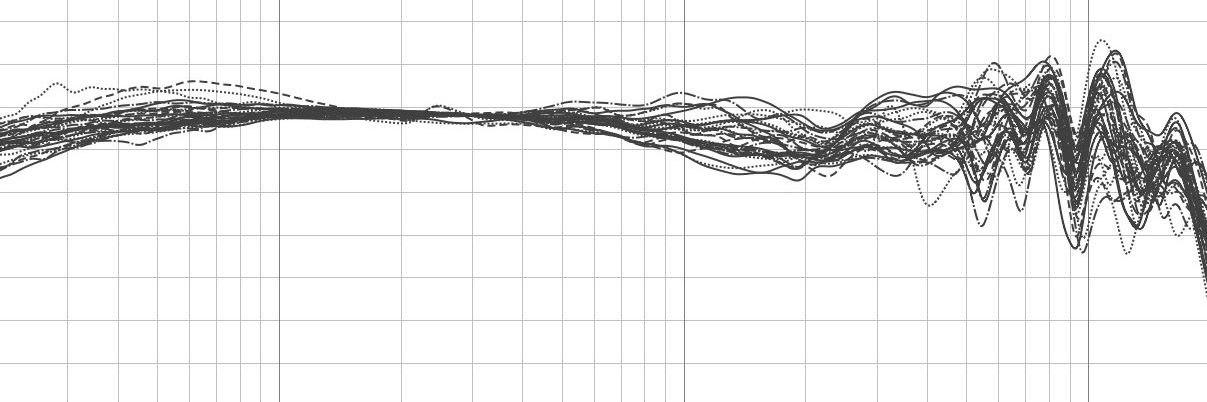
The response is obtained by an average of 5-6 positional variations. The FR shown on the graph is unsmoothed.
Positional Variation:
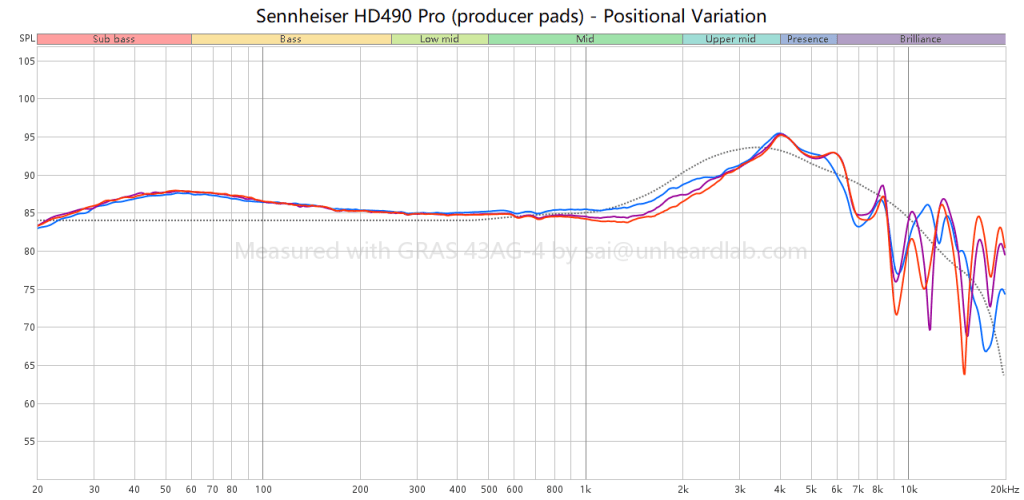
This graph illustrates how headphone placement on the head affects perceived tonal balance: with the ear positioned at the front (blue), centre (purple), and back (red) of the headphone. The FRs shown on the graph are 1/48 octave smoothed.
Leakage Tolerance:
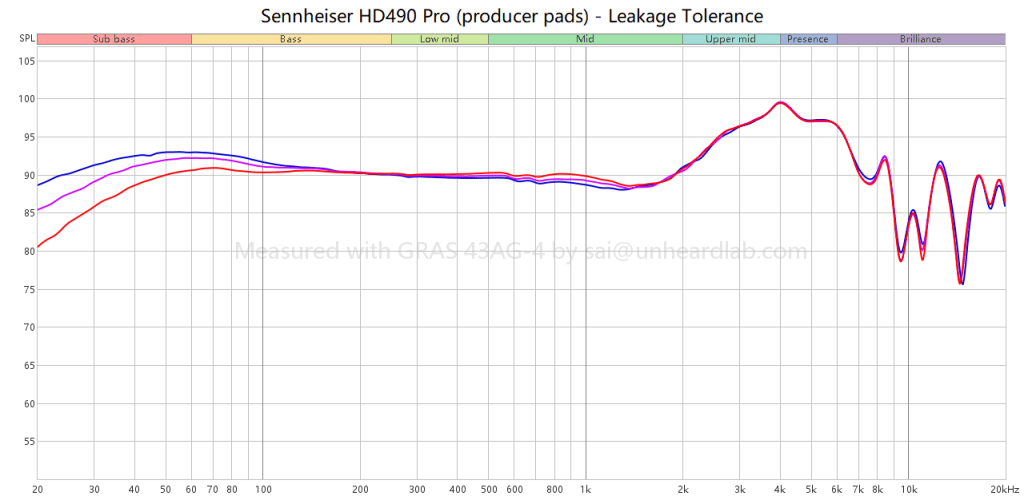
This graph demonstrates how leakages to the front volume can result in FR change: blue (good seal), purple (thin arm glasses), red (thick arm glasses). The FRs shown on the graph is 1/12 octave smoothed.
Comment: Like most open-back dynamic headphones, this headphone shows some bass roll-off when the seal is compromised. As such, getting a good seal is required for the maximum amount of perceived bass response.
Linearity and Dynamic Compression:
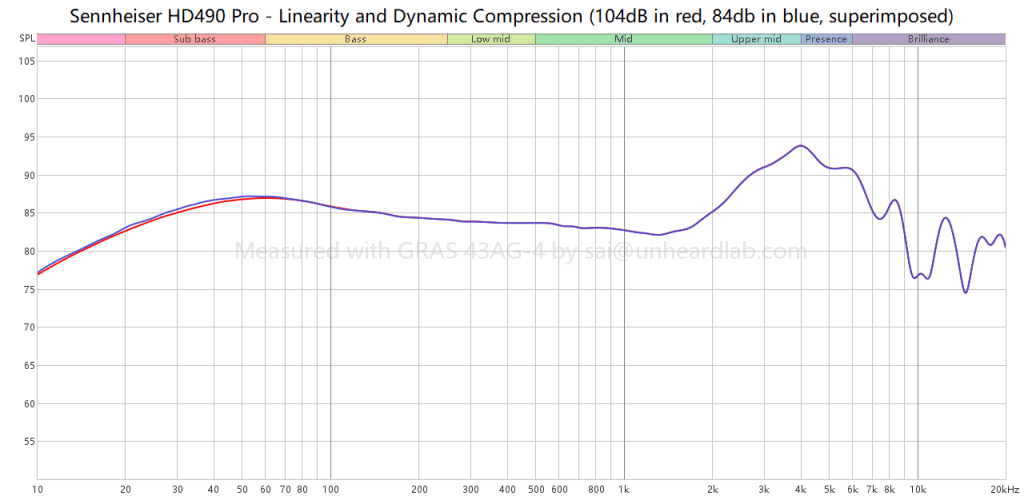
Linearity and dynamic compression testing plots the headphone’s frequency response at two input levels to show how it reproduces signals as loudness changes. Any divergence between the high-level and low-level curves points to where the transducer’s dynamic range begins to compress or distort. Here, the measurements are superimposed to allow direct comparison. The FRs shown on the graph is 1/6 octave smoothed.
Comment: This is very good. There’s tiniest compression below 20Hz (~0.5dB) at 105dB, which shouldn’t be a concern.
Impulse Response:
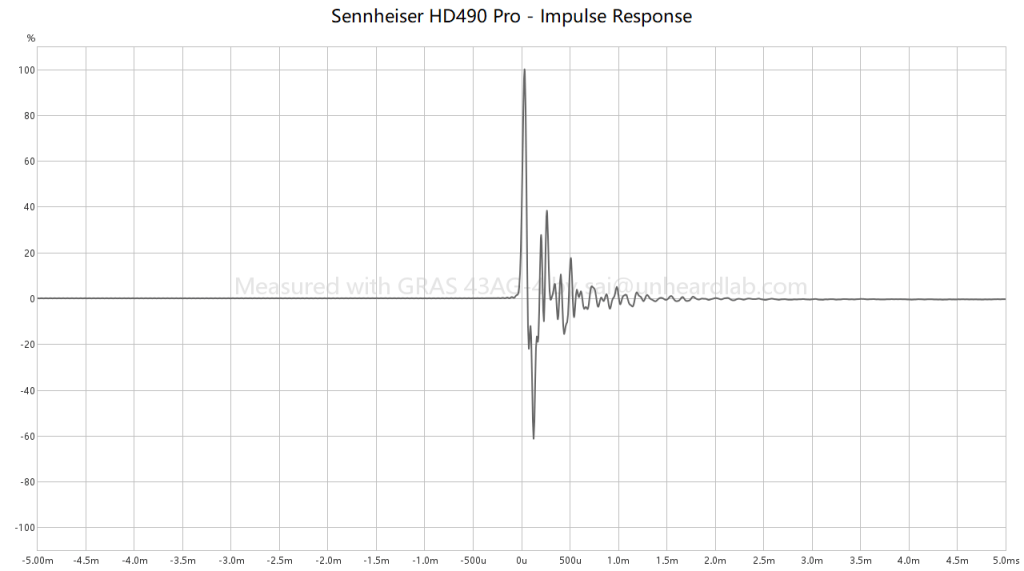
The impulse response test measures the initial response, overshoot, and decay of a transducer upon receiving a signal. An initial upshoot indicates a normal/non-inverted polarity, vice versa.
HpTF Variations:
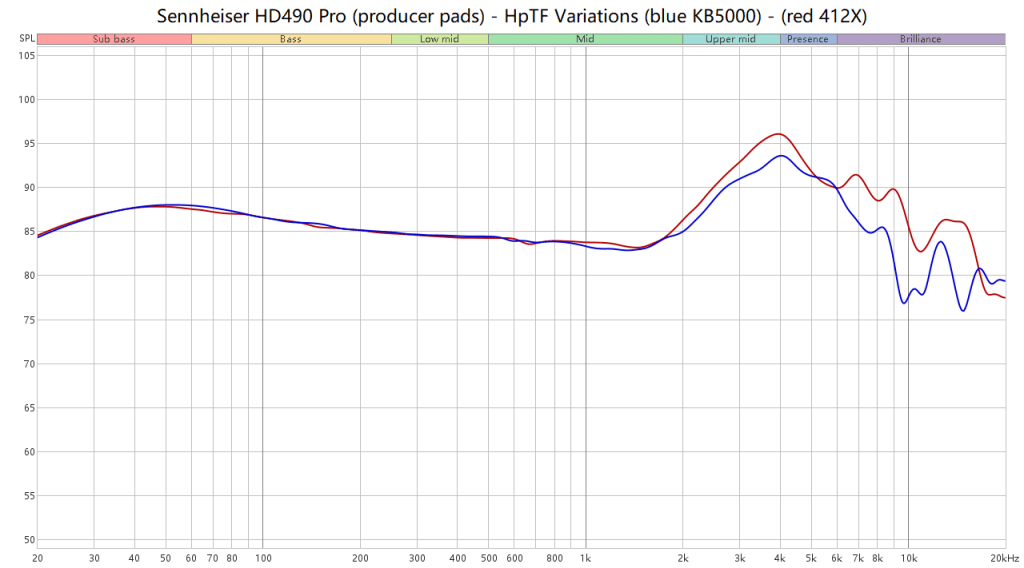
The Headphone Transfer Function (HpTF) describes how sound is shaped by headphone design and ear anatomy before reaching the eardrum. Different measurement rigs (with varying pinnae designs) introduce unique reponses/resonances and potential deviations from actual human perception. Understanding HpTF helps translate measured data into real-world listening experiences.
Total Harmonic Distortion (THD% 2nd-9th) & Excess Group Delay (94 dB):
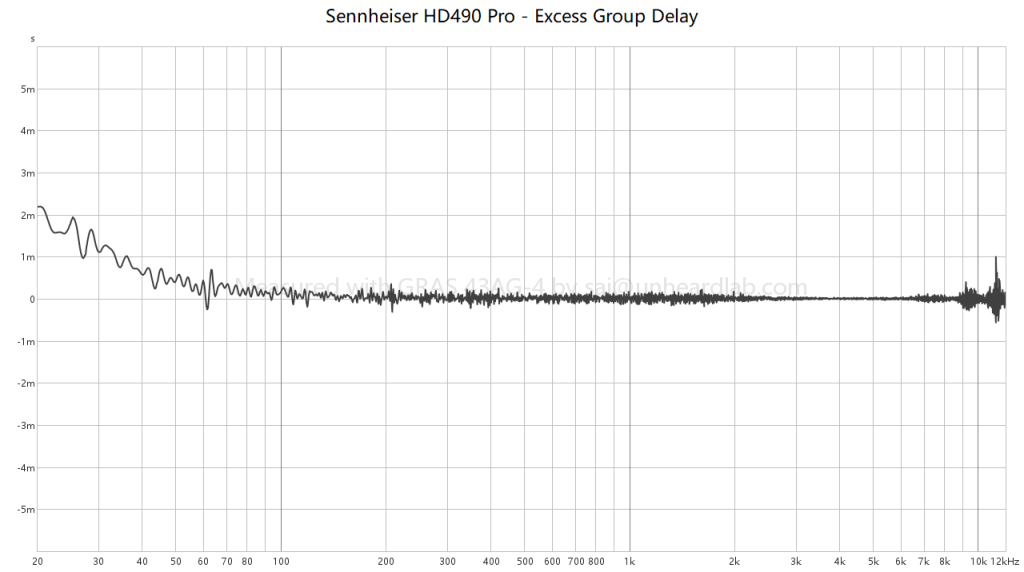
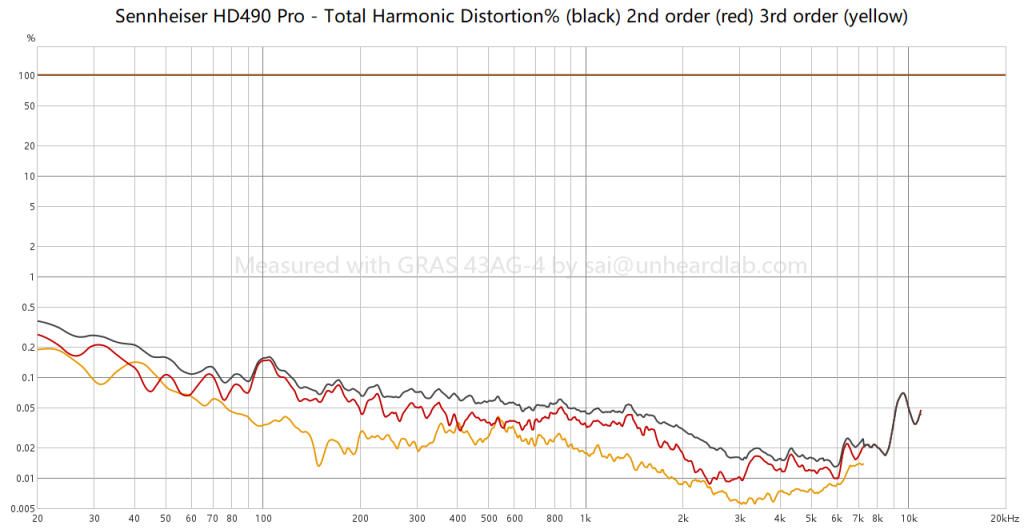
These measurements are conducted in quiet, normal room conditions (as opposed to an anechoic chamber), meaning there may be some influence from ambient room and external noise. These results should be considered a preliminary assessment of performance, primarily for identifying major issues, and do not reflect the best-case performance scenario. Any peaks/dips around 9 kHz are most likely artifacts from pinna interaction/phase cancellation, rather than inherent features of the device under test.
Comment: These are excellent results. Nothing to worry about here.
Channel Matching:
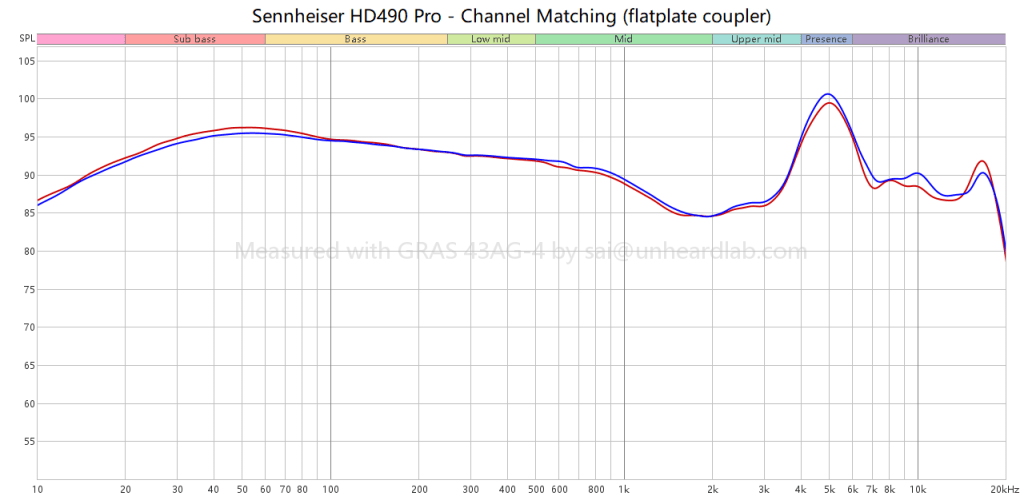
Channel matching graphs are intended for quality control checks and do not relate to the perceived sound profile. A specialised configuration is used in this test to capture differences between channels, mitigating interference from positioning on the rig and the asymmetry in the GRAS pinnae design, a legacy of KEMAR. The left (blue) and right (red) channels are measured using a flat plate coupler with an IEC60318-4 ear simulator.
Comment: Channel matching on this particular unit is good. Tight tolerance may contribute to imaging precision and the clarity of spatial cues.
Electric Phase & Impedance:
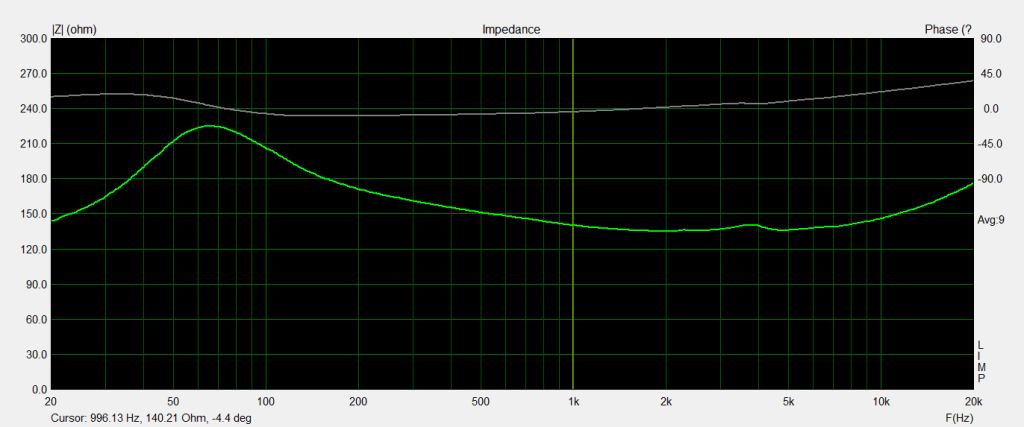
The above graph shows the measured impedance (green) and electric phase (grey), measured under free-air condition (minimal front volume coupling).
Comment: This headphone’s impedance curve is typical of a moving coil headphone, with variable impedance across the frequency spectrum. This means that when paired with high output impedance sources, such as some vacuum tube amplifiers, frequencies on where the impedance curves is higher can be boosted, causing a change in frequency response.
END OF THE ARTICLE
Disclaimer: This review is independent and was not sponsored or endorsed by any company or affiliated entity. All headphones reviewed are purchased for review unless otherwise stated. Any links or product references are provided for informational purposes only and are not associated with any financial compensation or affiliate arrangement.

Would you recommend these or the hd600s for music playback and vocal monitoring like podcasts?
LikeLike
I would say the HD600 remains more faithful in terms of most instrumental and vocal timbre. It is perhaps less articulate than the HD490 Pro with the mixing pads, but you do get a leaner midrange with the latter. So unless you really want a slightly leaner, dead neutral sound, I would go for the HD600. Also, value-wise, the HD600 is ahead. You just have a bit more midbass bump to deal with on the HD600.
LikeLike
Personally, I own an Sennheiser HD-560S and an HD-400 Pro, which are perfect for home cinema use (watching movies with my eldest son) and also for discovering music or videos online, connected directly to the audio output of my gaming computer; I also use them for video games.
For better sound resolution and fluidity, I use a very good (but not to expensive) high-end planar headphones on a tube amplifier (living room setup).
These two Sennheiser headphones offer unbeatable value for money; they do the job very well and remain a benchmark in terms of sound neutrality, despite a slight coquetry at 4.5 KHz, which is quickly forgotten; they are extremely comfortable to wear, once the headband has been softened with a hair dryer (to soften the plastic of the headband a little and reshape it to fit my large head…).
Eric65
LikeLiked by 1 person
Hey again, Eric. Yeah, ironically I also find the best (IMO) use case for the HD490 Pro (with producer pads) to be media consumption and probably gaming, with its tuning and larger staging compared to typical Senny headphones. Comfort is great for that, too. I do not have an issue with the clamp, but the hair dryer method is a cool trick to know.
LikeLike
Are the depths of the aftermarket micro fiber pads the same as the producer pads?? I would like a little bit cleaner sound, but need the extra depth, and like a little more bass than the mixing pads.
LikeLike
Yeah, dimension-wise they’re near identical if not the exact same. So I’m afraid they won’t add any extra room for your ears in this case.
LikeLike
Oh that’s not bad then. I meant the same size as the producer pads. The mixing pads feel not as deep and my ears definitely touch more. If it’s the same as producer pads then I may have to give them a whirl. Thanks!
LikeLike
Ah yes they are basically the same as the producer pads. No worries!
LikeLike
Spot on review! I recently tried these out for myself. A lot of people raved about their performance in gaming and noted that they were “not too bad” with music either.
The biggest selling point advertised (to me) was that they had the comfort of their big brother, the HD800S; so naturally I was intrigued to test this out (having never heard the HD800).
Unfortunately, you are absolutely correct. Although they are comfortable with all the different components combined (weight, cup material, headband), if your ear touches the driver mesh, its a deal-breaker… Ironically, my HD58X were far more comfortable after I broke in the clamp force. For anyone wondering if the comfort level is affected by large ears, it certainly is…
Performance in gaming was good, but I did not feel that they were “wall-hack” level of sound positioning as some have claimed. Certainly good for all types of games, but more of a “entry-level” experience, in my opinion. The bass definitely made up for the exaggerated expectations. Again, nothing mind blowing, but it filled out the bottom end nicely. I’m guessing the mixing pads would give it more detail with positioning, but the trade off is not very fun.
I wish I could test out the HD800S to try and understand why people compared them to the HD490 Pro… Some day, maybe.
– Michael
LikeLike
Hey Michael. Yeah my ears touch the mesh a bit too, and it can be really annoying at times given that scratchy texture. I agree it’s well-tuned for music, but yeah nothing mind-blowing at this price point… which seems to be a trend with Sennheiser’s more recent products.
You should try the HD800S. The design and build still offer something unique even after all these years. I think they’d offer something both similar and different to your HE1000se, with an alternative presentation.
LikeLike
If I can get my hands on the HD800S, I’ll definitely do some personal comparisons. It would be interesting to hear the different drivers in action in terms of detail presentation. I’ve read that they have the same kind of holographic presentation that the SE has. Ironically, I was going to grab those first before I considered the HE1000SE because I was weary of HIFIMAN quality issues, but they were not in stock anywhere, so I went with the HIFI. Maybe I can find a good used deal somewhere…
LikeLike
Haha yeah we’ve all heard the stories about Hifiman QC. Honestly, I’ve owned quite a lot of them and haven’t really run into issues myself. Maybe I’ve just been lucky, or maybe it’s because I tend to treat planars with a bit more care since they can be delicate.
You’re spot on about the holographic imaging. Both are excellent at it. The HD800S has a truly remarkable soundstage that feels exceptionally wide and airy. It is definitely an experience worth having!
LikeLike
Hi Sai,
Great in-depth review as always.
I’d appreciate hearing your comparative thoughts on the HD490 Pro, R70XA, and Sony MV1. These 3 headphones have almost identical pricing.
I had also read your impressions of MV1 on the Reddit from a while back. The MV1’s tuning is rather V-shaped, but I heard it does do great with EQ, as well. What concerns me regarding MV1 is that it might not be entirely open-back – some have mentioned that its sound doesn’t change much or at all when you cover its cups with your hands.
Which have you found most competent for the price and general sound qualities as an all-rounder daily driver, especially for such characteristics as macrodynamics and imaging?
LikeLike
PS:
I was also considering Aune AR5000, but the recent news of its yoke attachment breaking has not been helpful at all, to say the least. So, it’s just between the above 3 for now.
I’ve also been thinking maybe pass all these and, at a later date, going for the Hedd D1 that’s all the hype these days, but it’s 2-2.5 times the price of these headphones.
BTW, which one of the 3 contending headphones has less chance of experienceing muddiness in more complex passages?
LikeLike
Thanks for the kind words! Yeah the MV1 is definitely like that, but I still think it sounds open and airy enough to be considered an open-back. In that sense it’s pretty similar to the HD490 Pro while the R70xa feels the most open and spacious of the bunch.
In your case, I’d say the R70xa stands out. It sounds the most dynamic and capable out of the three. That’s really its strong suit and where it improves the most over the original R70x. Plus, you can easily swap the pads if you want to play around with different tunings.
I haven’t tried the HEDD D1 yet but defintely eager to!
LikeLike
Thanks for the response, Sai.
Yeah, pad rolling is a good tip that you mentioned and, now that I think of it, to be expected with all of these since neither of these headphones (R70XA, MV1, and HD490) have pads available on the usual online stores. I think that, with all of them, one has to make contact with their respective companies directly to ask for a pair of pads, unfortunately.
A part of my research into headphones is to go on AliExpress and see which of the headphones I’m interested in has good pads manufactured for them by these pad companies on the Ali. Haha! But, I never find that out, because the comments there almost never mention which Ali pads did sound good or close the og pads of their headphones. I just can see which ones have sold the most. Haha!
Incidentally, I was just watching the Headphones Show’s video of the best 2025 gear, and the Edition XV was the strong favorite there. It’s $400 like the HD490, R70xa, and MV1. However, I hadn’t included the XV in my original question, cause I’m truly afraid of the jaggedness I see in its mids on the FR graph. I was reading Oratory’s recommend EQ settings for the XV and I saw he’s gone after every single one of these jaggednesses in his EQ settings, like 5 or 6 eq bands were dedicated to them. Besides its mids’ jaggedness, I’m also afriad that the XV might sound too warm or dark for my taste, especially as an all-rounder daily driver.
How’s the XV’s technicalities (resolution, macrodynamics, imaging, and staging) fair when compared to the DD headphones in question – MV1, HD490, and R70XA?
LikeLike
PS:
I could get a new set of MV1 for $240 locally, so cheapest of them all. In fact, due to this amazing price, I was trying to find if it’s worth getting it compared to the rest or I should spend more and get one of the other sets in question. I’m willing to spend more on the better set. But, admittedly, that MV1’s price is tempting the hell out of me, too. Haha!
LikeLike
PSS:
Although, I have one rather strong reason for not considering the MV1, despite its current amazing price: I have a set of closedbacks that, I fear, might sound too similar to the MV1, the Beyer 770 Pro X LE. They’re both V-shape headphones.
Sorry for all the PS’s, dear Sai! But, whenever I’m in a headphone picke, I only have one very respected knowledgeable Audio Angel to pray to – you. Haha!
LikeLiked by 1 person
Hey man sorry for the late reply, I was away for the holidays.
The 770 ProX LE is definitely very V-shaped. I wouldn’t say the MV1 is nearly as V-shaped though. It’s much more neutral and balanced by comparison, so they’d actually complement each other pretty well.
Sonically, I still think the R70xa is your best bet (or maybe the Heddphone D1 if that fits the bill, going by other reviews), especially considering what you said about finding aftermarket pads. The XV is another great option if you want to try a planar sound that’s a bit different from the rest – fuller, smoother, and more organic. Technicalities wise, it’s great for the price and IMO beats most dynamic headphones in this range, though it’s maybe not the craziest among planars (the Moondrop Para 2 is more like that, but that’s a whole other story).
That said, if you can snag a bargain on the MV1, I’d say go for it. Worst case scenario, if you don’t like it, you can resell it for little to no loss. Otherwise, if you have a clearer idea of the sound you’re chasing now, that makes the choice even easier.
LikeLike
Dear Sai, I hope you enjoyed the holidays to the fullest.
I did snag that bargain on the MV1 while you’re on holiday. The price was too great for me not to get it – I thought I would surely regret it in the future if I don’t get it.
I like it. It’s comfortable to wear and suits my main genres of listening (classical, neoclassical, soundtracks, electronic) greatly. I especially like the sub-bass on it. The sub-bass hungry works of the maestro Hans Zimmer sound great on it. BTW, seeing the MV1’s bass on the graph, I thought it had to be a semi-open pair, but upon close inspection, I saw it’s truly open-back. That was a concern of mine when I was asking you about it. Haha!
And, I’m the same guy who mainly only listened to instrumental works and was consistently asking you about the HE1000 Stealth and Cosmo a few months back. I was concerned with resolution, precise imaging, and proper handling of the complex passages. I was also hoping for the news of a Cosmo 2 and you informed me about Moondrop news conference back the. You kindly told me that Moondrop had introduced an unveiled pair which would practically be the Cosmo’s replacement – initially named Laputa, now Skyland. When I was sure that the “unveiled” was merely Moondrop’s marketing and the Laputa was infact not unveiled, I pre-ordered it from China. I received it while you’re on holiday. Back then, I had promised to let you know what I get, and I had waited to first receive it and then inform my helpful friend.
It doesn’t even need to be mentioned, but I’m looking forward to your review of Laputa/Skyland, too. For the pad-rolling section, I would love to see how the EP100A pads do on the Laputa. We had talked a lot about these pads back then. Haha!
Regarding the naming debacle of Laputa, I also have a joke which I would share with you: what do I want Skyland for when I have Thebitch in the house. Because I had it preordered it, I have it with its og name. Haha!
In the end, I want to thank you, dear Sai, for all your help, great insights, hard work on the site, and one-of-a-kind interaction in the comments here. Simply, no one can’t ask for more. If I ever came to the Ausiland, I would have to hunt you and give you the biggest hug.
As always, take care, you great being in the world of hi-fi audio.
Your friend from another part of the world,
Mohsen.
(Almost 2 years ago, I had emailed you to thank you for your work when I had first discovered your great website.) Haha!
LikeLiked by 1 person
Hey Mohsen, it’s great to hear from you! Thanks, I had a really nice break.
I’m glad you managed to snag the MV1 at that price, you really can’t go wrong there. Soundtracks are an absolute treat with that sub-bass oomph. Dynamic drivers have really leveled up recently, and the MV1 is a great example of that. I also really love the fit. They just disappear on the head.
And wow, you actually snagged the OG “Laputa” batch! That’s practically a collector’s item now. Moondrop definitely learned a hard lesson with that one. I’m hoping to get my hands on a unit soon, but I’ve been swamped with other stuff lately.
I’ll make a note to test the EP100A pads for the review. I’d also love to hear your impressions too.
Thank you for the incredibly kind words and for sticking around for so long (it’s a shame I still haven’t been able to try the 105 AER you mentioned way back). If you ever do make it down to Aus, definitely hit me up!
Take care, my friend.
LikeLike
I would like a comparison with R70xa (and R50x if possible) . I’m considering them or hd490 pros, with the primary purpose being mixing and mastering dialogues, music and sfx for my small indie documentary film productions.
LikeLike
Hey man. I’ve only demoed the R50x briefly, so I’ll mainly focus on the R70XA. I’d say they both perform pretty well for the tasks you mentioned, but the HD490 Pro is more versatile. It offers a more immersive experience for film-related work, especially with the producer pads. You can get similar results with the R70XA using EQ or pad swaps, but it’s not as easy or intuitive. Comfort-wise, the R70XA can be a bit awkward for a lot of people since it lacks flexibility. If you can pick them up for a similar price, I’d say the HD490 Pro is the safer bet.
LikeLike
Hi!
I quote: “Sound quality trails cheaper competitors”
Please let me know which ones…
LikeLike
Hey, I mainly had in mind things like Sennheiser’s own HD6X0 series, as well as the HD560S/HD400 Pro and some of the newer models like the HD505/550. They aren’t necessarily better in everyway, but I think they get close enough in most areas and exceed in some. And then you also have stuff like the Fiio FT1, FT1 Pro, etc., more recent headphones that are really aggressive in terms of price-performance. But of course, it also depends on what you’re after.
I still personally think the HD490 Pro offers a bit less pure sound quality for the money, though what you’re paying for is the flexibility, comfort and overall package.
That said, street prices seem to have come down quite a bit since I wrote the review, so I’d probably judge the value a little more favourably now.
LikeLike
Hi thanks for your reply. Actually I’m looking for the most “neutral” headphones for mix purpose in my Pro Tools system. I’m very tempted for the famous HD650 or something similar in frequencies response… Harman OE 2018 linear target… I have a 400-500€ budget and for obvious reasons of comfort I need headphones as light as possible just like most of Sennheisers.
LikeLike
Yeah, in that case I think the HD6X0 family is still one of the safest places to start. I’d probably go with the HD650/6XX specifically. I used to prefer the HD600 for this sort of use, but with the current pad revision I find the 650 a little smoother and less strident in the treble, while still being very neutral through the mids.
They’re light and very comfortable, and for mixing there’s some value in using something that’s been such a common reference for so long. It makes comparisons with other engineers/users a bit easier too.
The Aune AR5000 is another good option. It’s also very comfortable and has a nicely neutral balance, but for professional use I’d still lean towards the Sennheiser simply because it’s the more established benchmark.
LikeLike
I agree the AR5000 is a good option but its bass and treble are not neutral in my opinion. It’s still incredible that there isn’t a current offer capable of competing with headphones designed more than 20-30 years ago!!! Even the new HD490 is a big disappointment! I was looking for something more modern but everything weights a ton like those Hifiman or Audeze. I own a Thieaudio Cypher for a month and its 412g are a real
issue in term of comfort. I hope you will test it…nice neutral sound despite a channel level gap in the mid-treble region that becomee a problem in my mixing work. I suppose HD650 with some eq settings will be my next step…I regret not having ordered the HD6XX during the last launch by Drop!!!
LikeLike
Yeah, that’s fair. I wouldn’t call the AR5000 strictly neutral if you value the extension at both ends. I mainly had it in mind as another lightweight, comfortable option with a generally sensible balance. I haven’t heard the Cypher yet unfortunately, but I’d definitely be interested in trying it.
I think Sennheiser now sells the HD6XX themselves, although I am not sure at what price.
LikeLike
Hi! Cypher is now sold and HD650 just arrived today…plastic shit but lightweight and comfort matter more than design finally. In term of sound it seems to be as described by most reviews. HD650 has less bass and treble than the Cypher it is obvious! Moreover I used the Cypher with -20db gain on my RME ADI-2 DAC and now I use the HD650 at 0db. It is far better!
Could you help me to adjust my RME equalizer to reach the Harmann OE 2018 linear curve please?
LikeLiked by 1 person
Nice, glad the HD650 worked out for you. Honestly the plastic construction is part of why it stays so light and comfortable haha.
The HD650 is already pretty close to that target. The newer pads like the ones on your pair do seem to have a bit more 5-6 kHz energy than the older versions though, so I’d start with something like this:
Preamp: -6.0 dB
Filter 1: PK, 20 Hz, +6.0 dB, Q 0.50
Filter 2: PK, 180 Hz, -2.6 dB, Q 1.00
Filter 3: PK, 5600 Hz, -3.0 dB, Q 3.00
Filter 4: PK, 5600 Hz, +1.0 dB, Q 1.00
If you still feel the upper treble could use a little more presence, you could also try:
Filter 5: PK, 6500 Hz, +2.0 dB, Q 3.00
I’d treat that last filter as optional and tune it by ear. The HD650 is already very well behaved, so I wouldn’t try to force it too aggressively onto the target.
LikeLike