
What has not been said about the Susvara?
Intro:
Although I have owned several top-of-the-line (TOTL) headphones since I got into this hobby in 2010, I have not written any reviews for them yet on this blog. This review of the Hifiman Susvara is intended to serve as a starting point and, perhaps, a benchmark for what I believe TOTL headphones should represent. Released in 2017, the Hifiman Susvara has become one of the most prominent high-end headphones on the market. Despite its high price point, the Susvara has been a staple at audio shows and stores, and also a hot topic of conversation on headphone forums, demonstrating its strong market presence and reception.
In recent years, the prices of flagship headphones have skyrocketed, even making the Susvara’s whopping US $6000 RRP appear relatively common among its peers. With such prices, these headphones should not only excel in specific areas but also meet a comprehensive set of criteria to earn their top-tier status. However, as we will see in upcoming reviews of other TOTL models, many fail to match the overall sound quality of the Susvara.
It is important to note that this does not imply the Susvara sets the lowest bar for TOTL headphones. Instead, it should be viewed as a benchmark others could be judged against. With Hifiman’s release of their new TOTL model, the Susvara Unveiled, the timing of this review could not be more apt.
For the full suite of measurements, see the final section of the article.
Specs & Comfort
Price: US$ 6000, AU$ 7500
Transducer size: ⌀100 mm
Effective area: ⌀80 mm
Transducer type: planar magnetic
Earpad size: 110*105*20-25mm
Earpad mounting: clipped
Sensitivity: 79 dB/mw @1kHz
Impedance: 60Ω @1kHz (measured)
Connector: dual 3.5mm TRS
Weight: 448 grams
Clamping force: medium
Headband swivel: 240° approx.
Comfort: 7/10 (slightly weighty)
Measurement & Sound

link to the frequency response measurement & more comparisons
Tonal balance:
Overall, the Susvara boasts a balanced and airy sound, with a slight emphasis in the upper-treble region. While vocals and midrange instruments may appear slightly reserved, they are by no means recessed or distant. The overall presentation is imbued with a reverberant and effortless quality.
The bass quality of the Susvara is exemplary, marked by its tightness and agility. It extends impressively down to 20Hz and below human audibility with minimal roll-off, showcasing the exceptional capabilities of its planar drivers. To those accustomed to high-quality speakers, the bass quantity might still seem somewhat polite, yet it unquestionably sets a bar for linear bass reproduction in open-back headphones. Even when the seal is slightly compromised upon wearing, the Susvara’s large driver size and low diaphragm tension maintain a very low resonance frequency, ensuring that the bass delivery remains punchy and dynamic.
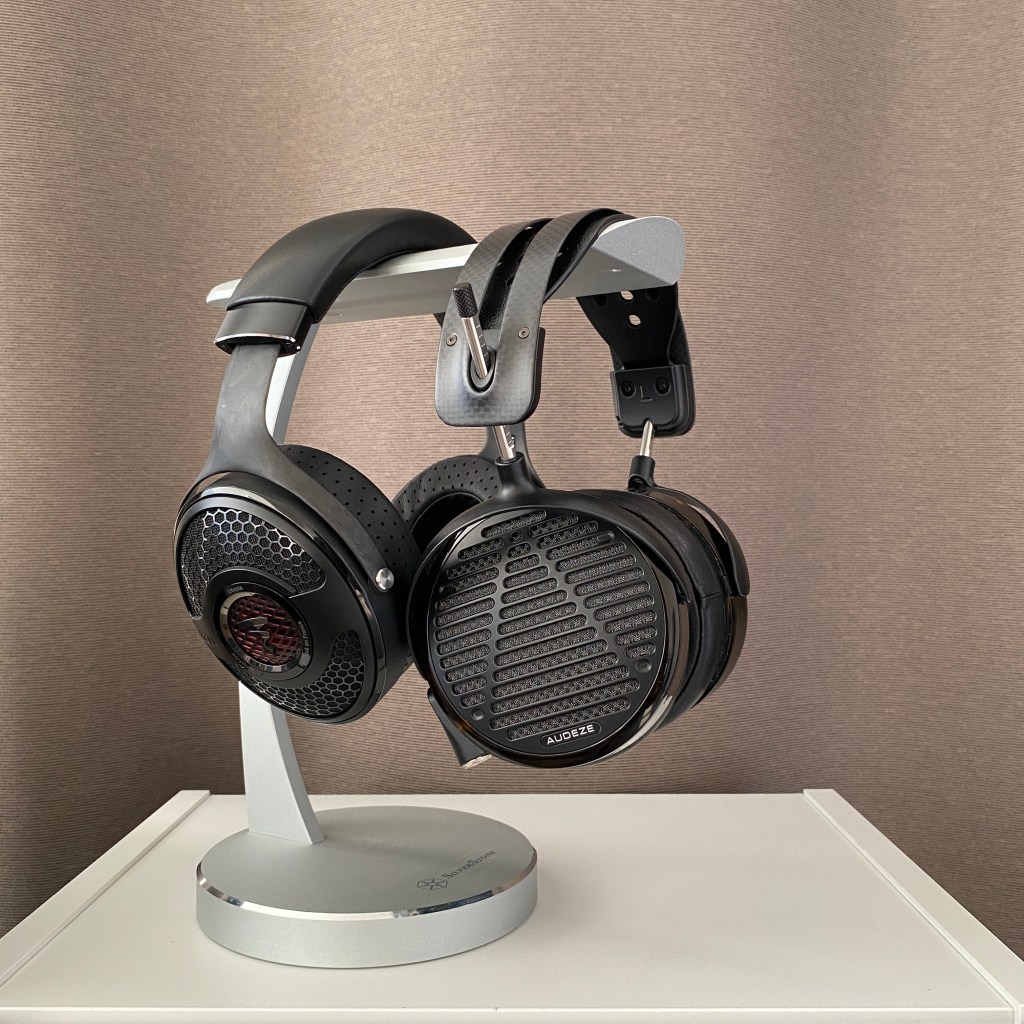
Compared to some other top planar magnetic headphones like the Audeze LCD-4 or even Hifiman’s own HE-6 OG, the Susvara’s bass presence might feel less ‘weighty’. Nonetheless, it surpasses them in terms of agility and snappiness. When properly amped, the Susvara will deliver authoritative bass impact. While it may not rival top dynamic headphones like the Focal Utopia in terms of tactility, it ranks among the best for planar headphones. For those open to using EQ, the Susvara responds remarkably well. Throw a 10dB bass shelf on it and the Susvara will do just fine, which speaks again of the driver capability when it comes to excursion limits.
The midrange offers a balanced if only somewhat polite presentation. Unlike TOTL headphones that are often tuned to a ‘special’ character — such as the lush vocals of the LCD-4 or the sharp instrument edges on the AB-1266 — the Susvara strikes a tonality that aims more at the faithful reproduction of recordings. The balance between fundamental tones, which provide fullness, and harmonic tones, which provide articulation and presence, is executed with an excellent balance.
While midrange timbre is pretty natural overall, the style of presentationis deliberately polite and restrained. This tuning philosophy, a signature of Hifiman, positions vocals and midrange instruments slightly further back in the mix, avoiding aggressive forwardness that might lead to listening fatigue. Meanwhile, it avoids the ‘fragility’ or ‘delicacy’ often noted in the Ananda and other Hifiman ‘egg-shaped’ models. Similarly, it does not emulate the ‘old school’ grunt of the HE500 or HE6. It should perhaps be seen as a blend of these styles.
This restrained approach may contrast with some expectations for TOTL headphones, where a more ‘engaging’ sound is often the norm.
The treble is notable for its exceptional clarity and liveliness, paired with a smoothness that is uncommon in high-end headphones. This combination allows the Susvara to deliver a treble response that is vibrant yet refined, enhancing the listening experience without veering into harshness.
However, compared to its linearity in the bass and most of the midrange, the Susvara exhibits a slight emphasis in the transition from mid-treble to upper-treble, particularly around the 10-12kHz range. This emphasis can cause higher-pitched instruments, like crash cymbals in modern rock recordings, to stand out more prominently than may be ideal. It may also introduce a touch of sibilance in certain female vocals, particularly those who sing in higher registers. On tracks that are mastered more aggressively bright, the Susvara can get a tad hot and zingy, like the sibilance tones in Patriacia Barber’s “The Wing Song”. In this regard, I find the upper-treble character of the Susvara reminiscent of the Stax SR-009S, an electrostatic headphone. A more reserved performance in this region, like that found in the Audeze LCD-5 or the Focal Utopia 2022, might make such recordings easier to listen to.
It is important to note that the perception of upper-treble frequencies above 8kHz is highly subjective and can vary significantly among listeners due to the unique shapes of their ears. In my experience, the Susvara’s treble is not metallic or edgy, but has a slight colouration that is perceptible yet not enough to distort the timbre of instruments in most cases. It imparts a brilliant, vibrant quality to instruments, benefiting genres with less energy at the top end of the spectrum, such as live jazz and classical recordings.


Other qualities:
- Soundstage and Imaging:
The soundstage of the Susvara is not necessarily the grandest of all headphones, but exemplary of what might be called ‘realistic.’ An extravagently large soundstage can sometimes feel unnatural or artificial, a critique often directed at models like the Sennheiser HD800 or the Abyss AB-1266.
With the Susvara, the soundstage varies with the recording — generally it’s airy and expansive, providing an open and transparent feel. Instruments and vocals take a small step back, while remaining clear but not withdrawn. In this regard, those like the LCD-5 and the HE-6 OG tend to pack things into a more compact space.
Imaging is precise, with a realistic spatial representation that allows for accurate placement of elements in the mix. The projection of depth is notably well-defined, as can be experienced in the separation between the solo instrument and the ensemble in chamber music recordings. Out of all the headphones I’ve heard to date, the Susvara tops the list when it comes to the realism of depth in music. Overall, the soundstage and imaging of the Susvara are admirablely authentic without compromising the timbre of instruments.
- Clarity:
The Susvara is known for its exceptional detail retrieval, to the point that some have called it a ‘detail monster’. It is extremely revealing, yet it manages to avoid the clinical sharpness often associated with detailed headphones. The overall timbre remains pretty natural, free from noticeable graininess.
While the Susvara is probably not the absolute pinnacle of clarity, it sets a high standard among TOTL headphones. I would argue the Stax SR-009S and their latest SR-X9000 may slightly outperform the Susvara in treble clarity, offering more effortless extension and finer resolution, the Susvara comes very close. Indeed, the difference between the Susvara and these top Stax models is small, especially when compared to the Susvara’s significant advantages over other TOTL headphones like the Focal Utopia 2022, the Meze Elite, or the DCA Expanse.
So again, it’s important to highlight that the level of clarity in the Susvara, particularly in the bass, is remarkable. It surpasses Hifiman’s first TOTL headphone, the HE-6 OG, and is notably superior to the HE6se V2. While the LCD-5 might offer slightly more agility and transparency in the mids, it does so at the expense of fullness and weight — something that many Audeze fans cherished in the previous flagship, the LCD-4.
- Dynamics and Impact:
We’ve finally come to the most interesting aspect of the Susvara’s sound. The dynamic qualities of the Susvara are somewhat unorthodox. On the one hand, it is marked by a very responsive and lightning-quick attack. The crispness and sharpness of the leading edge are immediately noticeable, especially when listening to a drum solo track.
On the other hand, the decay presents a contrast, appearing ‘slower’ compared to the attack. This trait aligns with observations from time-domain measurements such as CSD (Cumulative Spectral Decay) plots, which show unusual lingering decays — a well-documented aspect of the Susvara.
This feature is, of course, intentional. Many have praised the Susvara for its ‘reverberant’, ‘euphoric’, or even ‘mellow’ sound character, which could suit certain genres well. For example, solo instruments could potentially ‘fill the space’ more easily. A case in point is how the Susvara handles the Köln Concert. Of note, it does not sound ‘compressed’ or ‘mushy’, thanks to the Susvara’s diaphragm being remarkably thin and lightly tensioned.
That said, I often wonder if the Susvara could could achieve even greater realism without this design. In this aspect, the HE-6, with its more tactile and incisive sound, come closer to a more ‘traditional’ way. Nevertheless, there are too many variables at play such that a direct comparison may not provide a conclusive judgment.
Conclusion and value:
Talking value for money for a top-tier headphone like the Susvara, which has a whopping RRP of US $6000/ AU $7500, is undoubtedly absurd. The law of diminishing return applies vividly here — it becomes rather steep when considering the marginal benefits gained in the upper echelons of performance.
For a fraction of the cost, the HE6se series offers a similar sound profile, though with slightly less tonal accuracy and technical prowess. Getting a pair of the HE-6 OG from the used market could bring you even closer to the Susvara’s sound, albeit with a more ‘old school’ presentation instead of the Susvara’s airy, euphoric character. Indeed, for genres requiring a more forward, energetic presentation, the unique traits of the Susvara might not align perfectly.
Despite these considerations, the Susvara stands out as the pinnacle of Hifiman’s house sound — arguably one of the most technically capable headphones available, while maintaining a reasonable balance in tonality compared to other TOTL models that often feature experimental designs or esoteric tunings. I would prefer a bit more tactility and less energy in the upper treble, but these are my own preferences.
In today’s market, where TOTL headphone prices are getting crazier than ever, the Susvara might actually be justifiable, particularly if you manage to find a good deal on the used market. This is, of course, for those with the budget to chase top-tier audio experiences.
Pros: high-end allrounder; excellent tonal balance while maintaining superb technical performance; top-notch bass qualilty; airiness and transparency; realistic spatial performance; versatility across genres;
Cons: price point; slightly withdrawn mids; not the most energetic/engaging presentation; unorthodox dynamic qualities; high power requirements;
Tonal Grade:
Subjective Qualities Grade:
Value Grade:
Notes on pad-rolling
You can roll pads on the Susvara with Hifiman’s mounting clips, which can be bought easily. Velour and highly perforated materials tend to bring up the recession in the mids around the 1-3kHz region. If you want a darker sound, memory foam or natural leather pads may work.
Personally, my favourite option remains the stock pads, which provide the most balanced sound. However, if you’re curious about a more forward sound, I recommend trying Hifiman’s round velour pads or Dekoni’s fenestrated sheepskin pads, which bring the midrange harmonics up a notch.
For those interested in seeing the frequency response graphs of these attempts, I have uploaded the FR of these mods on squiglink.

Notes on EQ
The Susvara doesn’t require much EQ given its excellent tuning. The main area that might need adjustments is the mids, which can sound more linear by adding 3dB at 1700Hz with a Q value of 2. Beyond that, any further EQ is mostly down to personal preference.
For those who find the treble a bit bright, consider reducing 11500Hz by 3dB or so with a Q value of 2.5; however, this adjustment is optional and should be based on your listening experience. Finally, adding a bass shelf may enhance the listening experience for certain types of music.
My personal EQ setting for this headphone:
Preamp: -5.5 dB
Filter 1: ON PK Fc 30 Hz Gain 5.5 dB Q 0.500
Filter 2: ON PK Fc 260 Hz Gain -1.5 dB Q 2.000
Filter 3: ON PK Fc 480 Hz Gain -0.8 dB Q 2.000
Filter 4: ON PK Fc 850 Hz Gain -0.5 dB Q 2.000
Filter 5: ON PK Fc 1700 Hz Gain 3.0 dB Q 2.000
Filter 6: ON PK Fc 11500 Hz Gain -3.0 dB Q 2.500
If your goal is to EQ the response to match the Harman Target, consider the AutoEQ function provided by Squiglink as a convenient starting point. I personally recommend customising the filters to better suit your own hearing, especially in the treble. While the AutoEQ provides a useful baseline, individual adjustments can opften significantly improve your listening experience.

MEASUREMENTS
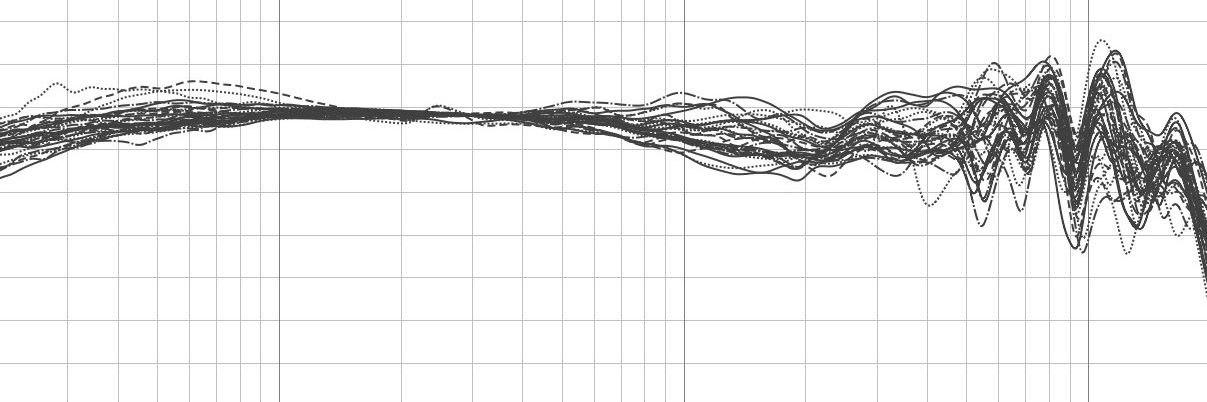
Frequency Response Average (unsmoothed):

Bass extension cutoff is 10hz so as to fully capture frequencies which though outside of the ‘audible range’, may be felt by our bones and muscles. The response is obtained by an average of 5-6 positional variations. The graph is unsmoothed.
Positional Variation:

This graph illustrates how headphone placement on the head affects perceived tonal balance: with the ear positioned at the front (blue), centre (green), and back (red) of the driver.
Leakage Tolerance:

This graph demonstrates how leakages to the front volume can result in FR change.
Impulse Response:

An impulse response graph illustrates a headphone’s ability to respond to sound signals.
Channel Matching:
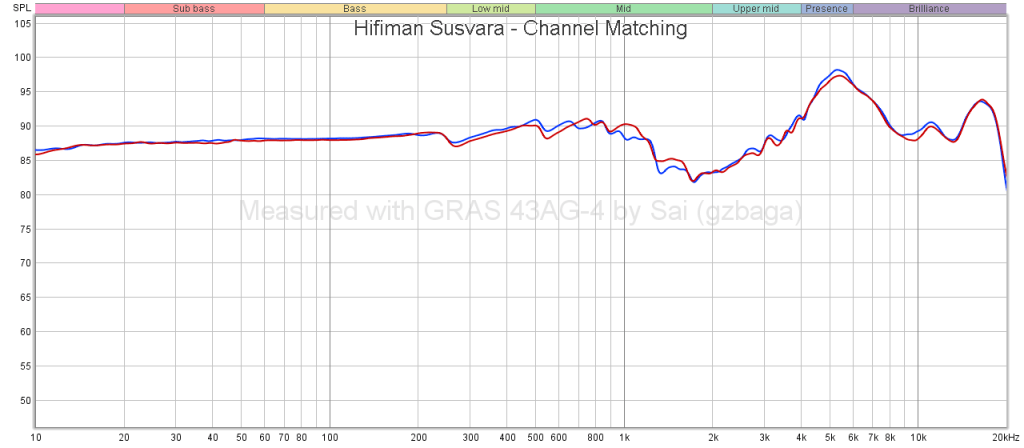
Channel matching graphs do not relate to the perceived sound profile. A specialised configuration is used in this test to capture differences between channels, mitigating interference from positioning on the rig and the asymmetry in the GRAS pinnae design, a legacy of KEMAR. The left (blue) and right (red) channels are measured using a flat plate coupler with an IEC60318-4 ear simulator.
Electric Phase & Impedance:

The above graph shows the measured impedance (green) and electric phase (grey).
END OF THE ARTICLE
Disclaimer: This review is not sponsored or endorsed by any business or related entity. The headphones reviewed are my own unless stated otherwise. Any links or recommendations included are purely informational and do not involve any financial affiliation or endorsement on my part.

You nailed it. This is the most accurate review of the Susvara I’ve read to date. I hope you review the Susvarea unveiled.
LikeLike
Thanks! I hope to review it properly one day too. I did get a chance to try it out at Canjam Shanghai and liked its fresh and engaging vibe. But, that was just a brief demo.
LikeLike
Very nice review! Having had the 6SE v2 for almost two years now, I dream of auditioning the Sus one day.
Looking forward to the next reviews, as you seem to be getting your hands on quite a collection based on the additions to the squig!
LikeLike
Thanks! Yeah, the HE6se V2 are brilliant headphones with a sound profile so close to the Susvara, and the prices are insane nowadays.
Indeed, I’ve been lucky to get my hands on some pretty interesting stuff lately. A lot of the recent uploads are loan units. Still there’s plenty to review, though. Life and work have been keeping me pretty busy, but do keep an eye out. There are some exciting stuff coming up you might enjoy!
LikeLike
Great and detailed review as always, well done.
What do you think about the position of the HE-1000 Stealth compared to HE6Se and the Susvara? Do you think It would stand in a middle point in between them? Something like HE6Se < HE-1000 Stealth < Susvara
LikeLike
Thanks! Yeah it’s like that indeed. I’d say the HE1000 Stealth sits closer to the Susvara than to the HE6se. They’re all fantastic headphones, though.
LikeLike
Great review.
I’ve owned the OG Susvara for a while; I’ve invested in a speaker amp, aftermarket hybrid cables to try to give the Sus more body/tactility (pure silver cables produced a mind-blowing amount of air and detail but for me very little musical enjoyment) and on the one hand I’ve been amazed at how transparent this headphone is in terms of its ability to clearly portray any change that I make to my audio chain; on the other hand, though, the honeymoon phase might be over and there are two things that I am still struggling with:
1. Rather gentle presentation. I like detail and transparency, but there needs to be some tactility to it too. There is a decent amount on the Sus when properly driven (on certain recordings, at least) but still not quite enough. I’ve had the Arya v2, HE1000 Stealth and HEKse so I know that Hifiman headphones tend to sound this way. The HEK Stealth’s bass surprised me in terms of its quantity – I really liked it but I must admit that it also felt like it was masking some of the detail that I was otherwise used to hearing. Everything is a double-edged sword it seems or maybe I am just hard to please. 😀
2. Soundstage. It’s good, the depth is great, layering is top notch, but the lack of height that the HEK series produce breaks the immersion for me just a little. Again, it might be a double-edged sword because when I had the HEKse I complained about its ‘off’ tonality and I suspect that in addition to the oval shape it was the tonal characteristics of the headphone that resulted in the illusion of the soundstage being so vast (in terms of being all around me). The Susvara fixes the tonality but it seems that they had to ‘rein in’ the soundstage aspect to make this happen.
If I could have a slightly bolder bass and bigger soundstage, I would be fully satisfied. Which makes me want to go back to the HEK Stealth but I know that it’ll be too much of a difference from the technical point of view as even compared to the HEKse the HEK Stealth was half a league below (in terms of clarity/perceived resolution).
Which makes me wonder if the new HE1000 Unveiled would be what I am after. Even if its tonality is not quite as great as the OG Susvara (which I am assuming it might not be), if it’s a refined HEKse with a similar or bigger soundstage, it might be closer to what I’m after than the Susvara is. Have you heard this headphone or are you planning to review it soon?
Thanks
Mike
LikeLiked by 1 person
Hi Mike, thanks for the thoughtful comment! I share a lot of your impressions, especially on how the Sus and HEK series compare. They do still carry that traditional Hifiman house sound with the upper mids dip. That’s something Hifiman tried to address in the new Unveiled series, though it does come with some trade-offs, like a slightly more forward midrange presentation.
And yes, I do plan to review the HE1000 Unveiled. I’ve had one on hand for a few months now, so it’s in the pipeline. 😉
LikeLike