
Intro:
So far, this blog has mainly focused on over-ear headphones. But IEMs are an equally important part of the audio world today. Recently, HifiGo reached out to ask if I’d like to review the Pula Unicrom. Pula seems a relatively new brand, but the Unicrom’s design looks promising. I also saw this as a good chance to formalise a testing methodology for IEMs, so here’s the review.
While I’ve handled plenty of IEMs over the years, I’ve never put them through a systematic process like I do with headphones. This seemed the right opportunity to start. It also gives me a chance to compare how entry-level IEMs line up today against the benchmarks I already know.
Detailed measurements can be found in the final section of this article.
Disclaimer: This unit was kindly provided by HifiGo for review. There’s no payment, no strings attached, no affiliate links, and no sponsored content. All thoughts and opinions are my own.
Specs & Comfort
RRP: $79.99 USD
Driver size: 10 mm dia.
Driver type: Dynamic
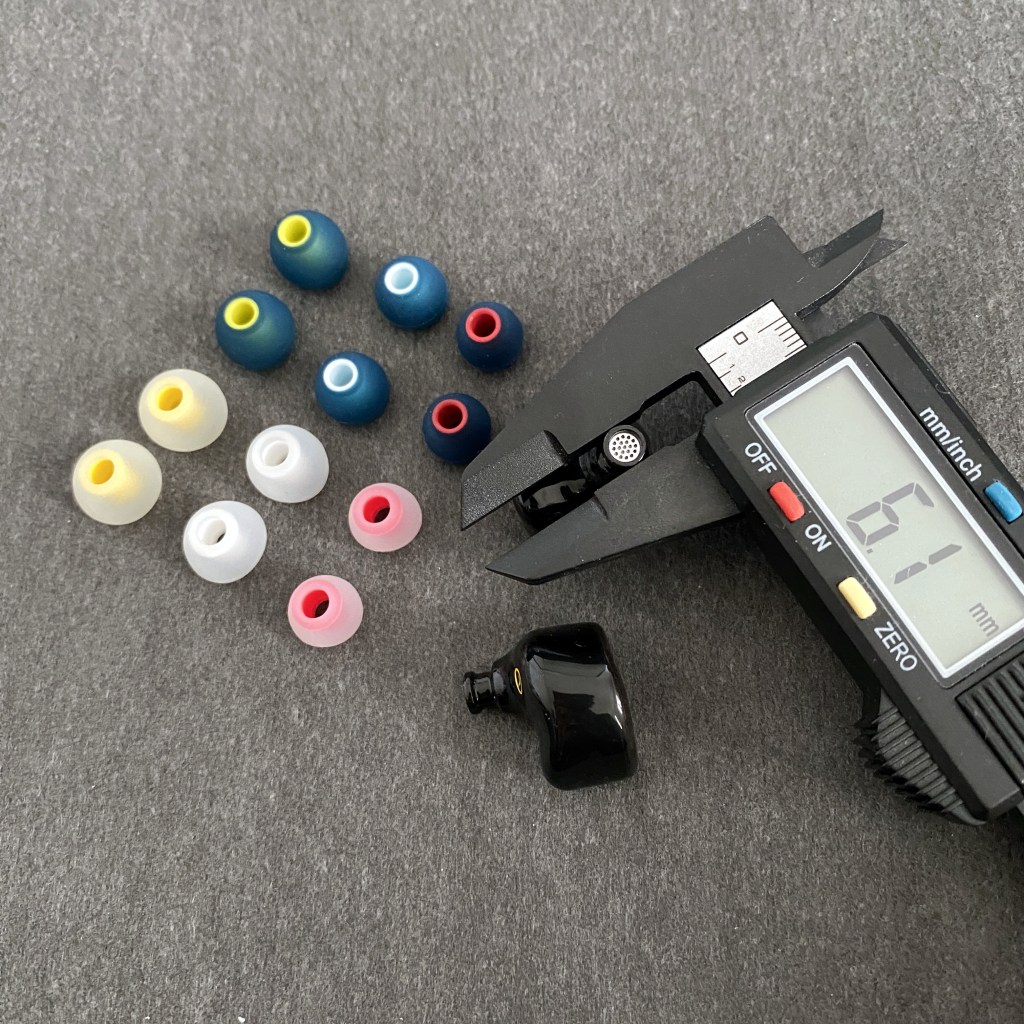
Nozzle size: 6.1 mm
Sensitivity: 104 dB/mW @1kHz
Impedance: 34 Ω at 1kHz
Connector: 0.78 mm two-pin
Weight: 6.6 grams ea.
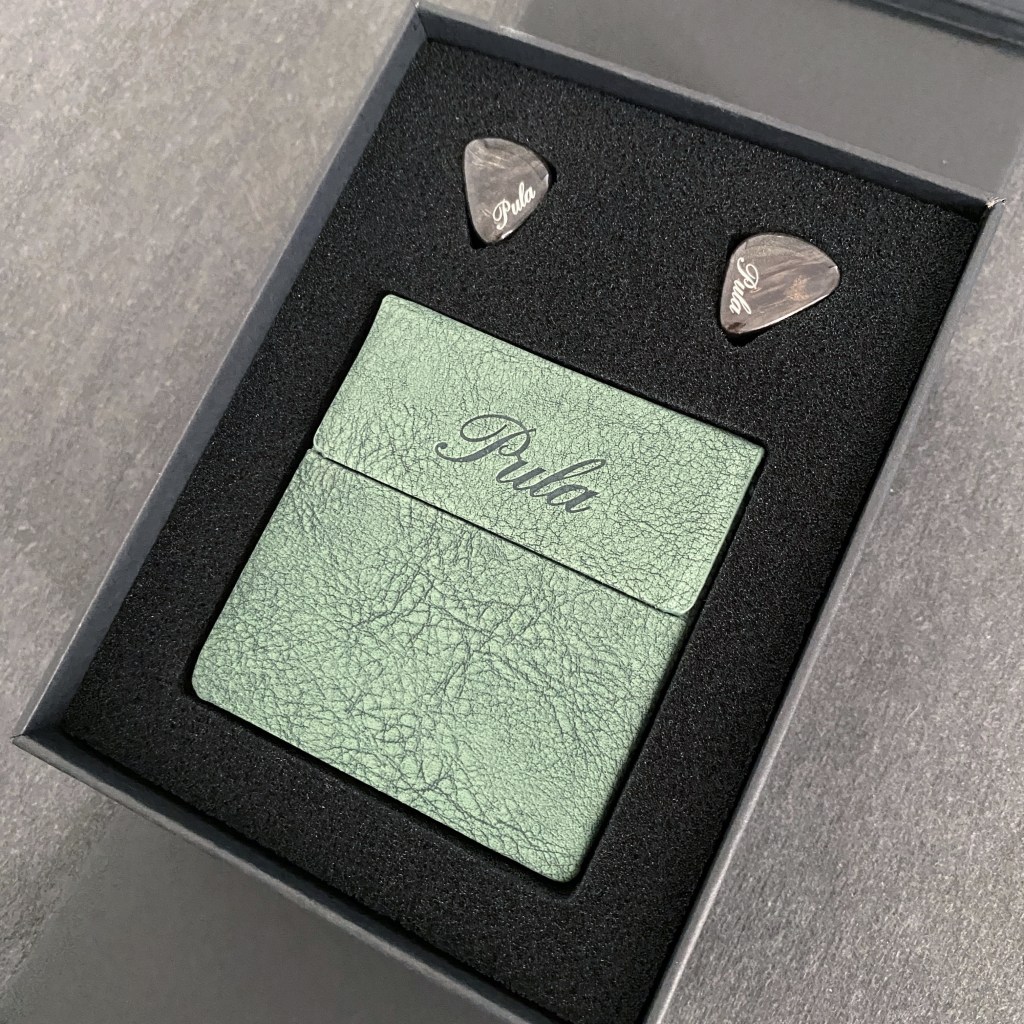
Accessories: carrying case, 1.2 M modular cable with 4.4 mm and 3.5 mm terminations, 6 sets of ear tips

Build and comfort:
The Unicrom is a single dynamic driver IEM using a 10 mm beryllium-plated diaphragm. The housing is a standard resin shell, which is moderately sized and smoothly contoured, making it an easy fit in my ears. I’d place them on the more comfortable side. Overall, build and comfort are solid, with no real complaints.
Sound
For more comparisons, visit my squiglink database.
Impression:
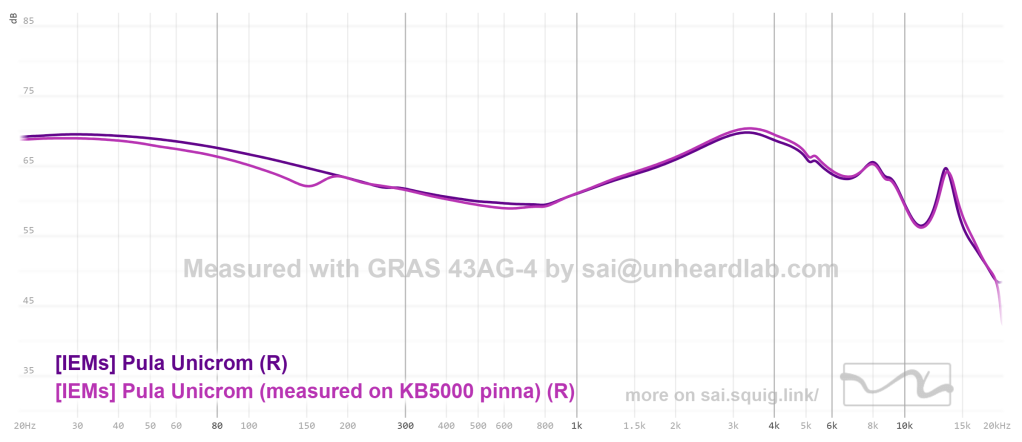
The Pula Unicrom delivers a slightly U-shaped tuning, with strong bass presence and crisp treble. The midrange is quite linear, carrying good articulation and clarity. It avoids the plasticky mids or shoutiness that can plague this price tier. Overall, it makes for an engaging listen, particularly well-suited to modern pop, rock, and EDMs.
Against many entry-level IEMs, the Unicrom stands out for its well-balanced tonal presentation. My reservation lies in the upper treble, which can sound a touch uneven. That’s not unusual for single-driver sets, where there’s less flexibility for fine-tuning compared to multi-driver designs.
In practice, cymbal strikes can come across a bit spicy, and certain vocal types may come with a little extra sibilance. For pop and rock music this usually isn’t a problem, as the Unicrom also has a strong bass boost that tapers off around 300 Hz. There’s a bit of upper-bass bloom, which helps balance out the extra treble shimmer when a track has healthy energy at both ends.
On bass-heavy tracks, the low end can sound a little boomy. Whether that’s a flaw or a flavour choice depends on taste and genre. Those who prefer the ultra-crisp, reference-leaning sound of Etymotic or older Moondrop models may find this less to their liking. As with most single DD designs, the sense of air is somewhat limited, though at this price it feels forgivable.
The good news is that the upper-treble edge can be managed with wide-bore tips, which smooth the top end noticeably. In my IEM reviews, I factor in both narrow- and wide-bore options, as they can meaningfully change the listening experience.
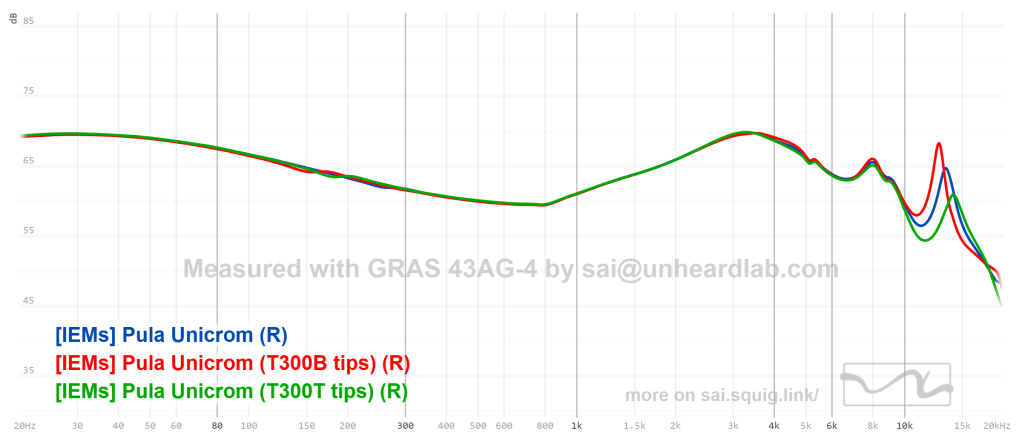
The graph illustrates how this earphone behaves with wide-bore (Tanchjim T300T) and narrow-bore (T300B) tips.
Conclusion:
At $79.99 USD, the Pula Unicrom is a well-rounded IEM that leans slightly U-shaped but maintains balance overall. It sounds crisp, dynamic, and still smooth enough to be a good choice for everyday use.
The stabilised wood faceplate also sets it apart visually. While the Unicrom sits a little higher in price, it offers a more refined and versatile presentation in return.
I would have liked to see wide-bore tips included in the accessory set, as they noticeably smooth the treble. That said, not everyone is sensitive to the upper-treble region, and the added sparkle can help counterbalance the bass weight. For me, it’s a minor but notable point.
This review also marks my first attempt at systematising an IEM review. Let me know in the comments if the format and measurement metrics work for you, and if there are particular comparisons you’d like to see covered.
PROS:
+ Full, powerful bass with good note weight
+ Clean, articulate mids without shoutiness
+ Stabilised wood faceplate adds a premium touch
CONS:
– Treble can sound uneven on stock tips
– Bass can verge on boomy with certain tracks
– Wide-bore tips not included in the accessories
Value Grade:
MEASUREMENTS
Frequency Response (measured on IEC 60318-4 coupler):
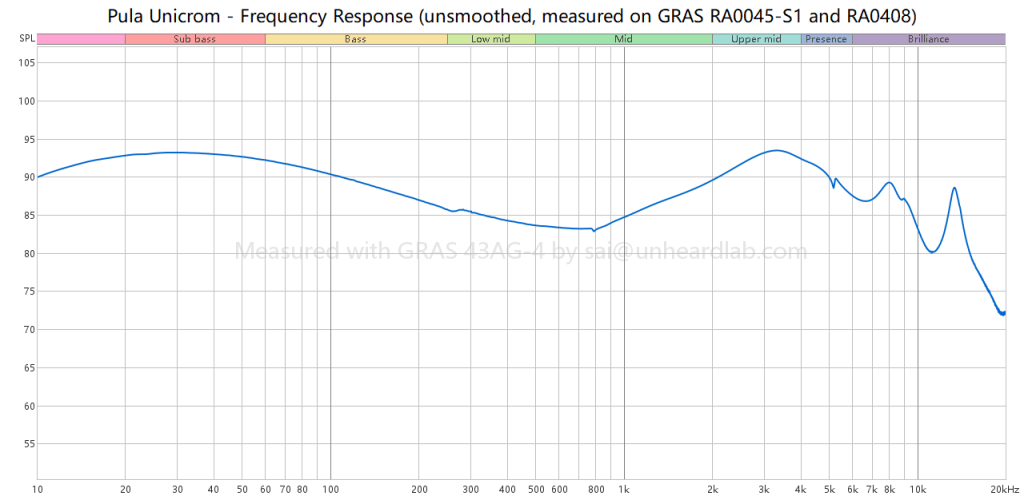
The measurement was made with a GRAS RA0045-S1 ear simulator fitted with the stainless steel ear canal extension (GRAS GR0408). Insertion depth was controlled so the length mode resonance appears at approximately 8 kHz.
Frequency Response (measured on coupler + anthropometric pinna):

This graph illustrates how the earphone measures on the GRAS RA0045-S1 with the KB5000 anthropometric pinna and ear canal. Compared with the straight cylindrical GR0408 canal extension, the KB5000’s softness and anatomically shaped concha and canal provide a more realistic coupling, which might yield a response closer to the perceived listening experience.
Insertion Depth on Frequency Response:

This graph illustrates how varying the insertion depth of the earphone into the GRAS RA0045-S1 ear simulator with the GR0408 canal extension alters the measured frequency response. Shallow versus deep fits shift the ear canal resonance, most notably moving the 7–9 kHz peak, which explains why insertion depth strongly affects perceived treble balance.
Linearity and Compression:

This graph illustrates how the earphone responds at different playback levels (green: 74 dB, blue: 84 dB, red: 94 dB, superimposed). Overlapping traces indicate that the frequency response remains stable with increasing level, with no signs of compression or non-linear behaviour across the tested range.
Impulse Response:
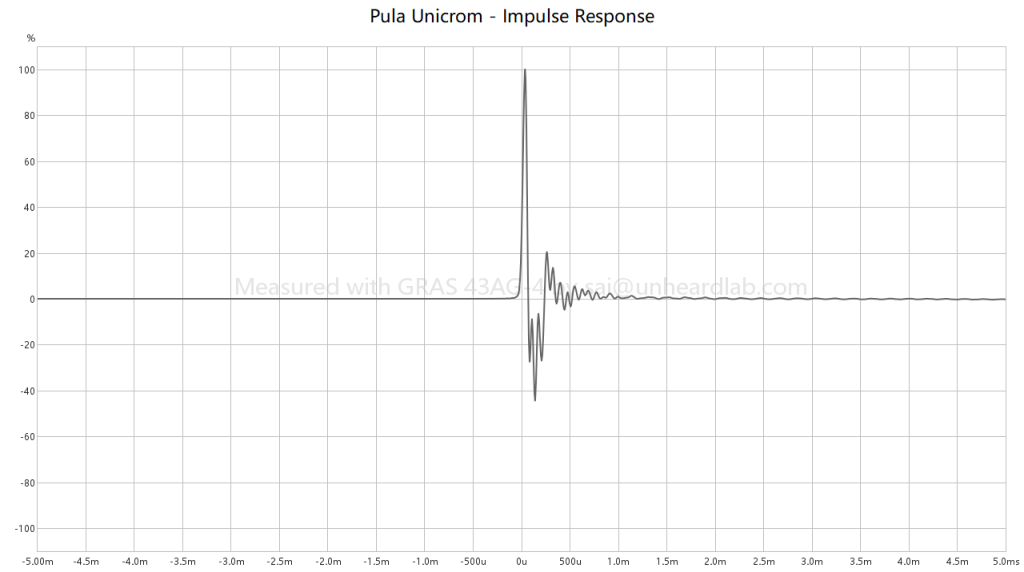
The impulse response test measures the initial response, overshoot, and decay of a transducer upon receiving a signal. An initial upshoot indicates a normal/non-inverted polarity, vice versa.
Total Harmonic Distortion (THD% 2nd-9th):

This graph illustrates the total harmonic distortion, with black showing overall THD, red the 2nd harmonic, and yellow the 3rd. THD represents additional harmonic components generated by the transducer when reproducing a signal.
Channel Matching:

This graph illustrates the left (blue) and right (red) channel frequency responses of the earphone. Close overlap indicates excellent channel matching, which supports accurate imaging and stable spatial presentation.
Electric Phase & Impedance:

This graph illustrates an earphone’s electrical impedance (in ohms) and phase (in degrees) across frequency. Impedance indicates how the load presented to an amplifier varies with frequency.
END OF THE ARTICLE
Disclaimer: This review is independent and was not sponsored or endorsed by any company or affiliated entity. All headphones reviewed are purchased for review unless otherwise stated. Any links or product references are provided for informational purposes only and are not associated with any financial compensation or affiliate arrangement.

I found the different ear tip measurements really interesting. The received wisdom is that wide bore tips increase treble and narrow bores increase bass, but not in this case. Nice to have your assumptions challenged.
LikeLike
Glad that was useful! Yeah I used to think the same about wide vs narrow bores, but it really depends on the IEM and the specific tips. With these, my own listening lined up with the graphs so it wasn’t just a measurement thing. Of course, the tips aren’t completly identical apart from bore size (despite the same material ), so there are still minor variables in play like exact dimensions of the tube/body. If you know of any tip models that make for a more controlled comparison, I’d definitely be keen to check them out.
LikeLike
Hello Sai,
I was so relieved to discover that you now also review IEMs.
1st may I appreciate your reviews, which are trusted and contain comprehensive information. I especially love the impulse response measurements, which are somewhat unique amongst headphone reviews. I find that more than anything else, they give me the best correlation with how “accurate” I can expect the headphone to sound.
Your public service and passion is highly valued by me.
I look forward to sending you some IEM’s for your kind analysis and publishing your opinions and measurements thereof. I must add though, in the same way that earpads are an important variable to over the ear headphones, with IEM’s in my opinion, from my own listening observations, the choice of ear tips and their fit in the ear, as well as the size of nozzles, and length of nozzles, and of course the user’s experience with placing the ear piece properly, all have rather significant contributions, to any listening impression and most likely also, any measurement of an IEM.
I definitely think IEM measurements are an objective valuable bonus, but from my own experience, the level of change that an ear tip, can introduce to the sound of an IEM, is huge. Pretty huge. It can degrade or improve the sound so much, and some of this is a bit of trial and error, cos many ear tips do not have published measurements, particularly stock ear tips, so unless one measures all the parameters (length, etc, bore diameter, bore length, etc, etc) and takes into account what material it is made of, in my opinion, there is so much of an opportunity for variance between any reviewer’s measurements or opinion of an IEM, and the real life experience of a listener, cos it’s impossible to measure with all the possible ear tips available in the market.
Nevertheless, I look forward to sending you IEM’s, for that we can all be better educated, on exactly how well IEMs measure, as some objective resource, for understanding why each IEM sounds the way it does.
From Wales, UK. Greetings
OK1
LikeLike
And of course your THD measurements are invaluable. Thank you. Thanks a whole lot
From Wales, UK. Greetings
OK1
LikeLiked by 1 person
Hey, thanks so much for the very kind words! I’m glad to hear that you find the info useful, as this is my first proper IEM review.
You are completely right about the complexity of IEMs. Eartips are absolutely the biggest variable, even more so than earpads on headphones. The combination of tip material, shape, nozzle length, and the insertion depth a user achieves can totally shift the sound. It’s just a huge source of variance. The biggest differences are normally contributed by insertion depth and bore size, which I try to factor into my reviews.
Indeed, I think THD measurements are quite useful for IEMs, as I have found my experience of some oddities about certain IEMs correlate quite well with their distortion profile. Also, linearity across different SPLs is something I really want to factor in, as hybrid IEMs build from drivers of different sensitivities will behave differently when the input signal varies.
As a whole, I treat measurements as a general guide, or as a resource for comparison under one consistent, measured condition, rather than a definitive prediction of what people will hear. That’s the same for headphones and IEMs alike.
I look forward to seeing what you’ve got and what we can learn about them! Cheers.
LikeLike