
Intro:
The original HE6 was one of the most talked-about headphones of its time, and it remains one of the most sought-after models on the used market today. It earned a reputation not only for its sound but also for its unusual design: its diaphragm traces were made with gold, and the driver structure was engineered to be extremely insensitive (my unit measures around 87 dB/V). Because of that, the HE6 became known as a “power black hole.” Audiophiles often claim that you need speaker amps to drive it properly. In today’s market, where dedicated headphone amps are far more powerful than they were a decade ago, this limitation is arguably much less of a concern.
So, as an OG owner, when Hifiman announced a successor to the HE6 line, I was immediately intrigued. The new HE600 is claimed to replicate the HE6’s sound when properly powered by a speaker amp. Design-wise, noteworthy changes include: the “Neo Supernano Diaphragm Gen 2,” what looks like silver, aluminum, or alloy traces, and new “rare-earth free” magnets. Whatever the exact recipe, sensitivity is noticeably higher than the HE6.
What kind of sound does it bring to the table? Is it truly the HE6’s sonic successor? Let’s find out.
Detailed measurements can be found in the final section of this article.
Disclaimer: This unit was purchased for the purpose of testing and review.
Specs & Comfort
RRP: $799 USD/ $1,449 AUD
Driver size: 100 mm dia. (chasis); ~80 mm dia. (active area)
Driver type: Planar Magnetic
Sensitivity: 108 dB/Vrms @1kHz
Impedance: 30 Ω at 1kHz
Connector: dual 3.5 mm TRS
Weight: 390 grams (excl. cable)
Clamping force: strong
Accessories: 1.8M cable;
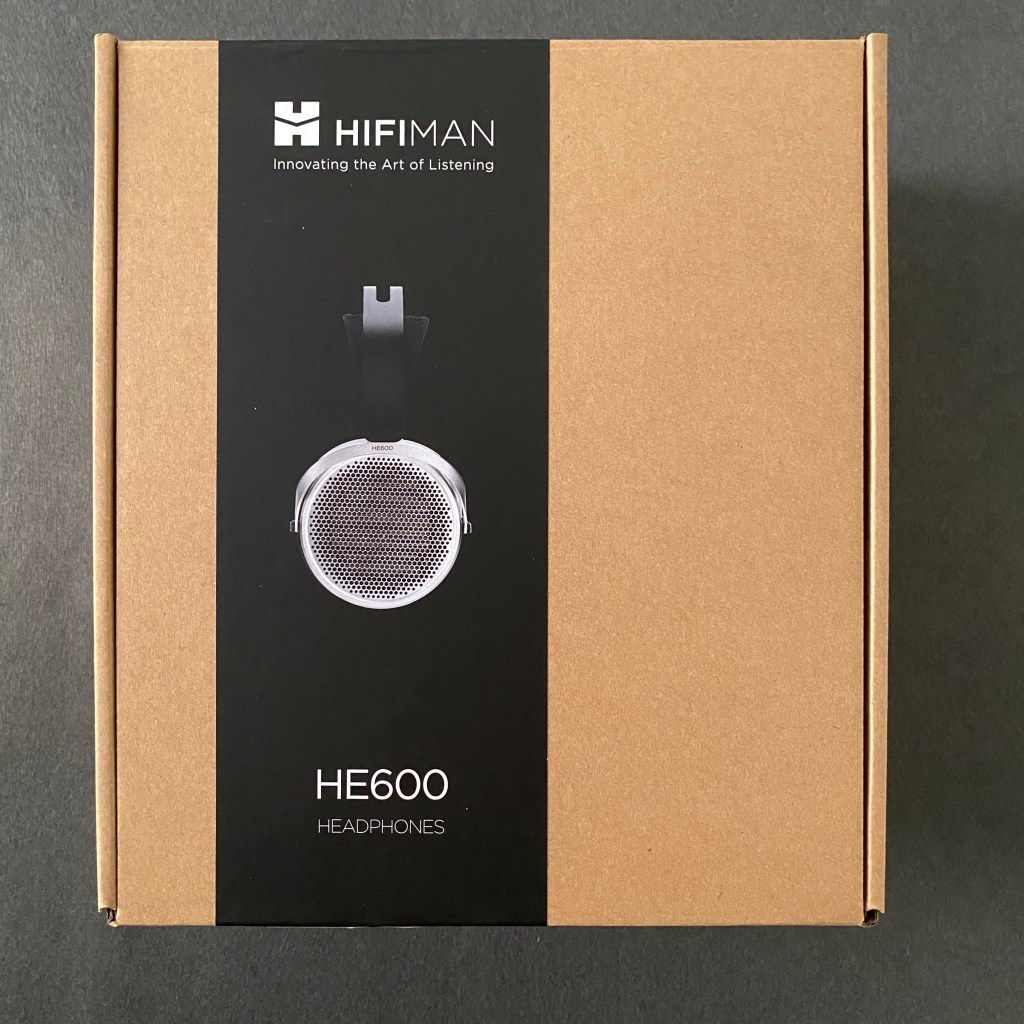


Note: the unboxing experience is…pretty forgettable. Accessories are sparse — just one cable plus the usual foam stand, which most of you probably won’t use anyway. Personally I don’t mind (less packaging waste is always good), but if you enjoy a premium unboxing, this may feel underwhelming.
Comfort is the HE600’s biggest issue for me. The headband clamps too hard and doesn’t open wide enough. I need to extend it to the very last notch just to get a workable fit, yet I still wish for more room. The suspension strap also feels stiff, pressing down on the top of my head. The weight is quite light, but overall, the fit isn’t enjoyable.
For context, I usually use about three notches on the original Sundara and two on Hifiman’s egg-shaped models — so I don’t think my head is unusually large. I’ve already shared this feedback with Hifiman. Perhaps we’ll see a solution, like an alternative longer strap. Until then, I wouldn’t recommend a blind buy unless you’ve confirmed the fit works for you in person (or you know you have a smaller head…)
Just to clarify, I don’t think it’s entirely down to the new headband design — I can get a good fit with the Edition XV. With the HE600, it seems more to do with the arc of the frame combined with the limited length of the strap, which together cause the fit issues for me.
EDIT 11/10/25: Bending the metal yoke of the headband slightly outwards noticeably improves comfort, reducing the clamping force quite effectively. Proceed with caution, as the adjustment may be permanent, and over-bending the metal arc can make it too loose. The method is the same as that used for the Sennheiser HD6-series headphones. A video guide can be found here.
Sound
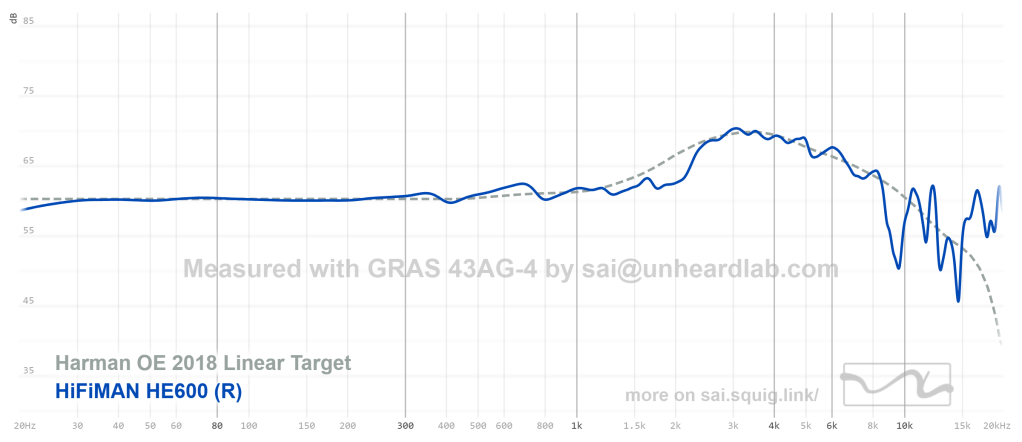
For more comparisons, visit my squiglink database.
Tonal balance:
Overall, the HE600 delivers a crisp, lively, and cohesive tuning that immediately feels modern yet familiar. Vocals and instruments come through with realism and articulation. You can still hear subtle hints of Hifiman’s house sound — a slight dip in the upper mids and a gentle lift above 8 kHz — but they’re subtle, more like seasoning than a defining trait. The result is a presentation that feels clean, even-handed and versatile across genres.
Bass
The HE600’s bass is tight, fast, and dynamic. It has an agile punch with a lively character. It doesn’t go for sheer weight; instead, it prioritises agility and texture. Kick drums land with precision and quick decay, while basslines feel nimble and articulate.
Compared to the OG HE6, which was known for its denser and more robust low end, the HE600 takes a cleaner, tighter route. Subbass rumble and heft are stronger on the HE6, while the HE600 emphasises speed and punch. In this sense, it feels closer to the Sundara or Susvara Unveiled, both of which lean toward that kind of agile bass. Personally, I find the HE600 more engaging than the HE6se, which could sometimes sound flat or restrained in direct comparison to the visceral OG.
Midrange
The midrange is one of the HE600’s highlights. It’s clean and articulate while still carrying enough body to feel natural and balanced. This reflects Hifiman’s recent move toward a more linear, neutral midrange — a trend I think is very welcome.
The upper mids, in particular, are less recessed than on many older models. That slight lift gives instruments a livelier, more immediate presence. Electric guitars have a bitey edge without sounding harsh, and snare drums cut through the mix with snap. At the same time, the timbre remains convincing, avoiding the plasticky tone that some headpones fall into.
The HE600 feels like it blends the neutral tone of the Sundara with a touch of the body and richness of the OG HE6 — in a way, it’s like a Sundara “Pro Max” if we’re borrowing iPhone terminology. Compared to the HE6se, which suffered from a big 2 kHz dip followed by a 4-5 kHz peak, the HE600’s tuning is much more balanced out of the box.
Treble
The HE600’s treble is refreshingly crisp and quite well-controlled at the same time. It has enough bite and sparkle to bring energy to cymbals, strings, and vocal overtones, without tipping into harshness or glare. This makes the treble feel vibrant without being fatiguing. Extension into the upper treble is excellent, lending a strong sense of air.
There’s a mild emphasis around 8-10.5 kHz that adds sheen and textural detail. On well-recorded tracks, this brings hi-hats and upper harmonics to life. On brighter material it can occasionally push forward, though not to the point of sounding too aggressive. Unless you’re particularly sensitive to this region, it shouldn’t pose an issue for most genres.
Compared to the OG HE6 and HE6se, the HE600’s treble is overall smoother and more linear, avoiding the peaks and dips that could affect timbre. It doesn’t have the buttery quality of the HE500, but instead lands in between: airy, crisp, and controlled, with the kind of refinement that keeps you listening comfortably for long sessions.

Other qualities:
- Soundstage
The HE600 offers a soundstage that feels natural and proportionate. It’s not particularly wide — defintely smaller than the OG HE6. Presentation leans toward an enveloping, cohesive field rather than an artificially wide one. When the music calls for grandeur it can still deliver, but it doesn’t exaggerate space. Tracks with atmospheric layering — whether it’s the reverb in a live jazz club recording or the ambient pads in electronic music — bloom naturally without sounding artificially stretched. The OG HE6 remains a step above in how it layers instruments front-to-back and conveys distance within the mix.
Imaging is a standout feature. Instruments and effects are placed with precision, and the stage feels convincingly three-dimensional. This is a known strong suit of the HE6 OG, and very much retained in the HE600. Placement of instruments and effects is rendered with accuracy and stability across the stage. Headphones with a linear treble range often excel here, and the HE600 is a textbook example.
- Clarity
Clarity is outstanding across the spectrum. The OG HE6 still edges it out in sheer ultimate resolution, but the HE600 makes up ground with a smoother and more coherent balance. It avoids the slightly edgy character the OG, which means details are not only audible but also easier to enjoy over long sessions.
Against the competition, the HE600 punches above its weight. It resolves nuance on par with headphones like the Aueze LCD-3, the Meze Elite, or Hifiman’s own HE1000 Stealth. On top of that, the HE600 achieves this without leaning on exaggerated treble energy, instead keeping a natural and coherent tuning.
- Dynamics
Dynamic performance is strong. In microdynamics — the subtle shifts and gradations in quieter passages — it ranks with headphones like the HD800S and Arya Unveiled. Subtle variations in subbass amplitude or the fine gradation of stick rolls on a ride cymbal are rendered with finesse. This sensitivity to small changes gives the HE600 an excellent sense of realism and flow.
Macrodynamics, or the sense of slam and large-scale impact, are solid but not the headphone’s defining trait. The HE600 hits with tight punch rather than brute force. It delivers impact with speed and immediacy, keeping the sound lively and propulsive. Kick drums and percussive hits snap with authority, but they don’t carry the sheer density or body of something like the Audeze LCD-4 or Focal Utopia. Compared to the OG HE6, it trades some visceral heft for speed and dynamism, similar to how the LCD-5 relates to the LCD-4. Genres that thrive on agile, punchy bass benefit greatly; but those looking for chest-hitting rumble may find it a bit restrained by comparison.
Conclusion:
At $799 USD/ $1,449 AUD, the Hifiman HE600 feels less like a verbatim clone of the HE6 than a modern reimagining of its legacy. It keeps that balanced tonality, precise imaging, and overall cohesiveness that made the original special, while adding a contemporary twist: tighter, faster bass and a more linear upper mids and treble. The shift is somewhat like moving from the Susvara to the Susvara Unveiled — not identical, but a refreshing update on the formula.
Hardcore HE6 fans may still miss its visceral weight and density, but the HE600 is by no means anemic. It simply leans toward a tighter, more dynamic style — think, for example, fast, punchy kick drums in funk, pop, or modern jazz compared to the dense, room-shaking low-end of doom metal or bass-heavy EDM.
The main caveat is fit and comfort. The clamp and headband design won’t work for everyone, and in my case it made comfort the biggest drawback. Until Hifiman provides a solution — perhaps a revised strap — I’d strongly advise auditioning before buying. Those with smaller heads may find it fine, but for others, comfort could be a dealbreaker. I was able to improve it by carefully bending the metal yoke of the headband, though this is a permanent modification and should be done with caution.
Sound-wise, the HE600 is an easy recommendation if you’re after a well-balanced yet vibrant tuning. Just don’t expect it to match the blowout value of the HE6se, which can still be found at heavy discounts near the end of its lifecycle. If you’re open to EQ, the HE6se remains one of the best values in the hobby. But if you want an out-of-the-box, modernised HE6 experience, the HE600 delivers.
If there are specific comparisons you would like to see, let me know in the comments.
PROS:
+ Crisp, airy, balanced tone
+ Fast, punchy, articulate bass
+ Excellent imaging and clarity
CONS:
– Clampy, uncomfortable headband fit
– Doesn’t match HE6 OG in tactility and stage depth
– Pricey compared to discounted HE6se
Value Grade:
Notes on Earpads and EQ

Regarding the earpads: the HE600 uses Hifiman’s traditional snap-on plastic ring system, the same style that’s been around since the HE6. That means pad rolling is straightforward. With the 105 mm size, you have a wide range of compatible options, and you can even use aftermarket pads by attaching them to spare mounting rings (as long as they have elastic backing).
That said, the stock pads are already well-tuned, offering a very balanced sound. Swapping to the Pali pads — which Hifiman has used on many previous models — introduces a noticeable dip in the midrange and adds a touch more treble energy. So, the pads on the HE600 may be subtly revised; the foam or fabric seems slightly different, even though they look and feel nearly identical to the Pali pads.
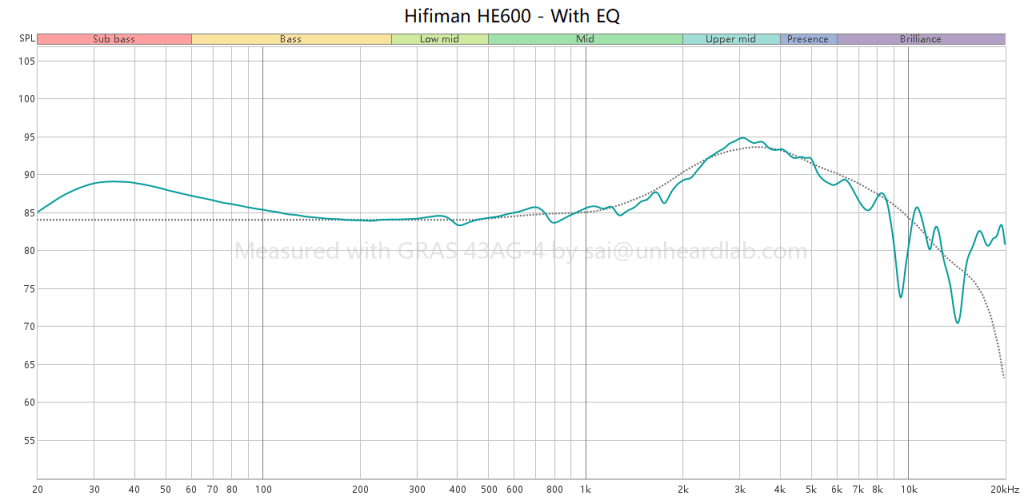
In terms of EQ, this headphone needs very little adjustements to sound well-balanced.
Recommended EQ setting for this headphone (adjust the bass and treble filters to taste):
Preamp: -5.5 dB
Filter 1: ON PK Fc 28 Hz Gain 5.5 dB Q 0.500
Filter 2: ON PK Fc 73 Hz Gain -0.4 dB Q 3.000
Filter 3: ON PK Fc 2000 Hz Gain 2.0 dB Q 3.000
Filter 4: ON PK Fc 7100 Hz Gain -1.5 dB Q 2.500
If your goal is to EQ the response to match the Harman Target, consider the AutoEQ function provided by Squiglink as a convenient starting point. I personally recommend customising the filters to better suit your own hearing, especially in the treble. While the AutoEQ provides a useful baseline, individual adjustments can often significantly improve your listening experience.
If you’re new to EQ, I’d recommend checking out this video by Resolve from The Headphone Show — it’s a really solid intro and walks through the basics in a clear, no-nonsense way. Great place to start!
MEASUREMENTS
Frequency Response:

The response is obtained by an average of 5-6 positional variations. The FR shown on the graph is unsmoothed.
Positional Variation:

This graph illustrates how headphone placement on the head affects perceived tonal balance: with the ear positioned at the front (blue), centre (purple), and back (red) of the headphone. The FRs shown on the graph are 1/48 octave smoothed.
Leakage Tolerance:
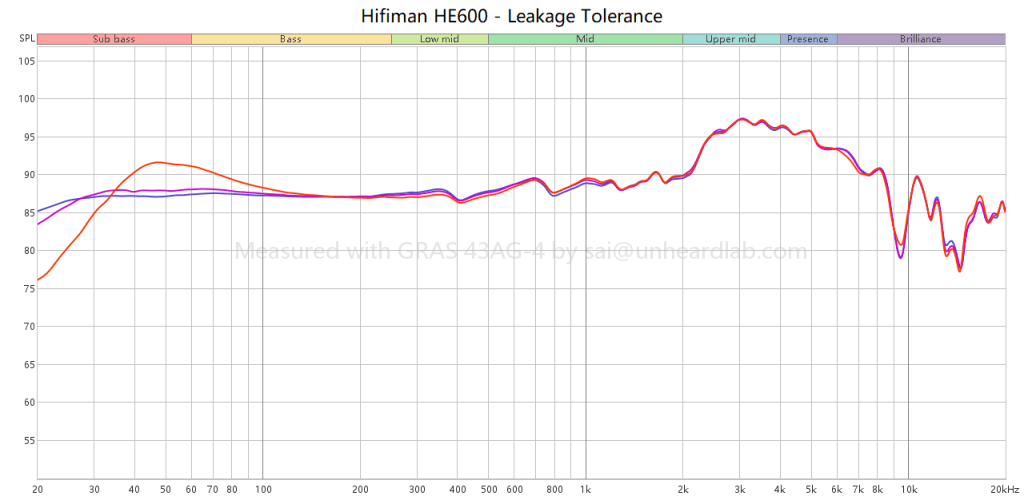
This graph demonstrates how leakages to the front volume can result in FR change: blue (good seal), purple (thin arm glasses), red (thick arm glasses). The FRs shown on the graph is 1/12 octave smoothed.
Comment: Like most open-back planars, this headphone can show a slight bass boost when the seal is compromised.
Linearity and Dynamic Compression:

Linearity and dynamic compression testing plots the headphone’s frequency response at two input levels to show how it reproduces signals as loudness changes. Any divergence between the high-level and low-level curves points to where the transducer’s dynamic range begins to compress or distort. Here, the measurements are superimposed to allow direct comparison. The FRs shown on the graph is 1/6 octave smoothed.
Comment: This is very good. There’s tiniest compression below 20Hz (<0.5dB) at 105dB, which shouldn’t be a concern.
Impulse Response:
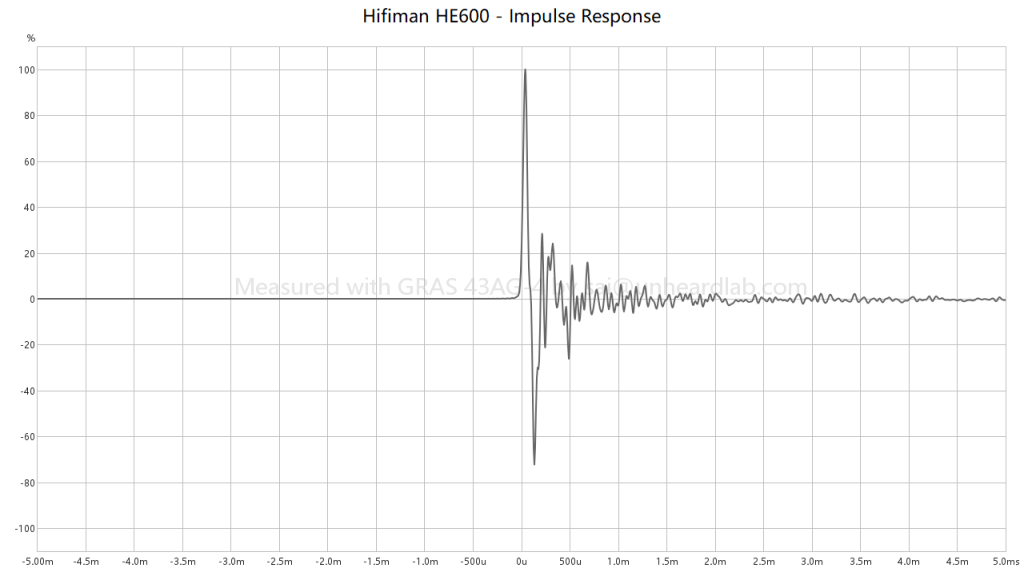
The impulse response test measures the initial response, overshoot, and decay of a transducer upon receiving a signal. An initial upshoot indicates a normal/non-inverted polarity, vice versa.
HpTF Variations:

Headphone Transfer Function (HpTF) describes how sound is shaped by headphone design and ear anatomy before reaching the eardrum. Different measurement rigs (with varying pinnae designs) introduce unique reponses/resonances and potential deviations from actual human perception. Understanding HpTF helps translate measured data into real-world listening experiences.
Total Harmonic Distortion (THD% 2nd-9th) & Excess Group Delay (94 dB):
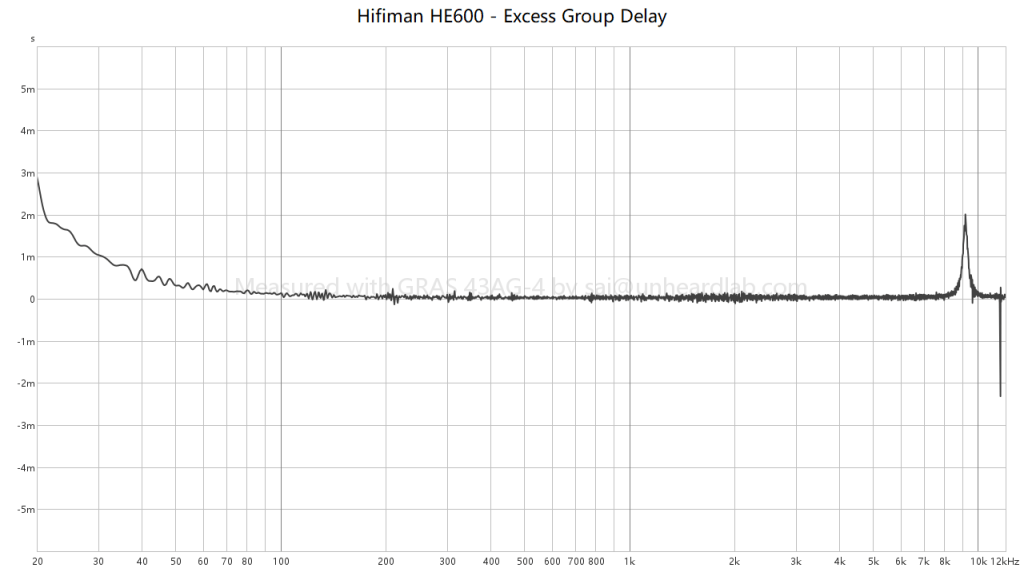

These measurements are conducted in quiet, normal room conditions (as opposed to an anechoic chamber), meaning there may be some influence from ambient room and external noise. These results should be considered a preliminary assessment of performance, primarily for identifying major issues, and do not reflect the best-case performance scenario. Any peaks/dips around 9 kHz are most likely artifacts from pinna interaction/phase cancellation, rather than inherent features of the device under test.
Comment: These are very good results.
Channel Matching:
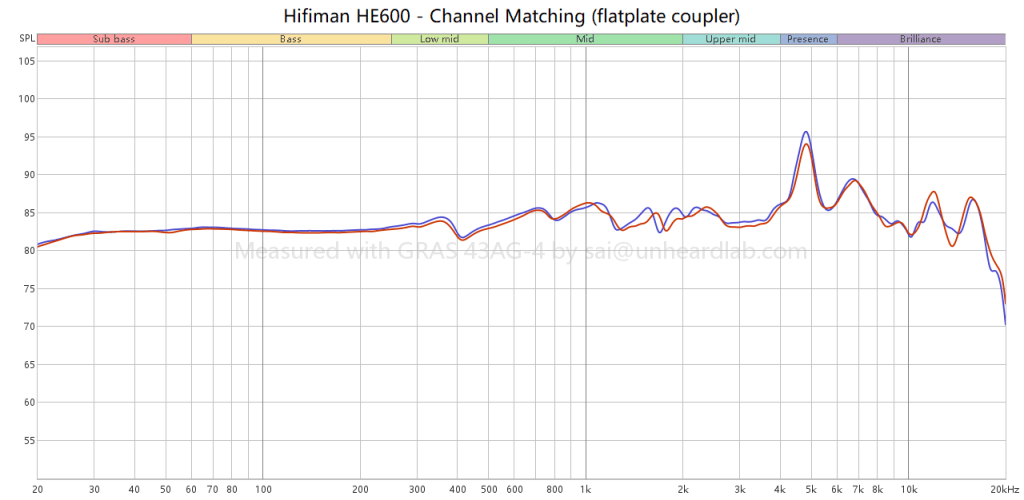
Channel matching graphs are intended for quality control checks and do not relate to the perceived sound profile. A specialised configuration is used in this test to capture differences between channels, mitigating interference from positioning on the rig and the asymmetry in the GRAS pinnae design, a legacy of KEMAR. The left (blue) and right (red) channels are measured using a flat plate coupler with an IEC60318-4 ear simulator.
Comment: Channel matching on this particular unit is very good, which may contribute to imaging precision and the clarity of spatial cues.
Electric Phase & Impedance:
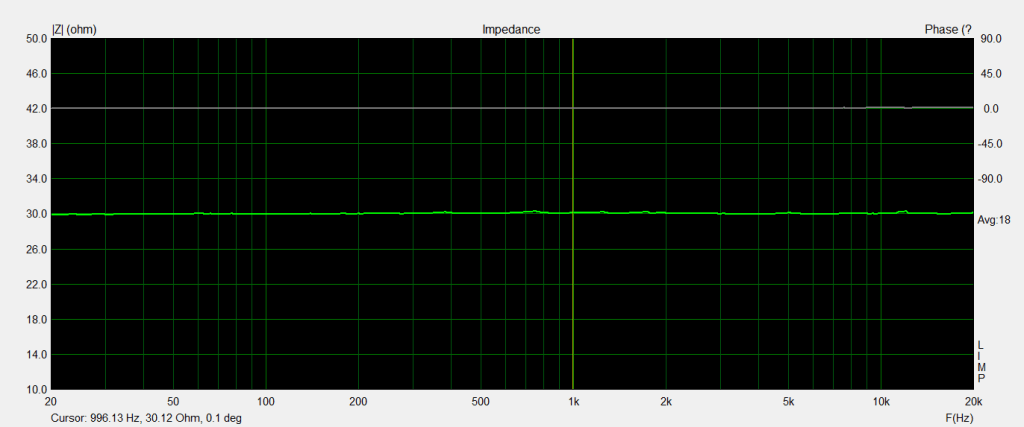
The above graph shows the measured impedance (green) and electric phase (grey), measured under free-air condition (minimal front volume coupling).
Comment: This headphone’s impedance curve is typical of a planar headphone – flat and low.
END OF THE ARTICLE
Disclaimer: This review is independent and was not sponsored or endorsed by any company or affiliated entity. All headphones reviewed are purchased for review unless otherwise stated. Any links or product references are provided for informational purposes only and are not associated with any financial compensation or affiliate arrangement.
EDIT 11/10/25: added instruction on bending the metal arc of the headband to improve comfort; revised the title.

Thank you as always for your wonderful reviews.
I previously asked you which would be better between the Serene and headphones like the NAN-7. Based on your advice, I ended up purchasing the Serene. Now I’m wondering—does the HE600 compete with the Serene?
Also, in terms of sound characteristics, is the HE600 closer to the COSMO or the Serene? Or does it resemble the Para 2 or some other model more?
LikeLike
Hey! How are you finding the Serene? Hope it’s hitting the mark for you. The HE600 and Serene definitely share some tuning similarities. Both have great mids and treble balance, crisp and clear yet still smooth. The main difference is in the bass. The Serene leans more towards that classic HE6 OG feel, with a denser, more tactile punch, while the HE600 is tighter, faster, and more “modern” in character.It’s tough to say if it’s closer to the Cosmo or the Serene – perhaps slightly more on the side of the Moondrop headphones. But compared to the Para 2, the HE600 gives a stronger, fuller bass and richer lower-mid fundamentals.
LikeLiked by 3 people
Thank you very much.
So the Serene is closer to the HE6 OG—that’s really helpful to know.
For now, it seems there isn’t much need for me to get the HE600.
If a demo unit becomes available at a store, I’ll give it a listen.
LikeLike
Yeah do give it a go when you have the chance to!
LikeLike
Thanks for the review. Appreciate it.
Can you compare it to the egg-shaped hifimans like Arya Stealth or the new Edition XV? regarding resolution and sense of space.
LikeLike
Hey mate, sure thing. TL;DR: the HE600 is more of an all-rounder, while the Arya Stealth and Edition XV lean into a more stylistic presentation. If you’re after that expansive, airy stage, the egg-shaped ones like Arya family still do it better. This is especially if you want a more V-shaped, exciting listen, then something like the Arya Organic or HE1000se fits the bill. The HE600, though, is a strong all-round performer with a crisp, lively character that holds its own against pricier egg-shaped models like Arya Unveiled or HE1000 Stealth in terms of the sense of resolution. The Edition XV is a bit of an outlier in that family with its smoother, richer tuning, so it comes down to which flavour of tuning you prefer.
LikeLiked by 1 person
I had to stretch the slider on the headband to the very end for most round hifiman headphones…couldn’t imagine how this would fit on my head from ur description😇
LikeLike
Ok my head’s probably on the smaller side compared to yours… Given that, I wouldn’t recommend the HE600 for you at the moment.
LikeLike
Maybe they made this for children
LikeLike
I guess they overcorrected. With the Arya/Susvara I barely need to extend it.
LikeLike
Few words on comparison to NAN-7? Which one would you take on sound quality? Forgetting the fit and comfort, just sound. Thanks.
LikeLike
Hey, let me circle back to you on this one. I am testing the NAN-7 with some new pads that are arriving soon so it’ll be a good chance to refresh my impressions against the HE600. Short version for now: they’re in the same tier for SQ, just with different flavours. I lean a bit towards the HE600’s tone, but the NAN-7 wins on dynamics and stage.
LikeLiked by 1 person
Hi! How is this HE600 compared to Arya Unveiled?
LikeLike
Hey there. They share some similarities but also some clear differences. Tonally, both are pretty neutral and balanced, leaning slightly crisp/airy/bright, though the Arya Unveiled is a touch warmer and smoother. Where they diverge is in presentation: the Arya Unveiled’s large drivers give it a more expansive, effortless stage, while the HE600 comes across with sharper, more cohesive imaging. The Arya feels more diffused, the HE600 more focused.
LikeLiked by 1 person
Thanks for your comment!
LikeLiked by 1 person
And compared to HE1000 Unveiled?
LikeLike
Pretty similar in tuning overall, both with that slight bright tilt. The main difference is in presentation. Think of the HE600 like more compact studio monitors, while the HE1000 Unveiled is more like bigger lounge speakers: more expansive, but less tight and focused.
LikeLiked by 1 person
Any plans to get the Ananda Unveiled in?
LikeLike
Yeah definitely interested. Just got a few others on hand to get through first.
LikeLike
Hello, Thank you for quick review of newest product.
I saw that the clarity is similar to the HE1000 Stealth.
I’m wondering if the HE600 is on the same level to the HE1000 Stealth in other parts too?
And also considering PARA2 and COSMO..
Could you compare these 3 to HE600?
Really getting help from your detailed reviews. Thanks in advance!
LikeLike
Thanks for the kind words. I’d say the HE1000 Stealth has the more effortless presentation in terms of staging, but overall sound quality they’re in the same ballpark. The HE600 feels like a step up from the Para 2 in a lot of ways: both share that bright, crisp, airy tilt, but the HE600 adds fuller fundamentals, stronger dynamics, and more precise imaging. The Para 2 still wins on value and fit, though. The Cosmo is the more polished, all-rounder option, great across the board except dynamics, which is its main weakness. Biggest caveat with the HE600 is the fit especially if you’ve got a larger head, but purely on sound it’s a very solid performer.
LikeLiked by 1 person
Ohh.. just Eqing Para 2 might not keep up to the HE600 due to dynamics and imaging..
I’m going round and round to find ‘THE’ pair of mine, since Para 2 is cheap, while second-handed HE1000 Stealth is at almost same price of new Cosmo&HE600.
🫠🫠🫠
Also considering verum one or two or sash tres se.
Maybe I should wait till I see reviews of Moondrop’s latest headphone; LAPUTA..
LikeLike
Yeah, that’s a pretty awkward name… Para 2 is still solid value even with the price bump. But yeah, best to see how Moondrop’s new one turns out first. I’ve been curious about the Sash headphones, maybe one day I’ll get around to them.
LikeLike
He6sev1/v2 vs HE600 in terms of sound. (same comfort, same eq, same price) what do you think ?
I kinda hate Sundara. Would i hate these two ? I think Sundara’s stage and timbre not good although i’m used to higher end eggshape Hifimans more so maybe thats why i hated it. I like my dt770 more than sundara lol.
LikeLike
That’s a tricky one, since you can’t really EQ two headphones into sounding exactly the same: driver properties, fit, leakage, and ear interaction always make some differences. But if both are EQ’d to a very similar target, I’d lean toward the HE6se series: they’re cheaper, comfier, and once EQ’d the sound differences get pretty minimal. Again, this is pretty unrealistic though. The bottomline is, the HE6se does have some rougher treble peaks that can stick around, but its lower driver resonance makes it more resistant to leakage. If you really disliked the Sundara, I’d not suggest the HE600 as it shares more of that tonal character.
LikeLike
You said:
”Hardcore HE6 fans may still miss its visceral weight and density, but the HE600 is by no means anemic. It simply leans toward a tighter, more dynamic style — think, for example, fast, punchy kick drums in funk, pop, or modern jazz compared to the dense, room-shaking low-end of doom metal or bass-heavy EDM.”
Does this apply to He6se as well ? Which one is a better complement to he1000 stealth in your opinion ? he6se or he600. (both will be eq’ed to match harman bass lift)
Looking for a type of headphone that gives more bombastic, faster, energetic sound relative to the polite sound of the he1000 family. Bass heavy edm, bass heavy orchestra what i listen. I also like crispy, energetic rock music.
I also heard people saying Ananda Nano is very energetic and punchy but since it’s eggshape, i doubt it. Do you have experience with that one ? or Ananda Unveiled ?
LikeLike
The HE6se doesn’t quite have the same dynamic punch as the OG. The HE600 sits somewhere in between, but with a different flavour, it goes for a tighter, more lively, dynamic punch rather than the sheer density and weight of the HE6. The HE6se carries more weight than the HE600, but it’s not as incisive or energetic.
As a complement to the HE1000 Stealth, I’d pick the HE600. It’s punchier, faster, and more energetic overall. For bass-heavy EDM or energetic rock, the HE600 fits the bill better. With orchestra, the HE600 has a more intimate stage but very good separation. Just keep in mind the comfort caveat I noted in my review.
On the Ananda Nano, I don’t find it especially bombastic. It is more dynamic than past Anandas, but it has rising distortion at higher SPLs. If you listen around 80dB or lower it’s fine, and if you can find one cheap it could be worth trying. Otherwise, I wouldn’t pick it as a go-to for the kind of energy you’re after.
LikeLike
Great article! Given that the Modhouse Tungsten was also touted as a spiritual successor to the HE6, could you compare the HE600 to the Tungsten?
The Tungsten was received extremely well by the community.
LikeLike
😉 Got a pair on the way and will defintely review them, so keep an eye out.
LikeLike
Thank you for the review! Speedy!
HE600 looks like one of the few HFM models I can actually enjoy. I heard the HE600 only weighs 389g compared to the OG’s 502g, which is always good news for my neck. The high clamp force and lack of swivel are unfortunate though.
This headphone retails for about 5200 yuan ($726), but second hand price has already gone down to 3900 yuan ($545) last time I checked. Very tempting XD.
Do you plan to review Moondrop’s next planar, the Laputa? (Named after Jonathan Swift’s Castle in the Sky… but we all know where this is going lol.) Retail price is 5000 yuan which puts it in the same ballpark. Having owned the Cosmo I’m looking forward to an improved version, preferably with lighter weight.
LikeLiked by 1 person
Haha glad you like it. Yeah the lighter weight makes a big difference. If they tweak the fit it could be gold. Definitely worth holding out a bit for possible revisions or grabbing one second-hand if you don’t mind.
And yeah… that name. Let’s just say Moondrop knows how to keep the memes flowing. Specs show a fair few changes from the Cosmo though, so I’m definitely interested.
LikeLike
How would you compare the HE600 to Moondrop Cosmo? It’s a similar price range. Which is better value?
LikeLike
As they are now (and factoring in the HE600’s potential fit issues), I’d probably lean toward the Cosmo for value as it can be had on sale for less. Overall sound quality is in the same ballpark,:the Cosmo is more linear, with better-rounded mids/treble and a bigger stage. The trade-off is that it’s weaker in dynamics and doesn’t have the same fullness in the fundamentals. Both are excellent headphones at the price point, so it really depends on what you’re after.
Oh and btw the above is based on the Cosmo with EP100A pads, which IMO are mandatory.
LikeLike
Hello Sai, hope you’re doing well ?
Since you’ve done basically a comparison with the original H6 in your presentation, between the other two HE6SE v1 & v2 models would you mind to give me an honest feedback since you own them or know them sufficiently to help me out, putting aside the price?
EQ is definitely what I’ll apply, so my goal is to end up as close as possible to a neutral, balanced (Harman-like) tuning similar to what the HE600 achieves. That’s why driver performance matters: it needs to handle EQ well. I have a powerful A70 Pro amplifier so it’s not a concern here with a low-shelf boost. Do you personnaly try to EQ them are you based your review purely from stock tuning because I see you do a lots of pads measurements also.
Which one is the fastest ?
Which one has the stronger microdynamics ?
Which one has more linear macrodynamic body/slam without introducing muddiness with a low-end shelf EQ? Meaning also, which one do you think has the most driver potential I’m not sure that they have taken a identical approach from both of the HE6se v1 & v2, it’s very interesting the way they design them, I don’t know the differences with the HE600 ? It’s also different from their egg-shaped approach, correct me if I’m wrong.
Which one is the most clean/uncoloured (like I had Arya Organic and for me they are coloured, besides the FR not really indicating it much when you compare to other models I guess, I don’t know what they did to this model but it’s clearly not flat, maybe they meant Organic for an Analog sound). Are the resonances that tend to congest/mask/leave clarity like, for example, Moondrop Para has weird resonances that can’t really be fixed with EQ. From what you said the highs being smoother & more linear on HE600 what about the mids/high-mids ?
I heard the timbre from HE6SE v1 & v2 isn’t as accurate compared to the other Stealth models like Arya, for example, but still close at some point.
Finally, about the soundstage/imaging, which one is bigger, with accurate placement of elements in the stereo field, depth & layering ?
Which one would you personally choose?
Many thanks.
LikeLike
Hi mate., Yep, I’ve had all of those models. For what you’re after (something that handles EQ well and has strong driver potential) the HE6se V1 is probably the pick. Its stock tuning is less tidy than the V2, but the unit I tried felt a touch stronger technically, so if you can get it at a similar price to the V2 it’s worth it. Neither quite reach the OG HE6 though, but the current market on that is pretty crazy.
The HE600 is a different design altogether, with a new diaphragm and build approach. It feels like an evolution of the Sundara blended with the HE6’s tuning. Out of the ones you listed, the HE600 is the cleanest and most uncoloured, with sharp microdynamics and a tighter, more dynamic punch, though it doesn’t carry the same weight or heft of the HE6 OG. None of them are muddy, nor do they suffer from any serious resonance issues.
On staging, the differences are smaller than people make out. The OG still wins for space, then V1/V2, and HE600. Personally, if price was no object I’d take the OG, but I could happily live with any of them.
LikeLike
How would you say the HE600 would compare to a EQd HE1000se with Dekoni Sheepskin earpads? I have my HE1000se with the Dekoni sheepskin earpads EQd so close to the HE600. Is there anything the HE600 might do better? As I feel the Dekoni sheepskin pads and a little EQ has made the HE1000se perfect. It slams, it’s hyper detailed yet smooth, stages large. But I’m just wondering if there would be any point in getting a HE600 in my case…
LikeLike
I’d say with EQ the differences shrink a lot. What remains is more down to things EQ can’t fully match, like acoustic impedance, seal and fit, or how upper treble and phase shifts play out. I don’t think you need the HE600 if you’re happy with your HE1000se setup. The HE600 might give you a bit tighter bass depending on seal, and its presentation is less expansive and airy but more compact.
LikeLike
Had a chance to compare the HE600 and HE1000se with EQ + Dekoni sheepskin earpads. Ultimately the HE1000se wins. It has more resolution, clarity, the bigger staging more precise imaging etc. But I am amazed at how good the HE600 is. To my ear, It’s the best tuned Hifiman to date. My wish would be for Hifiman to make a HE1000 series headphone with a even further refined tuning of the HE600. That would be endgame. The HE600 is the perfect all-rounder. Truly exceptional.
LikeLike
I pick the HE600, I’ll leave a feedback in the future
LikeLiked by 1 person
Hi everyone, I left my review on head-fi.org : Username : GreeGz : https://www.head-fi.org/threads/hifiman-he600.977492/post-18854486 . I changed the headband because it’s just too small and I don’t even have a big head. I’m also looking to have thicker pads that keeps the same frequency reponse, the problem is they are super confy but too soft and my ears is slightly touching the driver which is uncomfortable even with the new headband that is slightly larger. I don’t know why they didn’t think about pads/headband system optimization, it’s the biggest issue with this model. Otherwise they are just incredible in my opinion, have owned nano & organic, league above for me, don’t be fooled by the soudnstage that isn’t really accurate but it’s really fun especially on organic, I can miss this sometimes.
Sai do you have options that are thicker
LikeLiked by 1 person
Excellent writeup, thanks for reposting that here. I think it will be very useful for other readers to get another perspective.
Did you swap out the entire headband assembly or just replace the strap?
As for the ear pads, I don’t really have any meaningfully thicker options that sound just as good or better. They’re all going to change the tuning since increasing the volume changes things. But if you’re planning on EQ then I suppose it’s not gonna be a problem.
Some potential options are the Dekoni Elite Hybrid pads, which are slightly taller and have a mesh to stop your ears from touching the driver. The FT1 Pro pads are the same deal. Lastly, maybe try the Pali pads just for the mesh they include.
LikeLike
Hi Sai,
I did replace the entire headband system indeed, I bought it for 35 dollars on aliexpress it’s a better quality, slightly heavier but since they improve the total weight it’s overall pretty good.
For the pads I bought a couple on aliexpress, I’ll leave a comment here after I tested them. I did also make them unveiled removed the grills, mesh every protection basically, they breath even better soundstage slightly more open and airy, the most important part is a good 5-7% less resonnances, clarity is therefore welcome, I genuinely think this is the future of headphones making them unveiled as possible. The bass gained a good 2db roughly also. I slightly boost ear gain region 0.7 db at 1.9 khz.
I think here the double side magnets are playing a huge role, when it’s done properly the sound is coming through efortless and thus are more clinical and fast I believe.
Thanks for your advices.
LikeLiked by 1 person
Great work on that, I suspect a lot of people will want to replace that headband.
That’s a really interesting experiment to go all the way and unveil the drivers like that, removing all the protection. Good to hear it paid off. Hope the new ear pads work out well for you!
LikeLike
Thank you for the review. I bought one after trying it out at the store — they got the shipment while I was listening to a pair of Focals, opened the first box for me to listen and I bought the second box lol.
Loving the bass, the F1 movie soundtrack played this pair was quite engaging, I might just rewatch the movie with them. Not loving the headband, and I might just go without the strap if it doesn’t loosen up after a while. For context, K7XX barely fits my head, I honestly expected a painful clamp from these like Sennheiser HD6__s , but it was somehow ok.
LikeLike
Great to hear that you liked it so much you bought a pair right then and there! Yes, planars are awesome for that kind of material, especially with that deep bass rumble and impact.
For the headband, I also found hanging the strap on a stand and putting the headphones over a few books to gently stretch it helped mine loosen up a bit.
LikeLike
Coming back after a couple more days, yup it is absolutely amazing for Hans Zimmer’s works as well as other movie or game soundtracks as well as classical music. Thank you for the coverage, wouldn’t have known to ask to try one otherwise. 🙏
As I am pairing this with a K11 R2R, I am wonder if I should upgrade to a pair of balanced cables for more power out of the unit? HE600 seems to be current heavy, not sure if the higher wattage available on that unit means it can deliver that much current without audio artifacts, or at least more artifacts than the kind I bought a R2R for. 😅
Hopefully alternative straps become available sooner rather than later, that strap is shared with Edition XV and I think the other Unveiled headphone released together, so it ought to be available pretty pretty soon from 3rd party vendors. I tried just wearing the headphones without that strap and held together with rubberband, worked but uh not exactly elegent.
LikeLike
Great to hear that!
Have you experienced any issues like maxing out the K11 R2R’s headamp? If you still have enough headroom and volume before the amp runs out of steam, you might not need a balanced cable. Even though planars tend to be power hungry, the HE600 is quite easy to drive in that class. That said, I do not have experience with the K11 R2R to give more informed advice.
Yeah ergonomics seem to be the most problematic thing with these. I ended up gently bending the metal yoke by just a bit, similar to what people do with their Sennheiser HD6XX, and the HE600 now feels like one of the most comfortable planars in my collection. But if you try to do that, be very careful not to overdo it. Just apply a little bit of force to bend the yoke outward.
LikeLike
There has been a couple times when I turn up the volume and the bass doesn’t seem to get as much louder as other bands, which I am taking as a potential sign of a power issue, but I have not encountered any audible artifacts so far, nor have I seeked them out. I think I will try the more powerful amp a friend has before I decide.
I cannot bring myself to bend the yoke man, it looks nice 🤣 maybe I will do it when it really gets on my nerves at some point!
LikeLike
Haha yeah if you can handle the fit okay, then don’t bend the yoke. Another option is a Capra strap if you want to soften the top pressure. Trying your friend’s more powerful amp is definitely the right next step to confirm if more juice solves the issue!
LikeLike
“Personally, I find the HE600 more engaging than the HE6se, which could sometimes sound flat or restrained in direct comparison to the visceral OG”. Are you talking about the HE6se V1 or V2? And do you mean that the HE600 is more engaging than the HE6se, specifically in the bass range or in general? If you were talking about the HE6se V1, if you remember more clearly, could you explain to me the differences in the bass between the HE6se V1 and the HE600? That would be very helpful. Can you also explain to me how much the treble reproduction shifts in which direction when comparing the HE600 with the HE6se v1 and V2? To me, the treble on the HE6se v1 sounds very sharply defined, which can become unpleasant after just a few songs and noticeably strains my ears. I think the details in the treble are brought out better and you are bombarded with them more. On the HE6se v2, however, the highs sound quite smooth and rounded, which I find extremely suitable for long-term use because they never become unpleasant or demanding. I don’t feel that the highs of the HE6se v2 are less detailed, but rather that they aren’t as pronounced. For me, the V1’s presentation is a bit exaggerated, and the V2 doesn’t sound strong enough like the V1 to me. Can you tell me whether and to what extent it leans toward the V2 or the V1? That would help me a lot.
LikeLike
Hey! I would say both the HE6se V1 and V2 aren’t as incisive or impactful as the OG HE6. That is probably the biggest difference from the OG.
I think the biggest difference between the new HE600 and the older HE6/HE6se line is the kind of lively, engaging presentation of the HE600. The older line leans more towards a calm, steady, all-around performance, while the HE600 has more forward mids and a more nimble, agile bass that’s quicker and feels more dynamic (even if it’s less weighty than the OG HE6 bass).
I agree that the treble on the HE6se V1 is very sharply defined. It is definitely smoother on the V2. The OG can be bright too, but I always felt it was more organic and cohesive. Even though it’s bright, it’s not as offensive, maybe because the tilt is more gradual or evenly spread.
The HE600 is also on the bright side, but it has a very well-managed treble tilt. It sounds bright but not sharp or piercing to me. In this sense, it’s closer to the V2 than the V1.
Treble perception can vary a lot, so a demo would be best. Have you tried the Sundara and the Susvara? If you don’t find those bright, you should be fine with the HE600. If you find the Sundara okay but the Susvara a bit bright, the HE600 might be borderline for you.
LikeLike
Thank you very much for your response. You’ve definitely helped me to some extent and given me a clearer sense of direction. I haven’t heard the Sundara myself, unfortunately. However, I did get a chance to listen to the Susvara Unveiled and the HE1000 Unveiled at the High End show in Munich. Sadly, the environment was so loud that I couldn’t really get a proper impression of how they sounded. What I did notice, though, was that both seemed quite smooth in the treble to me — a pretty big contrast to the HE6se, in my opinion — and I didn’t find them unpleasant at all. Then again, that could simply be because the background noise was almost as loud as the music itself, which naturally makes your hearing less sensitive to brightness.
LikeLike
Yeah, I don’t get much out of shows either. It’s usually just enough to get a quick ‘hard pass’ or ‘maybe later’ impression.
But if both the Susvara Unveiled and the HE1000 Unveiled sounded smooth to you, which I agree they do compared to a lot of their older stuff, then you’re probably going to find the HE600 fine as well. Hifiman is definitely moving towards a more accommodating tuning overall lately.
LikeLike
Heyya! For mainly classical, opera, jazz, world music, and then a few pop and rock would which do you recommend between the Arya Stealth/HE600/Para 2/Cosmo? Or something else entirely you have in mind? Below $1K please >_< Thanks!
LikeLike
Hey! For the genres you mentioned, I think they are all pretty good options.
The HE600 and the Para 2 would probably be the most suited to the clean, airy, spacious, and a sparkly trteble presentation that those genres benefit from. The Para 2 is perhaps the best value for money here. Its stock tuning is great for those genres, and you have plenty of room for pad rolling if you want alternative tuning profiles for pop and rock. The HE600 is sort of an upgrade from the Para 2, giving you a more dynamic, lively sound with a more robust bass and fuller mids.
The value of the Cosmo is a bit less impressive since the Para 2 launched, and people are expecting the new Laputa/Skycastle to be the official upgrade to the Cosmo. I have not tested those new ones, just so you know.
The Arya Stealth is great if you can snag it at a good price, since prices have dropped and there are many used units around. But its midrange has that typical Hifiman dip. While that can give classical music an edge, it is not as engaging for stuff like jazz, pop, and rock.
LikeLike
“If you’re open to EQ, the HE6se remains one of the best values in the hobby”. – Do you refer to the HE6se V2 , or is there a V1 version as well ? I come from music production world where EQ is very welcome , I got into this hobby when I couldn’t have a treated room and got the Edition Xs with a FiiO BTR17 and it improved my music listening by many folds. Will the HE6seV2 bring something new to the table ?they go for less than 400 right now
LikeLike
Ah, that applies to both versions. As far as I can tell, they aren’t drastically different based on the small number of samples I’ve tested.
The main differences really come down to build and ergonomics, which then have a minor impact on the sound. Since you are comfortable with EQ, the differences between the Edition XS and the HE6se after EQ is primarily about driver-level behavior and fit-induced sound variations.
For instance, this includes how the bass responds to minor seal leakage and the modal responses (the frequency response wobbles you see in many of the Hifiman egg-shaped headphones like the XS) which you can’t truly EQ away.
With an EQ’d HE6se, you typically get a slightly better controlled midrange and smoother mids-treble overall, though I wouldn’t call the difference night and day. Additionally, the bass can be a bit more robust and impactful, and the sense of space might be more compact.
It is great to hear from someone in the music production industry. Let me know if you have any other questions.
LikeLike
Thank you for the response , I appreciate you taking the time. That kinda gives me perhaps a new direction to look at maybe a different type of headphone , maybe an open back dynamic as the Exs are my first open back. My experience is in electronic music , so many hours editing and critical listening sometimes robs you of the pleasure of listening to music .I think what I would like to find is a laid back high end set that’s enjoyable and unique , and I guess it’s a matter of trying different sets.
I’m surprised that EQ is not more popular in this community since it can do so much as far as figuring out what you like and don’t like in sound and tweak to your liking. Also it’s a very useful artistic tool , basically various kinds of filters are used to create effects sweeps and what not.
It would be beneficial in the future with EQs being more popular in gear , to know what headphones responds well to EQ , and what changes appear and perhaps allow people to choose a set by selecting a specific trait , like punch and dynamics and not mind brightness or lack of mids as you can fix that if at all possible.
Just thoughts from someone who’s new to the hobby and figuring things out.
Cheers
LikeLike
Glad to hear you are enjoying exploring the hobby!
You’re absolutely right, it is always a good idea to try different things and see what works best for you. Since you’re a pro, though, finding that might be more challenging in your case because you have a more developed critical ear.
You’ll always find people in the hifi community who prefer a more purist approach and avoid EQ. While there can be a learning curve, EQ is easily one of the most effective and simplest ways to improve the listening experience. But people are always free to approach the hobby however they choose.
Thanks for the suggestion regarding EQ. I do get asked about it. While it’s difficult if not impossible to EQ two headphones to sound identical, it’s possible to evaluate what makes them easy or difficult to EQ effectively. The Edition XS is an excellent value option for that with its great EQ capability and large driver size.
LikeLike
I actually read more of your reviews and noticed you do mention response to EQ , that’s a great part of a review , I’ll be honest as a devout basshead headphones gave me the most satisfying bass since there are no room modals to get in the way, especially Planars , totally new experience , like how can open backs do that is unreal.
LikeLike
Ah yeah I am starting to think that the response to EQ is a much more important dimension of any review. That feeling you are describing is part of the magical experience with planar bass. It’s what you get when you have a large speaker surface right near your ears, but the moving mass is still very light, making the bass both tactile and responsive. That’s why most open-back planars respond well to EQ in the bass frequencies. Enjoy that new experience!
LikeLike
That’s a great explanation of the driver mechanics , I hadn’t realized that’s how it works , that makes so much sense now, since I only have a point of reference to closed backs dynamics , I do see what is the slam or punch that is often mentioned , I do wonder is it the closed chamber that’s responsible for that or does an open back dynamic yield a similar result?
That’s very interesting stuff , I read a lot of articles out of curiosity, but yet to have met with an explanation like this.
Mo’ headphones mo’ problems …
LikeLike
Yeah it’s really more about the exact design than whether it’s open or closed. Some of what people consider the most “punchy” or impactful headphones are open-backs, like the Focal Utopia, while others are semi-open, like the Fostex TH900 series. While it’s true that with a lot of headphones (especially dynamic driver ones) you typically see closed-backs having more bass quantity than open-backs, you can also see cases where an enclosure actually reduces the bass. For example, if you remove the wooden cups from the FiiO FT1, the bass quantity actually increases. A lot of planars also behave this way. In those latter cases, it’s because the large diaphragm can move a lot of air, producing impactful bass when its excursion isn’t limited by the air volume, whereas an enclosure puts a limit on that. However, when the driver is smaller, you might see the opposite effect. The takeaway here is that sometimes size really matters, and that’s a large part of the planar magic.
LikeLike
Thats a great explanation of the driver mechanics , I guess I never thought of it this way ,it actually makes so much sense, so is it the speed of which the driver , in this case the planar , goes back to static state , which contributes to short decay and thus the sensation of instrument separation ? This is super interesting stuff , makes me curious to have a listen to some top of the line sets see what else is out there to explore. The jump from closed backs to open planar such as the EXS , was astronomical , I now wonder what a jump in price like 10-20 times that gets me …
LikeLike
Hi Sai! Thanks a lot for your amazing review.
I have a Focal Clear OG right now, and I would like to buy an other headphones, something smoother, less fatiguing but engaging at the same time. But I can’t decide between the Arya Stealth and them (and maybe the Edition XS which are very cheap atm).
How would you compare these in terms of dynamics, punch, and tuning ? I’ve heard the XS a long time ago, and while they are very spacious, I find them to sound a bit « lifeless » I would say (but I can’t remember exactly, it’s been a while). I know they’re priced very differently, but I would probably sell my Clear OG (love them but I’m really scared about qc issues, and the pads are ridiculously expensive).
Thanks in advance for your answer!
LikeLike
Can’t decide between the Arya Stealth, the HE600 and the Edition XS*
LikeLike
Hey man, thanks for the kind words. I’ve personally never found the Clear bright or fatiguing, so maybe our HRTFs or hearing are a bit different, meaning we’re sensitive to different areas in the treble. For me, I actually find the XS and the Arya Stealth brighter than the Clear almost across the board, with maybe the exception of the mid-treble around 8-9kHz where the Clear can stick out a bit.
In terms of dynamics, to me the Clear wins. But the XS and the Arya Stealth do have better sub-bass rumble and extension, so they might give you a stronger sense of that chest-thumping punch. Otherwise, I think the Clear does better in most modern genres with electric bass and kick drums. You’re right, compared to the Clear, I’d say both the XS and the Arya Stealth lean more toward a cleaner or more sterile sound (though I wouldn’t call them that on their own).
So this might be a little inconclusive for you. I suggest you try out the new Edition XV or the HE600. You’d most likely find the XV to your taste.
LikeLike
Thank you so much!
I’ll try the new ones then.
LikeLiked by 1 person
Hi!Of all these Hifiman speakers and older models…which one would you recommend for listening to movie soundtracks and watching movies in cinematic mode? Big sound, with bass and focus.
LikeLike
Hey man. That’s gonna be a pretty long list to choose from! But off the top of my head, if you plan on using EQ it mostly comes down to fit, comfort, and bass capability, so I’d go with something like the HE6se series or the Edition XS for price-performance.
If you want that big sound straight out of the box without EQ, I’d probably pick the Edition XV from the current lineup or the HE-500 if you want to go old school. Both have that cohesion, warmth, and authority you need for a cinematic feel. They’ve got great clarity but are still smooth and non-fatiguing, which is perfect for a long movie session. If you want something more exciting/V-shaped, then the Edition XS and Arya Stealth are worth considering.
LikeLike
I had a chance to demo this in the store and liked it enough I got it on the spot to be used in my office. I needed something open-back to hear when someone is calling for me, so I tried it against similar priced Hifimans and others like the Arya Organics and Audeze LDC2C, but the lack of the Hifiman treble spikes on the He600s makes it much better suited for background listening. The Organics always called for my attention when cymbals played or someone pronounced their “s”. The Audeze LCD2C sounds too odd and smeared for me.
On your note of demo-ing it to see if the fit is right, I thought the clampforce was just right on the demo set, but it didn’t occur to me that the demo was possibly well-worn which made the headband alot looser. So imagine my surprise when I got home and put on my fresh pair to try with my home setup and it felt like I had a vice clamp on my head. Eventually I got used to it but it was definitely an experience.
LikeLike
Your impressions are spot on (exactly how I would phrase the comparisons actually) and I am glad you are enjoying the sound! I had the exact same experience with the clamp force out of the box. Store demo units get stretched out by hundreds of heads so they always feel much looser compared to a fresh pair.
To fix mine I ended up bending the metal yoke slightly to relieve some of that pressure. It works well but doing that makes a permanent change to the headband. So it’s totally up to you if you want to risk bending them or just let them naturally loosen up over time like the demo pair did.
LikeLike