
Intro:
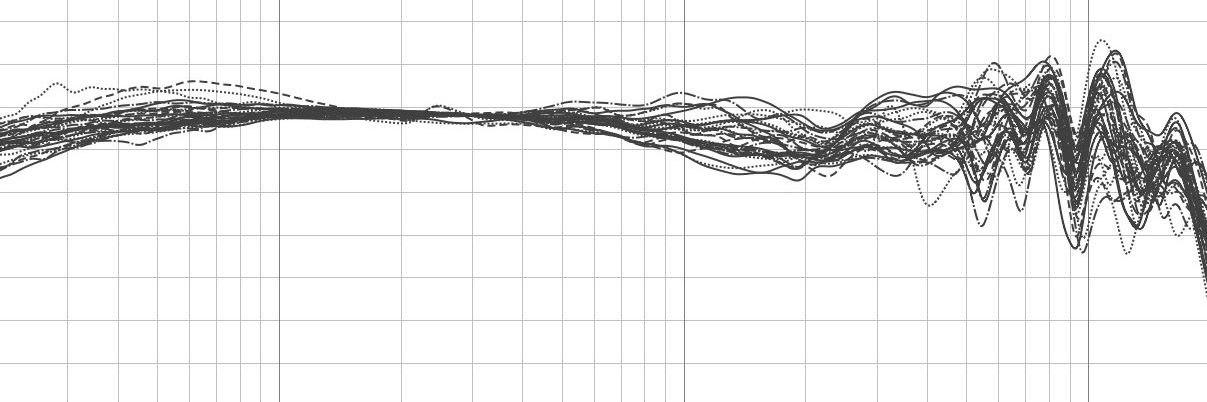
Despite feeling a bit too bright for my taste, I still enjoyed the original Moondrop Para when I reviewed it. It offered excellent value for money with its technical performance and flexibility with EQ and pad rolling. Moondrop’s current flagship, the Cosmo, also won me over with its overall sound quality. So, I had fairly high hopes going into the Para 2.
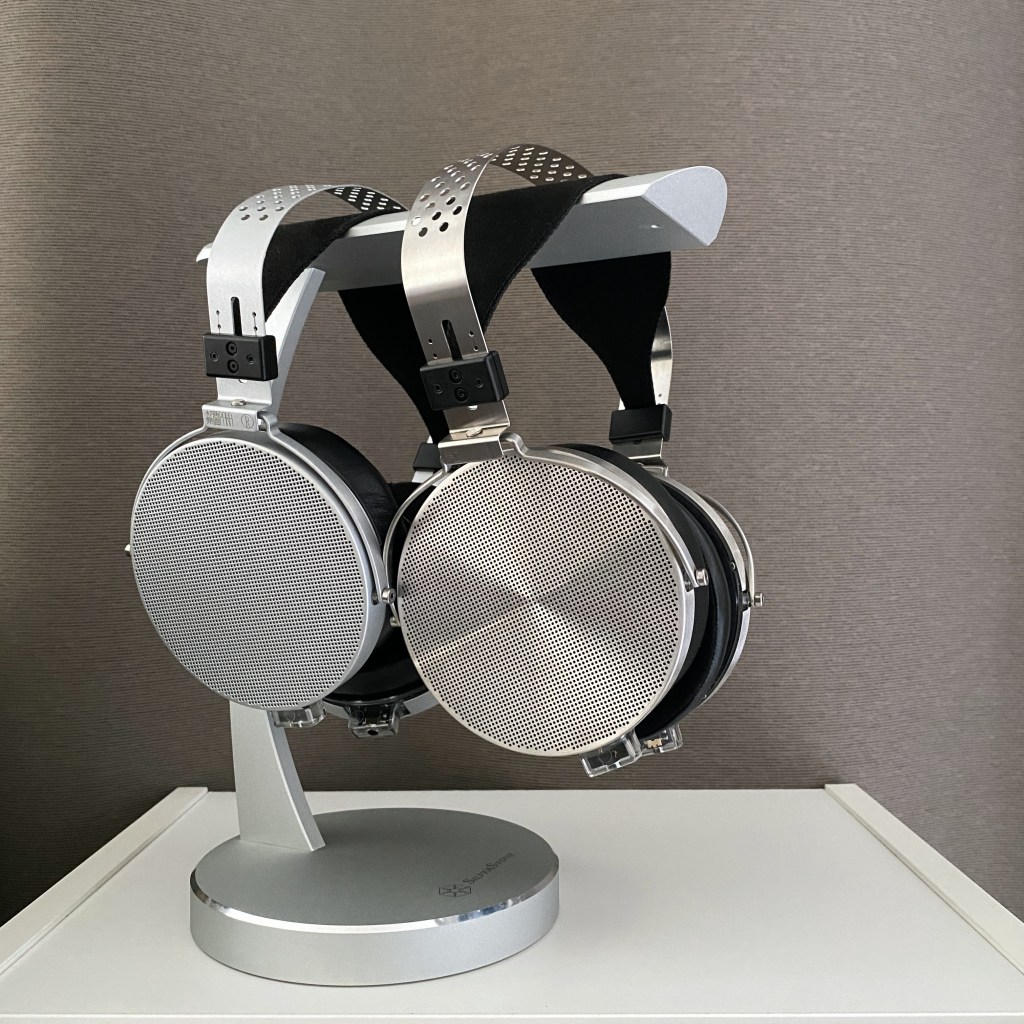
At first glance, the Moondrop Para 2 looks nearly identical to the OG: same chassis design, just a new finish. That raises the question: with the price jumping from $349 to $499, are there actually substantial upgrades under the hood?
Moondrop’s marketing doesn’t seem to suggest much has changed. The driver material is still the same silver-trace diaphragm, and no major technical updates are called out (thickness is said to be 1.2μm, but not disclosed for the OG). Visually, I do like the new look. The brushed stainless steel finish feels more premium and does a better job resisting scratches and daily wear. But let’s be honest — that alone isn’t enough. What matters is the sound.
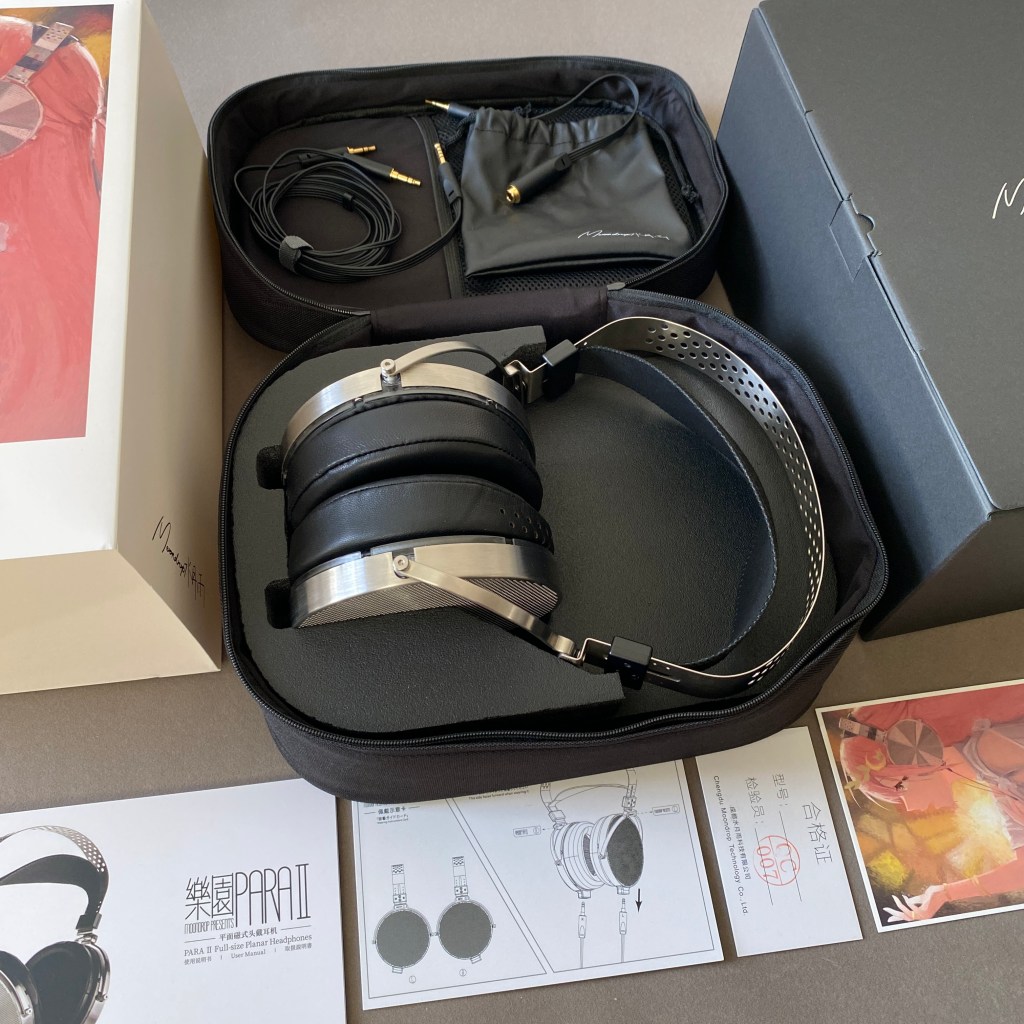
The only obvious change out of the box is the pads. From what I can tell, the Para 2 now ships with the Cosmo pads, a switch that definitely affects the tuning. But is that all? Let’s take a closer look.
For those who want to jump right into detailed measurements, check out the final section of this article.
Disclaimer: This unit was purchased for review.
Specs & Comfort
Price: $499 USD / $799 AUD
Driver size: 100 mm (frame); 80 mm (effective)
Driver type: Planar Magnetic
Sensitivity: 110 dB/Vrms @1kHz
Impedance: flat, 9 Ω at 1kHz (measured)
Connector: dual 3.5 mm TRS
Weight: 513 grams (excl. cable)
Clamping force: light
Comfort: 6/10 (weighty; clamping force a bit loose)

Measurement & Sound

For more comparisons, visit my squiglink database.
Tonal balance:
Overall, the Para 2 is an enjoyable listen. It offers some thoughtful refinements over the OG: smoother mids, more controlled treble, and slightly fuller bass. None of these changes are dramatic, but they do shift the presentation in a more polished direction. But there’s a catch. More on that in the sections below.
Bass
The bass here is tight, responsive, and digs deep, reaching all the way down to 20Hz. But it leans more toward the light, snappy, and agile side of planar bass, rather than the dense, weighty slam you’d expect from something like the Focal Clear or Audeze LCD-2.
For bass performance, the Para 2 is basically on par with the original Para. I own two OG units, and there’s noticeable variation even between them. My first unit, bought at launch, had a slightly brighter and tighter character with less low-end presence. The second had a fuller bass response and a more relaxed tone. The Para 2 sounds closer to that second pair: its low end feels a bit deeper and more atmospheric, while the OG leans slightly tighter and more focused. Still, the differences are subtle rather than dramatic. All in all, it feels more like a minor shift in diaphragm tensioning than a design overhaul.
Midrange
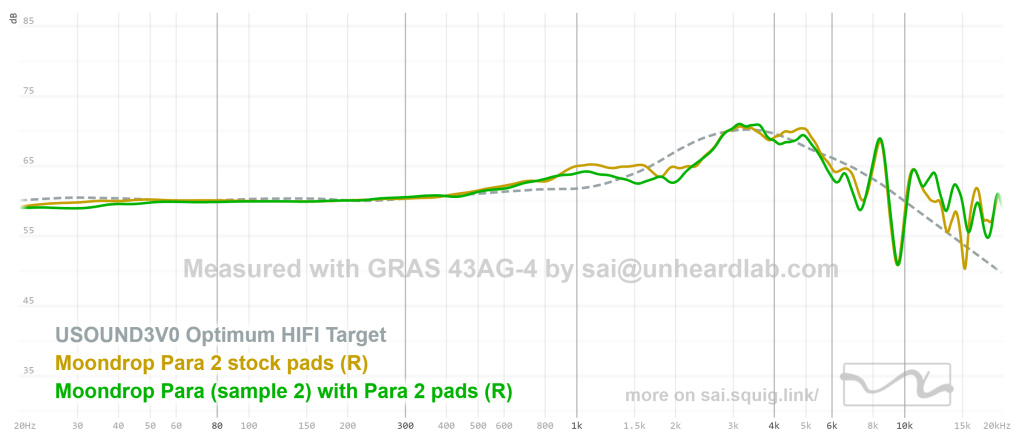
The mids on the Para 2 are clean and articulate — more like studio monitors than lounge speakers. They’re not the lush or rich kind, but they’re present, well-balanced, and avoid shoutiness. With the stock pads, there’s a subtle bump around 1kHz that makes the mids sound fuller than on the OG. Occasionally, this can lend a slightly nasal character, though it’s far from intrusive.
What’s interesting is that the main tonal difference between the OG and Para 2 stems from the pads. When tested with the same EP100A pad, the sound difference between the Para OG and Para 2 gets quite subtle. We’re talking maybe a 10-20% shift mainly in how the upper mids are rendered. The Para 2 presents them in a slightly more filled-in and cohesive way. There’s a stronger sense of texture and grain, especially in the upper mids.
Overall, I’d consider the mids a step forward with the new stock pads. They remain largely what I would call a neutral tuning. That means they won’t necessarily wow you or flatter vocals with extra warmth or sweetness. But in this price range, the clarity and tonal honesty are impressive, even if they don’t steal the spotlight.
Treble
When comparing both models with their stock pads, the Para 2 is noticeably smoother and more forgiving than the OG, though at the cost of some airiness. That said, treble tuning is highly influenced by ear pads, so to better isolate the differences, let’s compare them using the same new Cosmo (Para 2 stock) pads.
The treble tuning on the Para 2 reminds me of the shift from the Hifiman Susvara OG to the Susvara Unveiled. There’s less emphasis in the upper treble, which gives the Para 2 a smoother, less splashy top end, but also a bit less brilliance/air. On the flip side, there’s increased presence in the mid-treble region right where violins, cymbals, and vocal harmonics sit.
This rebalance works well for certain modern pop and rock tracks where energy in the 8-12kHz range is sometimes dialed up for extra billiance in vocals. That bite is still there, but now delivered in a slightly more controlled way. Still, I’d describe the Para 2 as smoother and slightly less edgy up top. Some listeners may even find it more natural or forgiving especially on longer sessions.
Other qualities:
- Soundstage
The soundstage on the Para 2 is reasonably wide: not overly expansive, but certainly not claustrophobic either. It scales naturally with the music. It won’t fake a grand stage where there isn’t one, but when the mix calls for something spacious and open, the Para 2 delivers.
Imaging is tight and precise, and depth, while not exceptional, is good enough to place instruments cleanly in a mix without feeling congested. Compared to the OG, the Para 2 is more of a sidegrade in spatial qualities. It offers slightly sharper imaging, but trades off a bit of depth.
- Clarity
Clarity is one of the standout traits here, just like on the OG. This level of resolution punches well above its price bracket. You typically need to move into kilobuck territory in the dynamic driver world for this kind of resolution. Even better, it achieves this without overly skewing the tuning toward brightness. There’s a slight tilt toward the treble, sure, but it doesn’t rely on artificial sparkle or peaky emphasis to fake detail. So, the level of clarity here feels clean and coherent.
- Dynamics
Dynamics are fast and incisive. Transient attack is crisp, and the overall presentation has good energy and pop. The Para 2 is very good at microdynamics (small-scale shifts and nuances in quieter passages). That linear bass, clean treble extension, and overall tonal balance work together to ensure you don’t miss out on subtle detail.
Macro-dynamics (slam and impact) are decent for the price, but not particularly standout. If you’re after that physical thump or head-rattling punch, you may find it lacking. Still, it handles EQ really well: no excursion limits hit at 100dB in the bass, no obvious compression jumping from 84dB to 100dB. Just keep in mind, its tolerance for leakage isn’t class-leading among planars.
Conclusion and value:
So, is the Para 2 worth the extra cost? If you’re judging purely by sound quality, the answer is a cautious maybe. The changes are more of a side-step than a true, all-around upgrade. You get a smoother and slightly more cohesive tuning, with fuller mids, but the overall sonic character and technical performance remain very similar to the original.
The most noticeable improvement comes from the new pads. They do change the tuning in a meaningful way, but since they’re compatible with the original Para, you could achieve a similar result just by buying the Para2/Cosmo pads separately.
That said, the updated brushed stainless steel chassis is a nice touch. It resists scratches better and is about 13 grams lighter, which slightly improves comfort over long listening sessions. If you’re tough on your gear, the Para 2’s more durable build makes sense. But if your focus is purely on sound, the OG still offers excellent value.
Honestly, I had higher expectations. Moondrop built its reputation by shaking up the IEM market with disruptive value and excellent tuning. The original Para largely followed that spirit. The new Para 2, in contrast, feels more like a conservative update. It’s the kind of safe iteration we’ve seen many other brands release.
At $499 USD / $799 AUD, I still recommend the Para 2 as it sounds great out of the box. But it would become a better buy if you can catch it on sale.
If this feels a little inconclusive, here’s the bottom line: go for the Para 2 if you don’t want to mess with pad-rolling, EQ, or if budget isn’t a concern. But if you already own the original Para, there’s no urgent need to upgrade. Just grab the Cosmo pads, you’ll get most of the benefit.
PROS:
+ Balanced tuning with a slightly bright, airy tilt
+ Smoother and more forgiving than the original Para
+ Clarity punches well above its price point
+ Improved build quality and lighter chassis
CONS:
– Not a major upgrade in sound quality compared to the OG
– Most of the improvement comes from the ear pads, which are swappable
– Noticeable price jump from the OG
– No extra set of pads included (an EP100A or hybrid pad would have been appreciated)
Value Grade:
Notes on Ear Pads and EQ

As an open-back planar, the Para 2 is quite accommodating for pad-rolling, allowing users to fine-tune the sound or replace the stock pads as they wear out.
The stock pads, though, are where the real tuning shifts happen. Moondrop’s new Cosmo pads, which come stock with the Para 2, change the character noticeably. They smooth out the treble and fill in the mids for a more cohesive and slightly warmer presentation compared to the OG’s stock pads. That said, some might prefer the Para pads or the EP100A pads on the Para 2 for a more traditional/neutral sound.
In terms of EQ, this headphone requires little adjustments to sound well-balanced. That said, there’s still room for fine-tuning.
As with many planars, the Para 2 responds well to EQ especially in the bass. It can handle healthy low-end boosts without distortion or compression, even at higher volumes. That gives you some headroom to dial in slam if you find the stock tuning a bit too polite down low.
My EQ setting for this headphone (with stock pads):
Preamp: -5.7 dB
Filter 1: ON PK Fc 25 Hz Gain 5.5 dB Q 0.500
Filter 2: ON PK Fc 140 Hz Gain 1.6 dB Q 0.500
Filter 3: ON PK Fc 1100 Hz Gain -2.5 dB Q 1.500
Filter 4: ON PK Fc 2200 Hz Gain 4.0 dB Q 2.500
Filter 5: ON PK Fc 10500 Hz Gain -2.0 dB Q 3.000
If your goal is to EQ the response to match the Harman Target, consider the AutoEQ function provided by Squiglink as a convenient starting point. I personally recommend customising the filters to better suit your own hearing, especially in the treble. While the AutoEQ provides a useful baseline, individual adjustments can often significantly improve your listening experience.
If you’re new to EQ, I’d recommend checking out this video by Resolve from The Headphone Show — it’s a really solid intro and walks through the basics in a clear, no-nonsense way. Great place to start!
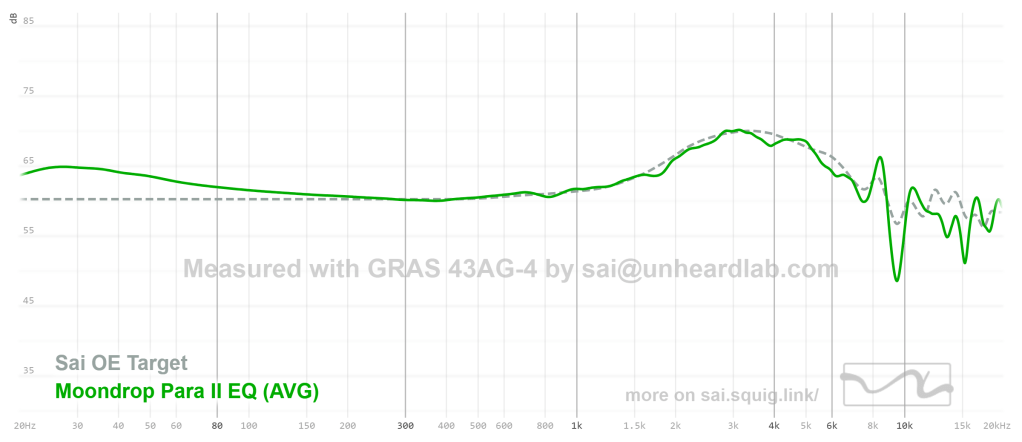
MEASUREMENTS
Frequency Response Average (unsmoothed):

The response is obtained by an average of 5-6 positional variations. The FR shown on the graph is unsmoothed.
Positional Variation:
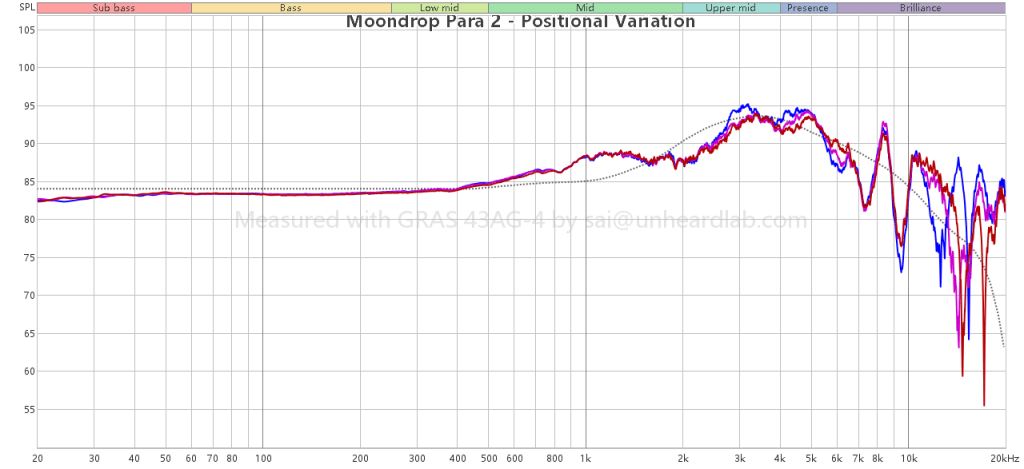
This graph illustrates how headphone placement on the head affects perceived tonal balance: with the ear positioned at the front (blue), centre (purple), and back (red) of the headphone. The FRs shown on the graph are unsmoothed.
Leakage Tolerance:
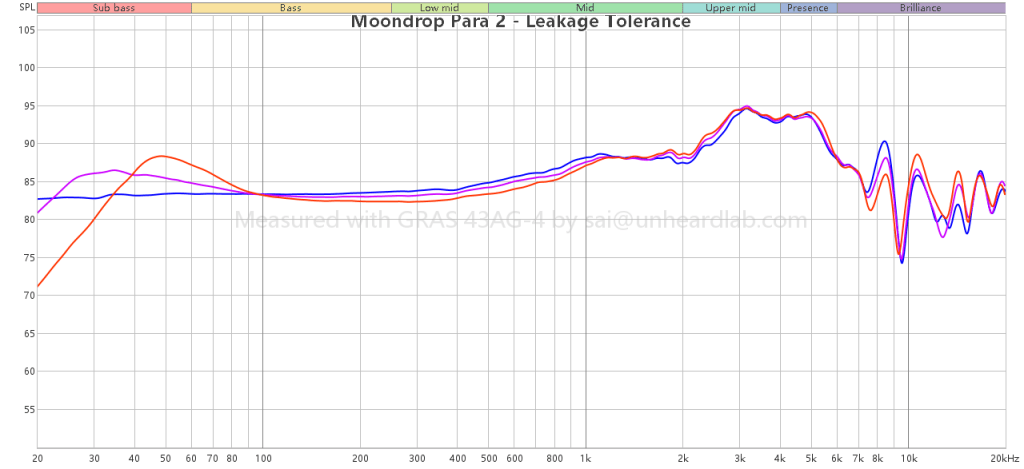
This graph demonstrates how leakages to the front volume can result in FR change: blue (good seal), purple (thin arm glasses), red (thick arm glasses). The FR shown on the graph is 1/12 octave smoothed.
Comment: Like most open-back planars, this headphone shows a slightly bass boost when the seal is compromised. Of note, midrange and treble level also shift with changes in seal, which may cause listeners report noticeable variation in perceived tonal balance.
Linearity and Dynamic Compression:

Linearity and dynamic compression testing plots the headphone’s frequency response at two input levels to show how it reproduces signals as loudness changes. Any divergence between the high-level and low-level curves points to where the transducer’s dynamic range begins to compress or distort. Here, the measurements are superimposed to allow direct comparison.
Comment: This is excellent result. There’re no signs of compression at high SPLs.
Impulse Response:

The impulse response test measures the initial response, overshoot, and decay of a transducer upon receiving a signal. An initial upshoot indicates a normal polarity, vice versa.
Total Harmonic Distortion (THD% 2nd-9th) & Excess Group Delay (94 dB):


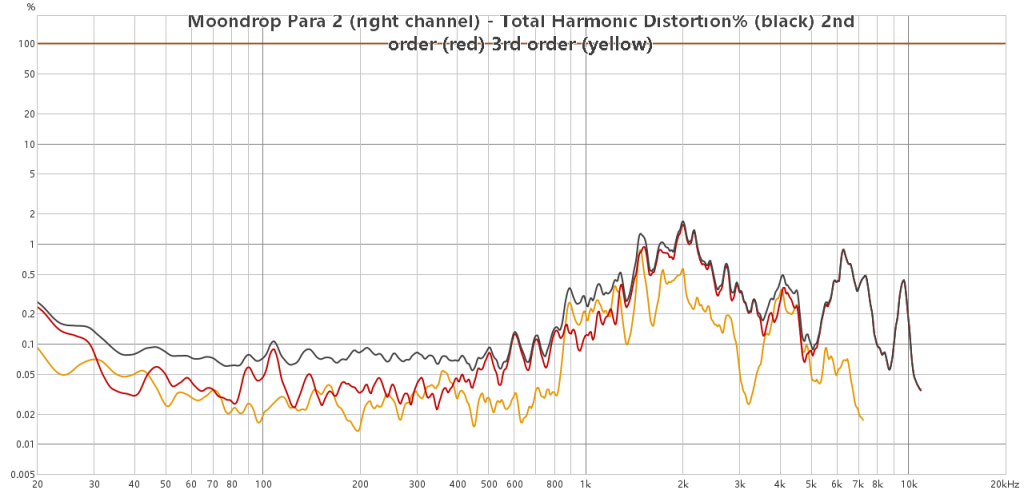
These measurements are conducted in quiet, normal room conditions (as opposed to an anechoic chamber), meaning there may be some influence from ambient room and external noise. These results should be considered a preliminary assessment of performance, primarily for identifying major issues, and do not reflect the best-case performance scenario.
Comment: 94dB distortion levels are a bit on the higher side hovering around 0.2-0.5% between 1500-8000Hz, but still within acceptable limits. At typical listening volumes, this should remain inaudible and not impact the overall sound quality.
Update: the rising THD issue appears to be limited to one channel; the other channel measures within expected bounds (very low indeed). That said, both drivers look nearly identical visually, so I can’t definitively say which one represents the “normal” case. I’ll give Moondrop the benefit of the doubt and include both sets of measurements here for transparency.
Channel Matching:

Channel matching graphs are intended for quality control checks and do not relate to the perceived sound profile. A specialised configuration is used in this test to capture differences between channels, mitigating interference from positioning on the rig and the asymmetry in the GRAS pinnae design, a legacy of KEMAR. The left (blue) and right (red) channels are measured using a flat plate coupler with an IEC60318-4 ear simulator.
Comment: Channel matching on this particular unit is very good, which may contribute to imaging precision and the clarity of spatial cues.
Electric Phase & Impedance:
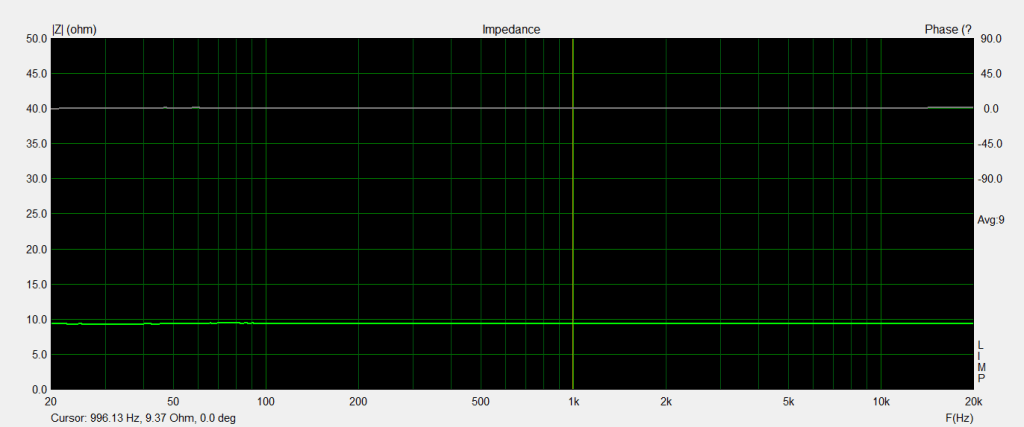
The above graph shows the measured impedance (green) and electric phase (grey), measured under free-air condition (minimal front volume coupling).
Comment: This headphone’s impedance curve is typical of a planar headphone – flat and low.
END OF THE ARTICLE
Disclaimer: This review is not sponsored or endorsed by any business or related entity. The headphones reviewed are my own unless stated otherwise. Any links or recommendations included are purely informational and do not involve any financial affiliation or endorsement on my part.
EDIT 07/08/2025: corrected info on RRP

Another great review, as usual. This’s one of the few early reviews of Para 2, too. Kudos!
Sai, I’m the frequent reader of your website who was asking you about HE1000 Steath vs. Cosmo the other day. Since our last correspondence, I have downgraded from HE1000 Stealth to Arya Stralth vs. Cosmo (with EP100 pads), and maybe Para 2.
The purchase decision came earlier than I had expected. So, I’m in need of your helpful response to a few last questions before finalizing this tough decision:
I’m concerned with mainly 2 things:
1. The quality of bass:
Based on the graphs, Cosmo’s bass quantity seems lower than any other planar to which I’ve compared it. But, how is the quality of its bass, both in isolation and compared to Arya Stealth and Para 2?
With and without EQ, does the bass on the Cosmo (EP100A pads) get muddy or congested in tracks with heavy busy passages?
In comparison, how do Arya Stealth and Para 2 fare with such tracks?
2. The accuracy of imaging:
Among these mentioned sets – Cosmo (EP100A), Arya Stealth, and Para 2, if I’m not mistaken Arya Stealth might have a more expansive stage, but which one has a more precise sense of localization among the respective stages they have?
Finally would you say that the resolution and clarity is significantly noticable on the Cosmo (EP100A pads) compared to Arya Stealth and Para 2?
I’ve been wondering about these questions and was not able to come to a conclusion so as to purchase and import one of these headphones. That’s why I’ve reached out again.
Thanks for considering my questions again, too, dear Sai.
LikeLike
Hey, good to hear from you again. It’s been a while since I last heard the Arya Stealth, so I’ll try my best to compare without going too deep.
Bass is probably the weakest part of the Cosmo. As you said, quantity is on the lighter side, though quality is good. EQ helps a lot, and even then, it still outperforms the Para 2 in bass. Moondrop clearly knows the game. If you’re looking to free up funds or prefer the updated look, the Para 2 makes sense. Otherwise, I’d stick with the Cosmo.
The Arya Stealth is a different beast. It’s more fun and energetic, with stronger bass and brighter treble. I prefer its bass presentation, but overall refinement still goes to the Moondrops. They each bring something different to the table.
Imaging on the Arya is larger and more diffused, while the Moondrops give a tighter and more defined sense of space. Cosmo and Para 2 are close here, given the similar chassis and pads. For stage, Arya tends to sound bigger and more open, Para 2 is more focused. In terms of clarity, I’d still give it to the Cosmo. Arya might shine in some upper bands, but the Cosmo feels cleaner more consistently. Para 2 is not far behind either.
If you’re trying to save a bit, Para 2 can stand in for the Cosmo with some trade-offs. But between Cosmo and Arya Stealth, it’s more about preference than one being clearly better.
Let me know how you go!
LikeLike
Hi sai.
Excellent review, always very pleasant to read, informative and detailed, as usual.
I think that the increased official sensitivity (at 1 KHz) of the PARA II versus PARA I (OG) (106 dB/Vrms @ 1kHz versus 101 dB/Vrms @1kHz) comes very largely from the PARA II stock pads (apparently identical to those supplied as stock with the COSMO) which increase the SPL level of these two headphones (PARA-II and COSMO) by about + 3 dB at 1 KHz.
I’ve taken the liberty of linking your review of the PARA II (versus PARA OG) to the general Moondrop headphones thread on head-fi.
Link: https://www.head-fi.org/threads/moondrop-horizon-para-para-ii-venus-and-cosmo-fitted-with-the-brainwavz-memory-foam-hybrid-xl-size-pads-and-zmf-universe-lambskin-perforated-pads-or-zmf-be2-lambskin-perforated-pads-or-zmf-caldera-lambskin-thick-top-and-side-perf-pads-discussion.970569/page-60#post-18785952
PS: still very happy with my Moondrop COSMO planar headphones fitted with the excellent ZMF Universe Lambskin perforated upgrade pads, which imho are a (small) improvement on the already excellent upgrade pads (for the same COSMO) which are the PARA OG hybrid pads; these ZMF pads being a little more dynamic in the bass than the PARA OG hybrid pads; they also attenuate the small level hum at 3 kHz and the small recession in the treble at 6 kHz observed with the PARA OG hybrid pads, without boosting the 800 – 1200 Hz zone (just like the PARA OG hybrid pads, unlike the COSMO (and PARA II) stock pads, which boost the 1 kHz zone by around 3 dB, resulting in a slightly nasal effect on female vocals).
Eric65
LikeLike
Hey Eric. Yep, you’re absolutely spot on. The increase in sensitivity is mainly from the pads, since they bump up the response around 1kHz as you said. With the same pads, the OG and Para 2 measure pretty much the same in sensitivity. Good catch on that, and thanks for sharing the review on Headfi. In the end, given that the Para 2 uses the same chassis and diaphragm as the OG, it’s no surprise the two are so close overall. A lot of the tuning for planars (and estats too) really does come down to the pads.
The Cosmo is still the best planar Moondrop makes in my book. The ZMF Universe Lambskin Perforated pads are indeed a great match. They keep the overall balance closer to stock but add a bit more stage, bass punch, and treble sparkle. And like you said, they dial back 1k bumps from the stock pads, so vocals come through less dominant in the mix.
Appreciate the insights as always!
LikeLike
Thanks for the review. I’ve got the Para and now I want to buy the Cosmo pads,, but I can’t find them for sale anywhere. Any clues?
LikeLike
Ah yeah, I checked again too and you’re right, there doesn’t seem to be a link to buy the Cosmo pads like there is for the EP100A. Best bet would be to reach out to their customer service and ask if they can sell the pads separately. Hopefully they’ll be able to sort something out for you.
LikeLike
Thanks I see. I wonder if I should just go for the Cosmo instead. Could you compare it to the Cosmo a bit more?
LikeLike
That’s a pretty steep price hike. Trade war to blame?
LikeLike
Could definitely be part of it. I wouldn’t be surprised if some of it also comes down to brands padding margins or covering other rising costs.
LikeLike
Where tf is the value rating for this headphone🥺
LikeLike
Well if you mean my rating for it, it’s right there in the article, you just have to look a little closer! 😉
LikeLike
hey sai, have you find the ultimate pad for para, ft1 pro’s pad look decent on the measurement, however is a shame that they don’t sell for that
LikeLike
im also interested to the jz w1000 perforated pads, unfortunately i don’t see any perforated pads for w1000 only round protein and sheepskin
LikeLike
Ah, maybe they no longer sell that. I can see they are still available on Taobao, but not on Aliexpress.
LikeLike
could you give me the link in taoboa, i was actually searching in their taoboa store for w1000 with perforated, but i didn’t saw it . btw i want to make a suggestion but idk if is capable, i think you can put links after the pad you test in squiglink, which can be very helpful, especially foreigner like me who often can’t match the description to the picture when finding it
LikeLike
I checked myself and I couldn’t find it either. It seems they might have pulled the specific listing or changed the title. The pads they are currently selling that look the most similar are the perforated lambskin L5000 pads. The difference is that the W1000 version has perforations only on the side that touches your cheek.
Yeah I have thought about it too, but the issue is the way the squiglink code architecture limits that kind of integration. Maybe the best alternative is for me to compile an Excel list or a simple directory of the most frequently used pads I have measured, along with direct purchase links.
LikeLike
Yeah the FT1 Pro pads really do seem like some of the best. The one problem is that you’d have to try reaching out to Fiio customer support directly, and even then, I’m not sure if it’s guaranteed, though I can get one since I own their headphones.
I did find another pad that’s pretty similar to them though. They’re aftermarket FT1 pads made with cooling gel, which is awesome for summer, and they change the frequency response in a way that’s really close to what the original FT1 Pro pads do. You can find them on AliExpress (links here). I’ve labelled them as “Para with FT1 ice silk pads” on squiglink. Alternatively, the XK Audio Fluxion pads are also pretty good because they give you an extra bass boost thanks to their ported design.
LikeLike
thanks for the suggestion, the measurement seems like Fluxion winter ported pads are the best ? ive tried jz denon protein pads half year ago, which has very smooth treble compare to original para pads, the only downside is not thick enough and i don’t have a large head, anyway love your pad rolling measurement
LikeLike
In that case, the Fluxion pads are definitely wider and have more depth than those JZ Denon protein pads. Do give them a shot if you can get hold of them. I think that bass port really helps give the Paras some extra energy and punch.
LikeLike
i saw you upload para with horizon DLC pads, which looks very very decent, it got a bass bump and very flat till 1khz, can you share about your experience. i have tried Fluxion pads and FT1 ice silk pads you recommended, the bass is enjoyable at Fluxion pads, but i guess is the scoop in 1-2khz, it makes the vocal a little back away, less resolution-feel , which is my biggest issue with this pads. FT1 ice silk pads is very decent, i like it a lot. I find that the charts of FT1 ice silk pads and jz denon protein pads is similar, however jz denon protein pads sounds more airly, feels unlike a headphone, so jz denon protein pads is still my favorite. para with horizon DLC pads looks very close to DF+10 db, i want to try it, but i doesn’t see anyone selling it……..
LikeLike
Ah, the Horizon DLC pads do sound quite good with the Para. They are sort of like the JZ Denon pads indeed, with well controlled highs and a more linear response through the bass and mids.
The mids are very clean and have that somewhat stereotypical pleather pad sound to them, if you know what I mea. They don’t sound as warm/fuzzy as some leather, suede, or velour. The nice part is that the bass and lower mids are more filled in than some other pleather pads, so I don’t find them thin.
The caveat here is comfort. The Horizon DLC pads are made of low-density/spongy foam, which tends to hold its shape even if you wear them for a long time. Because of that, you tend to always feel they are there, so comfort isn’t the best. The upside is that the staging also feels a bit more roomy than usual.
If you really want them, perhaps try reaching out to MD’s customer service?
LikeLike
Hi Sai,
Im really interested in getting the Horizon DLC pads but I can’t find information on the Internet.
1.Where can I purchase them?
2.What is the official name?
3.Are they supplied with Moondrop Horizon headphones?
4.Who is MD you refer to in your reply above?
Thanks for the graphs and effort you put in!
LikeLike
Ah, MD just stands for Moondrop. I think those pads ship with every new pair of the Horizons now, but I’m not sure if they even have an official name. It’s all a bit chaotic honestly. Hopefully Moondrop can sort you out cause I really have no clue if there’s a way to buy them separately. Sorry for the delayed reply, I was away for holidays.
LikeLike
Hey there! Long term reader of your reviews – I find they’re the best available on the internet currently. Just saying that I really appreciate them!
I had a question about the Para 2 vs Cosmo. Resolve seems to think the Para 2 are basically identical or near identical to the Cosmo in technical performance. However, others including you have stated that the Para 2 is not terribly close to the Cosmo in technical performance. Do you have any idea why Resolve would not perceive much of a difference in technical performance between the two models?
From what I gathered, the Cosmo have more of a certain “tactility” to their sound, which I think is probably related to microdynamics, while the Para 2 is more conventional sounding. Also I think you mentioned here that the Cosmo has better bass quality than the Para 2 even when both are EQ’d to the same bass levels.
World you be able to elaborate more on the differences in technical performance between the Para 2 and Cosmo (after both are EQ’d to the same target)?
Thank you!
LikeLike
Hey, thanks so much for the kind words! That means a lot to me and keeps me writing.
I do think there’s still a gap between them. The way I see it, the Para 2 uses a very capable driver, especially with that extra treble energy which gives a strong sense of detail. But in a lot of ways, it feels like a slightly looser, less controlled version of the Cosmo. It has more treble resonances and irregularities that the Cosmo manages to smooth out.
Even if you EQ them to the same target (which is impossible to get 100% perfect due to fit, positioning, and driver-level differences), the Cosmo still comes across as the more refined product. There are just certain spots, especially in the upper treble, that are really hard to fix with EQ, and that’s where the Cosmo pulls ahead.
In terms of tactility, the Para 2 is an improvement over the original Para (though the OG was actually a bit more incisive/sharp), but the Cosmo just feels fuller and more “solid.” The Para 2 plays the resolution and spatial game very well, but the Cosmo has that extra layer of control and weight that makes the difference.
LikeLike
Hello Sai, do you mind measuring Para 2 with Fiio FT1B pads?
Thanks in advance
LikeLike
Hey there, unfortunately I no longer own the Para 2. I might get them again in the future though, if I do I’ll measure them.
Would you like me to measure the Para OG with FT1B?
LikeLike
Yes, please do. Thank you for your work.
LikeLike
No worries I’ll circle back when it’s done!
LikeLike
Here you go. Apologies for the delay:
https://sai.squig.link/?share=Harman_OE_2018_Linear_Target,Para_(sample_2)_with_FT1B_pads
LikeLike
can topping L70 drive this headphone?
LikeLike
I would say it can based on the specs sheet, though I don’t have any experience with this amp specifically.
LikeLike