
Intro:
EDIT 8 August 2025: The HD505 has recently been available at 30-40% off during Amazon sales (AU$275, RRP AU$449). At these discounted prices, the value proposition is significantly stronger, and I highly recommend them.
Right out of the box, the HD505 feels like a typical Sennheiser headphone: mostly plastic, yet well-built and robust. It doesn’t scream luxury, but it’s solid and durable. The new colourway defintely helps distinguish it from the rest of the lineup. Notable design changes include the front damping scheme and improved headband padding. The reduced clamp force compared to the HD560S is a welcome improvement.
On the technical side, Sennheiser claims the HD505 offers a more “analytical” sound than the “neutral” HD560S. But how does that translate into actual listening? Let’s dive in.
For those who want to jump right into detailed measurements, check out the final section of this article.
Disclaimer: this unit was purchased and is owned by unheardlab.
Specs & Comfort
Price: US$ 249/ AU$ 449
Driver size: 38 mm dia.
Transducer type: moving coil
Sensitivity: 107 dB/Vrms @1kHz
Impedance: 137 Ω @1kHz (measured)
Connector: single 2.5 mm TRRS locking
Weight: 237 grams (excl. cable)
Clamping force: light-medium
Comfort: 9/10 (ear pads can be roomier, but no complaints overall)


Measurement & Sound


For more comparisons, visit my squiglink database.
Tonal balance:
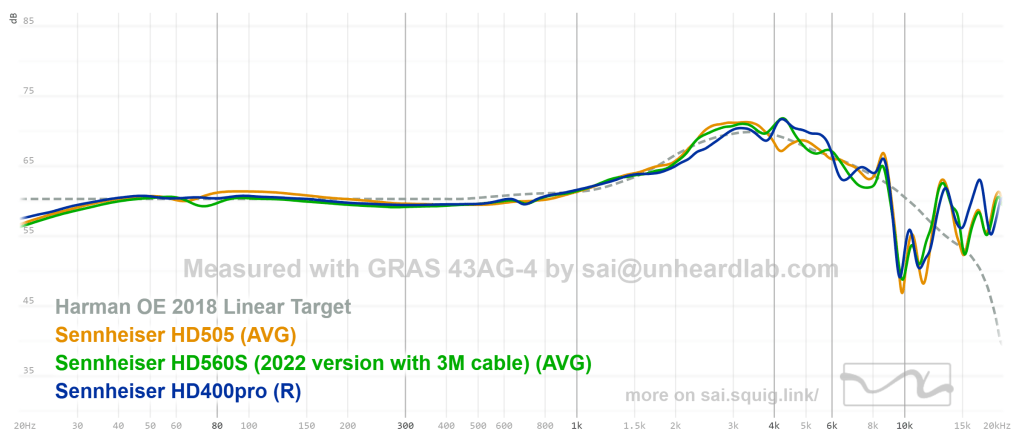
In short, the HD505 delivers a somewhat mid-forward yet still well-balanced sound profile. It sounds slightly fuller and more refined than the HD560S, though the differences—let’s be honest—aren’t huge.
Bass
For an open-back headphone, the HD505 has good bass quantity and extension, much like the HD560S. This sets it apart from older classics like the HD6X0 series. Kick drums feel deep and robust, though still lacking the lowest-octave impact found in planar magnetic headphones like the HE6se V2. Compared to the HD560S, the HD505 has slightly more mid-bass punch and slam, adding to its dynamic feel.
Midrange
The midrange balances fullness and realism, offering a forward and articulate presentation suited for critical listening. Compared to the HD560S, the HD505 sounds richer, avoiding the somewhat lean and clinical presentation of its predecessor. This is arguably the HD505’s greatest strength. Not only does it offer a fuller midrange, but it also smooths out the edginess and graininess often associated with the HD560S’s 4–5kHz peak. The result is a more refined presentation.
Treble
The treble here is generally clear and inoffensive, though somewhat dry sounding. While it aligns more closely with the HD560S than with the darker HD6XX/650, the HD505 is actually slightly more “clarity-focused” in specific treble regions.
Notably, the HD505 exhibits slightly more pronounced sibilance compared to the HD560S, especially in 7–9kHz region. The differences aren’t stark, but they are there. This was a surprising discovery, as it contradicts some earlier impressions. For example, in Patricia Barber’s The Wind Song, these differences become more apparent. However, the perception of treble can vary significantly between listeners, especially in the upper octaves which are among the most individually variable aspects of hearing.
In this sense, I see why Sennheiser markets it as more analytical than the HD560S, though I wouldn’t personally apply that characterisation to the overall sound signature. The HD505’s smoother upper-mids and fuller lower-mids undoutedly help counterbalance the added treble clarity, making it overeall a headphone that is easier to listen to compared to the HD560S.
Other qualities:
- Soundstage
The HD505’s spatial performance is similar to the HD560S—more spacious than the HD6XX but still not exceptional in today’s mid-fi market. Imaging and separation are quite good, with a well-defined center image that adds a touch of holographic feel. The angled drivers help with instrument positioning, though like the HD560S, depth remains somewhat lacking. The HD505 is slightly better in this regard, but only marginally.
- Clarity
Detail retrieval is decent. It presents micro-details in a more coherent, less “grainy” manner than the HD560S, but the improvement is, again, not stark. The finest details at both ends of the spectrum—deep sub-bass and upper treble—tend to be slightly glossed over. In comparison, headphones like the Moondrop Para or Audio-Technica R70xa extract more nuances.
- Dynamics
The HD505’s dynamics are passable. Transients feel somewhat smeared, much like the HD5XX and HD6X0 series. There’s a small improvement in impact over the HD560S, but it’s not a major upgrade—certainly not enough to justify the price gap.
Conclusion and value:
At an MSRP of $249 USD / $449 AUD, the Sennheiser HD505 delivers good sound but struggles with its value proposition. The issue isn’t that it’s a bad sounding headphone—far from it! The problem is that Sennheiser’s own HD560S and HD6XX exist at significantly lower prices while offering similar performance. It’s a classic case of “Sennheiser competing against itself.”
While the HD505’s improvements, particularly in midrange tuning and comfort, make it a compelling choice for some, the overall sonic upgrades aren’t substantial enough to warrant nearly double the price of the HD560S. The mid-fi market is crowded with alternatives that provide similar or even better performance, especially if you’re open to EQ, as the HD505’s biggest strength is its excellent frequency response out of the box.
So, at its current price, I struggle to recommend the HD505. However, if the price drops—say to $179 USD / $299 AUD—it becomes a much more attractive option. It’s a good-sounding headphone, and I do enjoy the tuning, but it simply doesn’t offer enough value against its own siblings.
Pros: Natural, well-balanced tone; fuller, smoother presentation than the HD560S; improved imaging and clarity; more comfortable fit with reduced clamp force.
Cons: No drastic improvement over the HD560S; The HD560S offers similar performance at almost half the price.
Value Grade:
Notes on Ear Pads and EQ
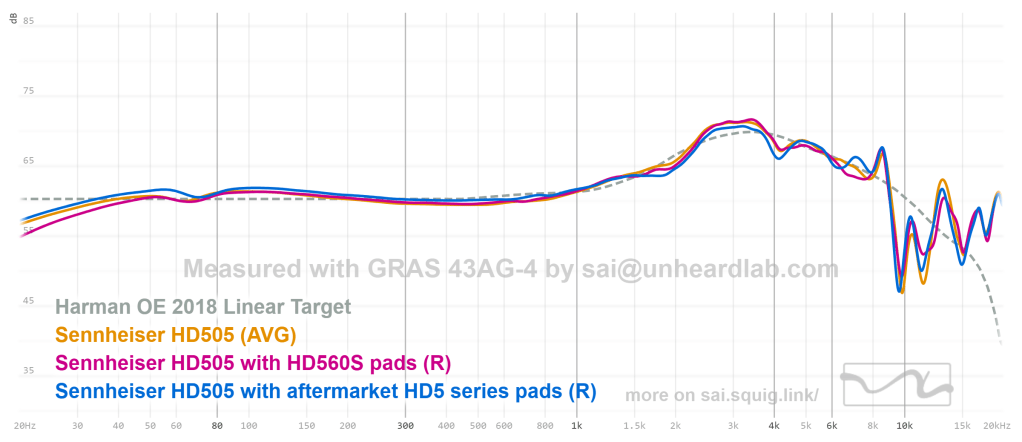
As an open-back headphone, the HD505 should, in theory, be quite accommodating for pad-rolling, allowing users to fine-tune the sound or replace the stock pads as they wear out. However, the ear pads attach using plastic snaps, which can limit aftermarket options.
For the Sennheiser HD5 series, I’ve found that the most common type of aftermarket ear pads on Aliexpress/Taobao/Ebay do an excellent job of preserving the original tuning. They look and feel almost identical to the stock pads, leading me to suspect they might come from the same factory.
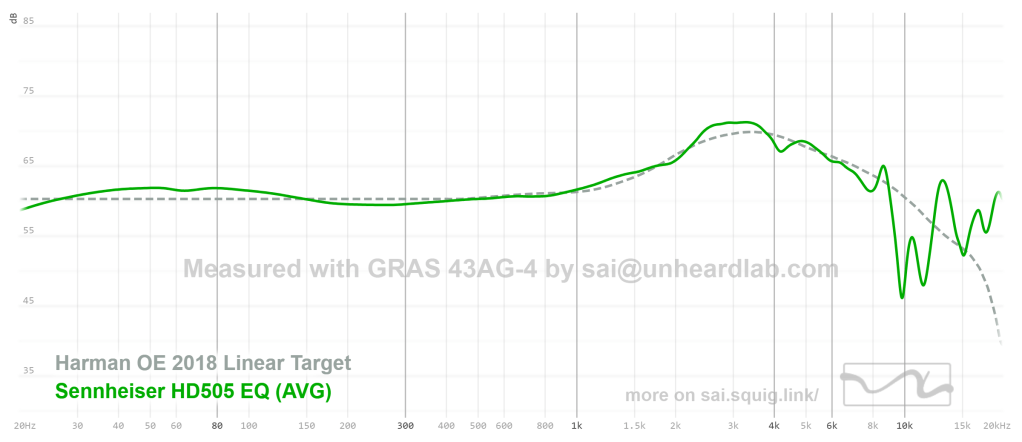
In terms of EQ, this headphone requires little adjustments to sound well-balanced. That said, there’s still room for fine-tuning.
My personal EQ setting for this headphone:
Preamp: -2.0 dB
Filter 1: ON PK Fc 20 Hz Gain 2.0 dB Q 0.500
Filter 2: ON PK Fc 65 Hz Gain 1.0 dB Q 3.000
Filter 3: ON PK Fc 190 Hz Gain -1.0 dB Q 1.000
Filter 4: ON PK Fc 530 Hz Gain 1.0 dB Q 1.000
Filter 5: ON PK Fc 8300 Hz Gain -2.0 dB Q 3.000
If your goal is to EQ the response to match the Harman Target, consider the AutoEQ function provided by Squiglink as a convenient starting point. I personally recommend customising the filters to better suit your own hearing, especially in the treble. While the AutoEQ provides a useful baseline, individual adjustments can opften significantly improve your listening experience.
If you’re new to EQ, I’d recommend checking out this video by Resolve from The Headphone Show — it’s a really solid intro and walks through the basics in a clear, no-nonsense way. Great place to start!
MEASUREMENTS
Frequency Response Average (unsmoothed):

The response is obtained by an average of 5-6 positional variations. The FR shown on the graph is unsmoothed.
Comment: Very good overall tonal balance. The main issue lies in the unevenness between 7kHz and 9kHz, where you might hear some minor peaks. When performing a manual sine sweep, I hear a peak around 7kHz and a stronger one around 8.3kHz, though the exact frequencies may vary depending on individual head shape and ear anatomy.
Positional Variation:

This graph illustrates how headphone placement on the head affects perceived tonal balance: with the ear positioned at the front (blue) and back (red) of the headphone. The FRs shown on the graph are unsmoothed.
Comment: The HD505 exhibits some inconsistencies in frequency response when its positioning is adjusted on the ear simulator. This could lead to greater variations in perceived sound between different listeners or listening sessions.
Leakage Tolerance:

This graph demonstrates how leakages to the front volume can result in FR change: blue (good seal), purple (thin arm glasses), red (thick arm glasses). The FR shown on the graph is 1/12 octave smoothed.
Comment: Like most open-back headphones, the HD505 shows a typical bass roll-off when the seal is broken. To get the most out of its bass response, ensuring a proper fit and seal is essential.
Impulse Response:
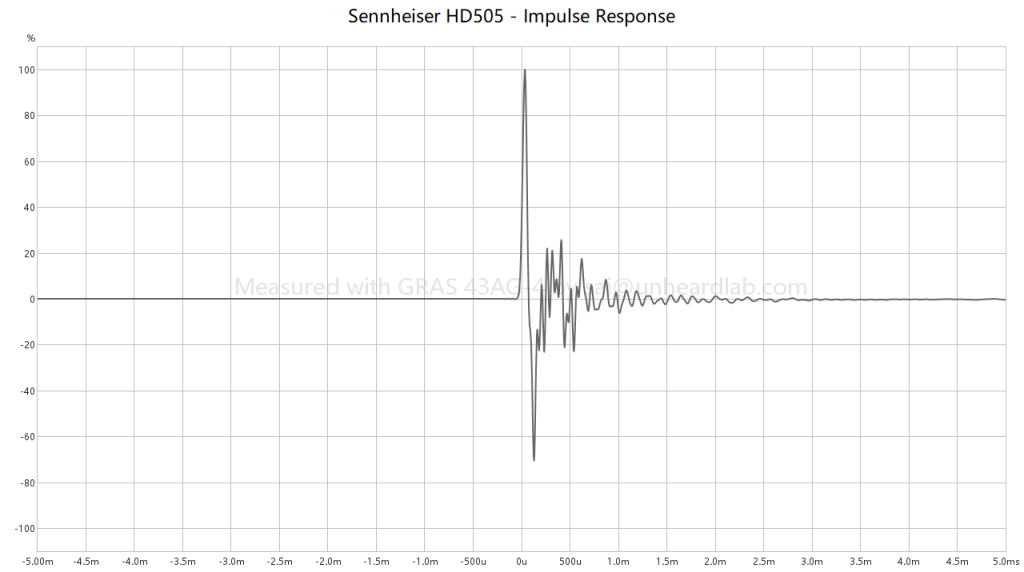
The impulse response test measures the initial response, overshoot, and decay of a transducer upon receiving a signal. An initial upshoot indicates a normal polarity, vice versa.
Comment: the HD505 displays a normal impulse response – nothing out of the blue here.
Total Harmonic Distortion (THD 2nd-9th)% & Group Delay (94 dBC):


These measurements are conducted in quiet, normal room conditions (as opposed to an anechoic chamber), meaning there may be some influence from ambient room and external noise. These results should be considered a preliminary assessment of performance, primarily for identifying major issues, and do not reflect the best-case performance scenario.
Comment: The HD505 performs okay at 94dB—not impressive, but generally not an issue for general listening. Bass distortion level is quite high (much higher than on the HD560S), similar to the increase observed when moving from the HD800 to the HD800S, likely due to the added bass quantity nearing the limitations of the driver given the high third-order component in the distortion profile.
Channel Matching:

Channel matching graphs are intended for quality control checks and do not relate to the perceived sound profile. A specialised configuration is used in this test to capture differences between channels, mitigating interference from positioning on the rig and the asymmetry in the GRAS pinnae design, a legacy of KEMAR. The left (blue) and right (red) channels are measured using a flat plate coupler with an IEC60318-4 ear simulator.
Comment: Channel matching on this particular unit is good, which may contribute to imaging precision and the clarity of spatial cues.
Electric Phase & Impedance:

The above graph shows the measured impedance (green) and electric phase (grey), measured under free-air condition (minimal front volume coupling).
Comment: The HD505’s impedance curve is typical of a moving coil headphone. Using an amp with a higher output impedance can shift the frequency response, causing elevations near the impedance peak—something to keep in mind.
END OF THE ARTICLE
Disclaimer: This review is not sponsored or endorsed by any business or related entity. The headphones reviewed are my own unless stated otherwise. Any links or recommendations included are purely informational and do not involve any financial affiliation or endorsement on my part.

Hello Sai.
Another great review from you, thank you for that.
As an owner of the HD560S, I was curious to see the differences to the new HD505, but they don’t seem to be that big.
In Germany, the new HD505 costs 279 euros, while the HD560S costs around 150 euros, so it’s significantly cheaper, at least for now.
I think the HD560S is very good out of the box, I just use a low-shelf filter to linearize the bass.
The slight peak between 4-5kHz, maybe 2dB above the Harman Target, doesn’t strike me as too negative. If you look at the frequency response of the HD560S, this peak obviously stands out, but that’s probably because the rest is so clean. Other headphones often have more ups and downs in the FR.
All in all, the HD560S is a very good and inexpensive pair of headphones that does a lot of things right out of the box.
Visually, I think the HD505 is very well designed and appealing, but I think I will stay true to the HD560S.
Best regards from Bavaria/Germany, Stefan
LikeLike
Hi again Stefan!
Yep, your observations are spot on. I also find the main deviation from a neutral sound on the HD560S to be that 4-5kHz emphasis. I’m a bit sensitive to this region, so I personally EQ it down, but it’s not a harsh or unpleasant peak, so I can see how it wouldn’t be an issue for everyday listening.
That said, I had another pair—the pro-line counterpart, the HD400 Pro—and that one sounded noticeably worse, with a grainier treble. So I suspect there may be some unit variation in the HD560S series as well.
The biggest upgrade on the HD505 is IMO the comfort, but since you’re happy with the HD560S, I don’t see much reason to upgrade, especially considering the high release price of the HD505.
Best,
Sai
LikeLike
Hi Sai.
As far as I know, the HD560S was probably slightly modified by Sennheiser sometime between 2022 and 2023, as some measurements in other forums show. The current measurements by oratory1990 also seem to confirm this.
Old measurements have a much more pronounced peak between 4-6kHz, similar to the HD400Pro, newer measurements have a more subdued one between 4-5kHz.
BR, Stefan.
LikeLike
Ah yes, that’s something I’ve been meaning to bring up, but I haven’t looked into the details yet. Thanks for the note! My pair of the HD560S came with the 3M long cable, so in theory, it’s from one of the earlier batches. The 4-5kHz peak isn’t as pronounced as what I heard on the HD400 Pro I had before, so I suppose the revision could be a factor there as well.
LikeLike
i have 560s with eq so this seems unnecessary… thanks for your review
LikeLike
With EQ, yeah, spot on. Unless the comfort on the 560S bothers you, there’s no real need to upgrade. But even then, it might not be worth the extra bucks.
LikeLike
Wussup Sai-sama. Love your review, especially the ADHD-friendly TLDR part. Can’t wait for your upcoming review of Halo EH-1. I have a sense of extreme competence from its name…or is it just a parody of Sennheiser’s HE-1?
LikeLike
Lol, hey there! Arigato for the kind words!
As for the Halo EH-1, I don’t think there’s any connection to the HE-1, at least not intentionally. EH probably just stands for Electrostatic Headphone. That being said, it actually sounds way more competent than you’d expect for the price, definitely punches above its weight. But nah, I highly doubt they had the HE-1 in mind when naming it.
LikeLike
Hello Sai.
Do you plan to review the XK Audio Serene?
I own the MOONDROP COSMO and Venus,
I am trying to decide between NAN-7 and Serene for my next headphone purchase.
LikeLiked by 1 person
Yeah, I do plan to review it, but it’ll take a while. I also ordered the Tungsten, and I want to include it in the comparison. With that, I’ll have almost all the gold-traced planars covered, haha. So the NAN-7 will definitely be compared as well.
The Serene and NAN-7 are quite different in terms of design and presentation. TL;DR: I like the sound of the Serene, but not the weight and fit. The Serene has a more intense, sharper focus, with a smaller stage compared to the NAN-7, but it offers more finesse, midrange clarity and upper extension. If you’re looking for something to complement the Cosmo, the NAN-7 might be a better fit, whereas the Serene is more in line with what you already have.
LikeLiked by 1 person
Thank you!
That was very helpful.
Knowing that Serene and COSMO are similar is extremely useful information.
I’m looking forward to your review of the Serene!
LikeLiked by 1 person
The HD6xx really makes most of Sennheiser’s lineup seem pointless, to be honest. At $199, it’s almost impossible to recommend anything else they make until you get to the HD800S.
LikeLike
Yeah that’s true Evan. For me the HD650/6XX/600 still stands out as the overall better pick compared to most of their newer offerings.
LikeLike
Hello Sai! I’m a Korean reader who was deeply impressed by your NAN-7 review. I have one question: The XK Audio X1226 and the Xinsheng Dracula 1266 seem to have identical frequency response graphs on Squiglink. I’m curious if you actually felt a difference between the two products when listening, and which product you preferred.
LikeLike
Thanks for the kind words!
Sonically, I’d say they’re close enough you could mistake them for being the same headphone. The Dracula might have slightly better extension on both ends, but it’s a pretty small difference.
My guess is they might be coming from the same factory, but I can’t say for sure. Either way, if you’ve heard one, you’ve more or less heard the other.
Also, shoutout to the Korean audio community—I’ve seen some great discussions and passion coming from there. Always cool to see how global this hobby really is.
LikeLike
Thanks for the kind reply!
The Korean community is quite small, so we’ve been debating the same topics for years—custom cables, whether amps really matter, preferences by price range, and so on. Haha.
One last question, if you don’t mind—would you say it’s pretty close to the original 1266 TC?
I’ve seen the clone version going for around $700–800, and I’m wondering if you think it’s worth picking up as a secondary pair.
For reference, I’m currently using the E70V and A90D with the HEDDphone ONE and HD820.
LikeLike
My pleasure. I always find it interesting how certain discussions just never seem to go away no matter where you are haha.
As for your question: I’d say the clones get some aspects of the AB1266 right, particularly the overall tuning and presentation style. However, they don’t really capture the raw dynamics, impact, or sense of scale that the real 1266 delivers. The bass on the clones isn’t terrible, but it’s not nearly as visceral or punchy either (which is also reflected by their significantly higher fs frequency), and the staging feels a bit flatter by comparison. They also share some of the original’s quirks, like the somewhat hollow midrange.
At that price, if you’re curious and looking for something a bit different to complement your current setup, I suppose it could be a fun second headphone to own. Just go into it knowing it’s more like “inspired by” rather than a true 1:1 clone. I suspect that’s because they don’t have access to the original driver tech/material.
Personally, I would rather see them build upon the original design, improve the fit, and create something unique and proprietary with the resources they have.
Let me know if you want a few more thoughts!
LikeLike
Thanks for your work! Fiio’s FT-7 just released this week. Will you be reviewing it?
LikeLike
Cheers, maybe one day! 😉
LikeLike
I’m writing to ask a quick question about your measurements for the Sennheiser HD660S2, HD650, and HD600 you share on squig.link. I saw you measured them with “Aide cooling gel pads,” but I can’t seem to find this product anywhere online.
Could you please tell me the specific brand or product you used? Any information would be greatly appreciated.
LikeLike
Hi mate, they are effectively the same as the Soulwit cooling gel HD6 series pads. Aide is the name of the company that manufactures it.
LikeLike
thanks!
LikeLike