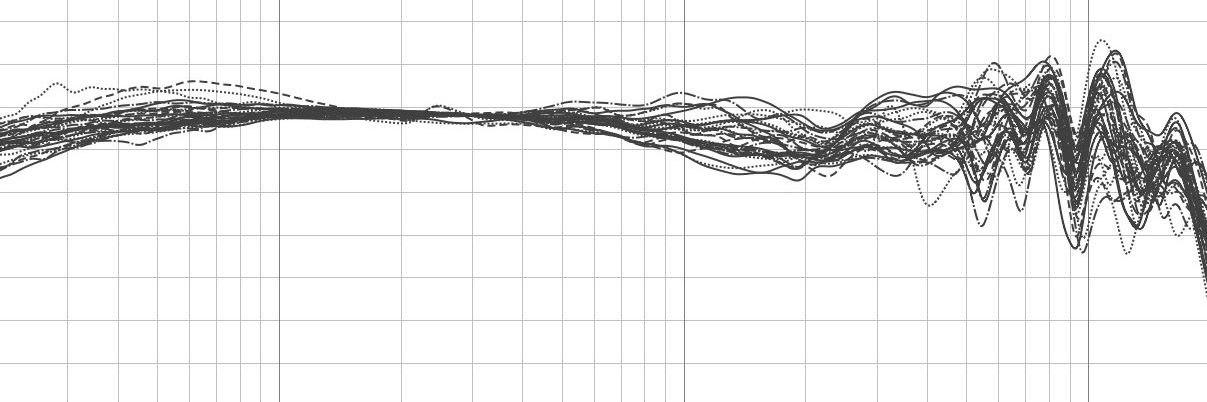

Disclaimer: this unit is purchased and owned by unheardlab.
First impression:
I like how these sound. Going in, I was expecting a neutral/warm neutral tuning based on my previous experiences with the R70X. That said, it’s been a while since I last heard the R70X, so I can’t provide a direct comparison as much as I’d like. Instead, I’ll mainly compare the R70xa to the HD650/6XX. I’ll try and get a pair of the R70x for comparison, so stay tuned.
Before that, I want to say something about the build and comfort. This is where I feel a bit let down especially in terms of build quality. While the chassis itself is fine, the headband feels like a downgrade. The design is somewhat awkward with limited ear cup articulation, which sometimes prevents a snug fit around my jaw and can cause slight leakage. There’s a hard stop at the top of the ear cup, restricting its movement – a design choice that, in my opinion, wasn’t necessary. It reminds me of the Moondrop Void in this aspect, though thankfully not as extreme.
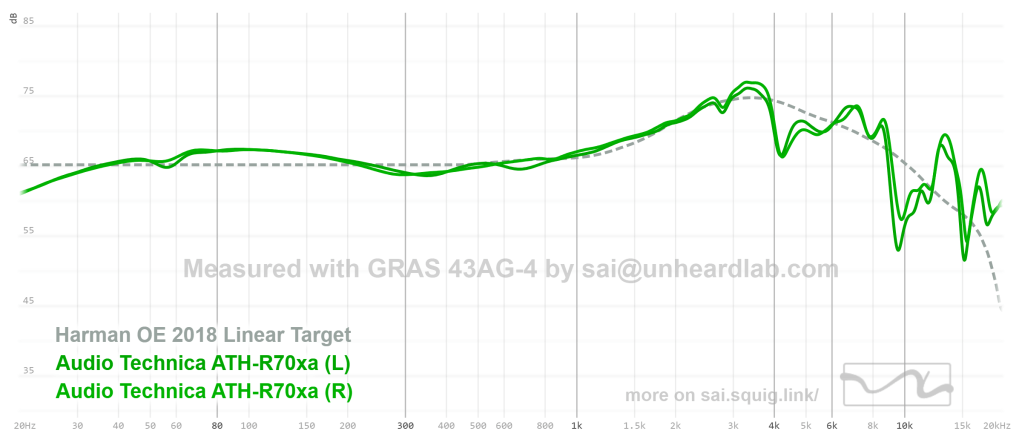
Right off the bat, the R70xa comes across as more U-shaped – with better bass extension and a more pronounced treble than the HD650. It feels ‘livelier’ and more dynamic, with kick drum thumps and snare hits carrying extra weight and clarity. This is likely due to the bass lift below 200Hz and the added treble presence. But it’s not as smooth or forgiving as the HD650. There’s a bit more grain, growl, and attack in the midrange and up, which makes it more engaging but potentially fatiguing if you’re used to the HD650’s relaxed presentation. Would this make the R70xa more suited for mixing and mastering? Possibly. Its added clarity and more revealing nature could lend themselves well to studio work, though that depends on individual preferences and how one defines ‘accuracy.’
In that sense, the R70xa reminds me more of my HD580 (black silk version). Imaging is sharper and more focused, while the soundstage is slightly wider and more diffused. The R70xa driver seems quite capable, but I think it could benefit from some fine-tuning through PEQ, acoustic damping, or pad swaps. It’s not an overly bright headphone by any means, though it could still benefit from more refined treble transitions. I’ve tried and measured a few aftermarket options, but I need more time to form my opinion on them.
Is it an upgrade over the HD650? I’m not sure yet, at least not in purely sound quality terms. I need more time to compare them thoroughly. But for now, I’d call it more of a sidegrade with a different tuning approach. One advantage of the R70xa is its flexibility: pad rolling is much easier compared to the HD650, which is limited by its plastic mounting system.
Aside from the standard set of measurements taken with the GRAS 43AG-4 and KB5000 pinna, HPTF measurements are available using KB501X and KB006X clone pinnae.
Below is the frequency response measurement of the R70xa. For the full suite of measurements, see the final sections of this article.
Specs & Comfort
Price: US$ 349/ AU$ 499
Driver size: 45 mm dia.
Transducer type: moving coil
Sensitivity: 97 dB/mW @1kHz
Impedance: 480 Ω @1kHz (measured)
Connector: dual 2.5 mm TRS locking
Weight: 199 grams
Clamping force: light
Comfort: 8/10 (not enough articulation/adjustments)


MEASUREMENTS
Frequency Response Average (unsmoothed):

The response is obtained by an average of 5-6 positional variations. The FR shown on the graph is unsmoothed.
Positional Variation:

This graph illustrates how headphone placement on the head affects perceived tonal balance: with the ear positioned at the front (blue), centre (purple) and back (red) of the headphone. The FRs shown on the graph are unsmoothed.
Leakage Tolerance:
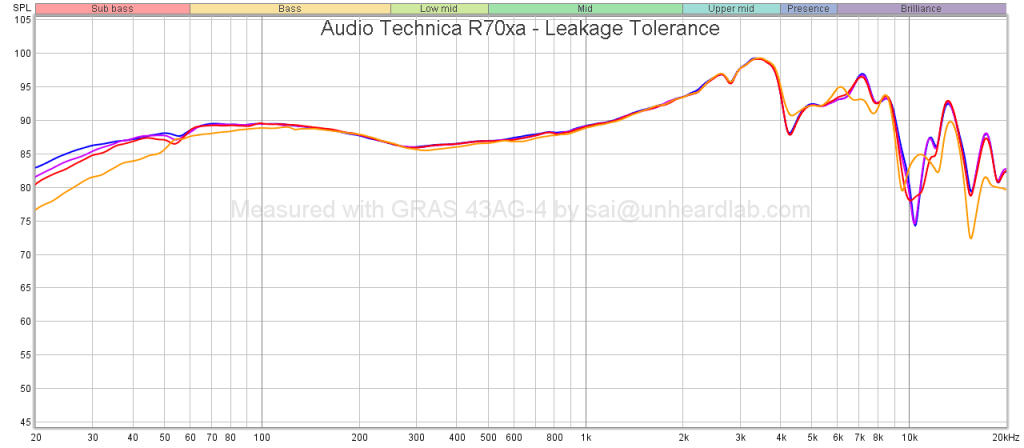
This graph demonstrates how leakages to the front volume can result in FR change: blue (good seal), purple (hair), red (thin arm glasses), yellow (thick arm glasses). The FR shown on the graph is 1/12 octave smoothed.
Impulse Response:

The impulse response test measures the initial response, overshoot, and decay of a transducer upon receiving a signal. An initial upshoot indicates a normal polarity, vice versa.
Total Harmonic Distortion & Group Delay (94 dBC):

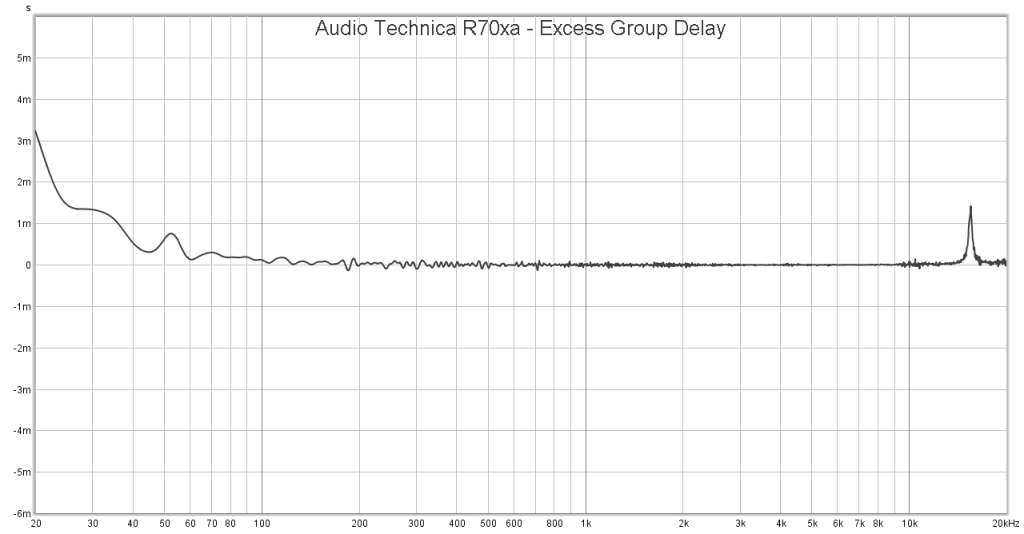
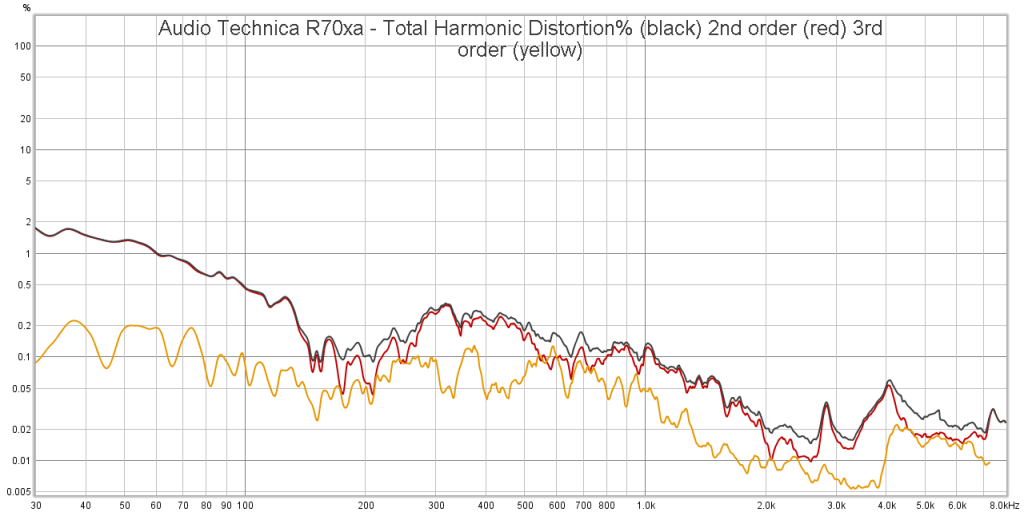
These measurements are conducted in quiet, normal room conditions (as opposed to an anechoic chamber), meaning there may be some influence from ambient room and external noise. These results should be considered a preliminary assessment of performance, primarily for identifying major issues, and do not reflect the best-case performance scenario.
Channel Matching:

Channel matching graphs are intended for quality control checks and do not relate to the perceived sound profile. A specialised configuration is used in this test to capture differences between channels, mitigating interference from positioning on the rig and the asymmetry in the GRAS pinnae design, a legacy of KEMAR. The left (blue) and right (red) channels are measured using a flat plate coupler with an IEC60318-4 ear simulator.
HpTF Measurements (experimental):

The Headphone Transfer Function (HpTF) describes how sound is shaped by headphone design and ear anatomy before reaching the eardrum. Different measurement rigs (with varying pinnae designs) introduce unique reponses/resonances and potential deviations from actual human perception. Understanding HpTF helps translate measured data into real-world listening experiences.
Electric Phase & Impedance:
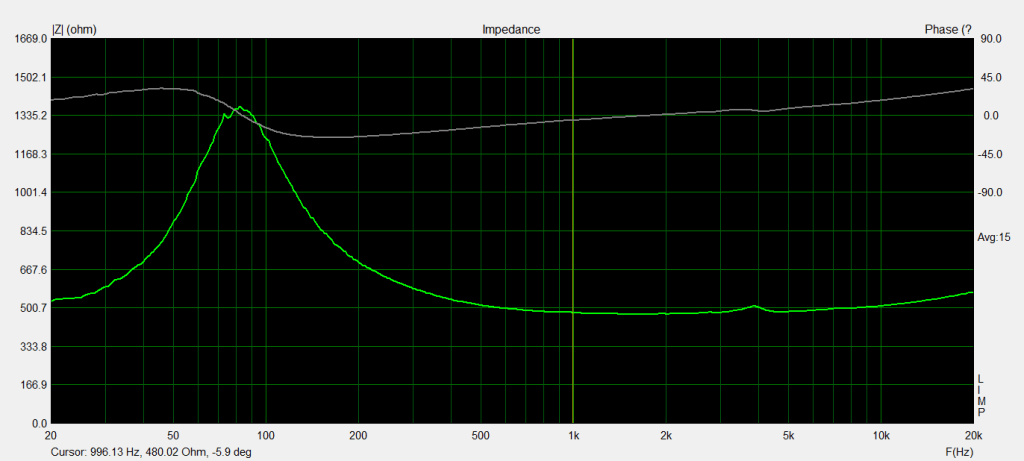
The above graph shows the measured impedance (green) and electric phase (grey).
END OF THE ARTICLE
Disclaimer: This article is not sponsored or endorsed by any business or related entity. The headphones reviewed are my own unless stated otherwise. Any links or recommendations included are purely informational and do not involve any financial affiliation or endorsement on my part.

will r50x have an article like r70xa?
LikeLike
Hey there! The R50x I measured was a demo unit. It’s more V-shaped than the R70xa, but I think it’s quite well-executed: the treble elevation is even, without any major peaks or dips, just overall more treble presence. It reminds me of some of the better tuned AKG and Hifiman headphones. If I end up buying a pair, I’ll definitely write about it.
Funny thing: the R50x stock pads are made of a suede-like material and are slightly thicker than the R70xa’s. They actually feel more premium to me and seem to make the sound a bit warmer. Now I’m hoping Audio Technica sells the R50x pads separately.
LikeLike
Thanks for your reply. I look forward to your comments and further measurements on the R50X and R30X.
As far as I know, some merchants on Taobao are selling third-party earmuffs for the R70X, with many different thickness options.
As shown in your measurements, the R50X seems to have more treble than the DF target, which may be solved by taobao earmuffs and adding sponge cushions.I guess the r50x might be a little closer to Harman target.
LikeLike
Thanks! Yeah, I’m aware of the Taobao pads. I measured what seems to be the closest to Audio-Technica’s original ones with the R70xa, which are quite thin (~15mm). Do you have a specific one in mind? Flatter pads tend to reduce treble resonances, but with the R50x and R70xa, pads that are too thin can be an issue due to the headband design.
LikeLike
On the DIY-Audio-Heaven website, Solderdude used AKG Foam Net Piece K-270/K-271 to modify the r50x, which reduced the peak value by 7~20khz. It seems that this method can effectively solve the problem of R50x’s treble being too bright.
I plan to try it soon and am looking for a way to buy it.
LikeLike
Thanks for the heads up! That indeed seems to make the R50x much more palatable in the treble. I’m still holding out for a sale myself – they’re marked up quite a bit here in Australia. Hopefully not too long to wait.
LikeLike
Waiting for your review of XK Audio Serene. I saw that you already measured it.
I must say I’m freakin impressed. Lately I bought them almost blindly, and it’s freakin jackpot.
Truly impressive headphone that competes with everything regardless of the price.
LikeLike
Hi there. Yeah, the Serene is a really solid headphone. Quick take: it’s really really capable and well-tuned, definitely up there with the big boys. My main gripes are the weight, comfort, and the super air-tight design of the pads and front volume seal, but overall, it’s defintely a strong entry into the planar scene. It’s not a very well-known headphone, though. Just curious, where did you hear about it?
LikeLike
Hello! Really awesome reviews!
Do you think the R70XA is a better choice than the Fiio FT1 Pro and the Aune AR5000? These three seem to be the most talked about headphones in the 200-300 price range recently.
Also, I’ve been going through a lot of them and have been finding them super informative.
Just wondering if you were planning on reviewing the XK Audio Avalon MK2? You have a lot of the XK Audio headphones graphed and this one seems like an interesting choice given it’s sub-$500 price point and the top of the line placement in the XK Audio collection (alongside the Serene).
LikeLike
Hi there! Thanks for the kind words!
I wouldn’t necessarily say the R70xa is the better choice—it really depends on what you’re looking for. At its current $349 price, it’s $50 more than the AR5000 and $150 more than the FT1 Pro, which is quite a jump. Sonically, I’d say they’re all in the same tier, just with different strengths.
The Avalon MK2 I measured was a loaner, and it’s definitely a great-sounding headphone, ie. not just good on paper/graph. If I were to do a full review though, I’d need to borrow it again or buy one myself. But if you’re just looking for some quick impressions, let me know, and I can drop them here!
LikeLike
I appreciate the reply!
If I was looking for something similar to the HD6X0 series but wanted more bad extension and treble energy would, which of the three would be the closest out of the three?
And I’d definitely appreciate quick impressions on the Avalon! I’m considering ordering a pair of that, the Serene, or a Nan7.
Cheers!
LikeLike
No worries, man!
Based on your preferences, I’d say both the Avalon MK2 and the Nan-7 would be solid choices. The Avalon leans more toward a conventional dynamic headphone sound but really delivers on bass extension and clarity. It’s very well-balanced—great bass impact and oomph, a lively and articulate midrange, and clear highs. The bass, in particular, has some of that planar-like extension and touch. Soundstage isn’t massive (not on an HD800 level) but is about on par with the Focal Clear. Overall, it’s a very competent dynamic headphone—not quite on the level of the top planars, but it competes well with pricier dynamic options.
The Nan-7 is the more capable headphone overall, though not neccessarily better tuned, but its flexibility with pad rolling allows you to fine-tune it to your liking. It does cost more, but if you’re looking for something that can adapt to different tunings, it might be the better pick.
The Serene is also a great headphone, but its tuning isn’t as smooth as the HD6X0 series. Plus, the ergonomics and fit aren’t as ideal compared to the Avalon or Nan-7.
Hope that helps! Let me know what you end up going with.
LikeLike
Well looks like I’ll be ordering the Nan 7 soon 🙂
Thanks for all the help!
Just curious, what is your main headphone these days?
LikeLike
I think you can’t go wrong with any of the options! If you’ve had other planars before and are used to their sound, the Nan-7 will likely impress. Otherwise, the usual caveat of a “plucked” planar sound applies—some also find the Nan-7 a bit unflavourful/dry, though this is something pad-rolling can help. If you’re looking for something more conventional, the Avalon MK2 is a solid all-rounder.
As for my main headphone—well, as a “reviewer,” it’s sometimes tough to stick to just one, but I try to keep my collection relatively small these days. I have the Nan-7 and HE-6 OG as my planar reference sets, with the HE1000 Stealth as the brighter test case. The HD600 is still my standard for general listening, while the Focal Clear is my go-to for a kickback session (I like the Utopias too, but their price tag is much harder to justify). For electrostats, the SR-009 has been my favourite (although I don’t own one).
LikeLike
Hi Sai,
I own a Hifiman Xs and a Sennheiser HD650. I like the soundstage of the Xs, but find the treble a bit too bright, and I’m not a fan of the dip in the mids around 1-2 kHz. On the other hand, the mids and treble of the HD650 are perfect for me, but it lacks a bit in bass and soundstage. I do have a preferred sound signature, but I’m not really into the technical aspects like resolution or imaging—I’m not at an audiophile level to notice much difference in that regard. Is there any headphone on the market that might suit me tonality-wise? looks like the rx70a might be a potential candidate. Ideally, my budget is around $500, but I can stretch it further if needed. The most expensive ones I’ve owned are the HD800s, but I didn’t keep them for long because they were too bright for me. Thanks for your input!
LikeLike
Hey there,
So, an ideal headphone for you would have the mids and treble of the HD650 but with better bass extension and a larger soundstage—a preference I think many people share! Personally, I do find the HD650’s treble a bit dark, especially for classical and acoustic recordings, but for modern pop, rock, and J-pop, it’s pretty much spot-on. Maybe just a bit of extra airiness and treble extension would be all I’d want from it.
The R70xa could indeed be a good fit. It’s more U-shaped, with better extension on both ends, and the soundstage is more expansive. For those who think the HD650 sounds ‘veiled’, I can assure it is not the case here. However, it is also brighter than the HD650, particularly in the 6-9kHz region, where a lot of instrumental timbre and vocal sibilance come into play. Percussive hits and certain sibilance tones may sound more pronounced, but I personally don’t find them overly sharp or bright—definitely not as bright as the HD800S.
One key caveat is fit. If you have a larger head, the lack of horizontal articulation in the design might be an issue. But if the fit works for you, I think the R70xa check a lot of your boxes.
Another option is the Aune AR5000. It’s slightly less U-shaped than the R70xa and not as “technical,” but it has a better fit and a smoother, more relaxed tone. If comfort is a big factor, this might be the safer bet.
Lastly, a notable mention is the Focal Clear. It’s more expensive, and soundstage isn’t its strongest aspect, but tonality-wise, it aligns well with what you’re after.
Hope that helps! Let me know if you need more details.
LikeLike
The HD650 is from 2003 and, after Sennheiser sold its consumer business, was since then superseded by the HD 490 Pro (Which is actually from Sennheiser, no the consumer branch) and that one is the direct competitor to the ATH-R70xa.
And the HD 490 Pro (With Mixing Pads) sounds actually very similar to the ATH-R70xa which is no surprise as they are intended for the same purpose. But the HD 490 Pro is way more comfortable, sadly. I like the design and the brand Audio Technica but the HD 490 Pro is slightly cheaper too. For me, it was the better deal.
LikeLike
Thanks for the input. It’s a bit of a different story here in Australia: over here, the regular HD 490 Pro (non-Plus version) retails for around A$600, while the R70xa goes for $449 (I actually got mine for $399 during the first batch pre-order).
That said, I haven’t had the chance to hear the HD 490 Pro myself, so I can’t make a direct comparison on sound just yet.
LikeLike