
Upgrade, downgrade or side-grade?
Intro:
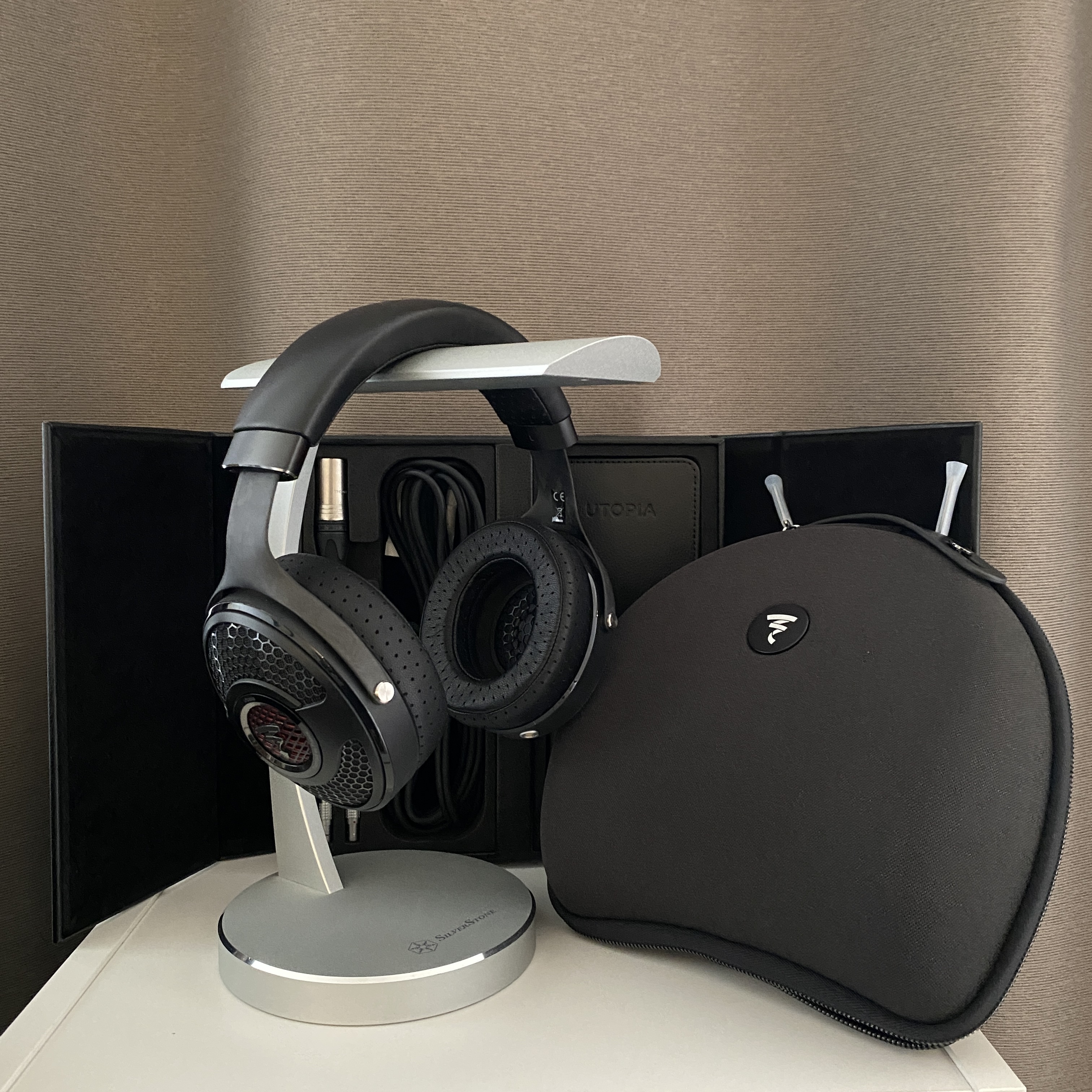
I’ve reviewed several Focal headphones here before, ranging from the budget-friendly Elear to higher-end models like the Clear MG Pro and the Radiance. Focal’s rich, engaging tuning has always been to my taste. This time, I have here Focal’s latest flagship, the Utopia 2022. With a significant price premium, does it deliver improved sound? And how does it compare to the beloved Utopia OG?
Let’s find out.
Check out the final section of this article for detailed measurements.
Specs & Comfort
Price (RRP): US$ 4999 / AU$ 6999
Driver size: 40 mm ø
Transducer type: dynamic
Sensitivity: 104 dB/ 1mW @1kHz
Impedance: 80 Ω @1kHz
Connector: dual Lemo
Clamping force: light
Weight: 492 grams
Comfort: 6.5/10


Measurement & Sound

link to the frequency response measurement & more comparisons
Tonal balance:
In short, the Utopia 2022 delivers a sound profile that is rich, smooth, and impactful. It carries a subtle warmth, an added sense of punch but avoids sounding boomy or muddy. The mids and highs are well-textured and articulate, with a hint of polish that gives them a smooth character.
The bass quality is exceptional, offering a deep, punchy performance with outstanding tactility and impact. The degree of subbass roll-off is much smaller compared to typical open-back dynamic headphones. While the quantity of bass might not be the most abundant, its tightness and dynamic slam are remarkable. It has an overall similar tonality as the Audeze LCD-5, but much fuller and punchier in the bass. The contrast between weaker and stronger bass notes, as well as the change in volume, are exceptionally clear.
The bass here is highly addictive and easily among the best in headphones. While some might prefer the fast transience and linearity of bass from top planar headphones, the Utopia 2022 is undeniably superior in its tactility.
The mids are articulate and smooth, while slightly warmer than neutral. Backed by the robust bass presence, the mids have a fullness that makes the Utopia 2022 an excellent choice for modern pop and rock genres. Vocals are somewhat forward but avoid being shouty or aggressive. Compared to the Audeze LCD-5, it sounds noticeably richer and fuller while not as ‘in your face’.
Acoustic guitars sound phenomenal, though the timbre of pianos and woodwinds can feel slightly forward or ‘clangy’ compared to dead-neutral tuning. This is largely due to the rise in mid-low frequencies between 50Hz and 300Hz and the 1kHz bump, which add body resonance and lower harmonics.
The highs are smooth and inoffensive though still sound decently clear. Compared to the original Utopia, the 2022 version tones down some of the peakiness. Vocal sibilances are somewhat downplayed, with an almost lush quality. As such, the treble may come across as slightly dark. Percussive instruments are clear but lack the crispness of the OG or Clear models, and they’re far removed from the sharp attack edges typical of many planar or electrostatic headphones.
While there’s a touch more air at the very top than the Clear and the original Utopia, the reduced sparkle is more noticeable than the increased airiness. Fans of the conservative treble presentation of the HD6XX might appreciate the shift from the Utopia OG to the 2022. To me at least, the 2022 model seems a bit ‘overly refined’ – I’d love to see a middle ground between the two, which I believe would be perfection.
Other qualities:
- Soundstage
The soundstage on the Utopia 2022 feels natural and slightly more spacious than the previous generation. It’s also noticeably wider than the Clear MG, though it still can’t match the expansive presentation of models like the Hifiman HE1000se. All in all, it’s probably not something to write home about.
Imaging, however, is one of the Utopia 2022’s strengths. Like its predecessor, it offers a very convincing, holographic and realistic sense of image projection, particularly with midrange contents. The imaging is focused and well-defined, far surpassing the slightly glossed-over sound of the Clear and Clear MG. It almost makes me wonder: what’s the magic with the Utopia model?
- Clarity
The clarity and resolution of the Utopia 2022 are respectable but not extraordinary, especially for a $5000 headphone. If you’re expecting a crazy amount of “detail”, you might find it somewhat underwhelming. While the Utopia 2022 excels in presenting bass and mids details, the highs are slightly veiled or smoothed over. This can result in percussive hits feeling somewhat glossed over compared to the OG.
That’s not to say it lacks detail: it rivals top-tier dynamic headphones like the Sennheiser HD800S or Audio-Technica ADX5000. Yet, it should be noted that those options cost only about half as much.
- Dynamics
The dynamic qualities of the Utopia 2022 are exceptional. Its ability to present dynamic contrast and slam is top-notch, much like the original Utopia. That said, the original model feels slightly more energetic, delivering a touch more raw impact in its slam. The 2022 model, in comparison, feels more controlled in busy passages. It excels at presenting nuanced contrasts between soft and loud elements, making for a more refined sound. Both models remain among the best when it comes to dynamic performance, though, so it’s more of a matter of preference.
Conclusion and value:
The Focal Utopia 2022 is a great sounding headphone, no doubt about it. Its smooth tonality, tactile bass, and competent technical performance make it a strong contender in the high-end headphone space.
However, the steep price tag is still hard to ignore, especially in the world of dynamic headphones. While it excels in many areas, it doesn’t dramatically outclass competitors like the Sennheiser HD800S, which is available at a significantly lower price. That said, the HD800S is known for its bright tonality, which may not appeal to everyone without EQ adjustments. The Utopia 2022 offers a clear advantage here, with its well-balanced tuning straight out of the box, and the added bass punch is defintely a big plus.
If you’re a fan of the Focal sound but can’t justify the cost of the Utopia 2022, alternatives like the Clear, Clear MG, or Clear MG Pro deliver a similar tuning at a fraction of the price, albeit with slightly less technical prowess. A used pair of the Utopia OG could also be a great option, offering a comparable sound quality for much less on the second-hand market.
At the RRP of US$4999/AU$6999, the Utopia 2022 is clearly targeted at a small market segment. For those with the budget to spare and a preference for refined presentation, engaging bass, and overall musicality, it’s a considerable option. I managed to snag mine at a significant discount — something worth looking out for, as it can make this impressive headphone a much more compelling choice.
Pros: Rich, organic tonality; tactile, impactful bass performance; excellent imaging and dynamics; refined and fatigue-free treble; build quality.
Cons: High price tag; clarity is mediocre among TOTL headphones; limited soundstage depth; not sonically a significant upgrade compared to the OG.
Tonal Grade:
Subjective Qualities Grade:
Value Grade:
Notes on EQ
This headphone needs little EQ to sound balanced across the frequencies. It can still be improved, though.
My personal EQ setting for this headphone:
Preamp: -5.5 dB
Filter 1: ON PK Fc 25 Hz Gain 5.5 dB Q 0.500
Filter 2: ON PK Fc 190 Hz Gain -2.0 dB Q 1.000
Filter 3: ON PK Fc 1200 Hz Gain -2.0 dB Q 2.500
Filter 4: ON PK Fc 5900 Hz Gain -2.0 dB Q 3.000
Filter 5: ON PK Fc 8400 Hz Gain 1.0 dB Q 2.000
Filter 6: ON PK Fc 12000 Hz Gain 0.7 dB Q 1.000
If your goal is to EQ the response to match the Harman Target, consider the AutoEQ function provided by Squiglink as a convenient starting point. I personally recommend customising the filters to better suit your own hearing, especially in the treble. While the AutoEQ provides a useful baseline, individual adjustments can opften significantly improve your listening experience.
MEASUREMENTS
Frequency Response Average (unsmoothed):
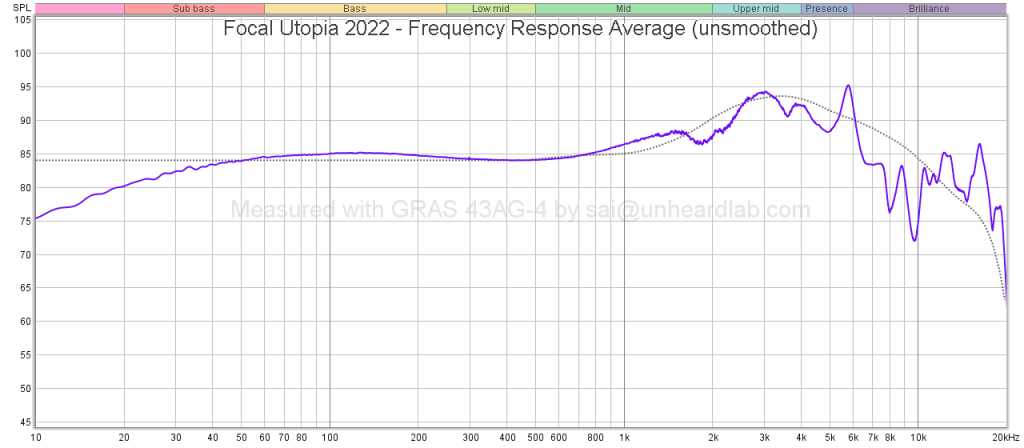
The response is obtained by an average of 5-6 positional variations. No smoothing has been applied to the FR shown here.
Positional Variation:
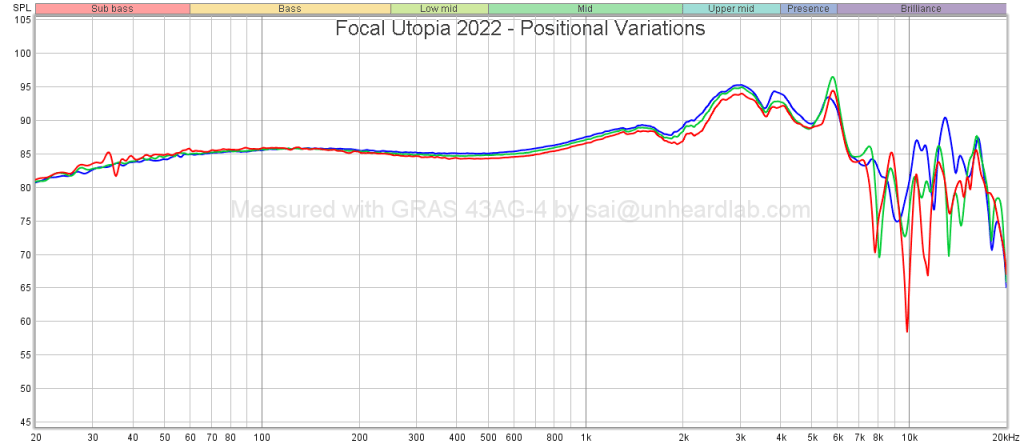
This graph illustrates how headphone placement on the head affects perceived tonal balance: with the ear positioned at the front (blue), centre (green) and back (red) of the front volume of the headphone. The FRs shown on the graph are 1/48 octave smoothed.
Leakage Tolerance:
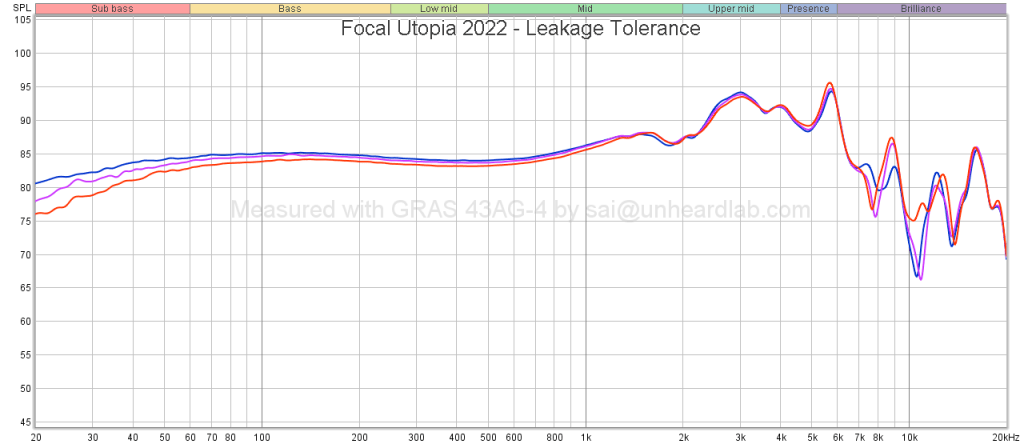
This graph demonstrates how leakages to the front volume can result in FR change. The FRs shown on the graph are 1/12 octave smoothed – good seal (blue); thin-arm glasses (purple); thick-arm glasses (red).
Impulse Response:
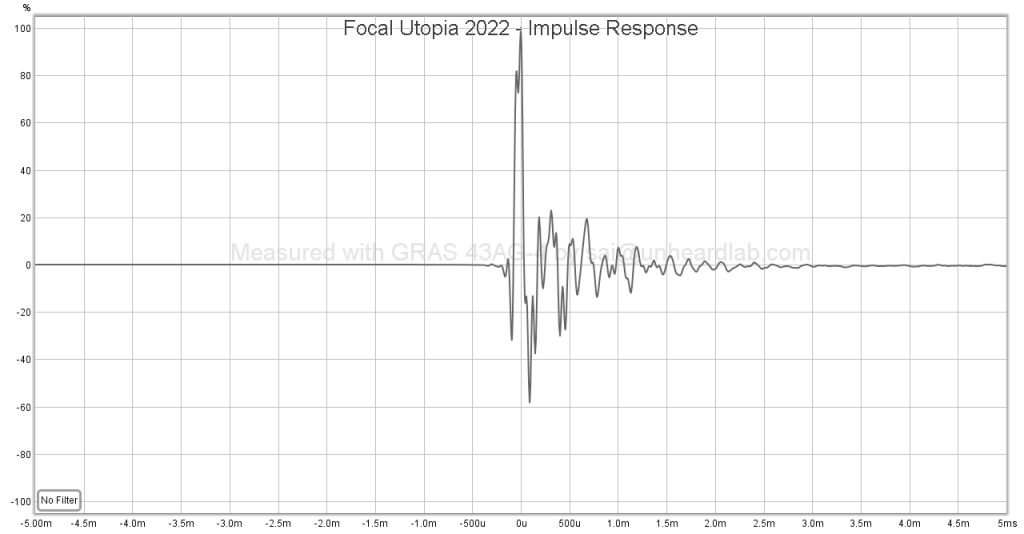
The impulse response test shows the initial response, overshoot, and decay of a transducer upon receiving a signal.
Channel Matching:
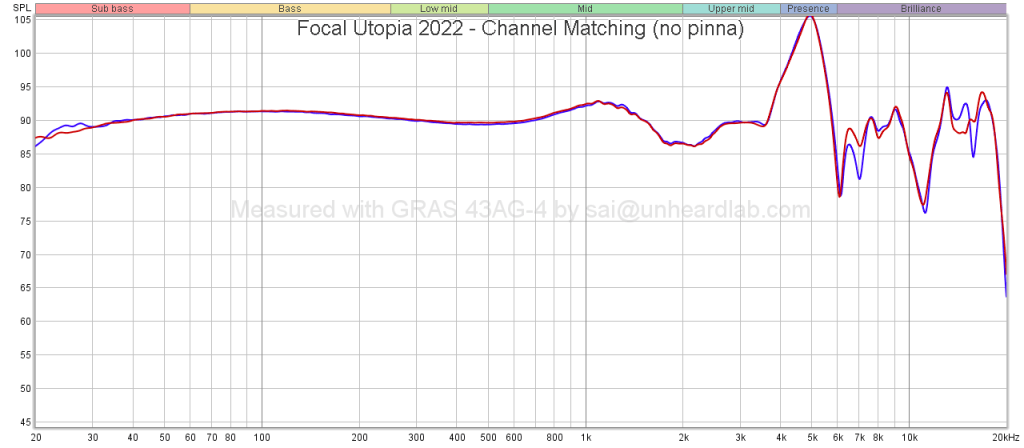
Channel matching graphs do not relate to the perceived sound profile. A specialised configuration is used in this test to capture differences between channels, mitigating interference from positioning on the rig and the asymmetry in the GRAS pinnae design, a legacy of KEMAR. The left (blue) and right (red) channels are measured using a flat plate coupler with an IEC60318-4 ear simulator.
END OF THE ARTICLE
Disclaimer: This review is not sponsored or endorsed by any business or related entity. The headphones reviewed are my own unless stated otherwise. Any links or recommendations included are purely informational and do not involve any financial affiliation or endorsement on my part.

I really like the positional measurements you provide. They explain to me very well why people hear the same headphone so differently so often.
LikeLiked by 1 person