
Intro:
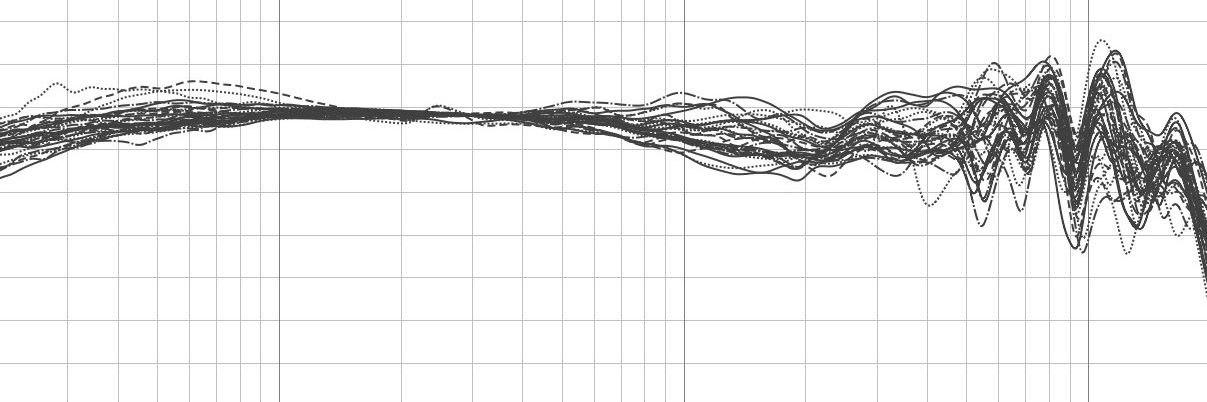
I’ve tested almost every Hifiman teardrop/eggshaped headphone. Released back in 2018 at a price of US$ 3,499, the HE1000se was once their flagship model before the new “Unveiled” series. However, it’s also known as one of their brightest-sounding headphones, making it somewhat divisive. Over time, as newer models entered the lineup, the HE1000se’s retail price has dropped to around US$ 1,999.
Hifiman has a reputation for continuously (sometimes silently) revising their products. Rumour has it that more recent production runs of the HE1000se offer a more balanced sound profile. Is this true? I’ve got my hands on a unit manufactured in mid-2023 to find out.
For those interested in detailed measurements, check out the final section of this article.
Disclaimer: the device under test here is from my personal collection.
Specs & Comfort
Price: US$ 1999/ AU$ 2819
Driver size: 80-100*65 mm approx.
Transducer type: planar magnetic
Sensitivity: 96 dB/mW @1kHz
Impedance: 32 Ω @1kHz
Connector: dual 3.5 mm TRS
Weight: 440 grams
Clamping force: light
Comfort: 7/10

Measurement & Sound

link to the frequency response measurement & more comparisons
Tonal balance:
In short, the HE1000se delivers an incredibly clear, articulate, and incisive sound. Despite rumours about newer units being warmer than previous versions, this particular mid-2023 unit remains the brightest in Hifiman’s teardrop-shaped lineup, matched only by the Arya Organic. That said, it’s not the most peaky or shrill-sounding. The treble is elevated as a whole but avoids harsh peaks or dips, resulting in a coherent presentation.
The bass is tight and impressively fast: clean, well-controlled, and free of bleed or bloom. It extends deep into the subbass range, with low frequencies clearly audible. However, the bass quantity is less satisfying compared to other models. For instance, the HE1000 Stealth offers more weight, while the HE1000se feels leaner, though still punchier than the Ananda Stealth.
The midrange is slightly recessed but paradoxically remains very clear and articulate. It’s not the full-bodied, forward midrange you’d find in headphones like the HD600. Instead, the HE1000se takes a restrained approach, much like the Susvara, highlighting texture and clarity over warmth or body. This makes it less ideal for lush, warm genres like country or vocal jazz but excellent for acoustic music, such as guitar solos, where its incisive, spacious presentation shines.
The highs are where the HE1000se excels technically, though this will be contentious for some due to its brightness. It’s undeniably bright but remains inoffensive for most well-mastered music, at least to my ears.
The treble is very airy and sparkly, extending effortlessly into the highest frequencies. Percussion instruments like hi-hats and snare drums sound energetic and bitey, making the HE1000se an excellent choice for classical and jazz. However, if a track emphasises vocal sibilance or breath, the treble can become fatiguing. Cymbal crashes, for example, can come across as too splashy. That said, for those who appreciate this type of tuning, the HE1000se stands out as one of the better-executed options in its category.
Other qualities:
When it comes to spatial performance, the HE1000se is outstanding. It sounds more open than the rest of Hifiman’s eggshaped lineup, with a noticeably more spacious soundstage. However, it still retains the signature ‘tall’ presentation of the series. Imaging is more precise than that of the HE1000 Stealth or HE1000 V2, with a holographic feel that adds depth and dimension. Individual sound elements are larger in scale compared to other headphones, though not as sharply focused as with models like the HE-6 or Susvara.
In terms of clarity, the HE1000se is a true detail monster. Its sharpness and crispness bring an incredible sense of separation and definition to the presentation. Every element is distinctly rendered, almost to the point of being ruthlessly analytical. However, it largely avoids the sterile, lifeless quality associated with some Beyerdynamic models, where the presence of major treble peaks throws off the timbre of vocals and instruments. So, if you enjoy bright, detailed tuning, the HE1000se stands out as one of the best in its category, thanks to its linear treble response.
The dynamics of the HE1000se is great, though perhaps not as impactful as one might expect from a $2,000 headphone. Macrodynamics, such as the sense of punch and slam, are similar to the rest of the eggshaped lineup, only marginally better than the HE1000 V2. That said, the HE1000se excels in microdynamics, handling busy passages with impressive control and presenting subtle contrasts between soft and loud elements. It’s the best in the series for this level of nuance, but if you prioritise dynamic impact, the HE1000se may not be the ideal choice in its price category.
Conclusion and value:
In summary, the HE1000se is defintely still a brightly tuned headphone, catering to a niche audience with a taste for detailed and airy sound. That said, the execution here is done quite well, offering a coherent tuning despite the bright tilt. The absence of major peaks makes it a mostly smooth and enjoyable listen, unless the music itself is already bright or aggressive. If this kind of presentation speaks to you, the HE1000se delivers with its technical prowess and remarkably clean, airy sound. The level of technical proficiency it offers comes very close to many top-of-the-line (TOTL) models, while its price point is less extravagant. If you love the eggshaped design and prefer a more balanced/well-rounded tuning, consider the HE1000 Stealth, which I also reviewed earlier.
Coming back to the question, have these been revised by Hifiman compared to earlier batches? Unfortunately, I don’t have an early production pair to directly compare. Based on my measurements and how they align with data from others using the same rig standard (e.g., by Crinacle and Oratory1990), there could be minor changes that make them slightly less bright. However, these differences might fall within the bounds of unit variation, and more evidence would be needed to confidently conclude that a revision has taken place.
If there was indeed any significant revisions, it is arguably the price drop on these. Currently priced at US$1,999 / AU$2,819, the HE1000se has become a much more sensible choice than it was at launch in 2018 (US$3,499/AU$5,499). As a niche, specialist headphone, it makes sense for those seeking this specific type of sound. It’s just not a crowd-pleaser — it’s the kind of headphone people will either love or hate, depending on their preferences.
Pros: Exceptionally clean and detailed and sound; airy, spacious and open presentation; excellent bass and treble extension.
Cons: May sound sharp and overly articulate; treble can be too bright or sparkly; high price point.
Tonal Grade:
Subjective Qualities Grade:
Value Grade:
Notes on pad-rolling and EQ
I have also measured a range of aftermarket earpad options for this headphone. You can see how they measure here.
The HE1000se can benefit greatly from EQ, especially if you’re aiming for a more balanced sound. With the right EQ settings, it can achieve a much more natural and smooth presentation, significantly reducing the sharpness in the treble. This makes the headphone more versatile and enjoyable across a wider range of genres.
My personal EQ setting for this headphone:
Preamp: -3.5 dB
Filter 1: ON PK Fc 1800 Hz Gain 3.5 dB Q 2.000
Filter 2: ON PK Fc 3600 Hz Gain -1.5 dB Q 2.000
Filter 3: ON PK Fc 7200 Hz Gain -1.5 dB Q 2.000
Filter 4: ON PK Fc 12000 Hz Gain -3.5 dB Q 3.000
Filter 5: ON PK Fc 30 Hz Gain 3.5 dB Q 0.500
If your goal is to EQ the response to match the Harman Target, consider the AutoEQ function provided by Squiglink as a convenient starting point. I personally recommend customising the filters to better suit your own hearing, especially in the treble. While the AutoEQ provides a useful baseline, individual adjustments can opften significantly improve your listening experience.

MEASUREMENTS
Frequency Response Average (unsmoothed):
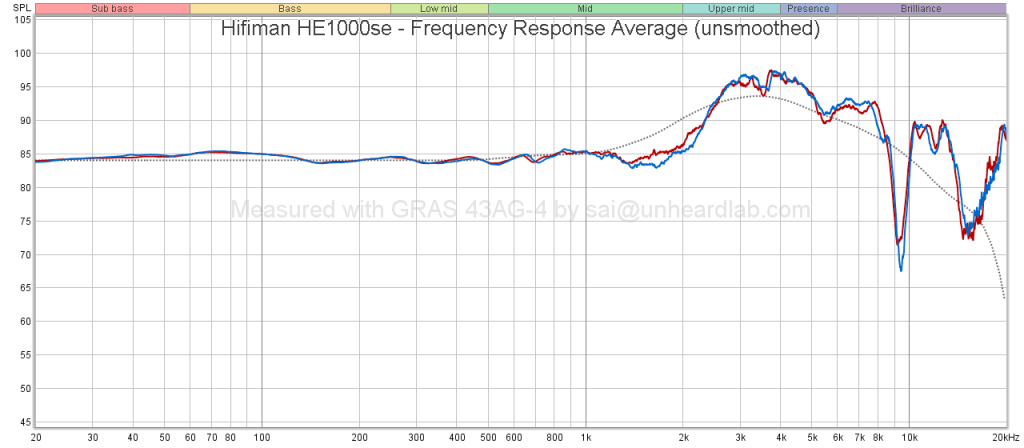
The response is obtained by an average of 5-6 positional variations. The FR shown on the graph is unsmoothed.
Positional Variation:

This graph illustrates how headphone placement on the head affects perceived tonal balance: with the ear positioned at the front (blue), centre (purple) and rear (red) of the headphone. The FRs shown on the graph are unsmoothed.
Leakage Tolerance:

This graph demonstrates how leakages to the front volume can result in FR change. The FR shown on the graph is 1/12 octave smoothed.
Impulse Response:
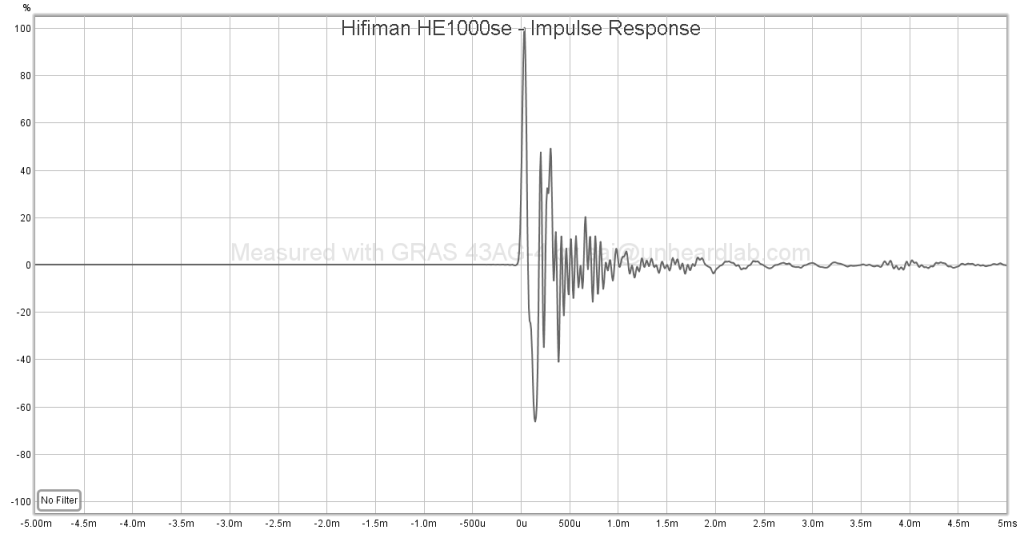
The impulse response test measures the initial response, overshoot, and decay of a transducer upon receiving a signal. An initial upshoot indicates a normal polarity.
Channel Matching:
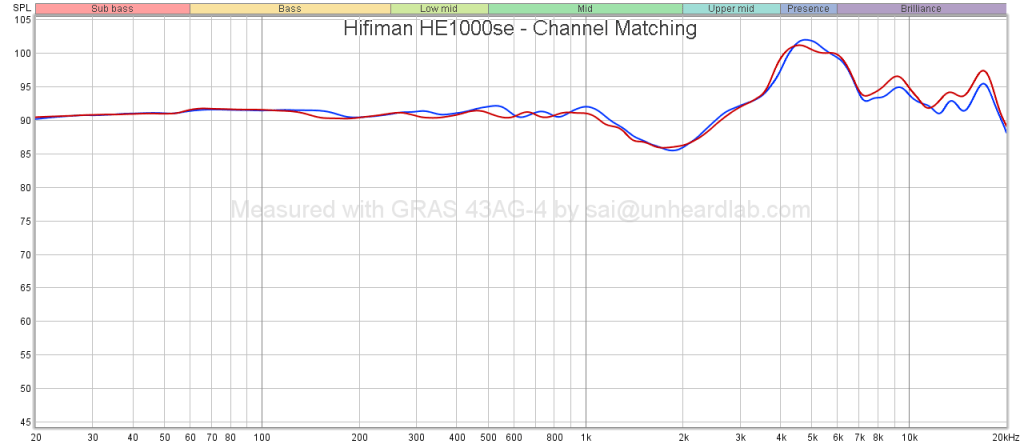
Channel matching graphs do not relate to the perceived sound profile. A specialised configuration is used in this test to capture differences between channels, mitigating interference from positioning on the rig and the asymmetry in the GRAS pinnae design, a legacy of KEMAR. The left (blue) and right (red) channels are measured using a flat plate coupler with an IEC60318-4 ear simulator.
Electric Phase & Impedance:
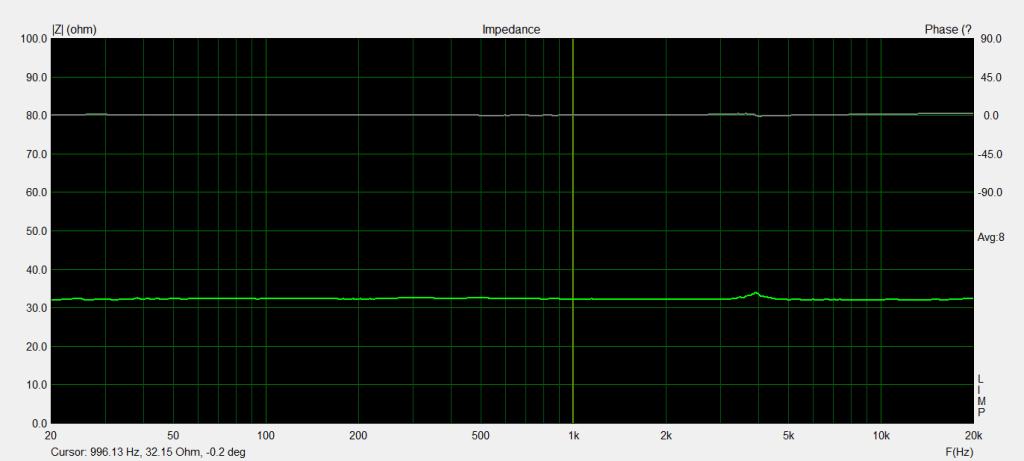
The above graph shows the measured impedance (green) and electric phase (grey).
END OF THE ARTICLE
Disclaimer: This review is not sponsored or endorsed by any business or related entity. The headphones reviewed are my own unless stated otherwise. Any links or recommendations included are purely informational and do not involve any financial affiliation or endorsement on my part.

I’ve never really understood what audiophiles mean by “technicalities”. Hifiman planars all seem to measure pretty similarly and I’m sceptical there’s much of a meaningful upgrade with the expensive models.
LikeLike
Have you tried the Susvara? I thought they be mid but they blew me away.
LikeLike
I’ve always wanted to write something about this topic, but I haven’t gotten around to it yet. In short, I don’t see ‘technicalities’ as completely separate from the frequency response. In fact, many of the qualities we describe as “technical” can often be traced back to specific parts/nuances of the FR itself. Even if they may not be determined by the FR alone, it is often most certainly reflected in the FR in one way or another.
So why do we discuss technicalities as if they’re a separate concept? To me it’s because they help us describe certain aspects of the sound we experience—like how spacious a headphone feels, how detailed it sounds, or how punchy the bass comes across. For example, spaciousness might stem from the contrast between midrange fundamentals and harmonics, detail often ties to treble extension and linearity, and bass punch can depend on the structure of the low frequencies and the driver’s excursion limits. These are just examples and I don’t mean to suggest they are the final words on the topic, just food for thought.
While these are certainly related to the FR, they’re not always as straightforward as simply looking at a graph. Some of these qualities may involve more nuanced aspects of the transducer’s behavior that aren’t fully captured by a single FR measurement. Factors like phase response, coupling behaviour, FR at different input/SPL levels, and even limitations in measuring high frequencies using the current 60318-4 microphone can all play a role in shaping what we perceive as “technicalities”.
So, while FR remains the most important indicator of a headphone’s sound, what people refer to as “technical qualities” give us a way to share impressions that extend beyond a single framework. To me, it’s also about staying humble and open-minded about audio as a continuously evolving subject.
Anyway, great question! this might just be the push I need to finally sit down and write that article.
LikeLiked by 1 person
Hi Sai, thanks for the brilliant review. Your review reminds me how I appreciated them more when I tried them recently at my local store. You should try the new HE 1000 Unveiled, they are the best thing Hifiman ever made.
LikeLike
Hi Jake, thanks for the heads up – that one is defintely on my radar!
LikeLike
Great review. Would you be able to graph the ZMF Hifiman+ subs perforated pads on the HE1000se. Looks like perf pads are the best way to go with HE1000se
LikeLike
Thanks! Let me see if I can get my hands on those. Yeah, perf pads tend to sound the best out of all aftermarket ones, I agree.
LikeLike
Thanks heaps. I’ve used the Dekoni pads and liked them, but the build on them seems hit or miss as mine started falling apart. I decided to try the ZMF Hifiman pads and immediatly prefer them comfort and sound wise. Seems that they add a slight bass boost, bring mids forward and also tame treble slightly
LikeLike
Yeah, the Dekonis aren’t bad, but I’ve noticed that on some darker headphones, the memory foam can over-tame the treble a bit. ZMF pad seem to strike a nice balance from what I’ve heard. Have you tried any of the other ZMF variants, like the hybrid or solid pads?
LikeLike
Unfortunately no. ZMF only make hybrid or perforated pads for the Hifiman headphones
LikeLike
I got the hybrid ones today and tried them on the Arya Organic, and my reaction is mixed. They definitely make the sound warmer and fuller with less aggressive upper mids, while the treble is toned down a little. But I’m not a fan of the glare around 1kHz. As the dip remains between 1.5-2.8kHz, the extra energy around 800-1000Hz becomes a bit disttracting. Also, the clarity at the top takes a hit, along with some of the soundstage and airiness. Hifiman’s egg-shaped models are usually on the brighter side, so rebalancing them with pads is tricky. That’s actually my main issue with most aftermarket pads. Although, I can see people who generally prefer a warm tuning to enjoy the ZMF hybrids.
Maybe the perforated ones would work better since perforations tend to smooth out the mids, but I grabbed the wrong ones—I thought you had the hybrids, lol.
LikeLike
I bought one before reading your review. As you described, these sound phenomenally clean and open and airy. I am not bothered by the bright tuning, so I guess this is my end game.
LikeLiked by 1 person
Hey sai, could you link me the Aliexpress Cloth and Fenestrated Sheepskin pads? I can’t wait for your Hifiman pad-rolling guide!
LikeLike
Hi there! Sure, here are the links. I was planning to wrap that one up, but then Hifiman dropped their new Unveiled series, so I’m debating whether to wait until I get my hands on those. Maybe I should go ahead and put out a pre-Unveiled version first haha.
LikeLiked by 1 person
Hi there. Which one is the cloth one from your measurements ? Is it the “mesh fabric” one ? How is your experience with them beyond measurements ? Thank you for all this.
LikeLiked by 1 person
Hey, yeah that’s the one. They’re pretty close to Dekoni Elite Velours overall. Mids feel more filled in, and the upper mids sound smoother, less gritty. You lose a bit of that raw detail, air, and staging compared to stock, but the overall balance is fuller and more rounded. Might be preferrable if you’re into modern genres or vocal-heavy stuff.
LikeLike
With the ZMF pads. Try to remove the mesh/fabric it has the covers yhe driver. The HE1000se already has a layer of fabric protecting the driver. With the ZMF pads. If you don’t remove the fabric on the pad. You are adding a second layer which kills the high end and basically adds a veil to the whole sound.
LikeLike
I see, I’ll give that a try later. I’ve done this with other aftermarket pads before, and yeah, those thin mesh covers can sometimes take off around 0.5-1dB in the treble. I guess they’re there for a couple of reasons: probably to keep them compatible with the first-gen HE1000se and older egg-shaped Hifiman models. But I also wouldn’t be surprised if it’s part of the tuning. Knowing Zach’s preference for a warmer sound, it makes sense. The memory foam pads also lean in that direction.
LikeLike
I preferred Arya Stealth over these in a lot of music. Arya evoked more emotion and engagement across whole spectrum not only in EDM but in orchestra work as well. Crescendos doesn’t have the intensity on hekse. It makes the crescendos/peaks highlights of the music sound regular and flat. Arya Stealth rewards you in those peak moments.
Hekse is detailed but it kinda cheats by having less dynamics. Notes are very light so it can go from one note to another very fast. It doesn’t commit to the note, it doesn’t contrast the note. Sound a bit flatter. Arya Stealth sounds more zippy (transients more noticeable because of the better contrast) and tangible.
The bass… I think the bass is quite weak on these. Hekse makes bass like it’s treble. You hear it but it doesn’t feel like bass. It’s light, ethereal, no texture to it. Lorn – Weigh me down https://www.youtube.com/watch?v=UEBIsUsvheA Arya Stealth makes you swim in bass texture. Such a pleasure. Hekse lifeless as usual.
Stage, imaging, separation much better on hekse though. I prefer Arya Stealth for music, Hekse for everything else(youtube, gaming, movies etc).
I want the hek stealth i’m curious if it can improve upon what makes arya stealth good but also get some of the staging advantages of hekse at the same time.
LikeLike
Hi mate, really well put. I get what you mean. The HE1000se is definitely on the bright side, so yeah in a way it can feel like it’s cheating. The upside is that the brightness is smooth and even without nasty peaks. In terms of dynamics, I don’t find it behind the Arya Stealth, it just comes across leaner tonally, which is probably the most divisive thing about it.
If you’re after something that keeps Arya’s engagement but adds more of that HE1000-style staging, the Arya Organic is worth a look. To me, the HE1000 Stealth is like a more refined Arya Stealth: great balance, though maybe less of a wow factor. The Arya Organic, on the other hand, pushes technicalities hard: more dynamic and lively, bigger stage, and extra clarity. The trade-off is that it can sound a bit grainy in the treble due to rising THD if you listen loud (above ~85-90dB). And then there’s also the Arya Unveiled, but like the HE1000 Stealth it might feel a bit “safe” if you’re used to the Arya Stealth’s energy. Best move is to demo if you can before deciding.
LikeLike
Hi Sai! Great article and review. Your insights (along with others) guided me toward the HE1000 SE. So far I’ve tried the Arya Stealth, HE1000 Stealth, and *almost* Arya Organic… Out of the ones I tried, the SE definitely sounds the most focused and pristine. I do feel the complaints Anon had in the comment you replied to though. At times, it does seem a bit lean or dull (the SE). In your opinion, can I EQ the SE to sound more like the Organics? To see if its something I might like? Or are they too different? In terms of fatigue, do the Organics tire you out more, or the SE?
Thanks!
LikeLike
Hey man, glad you found the review useful. Yeah even though I personally like the HE1000SE more than the Organics, I do give the Organics credit for sounding fun. The measured frequency response is pretty revealing about why: the Organics have almost a bass shelf, so the bass comes across as clean and punchy. Plus, the treble is boosted, especially in the air and sparkle region, making that overall U-shaped tuning really fun and engaging.
EQing the SE definitely gets you there. The upper treble on the SE already strikes a really good middle ground between being well-controlled and airy. You could try a Harman-style bass shelf e.g. 40Hz, 3dB, Q=0.5; 150Hz, -1.5dB, Q=2
LikeLike
Appreciate the response! That’s a good explanation on it, and I think that’s probably why the Organics gets the mixed reviews too. I never tried them because I read too many accounts saying that it was way too bright, however, the further up I went with the HIFIMAN’s, the less the perceived brightness felt harsh. The SE is currently the most comfy of the ones I tried. I’m using your suggest EQ in the review and… wow! It instantly made the listening experience more pleasurable. You have a good ear, sir 😉 I will make a profile with your Organics EQ as well to try out later. Thank you!
I guess at this point my only curiosity is if the HE1000 Unveiled brings anything new to the table if I’m already EQ’ing the SE. Again, so many conflicting views on the topic. Difficult to gauge without demo’ing. Personally, I would like to stick with the SE and just play with EQ if needed. I can still upgrade to an Unveiled, but if the improvements are minute (vs EQ’d SE), then I think I’ve found my endgame for now. I imagine you’ve heard the Unveiled? Or perhaps there’s a review already and I just haven’t read it yet, but do you find them more of a side grade with EQ, or just a slight upgrade if you only take into account stock tuning? SE vs Unveiled.
LikeLike
Glad the EQ settings worked out for you! Yeah keep tweaking them. I think you can probably improve them even further based on your own liking.
I do have the HE1000 Unveiled with me right now, and I’m planning a review. To me, the Unveiled series sort of represents a different direction: a safer tuning with less extravagant treble air and sparkle. I wouldn’t necessarily call them an upgrade over the HE1000 SE. They’re just good at different things.
They may do staging a bit more naturally, and the overall tonal balance is fuller and more polished, but the sense of articulation and air isn’t as stand-out as it is on the HE1000SE, which is what people love about the SE.
Broadly speaking, I think they are side grades. Since you’re happy to EQ, the gap isn’t really worth the extra cost IMO. You can EQ the SE to sound very similar to the Unveiled’s tonal balance while still being able to tweak the treble exactly to your liking.
LikeLike
Thank you for clearing that up. I had my suspicions that the Unveiled would be a side-grade headphone given the different tuning. My guess is that without EQ the Unveiled is the more complete package in terms of a “safe tuning” that will most likely appeal to a broader range of audience. A headphone that just “works” out of the box, so to speak.
I’m inclined to believe that a headphone that allows you to listen with different sound profiles is the “better” headphone since it allows you to target different genres. The SE seems to be able to do that with EQ which is a big PRO in my opinion. I can see how some listeners may be hesitant to stick with something like the SE when they could have the Unveiled and be satisfied with the stock tuning “turn on and forget.” So that is definitely appealing, but my gut tells me the SE is just as capable with its own unique sound signature that keeps them in the same TOTL space as the Unveiled.
For me, the EQ aspect adds the tinkering side of things with sound, and I’m definitely a fan of that. From everything I’ve read, people tend to praise the SE for its great EQ-ability, more-so than the Unveiled even (maybe you’ll be able to expand on that in your review.)
I’ll definitely be keeping an eye out for your coming review. Thank you for taking the time to discuss this with me, and I hope your review process reveals the unique intricacies between these two headphones. Good luck!
– Michael
LikeLiked by 1 person
That’s actually a really great summary of exactly how I see it, Michael. I’ll definitely cover the EQ part in the upcoming review. Enjoy your SE, and thanks for the chat!
LikeLike