
Intro:
I’ve previously reviewed Fiio’s planar headphone, the FT5. While I appreciated their build quality and comfortable design, the sound quality left me somewhat underwhelmed at its price of US$450. It seemed aimed at a niche market, which may explain its unique tuning.
This time, we’re looking at a more budget-friendly model: the FT1. These closed-back headphones feature a substantial 60mm dynamic driver, wood enclosure, and velour-covered headband padding. On paper, everything looks promising! Early reactions from the community are also very positive—a fair bit of hype you might say. So, I bought a pair myself to find out if they live up to the hype.
For the full suite of measurements, see the final section of the article.
Specs & Comfort
Price: US$ 149/ AU$ 239
Driver size: 60 mm ø
Transducer type: dynamic
Sensitivity: 113 dB/Vrms @1kHz
Impedance: 36Ω @1kHz
Connector: dual 3.5 mm TS
Weight: 340 grams
Clamping force: light
Comfort: 9/10


Measurement & Sound
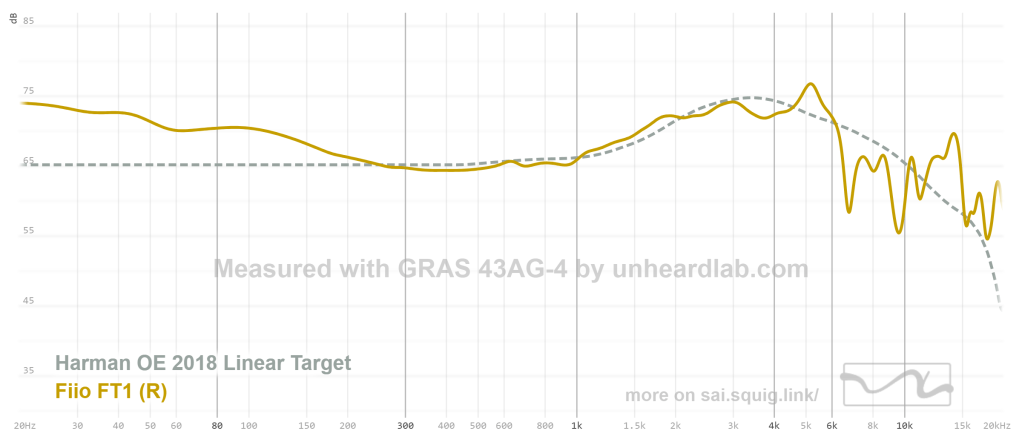
link to the frequency response measurement & more comparisons
Tonal balance:
Overall, the FT1 offers a pleasing, easy-to-listen tuning, with powerful bass and clear midrange. The level of fidelity is impressive—almost like studio heaphones, but with an enjoyable bass tilt that adds warmth. While soundstage isn’t exceptionally wide, the sound feels natural and coherent as a whole.
The bass is clearly emphasised, delivering a satisfying rumble. The boost is mostly clean, although there’s a touch of mid-bass adding warmth and body to the midrange. Certain bass-heavy tracks might sound a bit boomy, but it’s rarely overbearing.
This colouration may be welcomed for a lot of modern music, gaming, and cinematic audio. It doesn’t come at the expense of the midrange, which is impressively tuned with clarity and articulation. More on this below.
The mids are exceptionally well-tuned. They are clear, articulate, and slightly forward. Vocals and instruments are rendered with impressive accuracy, striking a fine balance between body and articulation. It manages to avoid a common pitfall of many closed-back headphones: an excess in the upper-mid harmonics (ie. 2-3kHz), which often leads to an unnatural clang and glare in midrange instruments like the piano.
If one were to nitpick, there’s a subtle emphasis in the presence region, similar to what’s found in the E-MU Teak. This can occasionally introduce a hint of forwardness and grain, but it’s a minor issue, as the added bass punch tends to balance it out. Altogether, the FT1’s level of midrange fidelity is impressive, rivaling the best mid-fi headphones such as the HD6XX and the Sundara.
As for the highs, the FT1 avoids harshness and is generally smooth and clean. There’s a slight emphasis in the upper treble that brings some added sparkle and ‘zing’ to certain instruments. Poorly mastered vocals might come with a bit of extra hiss, but the bass warmth prevents this upper-treble energy from becoming overly prominent. While the FT1’s treble extension isn’t extraordinary, it’s more than adequate for a closed-back headphone, avoiding a flat or overly damped sound.
Other qualities:
When it comes to spatial qualities, the FT1 is impressive for a budget closed-back headphone. While the soundstage isn’t expansive, it doesn’t feel particularly confined. Imaging is also notably dimensional for a budget product, with a decently holographic feel. That said, the E-MU Teak still provides a more natural and expansive soundstage.
In terms of clarity, the FT1 performs admirably. Its linearity across frequencies supports this strength, even with the extra bass warmth. The sense of resolution competes well against similarly priced and even higher-tier models, rivalling the HD6XX. It outshines most closed-back classics, including the Sony MDR-7506, AKG K361, and Beyerdynamic DT700 Pro X. While the Moondrop Para (US$299) still leads in resolution at this price point, as an open-back planar with a leaner sound signature, it may not be a fair comparison.
The FT1’s dynamic qualities is also good, especially its macro-dynamics. Bass hits are powerful, and the rumble is palpable. Micro-dynamic detail, ie. the subtle contrast in quieter passages, is slightly less pronounced, but it’s more than acceptable at this price point. For a significant upgrade, you’d need to step up to models like the Denon AH-D5200 or the E-MU Teak.
Conclusion and value:
Priced at US$149 / AU$239, Fiio has positioned the FT1 aggressively in this price range. It delivers impressive sound quality across the board, backed by excellent build quality and a generous set of accessories. For those seeking a neutral-to-warm or bassy tuning, the FT1 is an easy recommendation. Few headphones around this price offer serious competition, let alone closed-back ones. While the E-MU Teak and Denon AH-D5200 may provide advantages in soundstaging and dynamics, they aren’t fully sealed designs and come at significantly higher prices.
As such, the FT1 is one of the few products I’d recommend without hesitation. Even the same for non-audiophiles, as it brings a well-rounded experience for music, gaming, and general media consumption alike. This time, the hype feels warranted indeed, and I look forward to seeing Fiio continue on this path.
Pros: Well-balanced tuning; powerful bass paired with clear midrange and highs; engaging and easy to listen to; solid technical performance that punches above its price; high-quality build with premium materials; generous accessory bundle.
Cons: Minor unevenness in the upper mids and treble;
Value Grade:
Notes on EQ
This headphone needs minimum EQ to sound neutral. It can still be improved, though.
My personal EQ setting for this headphone:
Preamp: 0.0 dB
Filter 1: ON PK Fc 140 Hz Gain -2.5 dB Q 2.000
Filter 2: ON PK Fc 1500 Hz Gain -1.0 dB Q 2.000
Filter 3: ON PK Fc 5150 Hz Gain -3.0 dB Q 3.000
Filter 4: ON PK Fc 13500 Hz Gain -4.5 dB Q 3.000
If your goal is to EQ the response to match the Harman Target, consider the AutoEQ function provided by Squiglink as a convenient starting point. I personally recommend customising the filters to better suit your own hearing, especially in the treble. While the AutoEQ provides a useful baseline, individual adjustments can opften significantly improve your listening experience.
MEASUREMENTS
Frequency Response Average (unsmoothed):
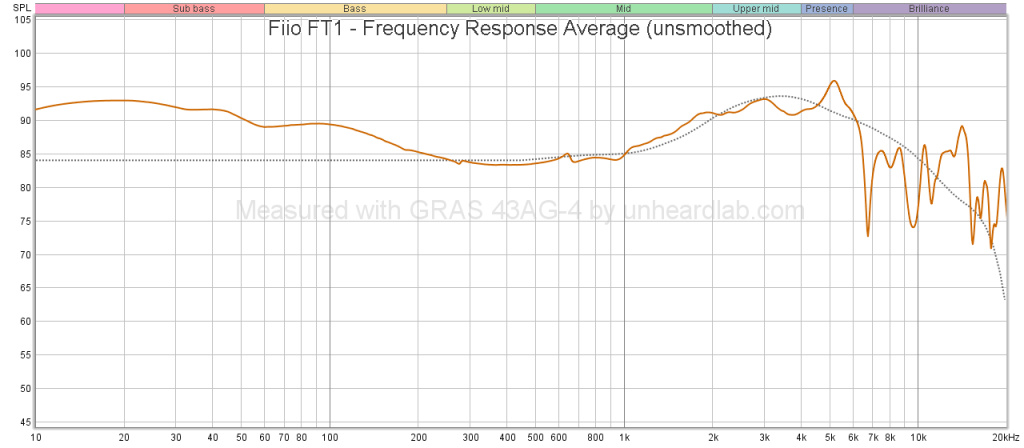
The response is obtained by an average of 5-6 positional variations. The FR shown on the graph is unsmoothed.
Comment: Excellent tonal balance overall. The main issue lies in the unevenness at 5kHz and 13kHz, where you might hear some peaks.
Positional Variation:
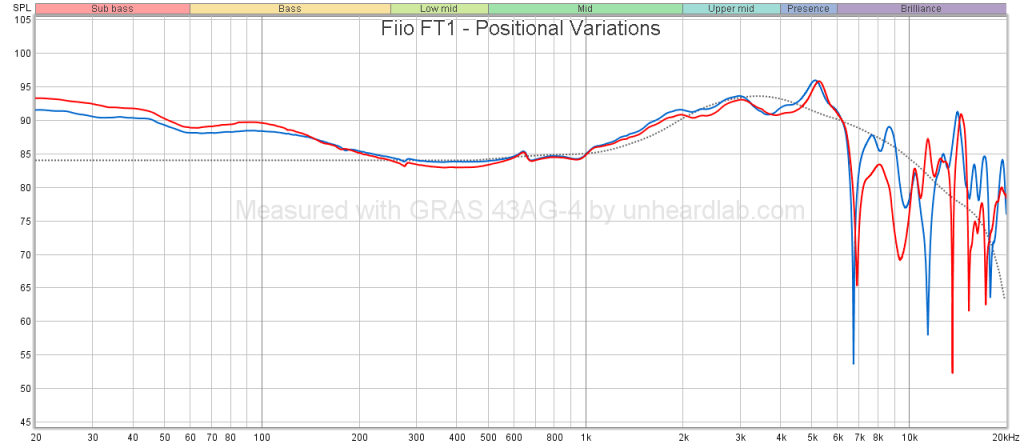
This graph illustrates how headphone placement on the head affects perceived tonal balance: with the ear positioned at the top (blue) and bottom (red) of the front chamber of the headphone. The FRs shown on the graph are unsmoothed.
Comment: The FT1 exhibits some inconsistencies in frequency response when its positioning is adjusted on the ear simulator, especially in the higher treble range. This could lead to greater variations in perceived sound between different listeners or listening sessions.
Leakage Tolerance:

This graph demonstrates how leakages to the front volume can result in FR change. The FR shown on the graph is 1/12 octave smoothed.
Comment: Like most closed-back headphones, the FT1 shows a typical bass droop when the seal is broken, even though it is not severe. To get the most out of its bass response, ensuring a proper fit and seal is essential.
Impulse Response:
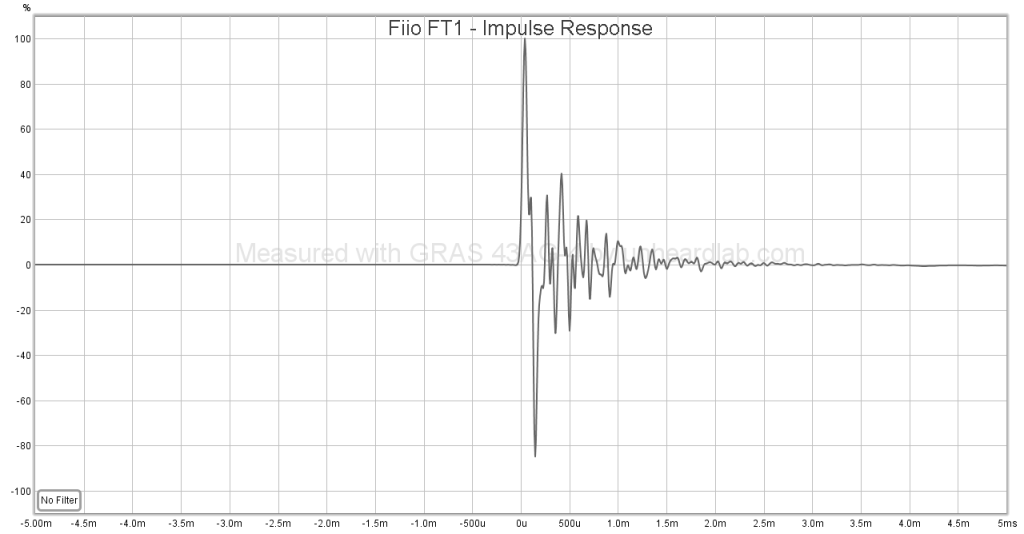
The impulse response test measures the initial response, overshoot, and decay of a transducer upon receiving a signal.
Comment: the FT1 displays a normal impulse response – nothing out of the blue here.
Channel Matching:

Channel matching graphs do not relate to the perceived sound profile. A specialised configuration is used in this test to capture differences between channels, mitigating interference from positioning on the rig and the asymmetry in the GRAS pinnae design, a legacy of KEMAR. The left (blue) and right (red) channels are measured using a flat plate coupler with an IEC60318-4 ear simulator.
Comment: Channel matching on this particular unit is very good, which may contribute to imaging precision and the clarity of spatial cues.
Total Harmonic Distortion & Group Delay:

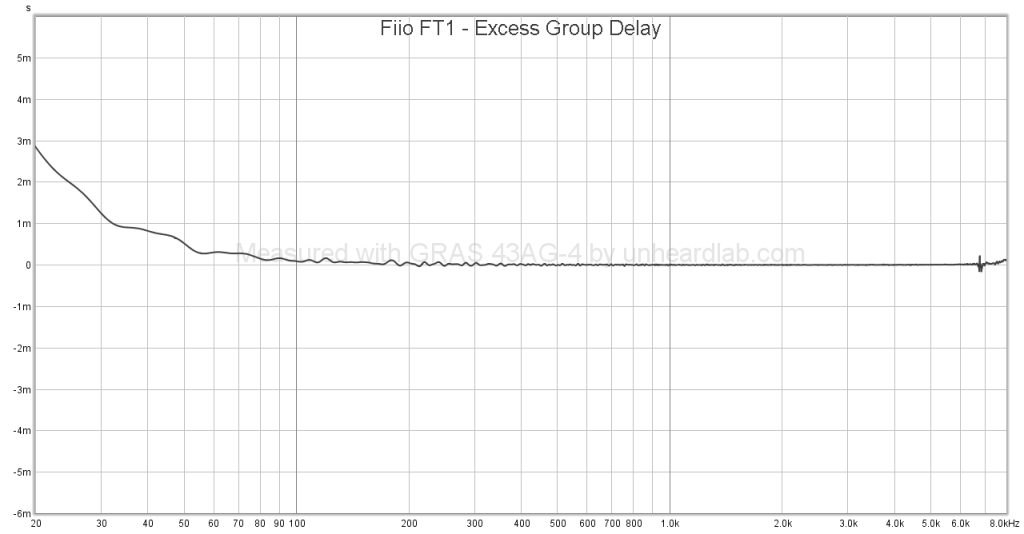

Supplied per request. For Group Delay charts, peaks/dips around 9kHz and up should be ignored as they are generally caused by the pinna, not the headphone. Note that the IR function setting for the Group Delay charts have been modified and should not be compared to previous versions. These measurements are conducted in quiet, normal room conditions (as opposed to an anechoic chamber), meaning there may be some influence from ambient room and external noise. These results should be considered a preliminary assessment of performance, primarily for identifying major issues, and do not reflect the best-case performance scenario.
Comment: The FT1 performs very well at 94dB. Nothing to worry about here.
Electric Phase & Impedance:

The above graph shows the measured impedance (green) and electric phase (grey).
Comment: The FT1’s impedance curve is flatter than a lot of moving coil headphones. This ensures a more consistent response when paired with amplifiers of different output impedance ratings.
END OF THE ARTICLE
Disclaimer: This review is not sponsored or endorsed by any business or related entity. The headphones reviewed are my own unless stated otherwise. Any links or recommendations included are purely informational and do not involve any financial affiliation or endorsement on my part.

Thanks for the review! I’ve got the E-MU Teak already but this looks like such a nice budget side set.
LikeLike
Cheers mate!
Yeah the Teak is a step up overall, tuned very similarly but with a larger stage, tighter bass and more dynamic presentation. That said, for what the FT1 offers at its price you really can’t go wrong haha. It’s less resolving than the Teak but warmer and more forgiving on bright tracks (also great for long gaming sessions with gun sounds, etc.). Funny enough, I bought the FT1 just to review it, but now I’m actually planning to keep it for gaming and movies when I need the isolation.
LikeLiked by 1 person
My exact impressions and reactions! I bought them for the lulz and maybe to resell after I got through with them, but now I use them as my working pair and for gaming.
They’ve effectively dethroned my iems because of comfort for long listening sessions, something I didn’t consider possible after owning much more expensive sets than these (DT 177X GO, Fostex X00, Shure 440/840s and some other borrows).
LikeLike
Hahaha true! For their price the FT1s offer so much that I just can’t be bothered to resell. IEMs still have their place for me in the summer when it’s too hot for closed-back overears.
LikeLike
How changed the sound with EQ? In sound quality?
LikeLike
If you’re wondering about how the FT1 becomes with EQ I would say it defintely becomes more neutral/cleaner sounding. The areas that need to be cut/boosted aren’t problematic for the driver to take so the FT1 reacts to EQ very well.
LikeLike
Great to see they don’t lose much bass when the seal is compromised which is important to those who wear glasses.
LikeLike
Yep that’s a big plus in my book for closed-back cans.
LikeLike
I’ve been in this hobby for more than 12 years and owned too many headphones since I’ve entered. I have to say that only a select few have put a smile on my face as these FiiO’s. After I saw your measurement for them, I pulled the trigger on the blind buy and couldn’t be happier.
I thought I wouldn’t like the warmness of the bass but I was sorely mistaken, they are fun and laid back without being overly mellow. Most importantly, in terms of coherency and overall presentation, including the “technical” aspects, I was also baffled by these: they sound almost as coherent as single DDs iem for my ears, which is an incredible feat from FiiO as most of the competition in the closed ear scene is just a mess, really.
LikeLiked by 1 person
Glad to hear these made such an impression on someone with your experience! I totally get what you mean about that single-DD-like timbre. Well I suppose the FT1s being DD headphones this is naturally their strong suit, but Fiio really nailed it with the tuning. To me they strike a very fine balance between warmth and clarity, a balance most closed-backs struggle to hit. Enjoy the tunes!
LikeLike
These or the Hifiman He400se?
LikeLike
Do not buy the 400SE, they don’t sound good for any genre and they are uncomfortable. They don’t even sound ‘okay’ they are actively bad, they make music and gaming sound bad.
I got a refund for them and they didn’t even want them back so I will not use them even though they were free.
LikeLike
I’d say they’re pretty different, so a direct comparison isn’t entirely fair. The HE400se is an open-back planar and costs a bit less, while the FT1 is a closed-back dynamic, so they cater to different use cases. The HE400se isn’t bad as-is, though with the stock pads and no EQ, they’re nothing spectacular. That said, a lot of people mod them and report a big improvement in sound, especially with pad-rolling to adjust the FR. I haven’t experimented much with that myself, though.
The FT1, on the other hand, feels like a safer bet for general listening and a wider range of uses.
LikeLike
FT1 chewed up every hifiman under $500
LikeLike
My hifman he400i sound better than my FT1. But thats mabye open vs closed headsets. THe he400i is a bit less punchy but better sounding mids and highs .
LikeLiked by 1 person
Could you compare FT1 with DT770?
LikeLike
Sure thing! The DT770s feel just like typical studio monitors. The midrange itself is quite linear, but the extra treble can make high-pitched vocals sound a bit grainy or sibilant. This is great for spotting recording flaws but can be less enjoyable for music.
In comparison, the FT1s are much more pleasant straight out of the box. They also have a V-shaped tuning, but the treble is smoother with just a bit of sparkle. There’s more warmth and bass oomph too, which adds impact and body. Unless you really dislike warm-sounding headphones, the FT1s should be quite enjoyable. When it comes to more subtle ‘technical’ qualities, I’d say the FT1s also have the edge overall.
LikeLike
Thank you!
LikeLike
Hi. I need a quick answer please. SteelSeries Arctis Nova Pro Wired or FiiO FT1. They are the same price in my country. Thanks
LikeLike
Hi, I’ve not tried the Nova Pro so unfortunately cannot comment on the comparison. I suppose they are quite different so it depends on your use case.
LikeLike
Is the D5200 better than the FT1?
LikeLike
For a more ‘neutral’ sound the D5200 does have the edge, and it also has a slightly more expansive soundstage. That said, the difference isn’t anywhere as big as the price gap might suggest. Some might even find the FT1 more enjoyable with its more flavourful V-shaped tuning. Also, a big downside to the D5200 is its ergonomics. It tends to create hot spots pretty quickly when worn.
LikeLike
Please review the new FT1 Pro
LikeLike
Stay tuned 😉
LikeLike
hi sai
I’m thinking about which one to buy between sivga robin and fiio ft1
LikeLike
Hi mate, even though I really like the FT1 and believe it offers great value for money, I haven’t tried the Robin so I can’t really give you an informed comparison. Sorry!
LikeLike
Thank you and have a nice day
LikeLiked by 1 person
Hello, can you add, please, THD graph to the review. Thank you!
LikeLike
No worries – added.
LikeLike
Hey Sai,
Could you do a quick comparison between these and the Focal Radiance? It’s quite odd given the huge price difference but I was thinking of selling the Radiance. I own the Focal Clear and he1000 stealth, which I’m happy with, but I bought the Radiance asI was looking for a closed-back with strong bass, some warmth in the midrange, smooth treble without anything sounding “veiled”.
I.e., something *kind of* like the Clear (but with more bass) lol.
I appreciate the Radiance, I do, but the FT1 looks incredible for a much lower cost; and from your review, it ticks all my boxes.
The lighter, less “blingy” and excellent build quality seems like a HUGE plus. I think the Radiance looks great, but I find myself handling them with too much care, and a bit on the heavy side when on my head.
After buying and selling so many headphones, I have come to realise comfort and build so much are arguably just as much, if not more important than sound for headphones. The sound doesn’t mean much if I have to constantly think about how I’m handling the headphones, making minor adjustments, or can’t wear them for long.
But I digress. Given all that I have said, do you think selling the Radiance and buying the FT1 is a good idea? Or is the Radiance that far apart from the FT1 that it would be a huge downgrade?
Regards,
Ryan
LikeLike
Hi Ryan,
I’m with you on handling gear carefully. It can definitely be a mental stress when something feels easy to scratch or damage. And yes, comfort is hugely important. On that front, the FT1 is much lighter than the Radiance, which is a big plus. It’s also impressively well-built for the price.
The Radiance is an excellent pair of headphones, especially for a closed-back since good closed-backs are relatively rare. If you like the Radiance’s sound signature, the FT1 will give you a similar experience since they’re both V-shaped in tuning. That said, there are some differences. The FT1 has slightly less treble sparkle but slightly more forward/textured mids. The bass quantity is about the same, but the Radiance delivers more punch and tighter, higher-quality bass. Overall, the Radiance is more technically impressive and have a bit more wow factor, but switching to the FT1 wouldn’t feel like a huge downgrade sound-wise, at least not to me.
So if you’re looking for a second headphone that’s comfortable and lightweight to use casually, the FT1 is definitely worth considering.
Hope that helps.
Sai
LikeLike
Hey Sai,
I just got the FT1 and as always, your observations were spot on. I still need to compare them more extensively but from what I heard so far, I actually think FT1 is better tuned and balanced. I will leave the following remarks for anyone else wanting to see how this headphone compares with the Radiance.
As you said, the FT1 has a pleasing (“musical”) sound and I’d say it’s relatively versatile, working well with all genres of music, but never making me go “wow”. Instead, they made me go “wow” with how music in generally just sounded… nice. Obviously in certain songs, the bass can be a bit “boomy”, but not so that it smears and muddies the midrange – but it can slightly overshadow certain elements, and therefore bringing down that perceived “clarity” and sense of detail.
I recall from your Radiance review, you said the extra energy in the treble and bass could potentially take the listener’s away from the midrange, and that the highs (while not bright) introduced a metallic texture; a bit of dryness/sharpness. All of which I found was true. And while it was not a big issue at all, it was still slightly distracting, and I was happy to see that the FT1 avoided that. I might be wrong, but I think the absence of those traits is why mids on the FT1 sound more forward? (That and the bump at 4 – 6 kHz). Regardless, that slight forwardness in mids and the the extra upper bass presence (for that warmth) on the were exactly what I was looking for.
The bottom line is that despite a few quirks, the FT1 sounded pleasing and natural, despite not being “neutral”.
And as you said, the things that the Radiance do better then the FT1 is the technicalities and the bass. The soundstage and instrument separation are the things that I noticed immediately when I switched between the two headphones. I don’t know about height, but the stage was definitely *wider* and Radiance was able to achieve greater separation between all the elements in the mix without losing that sense of intimacy and closeness.
But I found the FT1 to “compete” with this by utilising it’s midrange – being slightly forward and more pleasing (to my ear). And the stage is not necessarily claustrophobic or congested, but definitely more intimate, so things are more “in your face” if you get what I mean. In a way, it plays to the FT1’s strengths.
As for the bass – it’s a bit weird. Radiance is definitely cleaner and has better sense of impact and punch as you said (because of the bump at 150Hz and dip at ~ 250Hz), it’s quite addictive. But FT1 has more sub-bass and more body to the bass (as evident in the frequency response curve). I do think Radiance bass is also ‘higher quality’, but the bass on the FT1 is also quite good and just very… fun. Don’t know how else to put it, they’re like two slightly different experiences, though with Radiance just slightly edging out the FT1.
There are tracks where I enjoyed the bass reproduction from both headphones, but preferred FT1, and some where I liked both but found the Radiance’s bass impact and cleanliness to be far superior. As for the comfort – the lightweight and lower clamp force of the FT1 was just right for me, but Radiance is not bad either and isolates noise better.
Overall, yeah, in some ways, the FT1 is a downgrade, but the fact it still competes with the Radiance in other aspects is quite outstanding. And while not nearly robust in its construction, I think the overall build quality is decent and it looks beautiful imo. Insane value, and great performance even if you take the price out of the equation.
Considering that I have the HE1000 Stealth and Focal Clear, I think FT1 is different enough from those two and not a significant step behind the Radiance to warrant keeping and selling the Radiance… and using the proceeds for some other terrible financial decision 🙂 But it’s going to be tough saying goodbye to the Radiance.
LikeLike
Hey Ryan, thanks for sharing such a detailed comparison! I think you really nailed it when it comes to the sound of the FT1 and how it compares to the ones mentioned in your post.
It sounds like the FT1 has really earned its place in your collection, especially given how it holds its own against the Radiance in key areas while offering a different enough experience from your HE1000 Stealth and Focal Clear. Yes, the Radiance is still very much ahead in most categories probably except for some tuning differences especially in the highs. And Focal always nails it when it comes to bass dynamics and impact.
Selling the Radiance is definitely a tough call, but hey, that’s the joy (and curse) of this hobby, right?
I suppose the bottomline is, you’re not gonna lose much if you decide to sell the FT1 instead given its much lower price and its market status at the moment haha.
LikeLiked by 1 person
Absolutely! The more I’ve listened to both the Radiance and the FT1, the less I want to sell both. In fact, I’ll most likely keep them both lol.
Each headphone is different enough to offer something unique – the FT1 simply filled a void that I didn’t even realize existed… that too at a much more affordable price. Fantastic work by FiiO, and thanks again for the excellent review!
LikeLiked by 1 person
Sounds like the FT1 really made an impression on you! Yeah Fiio really nailed it with the FT1. Enjoy the headphones!
LikeLike
Hello Sai. Excellent review, with a great balance of subjective and objective, also I appreciate the measuremts section very much. Got mine for 2 weeks now, and after reducing the sub/mid bass a bit per EQ , I am really happy with the FT1. Greetings from Bavaria/Germany. Stefan
LikeLike
Hello Stefan, Thank you for the kind words! Great to hear that you’re happy with the FT1, and hopefully my review helped you made an informed decision. Personally I find the upper bass just a tad bloomy with modern genres but with acoustic stuff they’re mostly fine. Fiio has really done a great job here.
Enjoy your new headphones! Cheers, Sai.
LikeLike
AR5000 VS Fiio FT1 Which one do you think is good?
LikeLike
Hey Vike, I see there’s a duplicated comment here. I’ve replied to your question under the AR5000 post. Cheers, Sai.
LikeLike
Had to get these after your review, and wanting a pair of closed back to quiet down PC fans while gaming and in general. So far I’m enjoying these a lot! Tried to do some research comparing these to DT770 X considering I’ve got a DT1990 MK1 as open back and think that Beyer build quality is superb and comfort for me is super good. These are a lot lighter but for me very comfortable too! Fun trying something else and they pair nice with a Fiio K7. Def a lot darker/warmer than the DT’s (I use them with analytic pads and slight eq to boost sub bass and reduce 8 khz sibilance), and not as “tight”. But I find them more “chill” than the DTs as they’re pretty intense (but fun!). Now I’m kinda hyped for Fiio to release the FT7 as they have been teasing about. One negative thing about the FT1s are the cables as they are quite noisy.
LikeLike
Forgot to mention that I’m using your EQ profile which to my ears makes them sound better
LikeLike
Glad to hear you’re enjoying them, and I’m happy the review helped you make an informed decision!
The 770 Pro X is known for its brighter sound, so it’s probably best to demo it first if you can. That said, if you’re fine with the 1990’s treble, especially since you EQ, the 770 Pro X shouldn’t be a problem for you. My favourite Beyer is the T1 1st gen. Sadly they aren’t available anymore.
I actually like the FT1 cable for its softness and fabric covering, but I get what you mean. The good thing is that the FT1 makes it easy to swap cables, so you could pick up a plastic one (like the stock Hifiman cables) for pretty cheap.
Happy listening!
LikeLike
Funny. That is exactly how I did it with the cable for the FT1. I took the plastic one from my Ananda OG because the original ones causes too much microphonics to my ears. BR, Stefan.
LikeLike
Hahaha nice one Stefan! You’ve got a solid lineup there. The Ananda OG has a special place in my heart – it’s one of the headphones that pulled me back into the hobby after a long break. Yeah, their cables might not be everyone’s favourite in terms of feel, but they’re definitely not microphonic at all. Cheers!
LikeLike
My DT1990pro MK1 broke down and had no sound after 4 years of use. After it was repaired, it broke down again the next year. Its quality is not as good as people think.
LikeLike
That sucks to hear. I wouldn’t be surprised if it’s because of how thin the voice coils are on those high-impedance Beyers, they can be a bit fragile.
LikeLike
Yes, the fragile coil is thinner than a hair and may break even if it falls off a table. I feel disgusted with this brand. I wonder if the sound of FT1 will be much downgraded from 1990?
LikeLike
That sucks! I’m the one who left the original comment, with DT1990s. To me the BD feels very solid and from what I’ve read they should hold up fine with time. I did come across some QC issues with the FT1s on reddit with the screws holding the earcups failing, so that’s something to look after. Some having them fail after just a couple of weeks. Should/could be a easy repair but nonetheless, not something one should have to deal with that quick.
About FT1 being a downgrade – depends maybe on a few things. To me they are a supplement to my DTs for mainly gaming, to have a pair of closed backs for more noise attenuation than open backs. And I had the money to spend to get something else. They do sound really good, but jumping back into the DTs music just sounds better. Bass is better/tighter and not “bloating”, instrument separation/imaging is way better combined with better soundstage. Def brighter and more high res? I find myself listening more with the DTs being more intense. They want your attention! How much of a difference this is I think is very subjective, but for me I wouldnt give up my DTs. Will be interesting to see if Beyer release a new T1 seeing they’ve released MK2 1770/1990, in case I need to give that a try 😀
LikeLike
I haven’t spent enough time with the DT1990 to give a solid comparison myself, so thanks for such a detailed breakdown! I’m sure your comment will be very helpful for the other guy in the comments.
I’m with you on hoping Beyer drops a new T1 that’s a proper all-around upgrade. The 2nd gen felt more like a V-shaped sidegrade of the 1st gen, and the 3rd gen… well, the initial release was a bit of a mess. That said, I think they revised the earpads later, and it made the 3rd gen noticeably better, kind of like a slightly refined 2nd gen and easier to drive.
LikeLike
great review, straight to the point 🙂
you mentioned its great for gaming, do you mean single player games only or competitive multiplayer too?
also would vmoda boomic work with it?
LikeLike
Thanks! I meant more for general gaming and single-player stuff with cinematics, like Witcher, Wukong etc., or stuff like Monster Hunter World. I used to play a bit of CS and PUBG but not much these days.
As for the V-Moda Boom mic, I don’t think it’ll work since the FT1 uses dual 3.5mm inputs, while the VModa is designed for single 3.5mm connections. But I can be wrong if there’re other corresponding models I am not aware of.
LikeLike
My initial enthusiasm for the FiiO FT1 has waned somewhat.
The sub- and mid-bass have always been too pronounced for me, but I was able to get a pretty good handle on this with EQ. What bothers me more and more, however, is that if I move or tilt my head just slightly, the bass on this side becomes much more pronounced and louder.
I think this is due to a change in the pressure on the head and the associated change in the sealing of the ear pads.
In any case, it is quite annoying for me. I don’t know this with open-back headphones, probably also due to the open design.
BR, Stefan (Bavaria/Germany)
LikeLike
Hi Stefan, good to talk to you again. I haven’t personally experienced that issue with the FT1, but I don’t have long hair or wear glasses that could affect the seal. But yeah, open-backs tend to be better in this regard since they’re less sensitive to slight changes in seal.
LikeLike
Hello Sai.
Well, my hair is practically non-existent, haha, and the effect described occurs both with and without glasses.
However, I probably have a rather small head and the FT1 sits rather loosely on me. I am one of those people for whom a Hifiman Ananda or a Sennheiser HD6X0 or the HD560S are perfect comfort wise. Others like to complain about the comfort because it is too tight on their head.
LikeLike
Ah, gotcha. If the FT1 sits loosely on you, that could definitely be the issue. If you’re otherwise enjoying the FT1, you might try adjusting the headband or experimenting with thicker pads to improve the fit. Otherwise, an open-back might indeed be a better long-term solution for you.
LikeLike
Hi Sai. No problem, I actually own two open back headphones, the Hifiman Ananda OG and the Sennheiser HD560S, both slightly eq’d.
I just wanted to have an additionally closed back wired headphone. For wireless use I have a set of Valco VMK25 ANC from Finland, which should not be known where you live.
BR, Stefan.
LikeLike
I see, you’ve got a great lineup there! Yeah, I’m not familiar with the Valco – don’t think it’s available here in Australia… maybe in Austria!
LikeLike
In Austria for sure, haha.
They sell mostly direct in Finland, and then in Germany. Valco says the Germans must be crazy for that. Finish humor is quite special, as you can see on their webpage…
LikeLike
What do you think about the fiio ft1 with ft1-A pads? Is it better than the original tuning. Are there any other pads that improve the sound better than the stock pads?
LikeLike
I actually prefer the stock pads. The FT1-A pads make the tuning more V-shaped, but the stock sound is already that way, so it ends up feeling a bit overdone. Overall, I think the stock pads strike a better balance and are still my go-to.
LikeLike
Hey great review!
About your pad swap measurements squig’s. The Jz w1000 pads, what model jz are they? i got some round angled sheepskins with large round opening and just trying to find measurements of similar. thanks
LikeLike
Thanks! The Jingzhi W1000 pads I used are similar to the stock ones on the Audio-Technica ATH-W1000 – non-angled, 105mm circular with a round cutout, fairly thin at around 20mm, and made with lambskin. Hope that helps.
LikeLike
Hi Sai,
Love your reviews! I was wondering if you plan on reviewing any Dan Clark Audio headphones like the E3 and/or the Noire X? Seems like everyone loves those but I’d love to hear your thoughts on them!
LikeLike
Thanks, I appreciate that! I’ve definitely been keeping an eye on the E3 and Noire X as they’ve been getting a lot of love. I’d like to cover at least one of them soon, just depends on when I can get my hands on a pair. Will keep you posted!
LikeLike
Do you think these JZ Sheepskin pads for Fostex would sound good?
https://a.aliexpress.com/_EIaTPsm
There’s a round one and an oval one but I’m not sure which would sound better. I think headphoneer reviewer had round ones, but oval ones look more like ft1 stock ear pads.
Based on your experience with pads what difference would oval vs round have on the sound?
Would the ovals be bigger than FT1 stock too?
Thanks
LikeLike
please review denon d7200
LikeLike
Maybe one day… they are a bit dated now I wonder if Denon will be announcing a successor
LikeLike
Hello Sai, love your work! Any plan on also reviewing Fiio’s update/upgrade of the FT1 – the FT13? Cheers!
LikeLike
Glad you’re enjoying it! Yep you can expect the review in a week or so. 😉
LikeLike
Hi Sai, is the Fiio FT13 review still coming? I don’t see it in the “Upcoming Articles” column. Cheers!
LikeLike
Yeah lol I haven’t updated that column in time.
I basically have a good sense of the FT3 now and am just writing it up. I’m also waiting on something else: Fiio said on Headfi that they’ll be providing an earpad adapter for them. I might grab that and do more pad rolling before dropping the full review.
LikeLike
Yeah, I read that. Interesting how some people prefer the FT13’s new cable on the FT1 and the FT1’s cable on the FT13. Well, I’ll just keep waiting for the review then. I hope it’s more positive than Resolve’s 🙂 Cheers!
LikeLiked by 1 person
Hello Sai!,
How does the Fiio ft1’s compare to the dca aeon closed x?
LikeLike
Hey! The Aeon CX gives you a cleaner, more detailed sound, though the treble can be a little sharper on its own. If you use the included tuning inserts they smooth out a bit (or you can just EQ it)
The FT1 has way more powerful bass presence and punch. The midrange is pretty much a tie: the FT1 is fuller, and the Aeon CX is more neutral and linear.
Value wise, the FT1 wins, no contest.
LikeLike
which would be better for a person who wears glasses with thin arms?
LikeLike
Ah then that’d be the FT1. The Aeon CX is more sensitive to leakages while the FT1 shows less rolloff when seal is compromised.
LikeLike
Hey! I loved your review of the FT1. I’m someone who’s loved music since I was a kid and now I’m starting to produce music. I’m looking for a good closed-back headphone. Do you think the FT1 is better than the DT 700 Pro X for music production? I’m hesitant because I know DT headphones have a good neutral sound for production, but when I saw positive reviews like yours about the warm sound with pronounced bass (which is my musical taste) of the FT1 and its quality comparable to DT’s, I became increasingly tempted to buy it. What do you prefer in this case? Greetings from Brazil! o/
LikeLike
Hey there! I’m glad you liked the review. I am not a huge fan of the DT 700 Pro X personally. They do have an overall balanced tone, which is fine, but I find the upper mids quite forward and the treble somewhat elevated and uneven. I wouldn’t necessarily say the FT1 is more neutral than the DT 700 Pro X, but I do think it’s more enjoyable to listen to.
Are you planning on using EQ? If you are, I’d definitely recommend the FT1 as it’s just a more capable headphone overall. The sense of impact and stage is just so much better than the DT 700 ProX.
One thing to keep in mind though is how you tend to be with your gear. The Beyer headphones are very durable and built solid. While the FT1 is also nicely built, the nature of its wood and suede materials might not hold up quite as well over time.
LikeLike
Thank you for the review. I’m eager to buy FT1, but my ear is sensitive to 10-15khz/upper treble, like air sound of cymbal ssh ssh. Is it safe for me to buy FT1 and not using EQ?
LikeLike
Cheers mate. The FT1 does in fact have a bit of excess energy in that region. But because it also has quite a bit of bass, that excess shimmer (about 3dB or so above ‘neutral’) is generally not an issue for most listeners. That said, if you’re very sensitive to that region, I suggest trying them before buying, as it can be a bit much for you without EQ.
LikeLike
Thank you again. Keep up the good work.
LikeLiked by 1 person
Better distortion than hifiman planars ? with built in bass boost ? Interesting.
Do earpads seal well ? The opening looks a bit smaller i’m worried it might fit like on ear.
LikeLike
These are closed-back dynamic headphones so I’d say that’s not a surprise 😉
The ear pads seal pretty well and are over-ear (65x45x30mm approx).
LikeLike
How do these compare to the Meze 99 Classics and Neos? Do they seem like they’d have issues with repairability?
LikeLike
Unfortunately I haven’t owned the Mezes so I can’t really make an informed comparison. The Mezes were too bassy for my taste when I demo’ed them, though.
LikeLike
Fair enough, thank you still!
I’m really interested in the repairability aspect of these, since I’m looking to get some headphones to last a few years. I’ve heard some mixed opinions about FiiO as a whole.
Sound-wise I keep hearing that the FT1 are better aswell, more controlled bass yea.
LikeLike
No worries! Yea there are reports of the headband having issues but they seem to have fixed it. That said the FT1s haven’t been around for long enough so we’re not sure how they hold up in the long run.
LikeLike