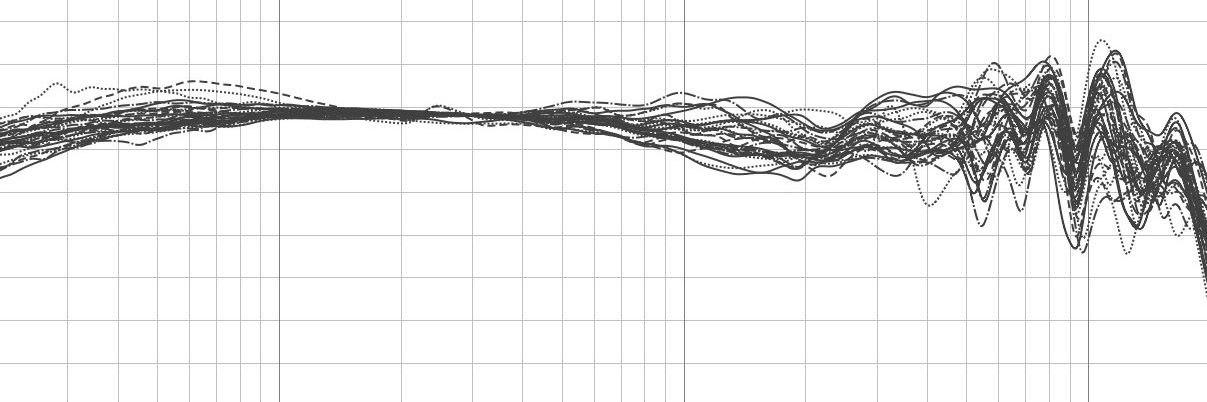

Another ‘flagship’ planar by Moondrop?
Intro:
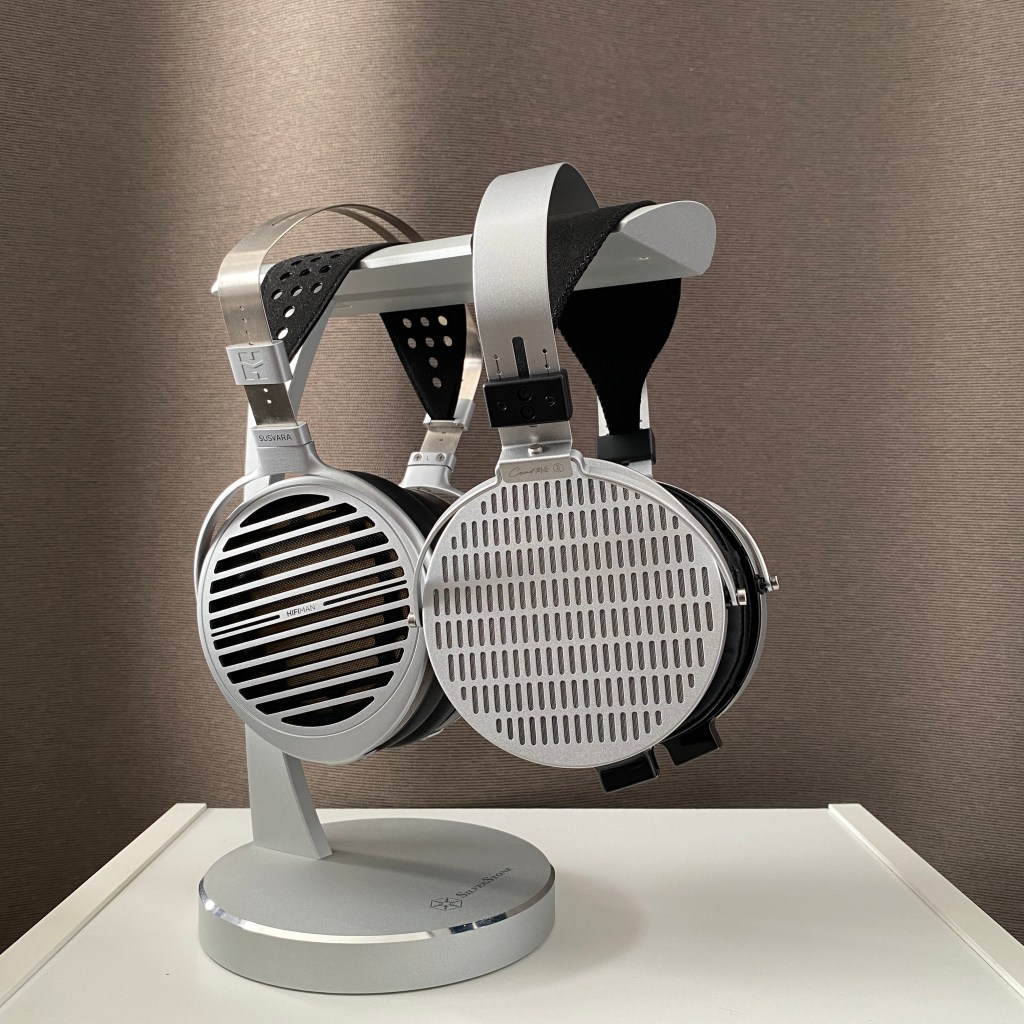
Since releasing the Venus in 2022, Moondrop has been rapidly expanding its headphone lineup. The Venus came out in late 2022, followed by the Para in September 2023, and now, the Cosmo debuted in mid-2024.
Interestingly, the Venus was touted as their ‘flagship’ planar magnetic over-ear headphone. Now, with the Cosmo (priced at US$ 899), sitting at a significant markup over the Venus (US$ 599), I can’t help but wonder: where exactly is Moondrop heading with their product line? Should we consider the Cosmo, according to their marketing logic, the ‘high-end’ flagship?
That’s why we have the Cosmo here today for you to find out.
For the full suite of measurements, see the final section of the article.
Specs & Comfort
Price: US$ 899, AU$ 1499
Transducer size: 100 mm ø
Effective area: 80 mm ø
Transducer type: planar magnetic
Earpad size: 105*105*15-30 mm
Earpad mounting: magnetic
Sensitivity: 99 dB/Vrms @1kHz
Impedance: 17Ω @1kHz (measured)
Connector: dual 3.5 mm TRS
Weight: 547 grams
Clamping force: light
Headband swivel: 60° approx.
Comfort: 6.5/10 (a bit heavy; weight distribution isn’t ideal)
Measurement & Sound

link to the frequency response measurement & more comparisons
Tonal balance:
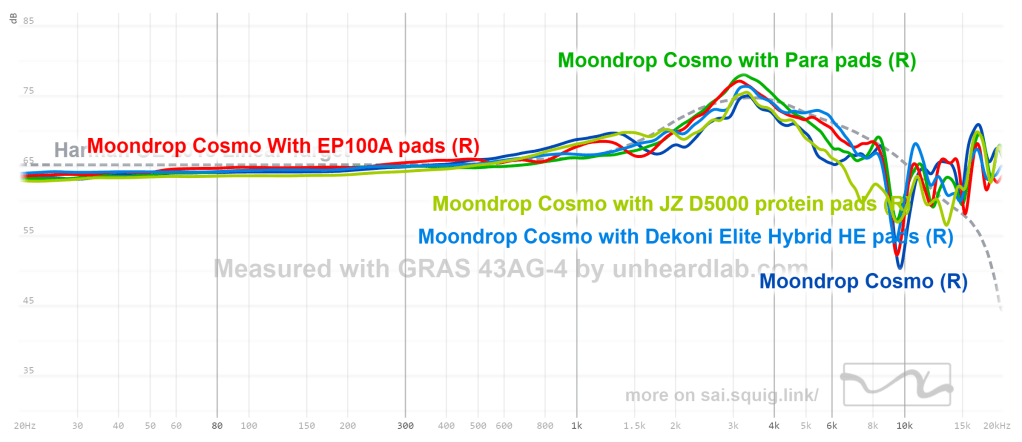
Overall, Overall, the Cosmo delivers a clean and articulate sound. With the stock pads, it has a rather mid-forward presentation, with a clarity and speed reminding me of electrostatic headphones. Bass is there but nothing mind-blowing, although the bass extension is decent. With Moondrop’s EP100A ear pad upgrade, the mid-centric character softens in favour of a very neutral and airy sound profile.
Bass is light but tight. While it offers the expected extension of a planar, reaching down to 20Hz, it feels lacking in quantity. Compared to other open-back planars like the Hifiman HE6se or the Audeze LCD-X, the bass is noticeably less full or impactful.
If you want that slam and punch, you’ll likely need to hit it with EQ. Luckily, the bass quality is still commendable—well controlled, snappy, and fast, thanks to a well-damped diaphragm. It’s reminiscent of the Audeze LCD-5, although the Cosmo falls slightly short in overall bass performance. Bassheads may want to look elsewhere, as the bass isn’t the Cosmo’s strong suit.
Midrange is arguably the standout feature of the Cosmo. With the stock pads, the mids feel quite forward but still maintain excellent timbre and articulation. It’s almost like a blend of the Focal Utopia’s midrange richness with the clarity of Stax headphones. There’s a slight nasally colouration to vocals, and some instruments may sound a bit boxy, but these traits are subtle, and you’ll only notice them if you’re really listening for it. Piano tracks and female vocals, in particular, tend to be more engaging, though some listeners might find this forwardness fatiguing over extended sessions.
If you prefer a more neutral, less coloured sound, switching to Moondrop’s EP100A ear pads easily achieves that. Alternatively, the Para ear pads offer an even more neutral sound, but they aren’t readily available for purchase, so you’ll need to contact Moondrop directly. With either of these pads, the midrange becomes more linear and balanced with the rest of the mix, reminding me of the Sennheiser HD600 but with much better transparency. The result is one of the most neutral and detailed midranges I’ve ever found on a planar headphone.
Treble is another strong point for the Cosmo. With the stock pads, it’s smooth, airy, and ‘safe’, meaning the frequencies typically prone to sharpness and sibilance are slightly toned down. This gives the sound clarity without a metallic edge. Some might find the treble lacking in terms of ‘excitement,’ but I personally think it strikes a great balance between clarity and treble forwardness. The extension is excellent, offering an airy, transparent sound that holds up well against top-tier competitors.
Crash cymbals and upper-treble instruments are handled particularly well by the Cosmo. Where other planar or electrostatic headphones might sound overly bright or splashy in this region (eg. the Hifiman HE1000se, or Moondrop’s own Para), the Cosmo keeps things crisp without becoming grating. With the EP100A pads, the treble becomes more linear, and the lower treble gets filled in, adding a bit more sheen and attack to instruments without being overly sharp.
There’s one potential drawback. The very upper treble, ie. 15kHz and above, has a bit of extra energy, giving it a ‘ethereal’ quality and slightly ‘sheeny’ edge to certain instruments. This reminds me of the Meze Elite in how it handles these frequencies. Some younger or more treble-sensitive listeners might find this too pronounced, but I doubt it’ll be a concern for the majority of people.

Other qualities:
- Soundstage and Imaging:
The Cosmo’s spatial performance is satisfactory, though it’s not groundbreaking. ‘Realism’ is probably the best word here. It doesn’t create the widest soundstage, but it also doesn’t feel too confined. With the stock pads, it doesn’t feel claustrophobic despite the forward midrange,which is a pleasant surprise. Depth is slightly compromised by the forward mids, but it doesn’t feel as flat as the Stax SR-L300.
Imaging is solid, though not exceptional. The Cosmo can position instruments and sounds with decent accuracy, but it’s not as pinpoint precise as the Beyerdynamic T1 Gen1 or Hifiman HE-6. Still, it holds its own and is on par with headphones like the Hifiman Arya Stealth.
Swapping to the EP100A or Para pads, the soundstage becomes more ‘even’ across the field. The midrange pulls back a little to a more natural position, resulting in a more open and airy presentation, though it’s still not as ‘grand’ or expansive as some competing models. Overall, it provides a pleasant sense of space but won’t impress those seeking a massively wide stage.
- Clarity
Where the Cosmo truly shines is in its clarity. Across the whole frequency spectrum, the level of detail is exceptional. With the EP100A pads, it competes with some of the top-tier headphones, such as the Audio Technica ADX5000, the Hifiman Susvara, or even the Stax SR-009. What’s particularly impressive is that this clarity isn’t achieved by pushing the treble forward artificially. In fact, the treble is relatively conservative, except at the very highest frequencies.
The Cosmo is an excellent example of how a headphone can deliver a highly detailed sound without sounding overly bright or fatiguing. Even if you apply a bass shelf through EQ, it retains its transparency and clarity. This is the headphone to get if you want top level ‘detail’ at a reasonable price!
- Dynamics and Impact:
In terms of dynamics, the Cosmo performs decently. Its microdynamics—the ability to distinguish subtle volume changes and reproduce quiet sounds—are excellent. Perhaps the thin diaphragm and well-damped design allow the headphone to control movement with agility and precision, rivaling some of the best models on the market. The stock pads slightly hinder this, but once you switch to the EP100A pads, the improvement is immediate.
On the flip side, macrodynamics (the sense of impact and overall punch) are average or slightly below. The Cosmo isn’t anemic, as it provides enough rumble to make the sub-bass audible, but it doesn’t hit particularly hard. It sits at a level comparable to the Sennheiser HD800 or Hifiman Ananda Stealth, but it doesn’t really surpass those like the HE6se V2 which costs less. The Audeze LCD-5 still significantly outperforms the Cosmo in this department, despite similarities elsewhere.
Conclusion and value:
Priced at US$ 899 / AU$ 1499, the Moondrop Cosmo offers exceptional value. While it’s far from a budget option, the sound quality it delivers, which rivals many top-of-the-line (TOTL) models, makes it a compelling choice in this price range.
It seems that Moondrop aimed for a non-offensive, easy-going yet clear and airy sound signature—a somewhat rare type of tuning in the current planar headphone market. To achieve this, they opted for the slightly ‘dark-sounding’ lambskin ear pads. I must say it’s somewhat surprising that Moondrop didn’t include a secondary set of pads with the Cosmo, given its flagship status. Even their entry-level planar, the Para, includes two sets of ear pads, which makes the omission here a bit disappointing. Simply including the Para or EP100A pads would have made the Cosmo a much easier recommendation. Still, even with the stock pads, the Cosmo provides excellent value for money, so consider my complaint a minor gripe.
Ultimately, the Cosmo delivers a TOTL or near-TOTL level of sound quality at a relatively affordable price—especially when you consider that many competitors, such as the Hifiman Susvara or Audeze LCD-5, are priced nearly five times higher. In fact, the Cosmo feels just like a Moondrop version of the LCD-5: with the same ear pads, they’re tuned very similarly except the Cosmo has a more linear/brighter treble, while the bass is not as tactile.
The downside is that the ergonomics, build quality, and materials aren’t particularly premium, and in these areas, the Cosmo doesn’t feel like a significant upgrade over the much more affordable Para. That said, if sound quality is your priority, I believe the Cosmo more than justifies its cost, despite the shortcomings.
Pros: exceptional clarity and transparency; forward and engaging mids; smooth yet airy highs; a solid all-rounder;
Cons: default tuning not the most neutral with the stock pads; lacking bass fullness; mediocre dynamics; average spatial performance; lackluster build and accessories;
Value Grade
Notes on pad-rolling
The Cosmo can benefit easily from pad-rolling. The ear pads are fitted with a magnetic plate insert, so it’s very easy to swap to other pads. Moondrop’s own EP100A is perhaps the most straightforward option for neutral sound. But there’re also other options for those who want to preserve the smooth quality of the highs.
Additionally, I have measured a few other pad options. For those interested in seeing the frequency response, I have uploaded them to squiglink.
Notes on EQ
With the stock pads, this headphone can benefit from EQ adjustments.
My personal EQ setting for this headphone:
Preamp: -7.0 dB
Filter 1: ON PK Fc 30 Hz Gain 7.0 dB Q 0.500
Filter 2: ON PK Fc 90 Hz Gain 1.0 dB Q 1.800
Filter 3: ON PK Fc 1100 Hz Gain -3.5 dB Q 1.500
Filter 4: ON PK Fc 2100 Hz Gain 4.0 dB Q 2.500
Filter 5: ON PK Fc 6100 Hz Gain 5.0 dB Q 2.600
Filter 6: ON PK Fc 13500 Hz Gain -3.0 dB Q 3.000
If your goal is to EQ the response to match the Harman Target, consider the AutoEQ function provided by Squiglink as a convenient starting point. I personally recommend customising the filters to better suit your own hearing, especially in the treble. While the AutoEQ provides a useful baseline, individual adjustments can opften significantly improve your listening experience.
If you’re new to EQ, I’d recommend checking out this video by Resolve from headphones.com — it’s a really solid intro and walks through the basics in a clear, practical way. Great place to start!

MEASUREMENTS
Frequency Response Average (unsmoothed):

Bass extension cutoff is 10hz so as to fully capture frequencies which though outside of the ‘audible range’, may be felt by our bones and muscles. The response is obtained by an average of 5-6 positional variations. The graph is unsmoothed.
Positional Variation:
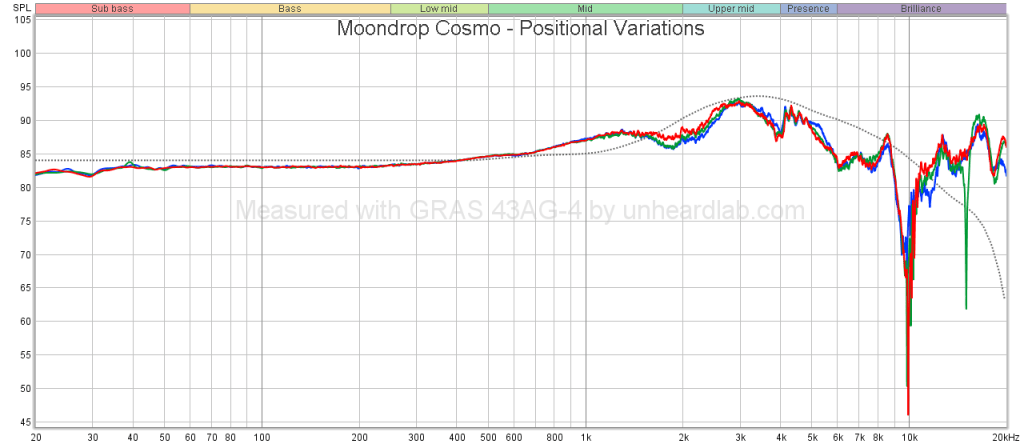
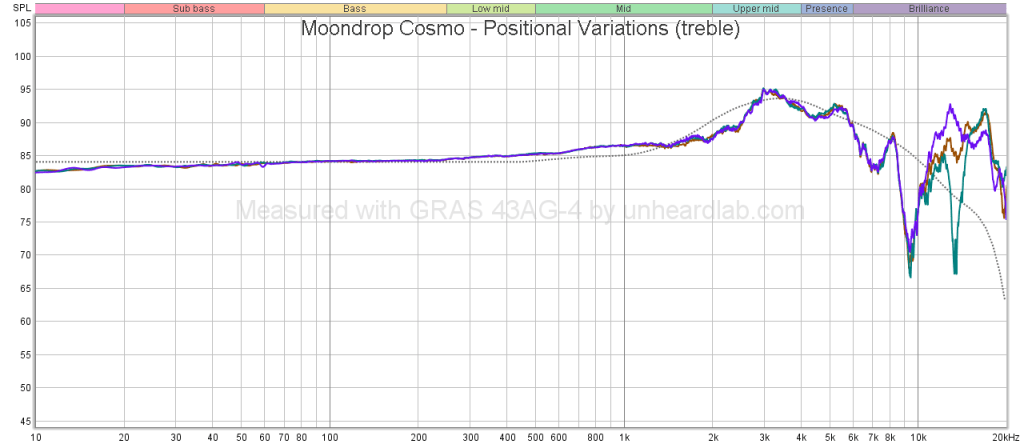
This graph illustrates how headphone placement on the head affects perceived tonal balance: with the ear positioned at the front (blue), centre (green), and back (red) of the driver.
Note: In more extreme wearing positions, the upper treble can fluctuate significantly—by as much as 8-10dB! This means the Cosmo may sound noticeably different depending on the listener. The same caution applies to the leakage tolerance test below. For the best experience, I recommend taking the time to achieve a good seal and finding the sweet spot where the sound feels optimal to you.
Leakage Tolerance:
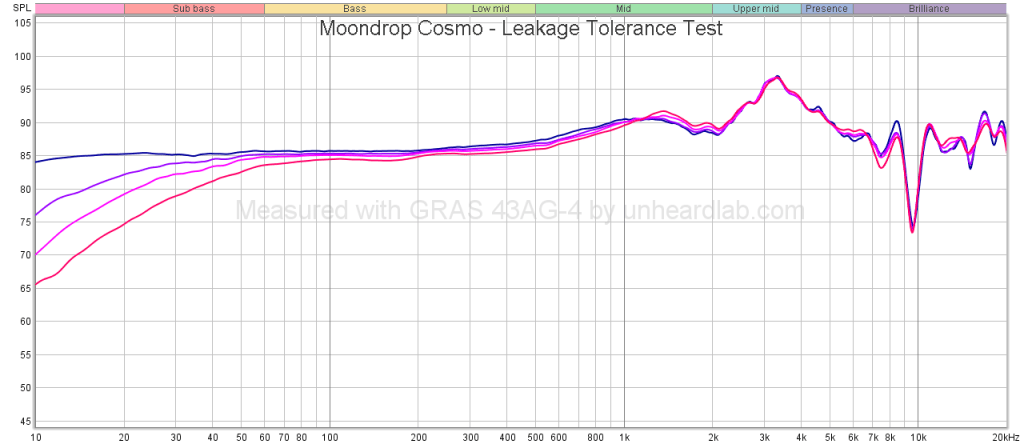
This graph demonstrates how leakages to the front volume can result in FR change.
Impulse Response:
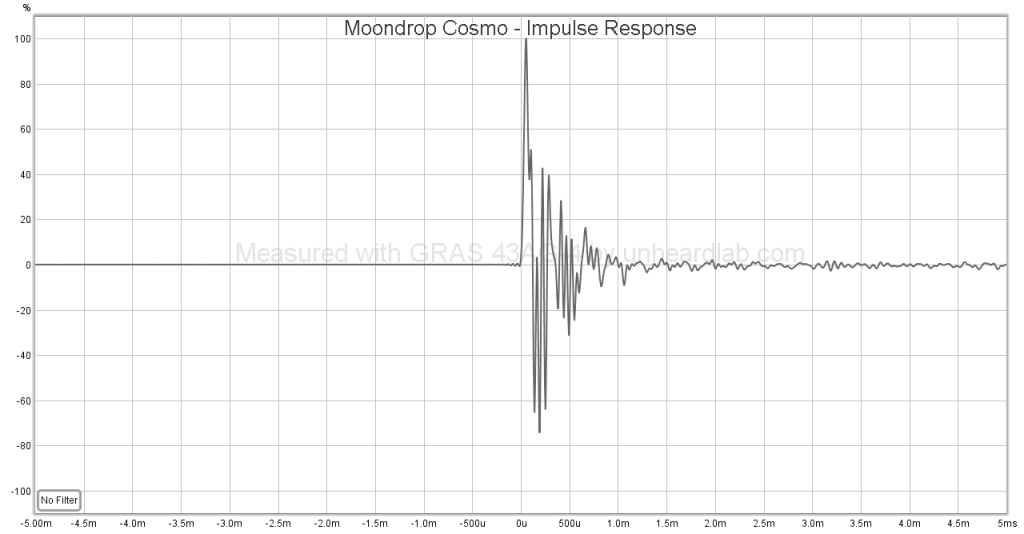
An impulse response graph illustrates a headphone’s ability to respond to sound signals.
Channel Matching:

Channel matching graphs do not relate to the perceived sound profile. A specialised configuration is used in this test to capture differences between channels, mitigating interference from positioning on the rig and the asymmetry in the GRAS pinnae design, a legacy of KEMAR. The left (blue) and right (red) channels are measured using a flat plate coupler with an IEC60318-4 ear simulator.
Electric Phase & Impedance:
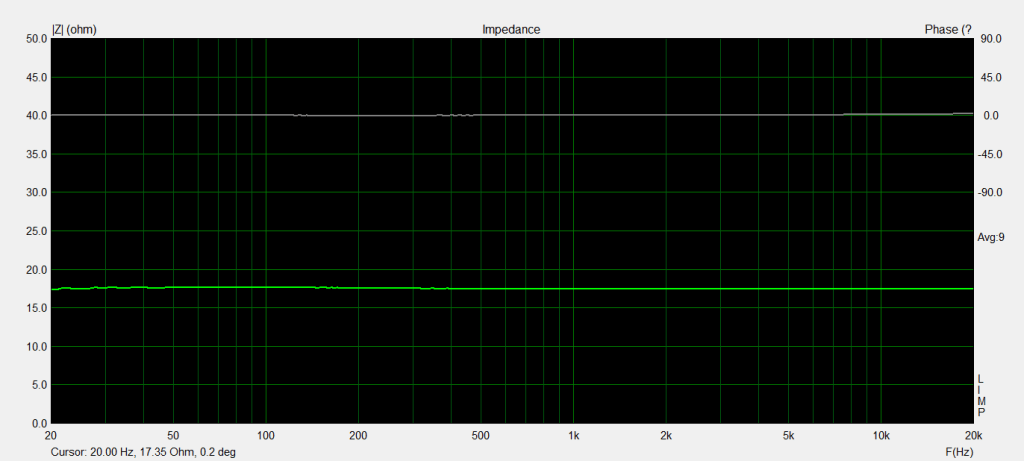
The above graph shows the measured impedance (green) and electric phase (grey).
END OF THE ARTICLE
Disclaimer: This review is not sponsored or endorsed by any business or related entity. The headphones reviewed are my own unless stated otherwise. Any links or recommendations included are purely informational and do not involve any financial affiliation or endorsement on my part.

Great Cosmo review, thanks for your time.
My comments on your COSMO review on head-fi, here:
https://www.head-fi.org/threads/moondrop-venus-para-hybrid-default-pads-and-ep-100a-pads-and-cosmo-re-equipped-with-the-paras-hybrid-pads-and-the-brainwavz-memory-foam-hybrid-earpads-xl-size-discussion.970569/page-35#post-18337800
This headphone Cosmo needs a lot of power, more than I thought to sound good, especially for bass dynamics.
The Cosmo’s original pads didn’t convince me; the two best pads to use with the Cosmo, in my experience, are the following:
Para hybrid pads, really excellent.
(note: I also own the Para ; note bis: it’s a pity they’re not supplied as standard, as alternative pads to the stock pads, with the Cosmo).
XL hybrid earpads recommended by @N3urolink on head-fi: Brainwavz Memory Foam Hybrid Earpads XL size.
LikeLike
Glad you enjoy the review!
I don’t have the Brainwavz hybrid XL pads that you mentioned but perhaps one day I’ll grab a pair to test. Do you find the treble hotter or darker on those?
LikeLike
Hi.
Hard to say.
I think that the Brainwavz hybrid XL pads bring, with the Cosmo, a treble level equivalent to the hybrid pads of the Para on the same Cosmo, i.e., they are rather soft at 6-8 KHz, softer than the highs of the Para and the Venus (with their stock pads); they don’t accentuate the diction of “ssss” unlike the Para headphones and the Venus, comparatively brighter in the treble and more sibilant.
Failing to measure the FR of the Cosmo, with these two hybrid upgrade pads, I did a sine-wave frequency sweep, by ear: the subjective results of this sine-wave frequency sweep were as follows:
Basically, to my ear, both pads (Para’s hybrid pads and Brainwavz hybrid XL pads) sound very similar for most sine frequencies: frequencies 315 – 400 – 500 – 630 – 800 and 1000 Hz are heard with both pads without noticeable attenuation or level bumps; frequencies 1250 – 1600 and 2000 Hz are heard with both pads with a little attenuation (maybe 2 or 3 dB as a guide).
There’s a frequency peak at 3150 Hz (for my hearing) with both pads, perhaps 3-4 dB; there’s a 2nd frequency peak at 5000 Hz, perhaps 2-3 dB, with the Brainwaz XL hybrid pads, not found with the Para hybrid pads; there’s high-frequency attenuation (for my hearing) at 6300 Hz (perhaps -3 dB) also found with both pads, and even greater attenuation (for my hearing) at 8000 Hz (perhaps -5 dB), with both pads.
My hearing is severely impaired from 10 KHz upwards, at my age
Still subjectively, when listening, the Brainwavz hybrid XL pads sound warmer and fuller, probably more in the midrange than in the treble, giving more thickness (and body) to the timbres of voices and instruments, which perhaps sound even more natural than with the Para’s hybrid pads; the soundstage also seems more spacious than with the Para’s hybrid pads (and much more than with the Cosmo’s stock pads, which I don’t like).
@N3urolink on head-fi, who probably has better hearing in the upper treble than me, finds that the Brainwavz hybrid XL pads bring the tonality of the Cosmo a little closer to that of the Venus (a little more bass and lower midrange?), while bringing the upper midrange and treble up to the same level as that of the Cosmo equipped with the Para’s hybrid pads, i.e. retaining great clarity and intelligibility in the midrange and upper midrange, without reinforcing sibilance in the treble (> to 6 Khz)
Fine FR measurements at the microphone, on your measurement platform, should show more significant FR differences than I’m able to find with a simple sine-frequency sweep.
Sincerely.
LikeLike
It’s great to hear that the Brainwavz pads sound similar to the Para pads! I think your impressions should be pretty spot on given the specs ie. material and size I see for the Brainwavz. Warmer and more natural and spacious than the Para would make a pretty compelling choice to test out.
But yeah, manual sine sweeps are tricky to do but once done right (sometimes I need to repeat a few times to confirm), the information you get from there can be pretty valuable. Given the extra front volume I suspect N3urolink may be also right that there could be a bit more treble here and there.
Cheers for your input.
Sai
LikeLike
Hello,
Thank you for this review!
Can you compare this headphone to MoonDrop’s Venus and Para? I also read people say this headphone sound like Audeze LCD-5.
Is is true?
Thanks.
LikeLike
Hi mate,
Glad you liked the review!
To compare, the Venus is a bit different, but the Cosmo feels like a BIG upgrade over the Para. The Para has a bright-neutral tuning and solid technicalities. For around $250, it’s exceptional value for money. But the Cosmo is much more well-rounded, with balanced tuning and stronger technical performance across the board. Gone are the treble peaks and sibilance issues you sometimes get with the Para.
As for the Venus, it’s a bit of its own thing. Being Moondrop’s first over-ear headphone, the sound profile is more unique, kind of ‘esoteric’ if you will. There’s more ‘flavour’, with a noticeable mid-bass bump (similar to the Meze Elite) and a bit of extra treble sheen, while the ear-gain region is slightly more subdued. Technical performance is solid, probably sitting between the Para and the Cosmo, but leaning more towards the Para. The Venus might have the edge in bass quantity (with stock pads), but the Cosmo’s bass is tighter with slightly better extension.
As for the LCD-5 comparison, I think people are referring to how the Cosmo measures similarly to the LCD-5 with the Para/EP100A pads. There’s definitely some truth to that. Both have a neutral, ‘monitor-like’ presentation. The differences? The LCD-5 is smoother, especially in the treble, making it easier to listen to for longer sessions. On the flip side, the Cosmo has a more open soundstage, with more air and sparkle. In terms of bass, the LCD-5 is punchier, tighter, and more robust, which is its biggest edge over the Cosmo (not to mention build quality and other non-sound factors).
Hope that helps.
Sai
LikeLike
Hello,
In terms of frequency response, the LCD-5 doesn’t seem to have a clear advantage in the bass compared to the Cosmo. However, you mentioned that the LCD-5’s bass feels punchier and more solid. What do you think contributes to this difference?
Thanks.
LikeLike
Hi Arthur,
You got the eyes for detail! Indeed, based purely on a single frequency response measurement, there doesn’t seem to be a significant difference in bass between the LCD-5 and the Cosmo. However, that’s under ideal measurement conditions—specifically, a perfect seal.
The reasons that the LCD-5 might feel punchier in practice can boil down to many factors like real-world fit and seal variations. Head shape, hair, and pad compression can introduce slight leakage, which affects bass perception. When the diaphragm is tensioned differently, when the seal is compromised, headphones can exhibit different degrees of bass roll-off, resonance shifts, or even significant boosts (think the Abyss 1266!), all of which influence the perceived sense of punch and slam.
That’s why in my full reviews, I always include different “modal” response measurements, such as leakage tolerance, to account for these variations. Some go even further to measure the f0 resonance frequency of the driver diaphragm, but there’s no standard for this, and obtaining consistent, interpretable data is still a challenge.
From my measurements, the LCD-5 appears to handle leakage better:

This might explain why its bass remains punchy compared to the Cosmo under real-world conditions. That said, this is likely only part of the equation. Other factors, such as f0 tuning, driver size, and THD in the bass region, could also contribute.
Hope that helps.
Best,
Sai
LikeLiked by 1 person
Hi,
Really appreciate your detailed response! It’s great to have passionate and thoughtful reviewers like you.
I completely agree with your point about how seal variations can affect bass perception (that’s actually one of the reasons I stick to keeping my hair short, lol). I’ve even heard that some manufacturers intentionally design pads with slight leakage to enhance the bass response.
LikeLiked by 1 person
No worries, and thanks for the kind words! Yeah, that’s absolutely true. Abyss headphones and the Stax Lambda series are classic examples of this.
LikeLike
Hello. Cosmo is a similar price range to Nan-7, and I’m curious about the comparison between the two products. (I used a translator, so the language may be awkward!)
LikeLike
Hi there – great question. I actually had the same thought but never got around to writing it down.
The Cosmo and NAN-7 are like polar opposites in many ways, though both perform exceptionally well for their price. In terms of technical performance like clarity, they rival top-tier headphones. The NAN-7 excels in dynamics, while the Cosmo stands out more in other qualities (especially with Para pads; the stock pads don’t quite match the NAN-7).
I’d say it comes down to taste. The Cosmo has a more ‘conventional’ sound with an airy tilt. It’s tighter, cleaner, and more precise. The NAN-7 is also an all-rounder but better suited for those who want visceral bass and dynamic contrast. It’s punchier, with more impact. Both are excellent choices for this price range, and honestly, you’d have to go up to top-of-the-line models to find something that’s significantly better. Even then, it’s often not a clear win.
As for build quality, neither is outstanding. The NAN-7 has some rough edges, and the Cosmo’s ergonomics are just okay. Although I do find the NAN-7 much more comfortable as it’s much lighter (420g vs 550g) and has a better headstrap for weight distribution.
LikeLike
Hello, i’m about to get myself a Cosmo as well, but when i’m looking around to check if my Fiio K7 can really drive it to its max potential, the reply is kinda mixed but the overall opinion indicates that it needs some kind of strong headphone AMP such as KA19, etc.
So i’m wonder if it’s true that i need something that’s close to a speaker AMP level or else
LikeLike
Hi mate. The Cosmo does require quote a bit of juice to get loud, especially if you wanna boost the bass via EQ. That said I don’t personally think you need a monster of an amp. Headphone amps have become much more powerful than they used to be when the HE-6 hit the market.
LikeLike
Hello Sai.
I’m taking the liberty of relaying here a very original way of “objectively” comparing two headphones via a microphone, not for measuring, but here for “listening” to the headphones being compared: here the Sennheiser HD-800S versus the Moondrop Cosmo fitted here with the upgrade pads proposed by @N3urolink: Brainwavz Memory Foam Hybrid Earpads XL size.
You may also be interested in this.
But there is one condition: you must have sufficiently neutral headphones at home (or monitoring speakers that are “neutral” enough) not to skew this comparative listening too much.
Link to Head-Fi: https://www.head-fi.org/threads/moondrop-venus-para-hybrid-default-pads-and-ep-100a-pads-and-cosmo-re-equipped-with-the-paras-hybrid-pads-and-the-brainwavz-memory-foam-hybrid-earpads-xl-size-discussion.970569/page-36#post-18354046
LikeLike
Cheers Eric – definitely an interesting approach, great for those who can’t get access to store demos. It seems the Brainwavz pads are doing some interesting stuff to the Cosmo. I also suspect quite an impact on the spatial qualities. Will make sure to test those pads.
LikeLike
Your review gave me the confidence to blind buy the Cosmo (with EP100A pads as recommended). Very happy with it!
Thank you!
How would you compared Cosmo and HE1000 (any version, preferably Stealth)? I’m particularly curious about detail retrieval / microdynamic of the Hifiman planar.
Hifiman’s tuning doesn’t really suit me, so this is more about my being curious than anything.
LikeLike
I’m really happy to hear that you’re enjoying them! That made my day.
The Cosmo and HE1000 Stealth are quite different in both sound and design. The HE1000 Stealth is actually my favorite in the HE1000 lineup so far, though I have a pair of the HE1000 Unveiled coming in, so we’ll see how that compares.
Compared to the Cosmo, the HE1000 Stealth has a more spacious and airy sound with a larger stage, but it’s also noticeably coloured in the mids and highs. If you’re not a fan of the Hifiman house sound, you might find it a bit withdrawn in the mids and slightly sharp in the highs.
When it comes to detail retrieval, I’d say they’re about on par. The HE1000 Stealth is slightly less articulate in the mids but has more sparkle and sizzle in the highs. As for microdynamics, I actually think the Cosmo does a better job, especially with nuanced volume changes, while the HE1000 Stealth gives you a more expansive stage.
So… you’re not already eyeing another pair of headphones, are you? 😉
LikeLiked by 1 person
Thank you for the reply! I’m not looking for upgrade any times soon, hopefully :))
My current arsenal consists of HD800S (soundstage and comfort), AWKT (woodwind and string instruments, and female vocal) and the Cosmo+EP100A (pretty much everything else). I get my daily dose of bass with the help of equalization.
My only wish is for the Cosmo to be a bit more comfortable. Despite weighing about the same as an LCD-2C, the latter just feels nicer on my head.
LikeLike
That’s a solid lineup you’ve got there! I haven’t heard the AWKT myself, but I’ve seen a lot of praise for how it handles female vocals.
Yeah, I agree, the Cosmo could definitely benefit from a beefier headstrap etc. I haven’t tried modding it yet, but from what I can tell, it should be fairly easy to disassemble. The main thing is just finding a strap that fits properly. Not sure how easy it is to source one, but it could make a big difference in comfort.
LikeLiked by 1 person
The creator of the nan7 has recently released the entire headband assembly for nan7 as well as lambskin headstrap in his Taobao store. Unfortunately, the headband assembly is only being sold to existing nan7 customers. I’m not sure about the availability of the headstrap (whether they’re restricted to nan7 customers or available to everyone). I’m also not sure if these parts can be easily modified to fit on Cosmo.
LikeLike
Yeah, I saw that too. I’d guess the headband assembly probably won’t be a direct fit, but if you’ve got decent DIY chops it might be worth a shot. The width isn’t too far off, so it’s not out of the question with a bit of modding.
As for the strap, the NAN-7 one is quite sturdy and on the thicker side, so I’m not sure how well it would suit the Cosmo, which might benefit more from something a bit lighter and more flexible.
LikeLike
Cosmo with Para pads seems to be the most neutral headphones among your data base according to the frequency response measurement. It’s wild they didn’t include those pads stock. And the weight……biggest letdown for sure.
LikeLiked by 1 person
Yeah and it’s not just about the graph, this combo is one of the most neutral/balanced tuning I’ve heard, among planars at least. Let’s hope they improve the ergonomics and accessories in the future.
LikeLike
Thanks for your great review! Your past reviews save people(including me) who are having difficult time of choosing headphones. 😂
I’m now trying to find a headphone that has potential to be neutral-clean tone(gonna apply EQ), detail-revealing with good microdynamics, punchy transient response without laid back groove, and have precise imaging with good soundstage.
It seems that I want really well built studio monitors on my ears😅
It doesn’t have to be superior to all and super-hifi.. just have to be on or over average.
Cosmo and Hifiman Arya stealth have been discounted and now on similar price range(600$~690$) in my country.
But it seems you see cosmo as he1000 stealth’s level.
Will Cosmo show the best price-performance ratio on that price range? Or maybe there’s something else..
Would love to hear your opinion 🙂
And for the dynamics part, is it because it lacks a bit of low~sub? Or is it still weak even after pad rolling and boosting lows?
I’m confused whether it’s just because of tuning(tone balance) or the driver’s performance limitation.
If the macro dynamics can be more punchy with pad rolling and EQ, then maybe the Cosmo could be my final choice🤔
LikeLike
Hey, glad you find the stuff useful!
Given your preferences, the Cosmo looks like the most promising pick in that price range. If you plan to EQ, the Para 2 could also be worth considering at a lower cost. The build is more robust with stainless steel, and while the sound is a little less refined than the Cosmo, EQ gets it close.
Neither are standouts for punch or macrodynamics, which I see as a weaker point of Moondrop headphones in general, but they cover most of your other requirements well. This does come down to the driver behaviour, things like bass to treble linearity, resonance frequency, and acoustic impedance, rather than simply tuning. You can still apply a solid bass shelf without running into clipping or distortion, so it should not be a major concern. They will not reach the level of a Focal Utopia or Audeze LCD-4 (after EQ), but they can improve a lot over stock and remain very good value for money.
LikeLike
Hi Sai, jumping into this thread as a new reader. I’m following your exchange with ‘Anonymous’ about the Moondrop Cosmo and I’m still a bit confused about one point regarding its dynamics.
You mentioned that the lack of punch/macrodynamics is a general Moondrop weakness and comes down to ‘driver behaviour’ rather than ‘simply tuning.’ However, you also said a solid bass shelf can ‘improve a lot over stock.’
To clarify, when you EQ the bass up, does this actually improve the macrodynamics (the punch, slam, and impact), or does it mostly just increase the quantity of the bass, while the fundamental dynamic limitation of the driver remains?
LikeLiked by 1 person
Hey Arthur. That’s a really good question. To me, all those ‘technicalities’ are not free from the frequency response; they are not never separate things. Here I talk about them as if they are distinct categories because those established terms help us communicate better.
For a general definition, dynamics describes the contrast between loud and soft elements. To me, macrodynamics (specifically the perceived ‘punch’ and ‘slam’ in the bass region) is made up of at least three things: 1. The perceived level of impact. This is largely to do with the stock tuning, particularly the frequency response in the bass region, not least the ability of the tranducer to produce rich, quality subbass 2. The potential of the driver in delivering that impact. This involves the physical limits of driver excursion, and the distortion profile, which may limit the headphone’s ability to deliver high SPL low frequency sounds cleanly. 3. The driver’s ability to consistently deliver bass performance in real world scenarios, such as when there are seal breakages or leakage on the human head.
To clarify your point on the Cosmo and bass dynamics: when you EQ the bass way up (say 6-10dB), it definitely improves the perceived punch and impact. That is the tuning part. However, it does not change the driver behavior for the second and the third point. This is especially true for leakages. The Cosmo seems to have a high f0 design, and the modal response in the presence of leakage is also not as ‘sharp’ as some other planars. So, the Cosmo is still a weaker planar headphone in this regard.
LikeLike
Hello, I’m wondering which would be your choice for best 3 pads for cosmo..(when applying EQ)
I saw the measurement of cosmo with dekoni THX00 fenestrated sheepskin pads have gorgeous top-end, and the dekoni elite hybrid HE seemed to have gorgeous mid range..
But outside just tonal balance which I can apply eq, what were the favorite pads for you in case of soundstage, precise imaging, and dynamics?
LikeLike
Hey there. I tend to find the Cosmo really accommodating to different pads since it’s well-designed on the speaker level. If you’re gonna EQ anyway, I recommend looking for ones that give you more room for your ears (for comfort and better spatial effect) but have less peakiness in the treble, especially around 10kHz and up. That range can be very tricky to EQ because it’s so sensitive to head position and all those complex interactions with our ears.
As such, I recommend Moondrop’s own EP100A for a budget, all-around option, and the ZMF Universe Suede Perforated for a roomier feel. Honestly, the EP100A does the trick pretty well already. But if you have the funds, grab the ZMFs, find the perfect EQ setting for you, and you’re set. The Dekonis do a very similar job to the EP100A but cost more. If you prefer their comfort or slightly more room because of their angled design, they aren’t bad either.
LikeLike
Thanks for your reply! Then aside from price, which has better soundstage between dekoni THX00, dekoni elite hybrid HE, and ZMF Universe SP?
Cause I’m willing to pay more to get the best out of it..
LikeLike
No worries. To me it’s: ZMF Universe SP > Dekoni elite hybrid HE > THX00. Sometimes it’s really the size factor that matters haha.
LikeLike
Oh… maybe the ZMF Universe SP is the best option for the cosmo!
Have you tried the Lambskin Perforated version too?
LikeLike
Can’t remember if I tried the LP with the Cosmo. The SP generally sounds a bit softer/more mellow compared to the LP’s cleaner, more cohesive sound. So it depends on what you’re after.
LikeLike