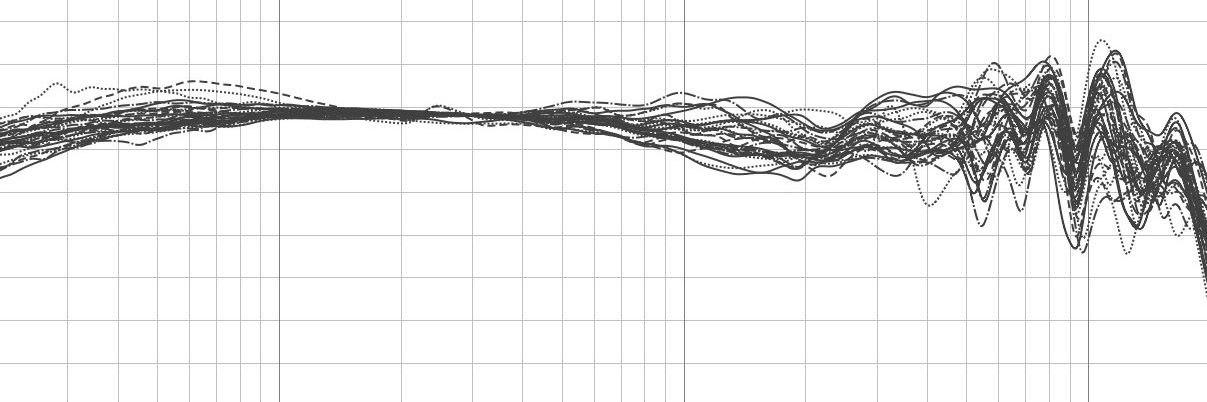

The new budget-fi planar?
Intro
In late 2022, Moondrop released their first over-ear planar headphone, the Venus, after a prolonged wait since their debute on a launch event. While I appreciated the Venus, its hefty weight and modest performance for its price left me somewhat wanting. It didn’t take too long before they introduced a more affordable model, the Para.
The Para, adopting a similar design language, is priced at $299. This is quite aggressive, considering the typically higher cost of planar technology compared to conventional dynamic driver headphones. The materials and build quality appear quite decent. But what do they sound?
EDIT# May 2025: I’ve recently bought a second unit and measured a few more pad options including the EP100A.
Specs & Comfort
Price: US$ 299
Driver size: 100mm (advertised)
Earpad size: 105mm
Sensitivity: 108 dB/Vrms @1kHz
Impedance: flat, 8Ω @1kHz (measured)
Connector: dual 3.5mm
Weight: 526 grams
Clamping force: medium
Headband swivel: YES
Comfort: 6/10 (weighty)
Measurement & Sound
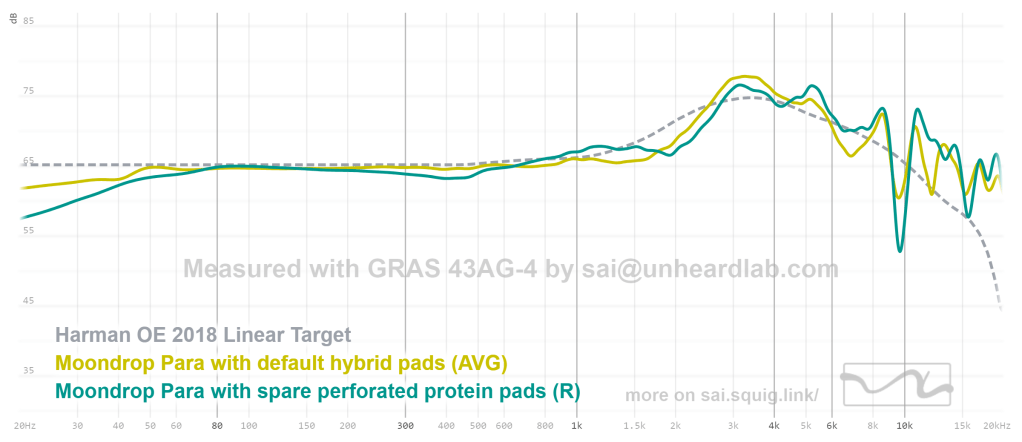
link to the frequency response measurement & more comparisons
Tonal balance:
My first impression was – wow, this is a very capable headphone! Immediately the technical performance comes off clearly ahead of those in the price range, like the HD600, the DT900 ProX, or Hifiman’s entry level planars. I wouldn’t describe its timbre as the most natural though. While it may sound ‘neutral’ at first, the tuning feels somewhat bright and intense.
This review primarily focuses on the hybrid pads, as the perforated pleather pads are excessively bright, to the extent that I find them unlistenable without EQ. I will discuss those pads in the final section on EQing the Para.
The bass is relatively lackluster. As a planar, the Para’s bass extension and the sense of punch are passable. It doesn’t sound limp, but neither the bass quality nor the scale of impact is particularly impressive. There’s not m uch grunt or rumble, and the bass quantity is somewhat unsatisfying. The measured response confirms a noticeable roll-off in the sub-bass area, which aligns with my listening experience.
Planar headphones typically offer a linear bass response, but that’s not the case here. This is likely due to higher tension applied to the Para’s diaphragm plus certain degrees of front volume leakage. The trade-off is a tight, fast, and well-controlled bass response, free from muddiness or bloat. Overall, the bass performance is clearly behind the likes of the Hifiman HE6se, slightly behind the Edition XS, and about on par with the Sundara.
The mids when considered in isolation, are quite pleasing, clean and transparent. The upper-mids are less recessed than typical Hifiman planars like the Sundara, HE6se, or Edition XS. Compared to the Moondrop Venus, the Para’s mids are a bit less full-bodied, yet actually a bit more articulate. It’s not the lush and warm kind, rather just the neutral and uncoloured kind.
It’s important to note that the mids are influenced by other frequency ranges, particularly the treble in this case. Male vocals are mostly fine, unless we are talking about some sort of thrash or hiphop. Some female vocal tracks can sound quite sibilant or sharp, depending on the register and the mastering. For well-recorded tracks, like ‘Bird on a Wire’ by Jennifer Warnes, the Para does a decent job of faithfully reproducing the vocal timbre, though the sibilance in Ss and Ts is borderline uncomfortable. More on this below.
The treble, as expected, is somewhat bright and splashy. The Para generally maintains a neutral midrange and lower treble tonality, but there’s a distinctive sheen to vocals and instruments from 5kHz upwards, somewhat reminiscent of the Venus. It’s mostly in the upper treble ‘air’ and ‘zing’ frequencies, which can make violins, piccolos, and cymbals sound overly energetic, to the point of being intense and fatiguing for many. Hifiman planars are known for boosts in this area, and the Moondrop Para takes it a step further. If you find the Sundara or the Ananda already a bit bright for your taste, the Para is likely going to give you a hard time.
The upside is that instruments sound exceptionally crisp, sharp, and clear. The level of detail the Para reveals is remarkable. However, for many listeners, this level of brightness might be overwhelming. I find about 50% of my library challenging to listen to without EQ. Songs with significant content above 8kHz immediately highlight this brightness. However, tracks with fewer high frequencies, such as those featuring male vocals, are generally more manageable.
Overall, aside from the treble, the Para is quite well-balanced. It leans towards brightness, but fortunately, the mids and bass don’t feel lean, which would have been a very problematic combination.
Other qualities:
- Soundstage and Imaging:
The soundstage of the Para is quite impressive. It’s not as expansive as the Venus but slightly surpasses the Sundara 2021. Imaging is also commendable, with vocals sounding clear and distinct – a clear step up from the HE400se and slightly better than the Sundara 2021. This may be due to strong energy in the ear-gain region between 3-5kHz. However, stage depth is somewhat flat, more noticeable in orchestral music, such as when locating the timpani.
- Clarity:
The clarity and resolution are impressive. The Para’s detail-oriented tuning reveals many subtle details, particularly in percussion instruments like hi-hats or cymbals. Some might attribute this to the elevated treble, suggesting a ‘false’ sense of detail. My view is mixed: while the treble boost does enhance perceived detail, the Para’s driver is genuinely capable of reproducing high-frequency sounds with good fidelity. It is excellent not only for the price, but can compete even with some much more expensive headphones, like the Focal Clear, the Audeze LCD-2 Fazor or the Stax L500.
However, there seems to be a potential resonance issue between 12-14kHz. The unsmoothed frequency response shows some messiness or what might be called a ‘sawtooth’ pattern in this region, indicating some form of non-linearity. In my listening tests, the 11-13kHz range indeed stands out noticeably, translating into audible peaks, which affects the treble timbre. Smoothing this region could significantly refine the overall treble quality.
- Dynamics and Impact:
The dynamic qualities of the Para are good for the price, comparable to the Sundara 2021. It offers slightly better control and contrast between loud and soft elements, with even the decay of quieter sounds being clear and distinct. However, its slam and impact are somewhat lacking, surprising given its double-sided magnet structure compared to the single-sided Sundara. The Venus excelled more in these aspects.
Conclusion and value:
Without EQ, the Para might feel a little too clinical and bright for many genres, except perhaps acoustic or classical recordings. Nonetheless, its exceptional technical capabilities, decent build quality, and materials make it a strong contender. However, it may not distinctly stand out from other similarly priced offerings, such as the HD6 series, Sundara, or Verum One. While the Para is unquestionably the most technically capable in this group, its un-EQed performance doesn’t quite elevate it to a higher tier, due to the somewhat fatiguing treble.
However, for those less sensitive to treble above 8kHz, the Para is undoubtedly an excellent headphone. Most of my concerns stem from the treble region above that.
At $299, the Moondrop Para still offers great value, particularly for those open to EQ. While its stock tuning might not suit everyone due to its overly zealous treble, it’s easily adjustable. A simple reduction in the upper treble significantly improves tonality, as the mids are already quite linear up to 8kHz.
It’s encouraging to see budget planars getting more competitive. With what Moondrop has achieved with the Para, I am optimistic about their future releases.
Pros: Exceptional clarity; bright tuning but with a natural midrange; clean and tight bass; outstanding technical performance for the price; solid build and materials.
Cons: Vocal sibilance; peaky upper treble; potentially intense for modern genres; bass extension and quantity could be better.
Value Grade (subjective assessment on value, NOT sound quality):
Notes on EQ
The Para doesn’t require much EQ aside from the treble and pure bass quantity. A high-shelf filter above 8kHz would perhaps be the easiest way to go, but you could potentially do better by trying to locate the rough positions of the peaks and pull them down with peak filters.
My personal EQ profile for this headphone (with the perforated pleather pads, as it has better spatial representation than the hybrid pads):
Preamp: -7.0 dB
Filter 1: ON PK Fc 20 Hz Gain 7.0 dB Q 0.500
Filter 2: ON PK Fc 420 Hz Gain 1.5 dB Q 1.200
Filter 3: ON PK Fc 530 Hz Gain 1.0 dB Q 3.000
Filter 4: ON PK Fc 1100 Hz Gain -1.5 dB Q 1.600
Filter 5: ON PK Fc 2000 Hz Gain 4.5 dB Q 3.000
Filter 6: ON PK Fc 5400 Hz Gain -3.0 dB Q 3.000
Filter 7: ON PK Fc 8600 Hz Gain -2.0 dB Q 3.000
Filter 8: ON PK Fc 12000 Hz Gain -6.0 dB Q 2.200
Filter 9: ON PK Fc 12500 Hz Gain -2.0 dB Q 3.000
If you want to stick with the default hybrid pads:
Preamp: -6.0 dB
Filter 1: ON PK Fc 22 Hz Gain 6.0 dB Q 0.500
Filter 2: ON PK Fc 450 Hz Gain 0.5 dB Q 1.500
Filter 3: ON PK Fc 540 Hz Gain 0.5 dB Q 3.000
Filter 4: ON PK Fc 1900 Hz Gain 3.0 dB Q 2.000
Filter 5: ON PK Fc 3200 Hz Gain -2.5 dB Q 2.000
Filter 6: ON PK Fc 8500 Hz Gain -1.5 dB Q 3.000
Filter 7: ON PK Fc 11000 Hz Gain -3.0 dB Q 3.000
Filter 8: ON PK Fc 14000 Hz Gain -4.0 dB Q 3.000
If you would like to EQ to the Harman Target, there’s an handy AutoEQ function built in Squiglink that you could use as a starting point (I personally do not recommend doing so – ideally you should adjust the filters to suit your own hearing especially in the treble).

MEASUREMENTS
Frequency Response Average (unsmoothed):
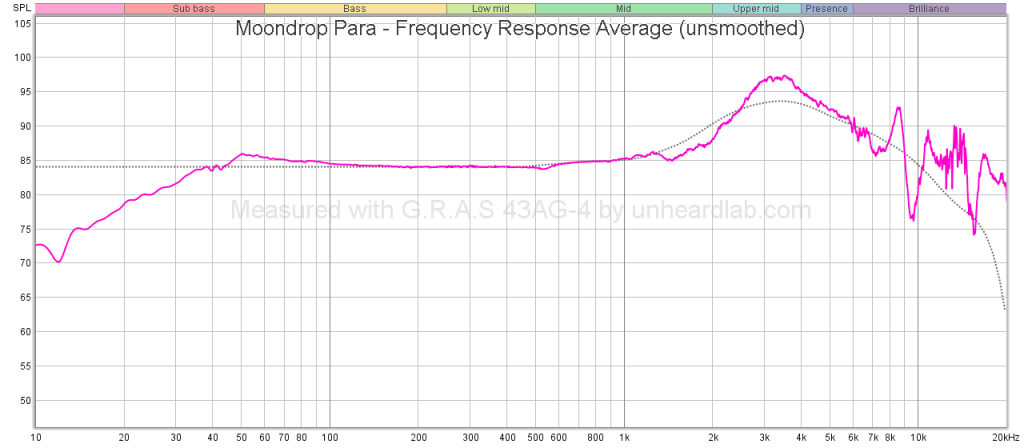
Bass extension cutoff is 10hz instead of 20hz on the extende frequency response measurement, so as to fully capture frequencies which though may not outside of the ‘audible range’, may be felt by our ears, bones and muscles and enhance the sense of ‘impact’. The response is obtained by an average of positional variations. The graph is unsmoothed to better show the peaks and dips that might be audible.
Positional Variation:
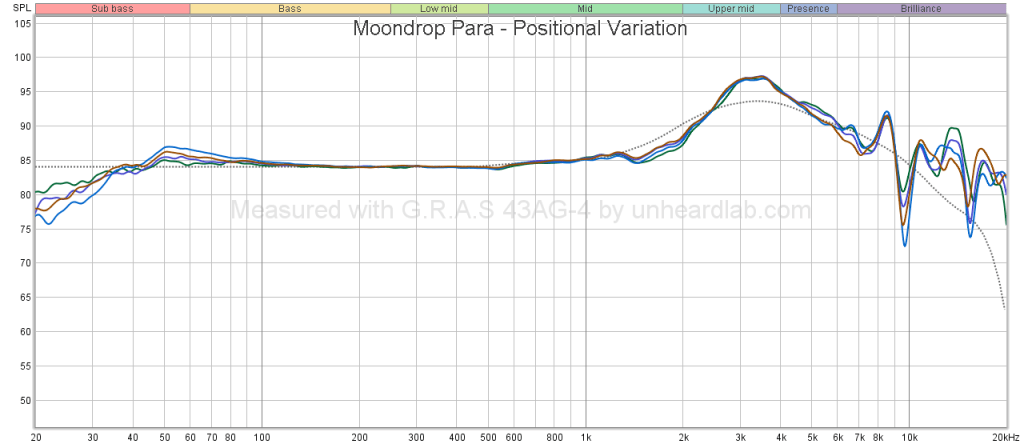
This graph shows how the tonality might be affected when you wear the headphones differently on the head.
Leakage Test:
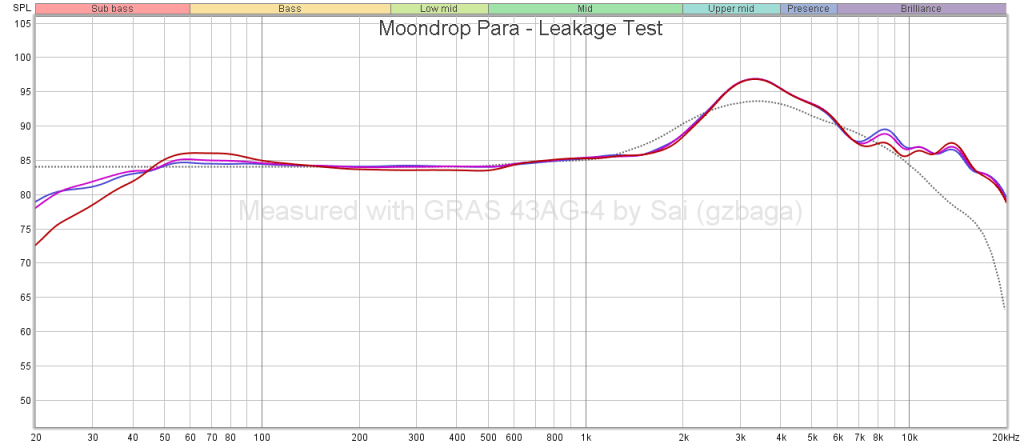
This graph demonstrates how a small leakage (simulated using thin-armed glasses) can result in FR change.
Impulse Response:

Impulse response contains information about transducer movement when a test tone is played.
Channel Matching:
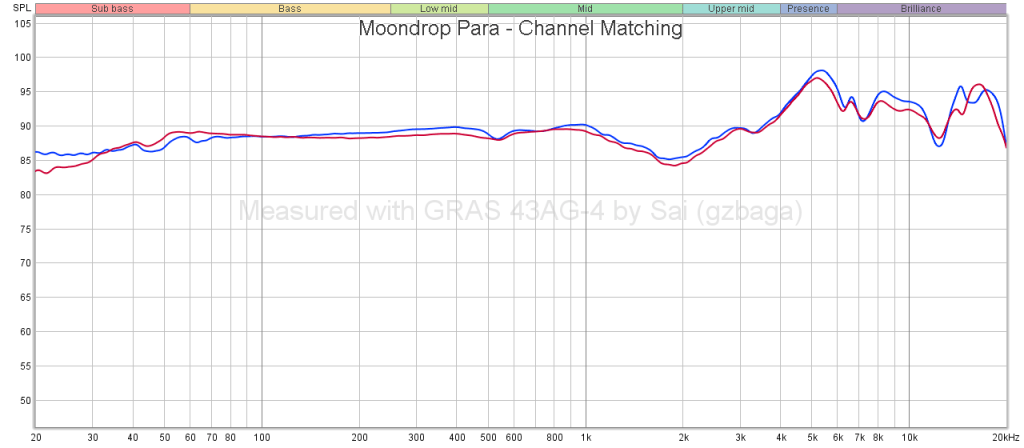
Channel matching graphs DOES NOT RELATE TO SOUND PROFILE.
a specialised configuration is used to capture channel differences to mitigate the interference from positioning on rig and the asymmetricity in GRAS pinnae design (legacy of KEMAR).
the Left (blue) and Right (red) channels are measured on a flat plate coupler with an IEC60318-4 ear simulator.
Total Harmonic Distortion under 94dB SPL (supplied per request):
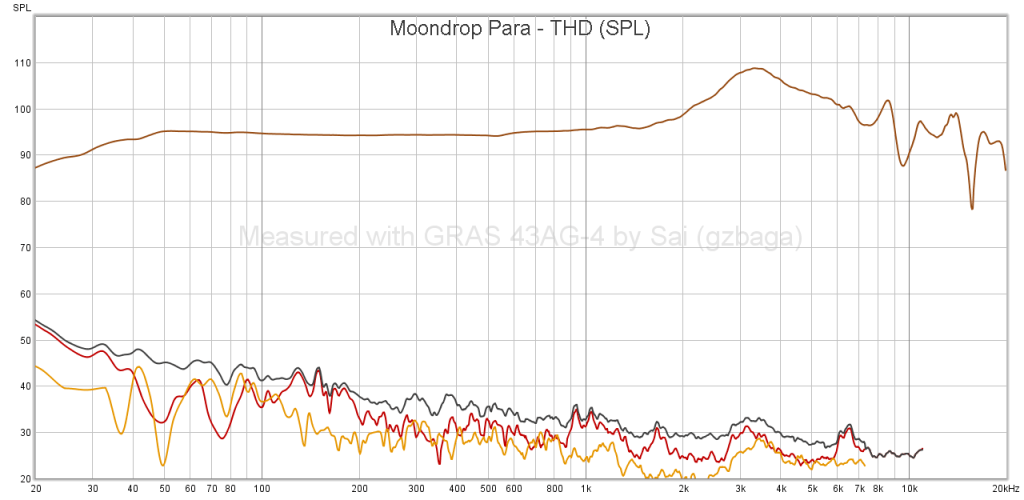
Measured under normal room condition. THD (black), 2nd harmonic (red), 3rd harmonic (yellow).
Electric Phase & Impedance:

The above graph shows the measured impedance (green) and electric phase (grey).
END OF THE ARTICLE
Disclaimer: all the headphones tested here are my personal units unless otherwise stated. All the links and recommendations provided are not associated with me in any financial manner.
EDIT 27/01: corrected several typos and expressions for clarity
EDIT 07/02: added comparison for clarity with other headphones

hey sai!
Great review! While I bought the Para before your verdict, it was worth it and I’m quite glad I did it as my first audiophile headphone
I saw the frequency response on your squig.link, and the 1688 hybrid pads were really interesting (since it controlled the upper-mid range/lower treble while still making it airy)
do you have a link to buy it? Also do you have any plans on making a pad-rolling article for the para?
thank you for the review and for giving us this great blog
LikeLike
Hi mate, thank you for the kind words! I’m glad that you find the information here useful. The Para is without doubt a great headphone.
Here’s the link to the 1688 hybrid pads that you’re after. These are indeed very good ear pads and they suit a lot of headphones, especially open-back planars. Personally I find these still a bit bright though, and I prefer the JingZhi Denon D5000 protein pads and aftermarket Audio Technica A900X protein ear pads for modern pop and rock genres.
As for a pad-rolling article for the Para, I don’t have immediate plans for one. The main reason is that I’m satisfied with the stock pads, and many aftermarket options tend to brighten the sound further. Also, the Para can be easily fine-tuned with some EQ or simple mods. A simple trick is the toilet paper mod – just place a piece of 3-ply tissue inside the ear pads. It’s surprisingly effective at reducing treble above 6kHz by about 1-3dB.
Hope that helps, 😉
Sai
LikeLike
Fantastic review! I’ve seen your squig measurements with different pads, what exact model is Yaxi Alcantara? Thanks!
LikeLike
Glad you find it useful mate!
Those are the Yaxi Alcantara pads for TH900. They also fit the Hifiman headphones and those with 105-110mm pad dimensions.
LikeLike
Super, thanks! They looked very good on paper, did you like them? I really liked the Paras, but found them on the brught side, and would love to avoid using EQ whenever possible:)
LikeLike
If you’re asking whether I like the Para, yea I do! Looking back, I think my initial review might’ve been a bit harsh actually. They’re definitely on the brighter side, as you mentioned, but it’s a small issue that can be easily tweaked with EQ or pad swaps. Even straight out of the box, the Paras offer some of the best value for money among planars.
Re the Yaxi pads, they do help tone down the upper mids a bit, but they don’t do much for the treble brightness. If you’re looking for pads that can soften the upper treble, I’d recommend the Jingzhi sheepskin pads for Denon D5000. Another good option is the aftermarket ATH-ADX ear pads in protein and velour, which offer a similar tuning (don’t buy the thicker option). You can find these on Aliexpress, and I have measurements for them on my Squiglink page if you want to check that out.
LikeLike
Thanks! And congratulations for your site, by far the most reliable source for headphone reviews I’ve found, bravo!
LikeLiked by 1 person
Your words mean a lot to me, thanks! 😊
If you end up getting any of the pads, feel free to drop by and share your thoughts anytime!
LikeLike
Para with EP-100A pads graph ?
LikeLike
Para with AR5000 pads graph too, Thanks.
LikeLike
The Moondrop ad has a graph for Para with the EP100A pads.
Unfortunately I’ve sold my Para. Although I do intend to measure them again given the chance. Perhaps I’d buy another set in the future.I’ve recently bought a second unit and measured a few more pad options including the EP100A.
LikeLike
Thank you very much for the re-measurement.

The graph shows that the EP100A makes the Para’s tonalities as they should be.
I sent my Para to my friend to measure.
However, the graph is less different than I thought compared to what I actually felt.
He liked the Hybrid Mesh Pads the most.
But I still prefer the Hybrid Velvet Pads because of the comfort.
LikeLike
*Edit: I meant the velvet pads (side-touch velvet and outside velvet).
LikeLike
Glad it helped!
Yeah, someone sent me this graph too actually – props to you and FFCuties. Pretty sure I’ve got those pads lying around somewhere (probably buried in the pad pile). Did you take off the plastic mounting ring? Since they’re made for Hifiman, I figured that was the move. From what I’ve seen, they’re tuned kind of like the Pali pads, so they should work well on the Para too. I’ll give them a shot, though I have to locate them first.
LikeLike
Yes, I did. I asked the seller to separate the plastic mounting ring.
LikeLike
Your comment got flagged as spam because of the links and I just fixed it haha. It’s great they were happy to do that. Mine came with them attached, so I might just grab another set without the rings this time.
LikeLike
Moondrop Para First impression It’s very bright, thin, sharp, very unnatural vocals, can’t hear at all. But when switching Pads to EP100A, the game changed. The sound is smoother, much better than Stock Pads, but the vocals are still a bit too forward. Then I switched to Velvet Pads* and I found the real Endgame without EQ, natural tone, balanced, relaxing, smooth, flowing, no peak. For me, it’s perfect, except for the weight.
Velvet* > EP100A / Mesh*(more Bass,Treble) >>> Stock Pads
*PEPS EarPads Hifiman SUNDARA Replacement (Ask seller to separate the ring.)
LikeLike
Thanks for sharing your impressions!
I definitely agree – the stock pads can sound bright and thin, especially with the perforated pleather ones. The EP100A pads do a great job of toning down the treble and smoothing things out.
Just to clarify, when you mention the velvet pads, are you referring to the PEPS Sundara replacement pads (the ones with velvet material on the side touching the face)?
LikeLike
Velvet touching side and velvet outside.
Color: Red/Blue/grey/black
I haven’t tried Protein Velvet yet.
LikeLike
I see. I’ll give them a try as well.
LikeLike
If shop in Aliexpress can’t separate the ring, you can ask 华海旺耳机套 (Huahaiwang earphone set) in Taobao /item 666884847083, this shop may be a manufacturer, can be customized.
LikeLike
Thanks! I’ve already ordered them and am just waiting for their arrival. You’re spot on. I think Huahaiwang also has its own store on 1688, the Chinese version of Aliexpress. Looks like we’ve got a pro shopper here 😉
LikeLike
Yes, 乾音品牌旗舰店 (Qianyin brand flagship) Huahaiwang on 1688, should be the same store that I bought from Qianyin on Shopee, but 1688 seems to ship to fewer countries than Taobao.
LikeLike
Yep, you can tell from the listed items. For those familiar with parcel forwarding, buying directly from 1688 is a much more cost-effective option.
LikeLike
You are the best reviewer I have ever seen! Thank you for the review. My Para after changing pads, its technical can be on par with very high-end headphones like He1000 and LCD-4,5.
Apart from the stock pads, which one do you think is the best in terms of tonality? I’m new to headphones and my taste in iems is Thieaudio Monarch MKII.
LikeLike
Hi mate, I really appreciate the kind words!
Yeah, the Para is definitely one of the most impressive headphones in terms of technical performance. As you may have noticed, it’s kind of become a benchmark for me when it comes to headphones that punch above their weight though its stock treble tuning holds it back a little, IMO.
For ear pads, Moondrop’s own EP100A upgrade pads do a great job of reducing treble sharpness while adding more body to the mids. If you’re looking for even smoother tonality, I actually prefer the thin Audio-Technica pads used on their ADX series headphones. By reducing front volume resonance, they help tame the treble quite effectively. There are cheap ones from Aliexpress.
Hope that helps!
LikeLike
Thanks for the reply.
Regarding the ATH pads, have you ever measured them with Para? Can I find the graph in the squiglink?
LikeLike
You’re welcome! Here they are: https://sai.squig.link/?share=Harman_OE_2018_Linear_Target,Para_with_default_hybrid_pads,Para_with_Taobao_ATH-ADX_protein_pads,Para_with_Taobao_ATH-ADX_velour_pads
LikeLike
Your measurements make my day bro!
But something I didn’t get…I have compared them with the EP-100A but seems like the ATHs have less bass and a very high peak in 8k region. Can you explain me why it be smoother? ^_^
LikeLike
Well yeah, the 8-9kHz peak on the Para is quite prominent, and that’s something you’ll likely find with almost all ear pads. But this region is also highly dependent on fit and positioning, so the way it sounds can vary from person to person.
If you’re looking for something even smoother, I’d recommend the protein variant of the ATH ear pads. You can grab them from 1688 (note it’s the thin version), just use a forwarding agency for shipping if needed.
LikeLike
I find these in Taobao and are there the same pads that u mentioned? https://e.tb.cn/h.TDk5EhScpG4WNdu?tk=HAAkeNTHxz6
LikeLike
No, those are the thicker ones. Here’re some listings from Taobao that appear that sell them (link 1, 2).
LikeLike
After testing the ATH pads, I realized that the peak in the 8k area is really annoying for me, especially when the dip around 7k makes this area more noticeable (T-T).
Now I want to move on to Jingzhi pad R10 and Jingzhi denon, what do you think about these pads? And if possible, give me the link to buy them on taobao. I searched in the Jingzhi shop but didn’t know which one to choose, and I couldn’t find the R10 anywhere…
Your measurements really make me curious and want to try them all ^_^
LikeLike
So sorry to hear that!
Unfortunately, the JZ R10 pads have been discontinued, so they’re no longer available. But Jingzhi still has a few other options that might help. If you’re buying from China, I’d recommend checking out their Taobao store. They used to sell these on 1688, but not anymore.
At the end of the day, the Para is a bright-leaning headphone. While pad-rolling can help tame some of the treble, the effect also depends a lot on how they couple with your ears. If you want to experiment, I’d say the Jingzhi Denon D5000 lambskin pads are worth a shot!
LikeLike
Hello Sai, have you ever tested this Pad?
ZMF系列auhp 原版记忆棉打孔 (ZMF series auhp original memory foam punching)
https://item.taobao.com/item.htm?id=760358484451
Buyer reviews say it works well with FT1 Pro, but no reviews with Para.
LikeLike
Hi there, I haven’t tested it yet. I’d need to get another pair of the Para to try it out. Based on my past experience, though, the Para is already a bit too bright for me at 8kHz and up, and thicker pads tend to make that even more pronounced. In contrast, the FT1 Pro is much more controlled in that region, so I can see why this pad might work well with it.
LikeLike
Thank you for your recommendation, Sai!
Since trying the JZ Denon lambskin pads, I’ve been smiling every time the music starts. Maybe I can call this the endgame. They’re comfortable to wear, offer very high detail, and the reference tuning makes the sound incredibly addictive!
Perhaps it’s not perfect—3kHz could be softer by about 1-1.5dB, and the low mids around 500Hz could use a slight boost to make the sound livelier—but EQ can easily fix that!
Once again, thanks a lot, and I look forward to more of your reviews and measurements.
LikeLiked by 1 person
It’s great to hear that you enjoy them! Yes, the Paras are very capable headphones, just needing some tweaks to suit everyone’s taste. I’m happy to know that my words helped.
Personally, I actually don’t mind the slightly higher 3kHz on the Para. Perhaps I am not that sensitive to more ear gains, but YMMV. Indeed there are many who enjoy a more laid-back tuning, and that’s how Audeze make their sales haha.
Cheers,
Sai
LikeLike
Thank you for the review. What do you recommend for the pad swap on para when it comes to neutral tonality and decreasing the resonance issue between 12-14kHz after your second unit measurement?
LikeLike
Pleasure! At the end of the day, I still find the stock hybrid pads and the EP100A to be the most recommendable for those who listen to a wide range of genres.
If you’re specifically sensitive to that 12-14kHz resonance, I’d suggest going for pads that are as thin as possible and made from lambskin or high-quality protein leather like the Jingzhi Denon D5000 or Audio-Technica AD900X pads can help bring down that upper-treble zing. That said, the trade-off is that the mids won’t be quite as linear compared to the stock or EP100A pads.
Hope that helps!
LikeLike
i find that, in your measurement, para with fluxion ported pad in sample 2 was extremely similar to hifiman edition xs and some other hifiman products, but better in bass extension. How’s the your experience with fluxion ported pad on para compare with hifiman edition xs, and if your experience is good, can you link the pad store, because i can’t find it elsewhere.
LikeLike
Yep, you caught it. The Fluxion ported pads are actually my current favourite for the Para. They add a nice sense bass tactility, while keeping the treble controlled. In some ways, they really do remind me of the Edition XS, especially with that extra bass extension and more filled-in lower mids.
That said, they’re not officially available for sale as far as I know. You might want to try reaching out to the XK Audio store on Taobao and see if they’re willing to sell the pads separately. Worth a shot if you’re keen.
LikeLike
I just heard another method to bring down the upper treble from the super review. He said that the akg k240 foam Earpad Disk can reduce the upper-treble. However, he doesn’t measure it.
LikeLike
Yeah that’s not unheard of. A bit of tissue or toilet paper can also work as a quick fix, though not really ideal long term. Beyer and AKG both sell foam discs that can help with this kind of thing.
I might actually have a few lying around from a T1 or DT770 – if I find them, I’ll give it a go and see how the FR changes.
LikeLike
Hey mate just a heads up that XK is now selling the fluxion ported pads.
LikeLike
I see there are 2 options with port, which one should I choose?
LikeLike
The so called “summer” ported one with fabric and pleather. I haven’t tested the all pleather ported variant .
LikeLike
You may have already tested the “winter” one. Can you compare it with the “summer” one?
LikeLike
Yeah I did. I prefer the summer one as it’s a bit more linear across the treble, which makes it sound smoother overall. The winter one has brighter treble, with ever so slightly wider stage.
LikeLike
Hi sai, I tried Para with Cosmo Pads, it’s pretty perfect. If you have tried it, I would love to see the FR Graph and see how it compares to Fluxion ported “winter” and “summer” pads. Thanks.
Oh, I asked Moodrop on Taobao, they sell Cosmo Pads at 120CNY per pair, excluding shipping.
LikeLike
Hi there, I don’t have access to the Cosmo pads anymore, so I can’t run a fresh graph at the moment. But will update if I do get my hands on them again. Thanks for the heads-up on the pricing.
*edit: OK I just bought another set
LikeLike
How do you usually clean the headphone diaphragms? There is always some little dust in my para, and the strange thing is that sometimes it seems to have a little dent in the hole of my left diaphragm. If I change to another angle, it seems like there is a little change of color in that place instead of a dent. It feels like para is very easy to catch in dust compared to he400se that I used to have. I don’t know if the dust will change the sound signature. Another question I have is if two headphones have very similar frequency responses, for example, the he1000 unveiled and the old Susvara you test. How can we tell which is better just by the data?
LikeLike
Hi there. I never really clean diaphragms, especially with planars – they’re quite fragile and best left alone. I just try to use them carefully, store them in a cool, dry place, and wrap them up if I’m not using them for a while. Some slight discolouration can happen over time due to oxidation or moisture exposure, but that’s usually not a sign of damage.
As for dust, it’s generally not a big concern. When you’re playing music, the diaphragm vibrates and usually shakes off any loose particles. Unless you’re hearing obvious issues like distortion or channel imbalance, they’re likely just fine. These drivers are surprisingly resilient when it comes to performance – just don’t physically touch the diaphragm.
Regarding the FR question – IMO the HE1000 Unveiled and OG Susvara don’t really have that similar of a frequency response, at least not on Hifiman vs Hifiman grounds. They may look close compared to other brands, but there are clear differences, especially from 4kHz and up. The upper treble region, which often gets overlooked, can have a big effect on things like air, layering, and overall clarity and balance with the rest of the spectrum. So even small changes there can result in noticeably different experiences.
Hope that helps.
LikeLike
HI i really love my pair of the para but i want to change the pads, i really enjoy the treble being sharp and bright i just want to improve the soundstage while keeping the brightness i really love, please do have any tips for replacing the stock pads??
LikeLike
Hi mate. Yeah if you really like the stock pads why not email Moondrop for a replacement set? I’m sure they’ll be happy to help. If you want a bit of change then the EP100A pads aren’t bad either as they largely keep the stock tuning while smoothing things out a bit.
As for one that gives you a larger stage at the same time, the Caldera perforated lambskin pads would be one of the options, but it’s not as linear in the mids.
LikeLike