
Intro:
Ultrasone headphones are often considered to have one of the more ‘unorthodox’ sound profiles, particularly for their Edition lineup. Personally, I’ve tried the Edition 8 and 10, and let’s just say they weren’t exactly to my taste. The Edition 11 seems to be breaking the mould, garnering a decent amount of positive reviews in the community. Many even regard it as the odd one out of the Edition family due to its more ‘correct’ sound signature. Naturally, I’m intrigued to try them out.
Upon first listen, the Edition 11 did make an impression with its thunderous bass, clear mids and smooth trebles. Yet, as I sample a wider range of musical genres, it occurs to me that the tonal balance still leaves something to be desired. My experience seems to be closely tied to the particular style of music I was listening to.
Let’s get into it.

link to the frequency response measurement & more comparisons
Tonal balance:
If one were to summarise the Edition 11’s sound in a single line, it’s like listening to floor-standing speakers in an acoustically untreated room.
The bass is arguably the most contentious aspect, simply because it is far too liberal in quantity terms. This boost is considerably more exaggerated than what you’d typically find in most gaming headsets, let alone ‘hifi’ headphones. In addtion, this abundance extends all the way into the lower mids, resulting in a sound that’s bloated and thick. When compared to models like the Sony MDR-Z1R or the Sennheiser HD820, the Edition 11’s bass is even more dominant, often taking attention away from other elements in the mix. It’s reminiscent of a rock concert where the drummer has eclipsed the lead vocalist in a battle for the spotlight.
A slight consolation is that this bass emphasis is primarily around 80Hz , which falls on the mid-lower end of the bass spectrum. This means tracks without abundant mid-bass can still sound relatively clean and punchy, although this does make your enjoyment significantly dependent on the musical selection. Personally, I’d opt for a more restrained bass profile. One way to achieve this without using EQ is by intentionally breaking the seal, which reduces the bass amount considerably, as shown in the Measurements Section.
Considering the mids in isolation, they’re actually rather well-executed, rendering instruments and most vocals with a forward and articulate presence. This however does vary depending on the type of vocal; while female voices generally come through cleanly, male vocals can sound somewhat nasal due to the bass intrusion. The upper mids are mildly smoothed over, which makes vocals come across as less harsh than they might on other headphones. Sibilance tones are noticeably less prominent compared to other models like the HD600, Sundara, or the Harmonicdyne Zeus.
As for the treble, it possesses a decent level of energy. It sounds generally clear and quite smooth, perhaps a bit overly so. Some instruments have had their ‘edges’ softened, resulting in a sound that, while pleasant, may not be entirely ‘realistic’. Hi-hats and violins, for instance, lack the level of snappiness or sharpness that some might prefer, although they stop short of sounding muffled. While this might be more to some people’s taste, it doesn’t necessarily offer a faithful reproduction of a track’s original mastering. Coupled with the forward-leaning mids, some instruments can sound a bit ‘dry,’ given the slight harmonic imbalance.
In summary, the sound signature can become somewhat taxing during extended listening sessions, primarily due to its overzealous bass response. With string instruments, for instance, the resonance from the chamber often overshadows the actual sound generated by the strings themselves. Using an equaliser to dial back the bass certainly makes for a more balanced sound, although I find the treble still lacks the desired snappiness compared to other headphones that use the similar biocell driver type, like the Fostex cans.
Other qualities:
The soundstage generally feels somewhat restricted, an impression that’s reinforced by the lingering bass, which creates a sense of being in a smaller space. This limits the sense of airiness and transparency you might hope for. A close comparison would be the Sennheiser HD6XX. The Harmonicdyne Zeus, for instance, offers a much more expansive horizontal stage.
On the brighter side, imaging is relatively strong, especially in terms of vocal projection to the front. Sound elements maintain a solid sense of presence and directional cues are easy to pick up, likely helped by a decent ear gain in the 3-5kHz range.
As for clarity and separation, the Edition 11 doesn’t dramatically outclass mid-range options such as the Harmonicdyne Zeus or the Beyerdynamic DT900 Pro X. It is still better than the Sony MDR-7506 and perhaps the HD6XX, though maybe just by a hair. During busy passages, the headphones can struggle a bit to maintain control; different elements often meld into a bass-heavy blur. The somewhat muted treble response doesn’t help either.
As for dynamic qualities, they’re just enough to be ok, particularly for headphones featuring a dynamic biocellulose driver. While they deliver adequate macrodynamic slam, they fall short in finer aspects of bass reproduction, such as differentiating between bass guitar tones and simultaneous kick drums or capturing microdynamic nuances in softer passages. Instead, the bass remains consistently forward and boomy, overshadowing other musical elements. In this respect, the Edition 11’s ability to effectively contrast between loud and soft sounds is noticeably weaker than the E-MU Teak, which is a bit of a let-down. It’s not that they suffer from any form of dynamic compression; it’s more that they could certainly improve in this aspect.
Conclusion and value:
In summing up, the Ultrasone Edition 11 fails to win me over, largely due to its excessive bass which tends to dominate the audio experience. Beyond the overabundance of bass, neither the mids or the treble are particularly impressive in my opinion, especially considering the price tag. At its RRP of $1,200 USD, there are simply better options available.
If you’re a bass enthusiast seeking gains far above the Harman 2018 OE target, and are also sensitive to treble, the Edition 11 might be a good choice. However, it’s hard to see a broad appeal for these unless your music library consists almost exclusively of tracks with little bass. In genres like instrumental or vocal solo, the bass bloat does become less intrusive, but in genres like modern pop and rock, it most often dominate the spectrum.
Perhaps the Edition 11 could find a niche in the gaming-hifi community. With its generous bass and decent imaging capabilities, it could excel in tracking footsteps in FPS games or adding impact to MMORPG cinematics. The subdued treble also makes high-pitched noises like gunshots less jarring.
In conclusion, at an RRP of around $1,200 USD, the Ultrasone Edition 11 isn’t a headphone I can recommend for general music listening. If you’re in the market for a bass-heavy sound profile, you might consider other options like the Focal Radiance, Fostex TH900, or more budget-friendly choices like the E-MU Teak, Meze 99 Classic, or Harmonicdyne Zeus. If the Edition 11 were priced similarly or even a bit higher than the Zeus – say, around $400-500 range, I might actually recommend it. Despite its shortcomings, it does offer a reasonable take on the bass-heavy genre and marks an improvement over some of Ultrasone’s previous Edition models. However, at its retail price tag, it struggles to offer value for money – unless, of course, you’re particularly taken with its aesthetics and the exclusivity that comes from it being a limited edition of only 1,111 pairs.
Pros: bass abundance that will delight even the most ardent basshead; reasonably well-tuned mids; unfatiguing treble; build quality; look and comfort.
Cons: bloated bass encroaches into the lower mids, often overwhelming the rest of the spectrum; mids can soud rather forward due to slightly dimmed treble; could improve on clarity and airiness; high price point.
MEASUREMENTS
Frequency Response Average:

bass extension cutoff is 10hz instead of 20hz on the extende frequency response measurement, so as to fully capture frequencies which though may not outside of ‘audible range’, may be felt by our ears, bones and muscles and enhance the sense of ‘impact’.
Positional Variation:

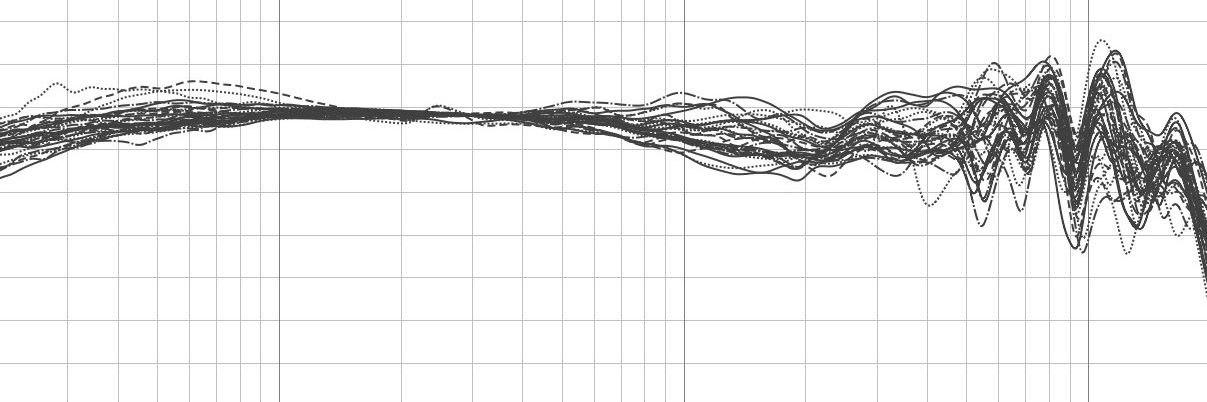
this graph shows how the tonality might be affected when you wear the headphones differently on the head.
Leakage Test:
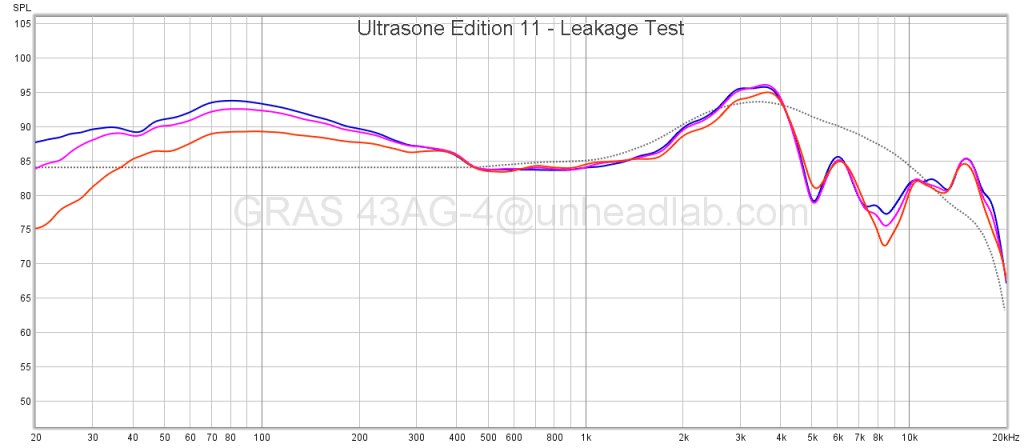
this graph demonstrates how a small leakage (simulated using thin-armed glasses) can result in FR change.
Impulse Response:

impulse response contains information about transducer movement when a test tone is played.
Channel Matching:

channel matching graphs DOES NOT RELATE TO SOUND PROFILE.
a specialised configuration is used to capture channel differences to mitigate the interference from positioning on rig and the asymmetricity in GRAS pinnae design (legacy of KEMAR).
the Left (blue) and Right (red) channels are measured on a flat plate coupler with an IEC60318-4 ear simulator.
END OF THE ARTICLE
Disclaimer: all the headphones tested here are my personal units unless otherwise stated. All the links and recommendations provided are not associated with me in any financial manner.

Interesting review. I also agree, the low end unfortunately makes things sound bloated and muffled. But once EQ is used. The overall experience changes completely. While it’s not the most detailed, largest sounding, fastest or most dynamic. It is a very natural, extremely easy listening headphone that you can sit back and just listen to. The bass has very nice texturing and is engaging and fun to listen. Vocals have a nice flow and treble is never splashy and smooth. The sense of air, and space also improves with eq and overall. It’s a headphone I really enjoy to have in my collection. With tubes, it’s a dream and I have fallen asleep with them so many times. Overall, yes, with no eq. It’s a niche headphone. If you really want slamming bass, go for it. But once eqd, they are surprisingly very nice to listen. Maybe from now on, try talking about how headphones sound when eq is applied? 😊
LikeLike
Hi there, thanks for taking to time to read the review and share your thoughts, your honest perspective and advise are appreciated. It’s true that they’re not bad by any means. As I mentioned, they’re recommendable for certain preferences, especially at a lower price point. With the model being on the market for a few years and street prices dropping, they do become an appealing option for those who are into EQ or enjoy a bass-heavy sound. And you’re right, a bit of EQ can really transform them into a more balanced and articulate set of cans.
So I do agree with your comments, but there’s a significant challenge in evaluating headphones with EQ applied. We’re faced with two key questions: Can all headphones be equally EQed to a specific target curve? And further, can we agree on a universal target curve that suits all headphones? It would arguably be unfair to evaluate headphones without a standard benchmark. Each headphone has its own acoustic model that interacts differently with the human auditory system, as evidenced by the variations like the 9kHz dip in GRAS pinnae and the 7-8kHz bump in Bruel and Kjaer 4128/5128 rigs. These factors make post-EQ evaluations complex and potentially unfair.
That said, it’s indeed possible to include a note in reviews about how well a headphone responds to EQ. In this case, I can say that the Edition 11 is quite EQ-friendly (mainly just dropping the bass and a slight treble boost), and its performance post-EQ is very good.
Cheers,
Sai
LikeLike