
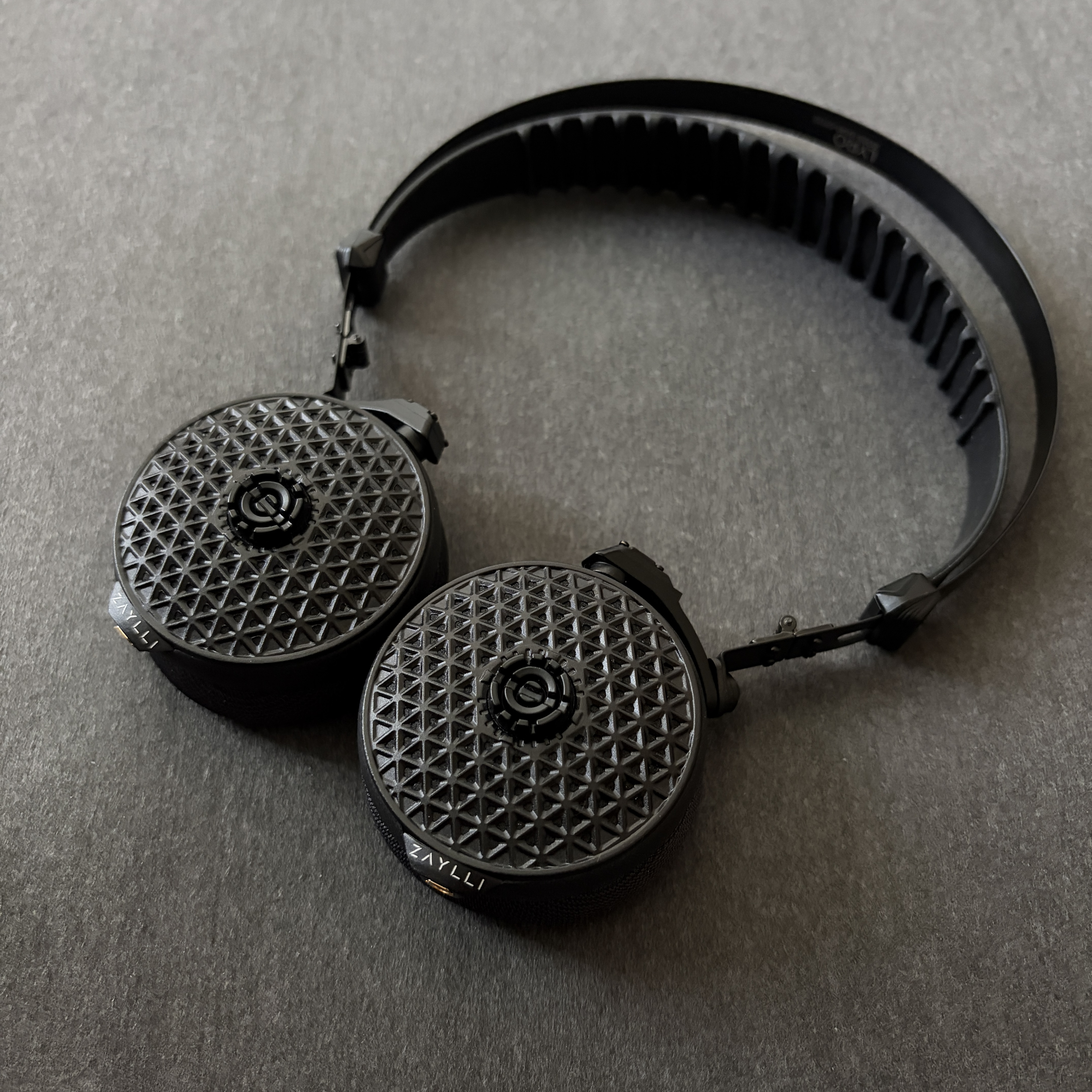
Intro:
When Zaylli initially reached out to me with their WIP product — a retro-looking on-ear headphone “Lyrö” launching on Kickstarter — I was admittedly skeptical. I hadn’t heard of the brand, and we’re all too familiar with audio Kickstarters that promise the moon but fail to deliver a viable product.
But my doubts were quickly dispelled as I read through their documentation. I realised there was serious engineering. Their use of industry-standard testing shows real effort, and they went the extra mile by sharing those test results directly. That level of transparency is rare and, I’m sure, appreciated by the community. The use of standard rigs also shows guts, as it establishes repeatability as a touchstone for the authenticity of their results.
Naturally, I accepted the review request. And I must say, after putting them through their paces, I am very impressed by what they have to offer.
Detailed measurements can be found in the final section of this article.
Disclaimer: This unit was kindly provided by Zaylli for the purpose of testing and review. There are no conditions placed on the content, and there is no financial involvement or use of affiliate links.
Specs & Comfort
RRP: $249 USD/ ~$379 AUD (converted)
Kickstarter special (non-affiliated link) : $169 USD (earlybird)
Driver size: 40 mm dia.
Driver type: moving coil
Sensitivity: 110 dB/Vrms @1kHz
Impedance: 36 Ω at 1kHz (DF mode)
Connector: dual MMXC
Weight: 112 grams (excl. cable)
Clamping force: light
Accessories: 1*1.2M 3.5mm TRS cable; 1*1.2M 3.5mm TRRS cable with mic; carrying case; second headband.
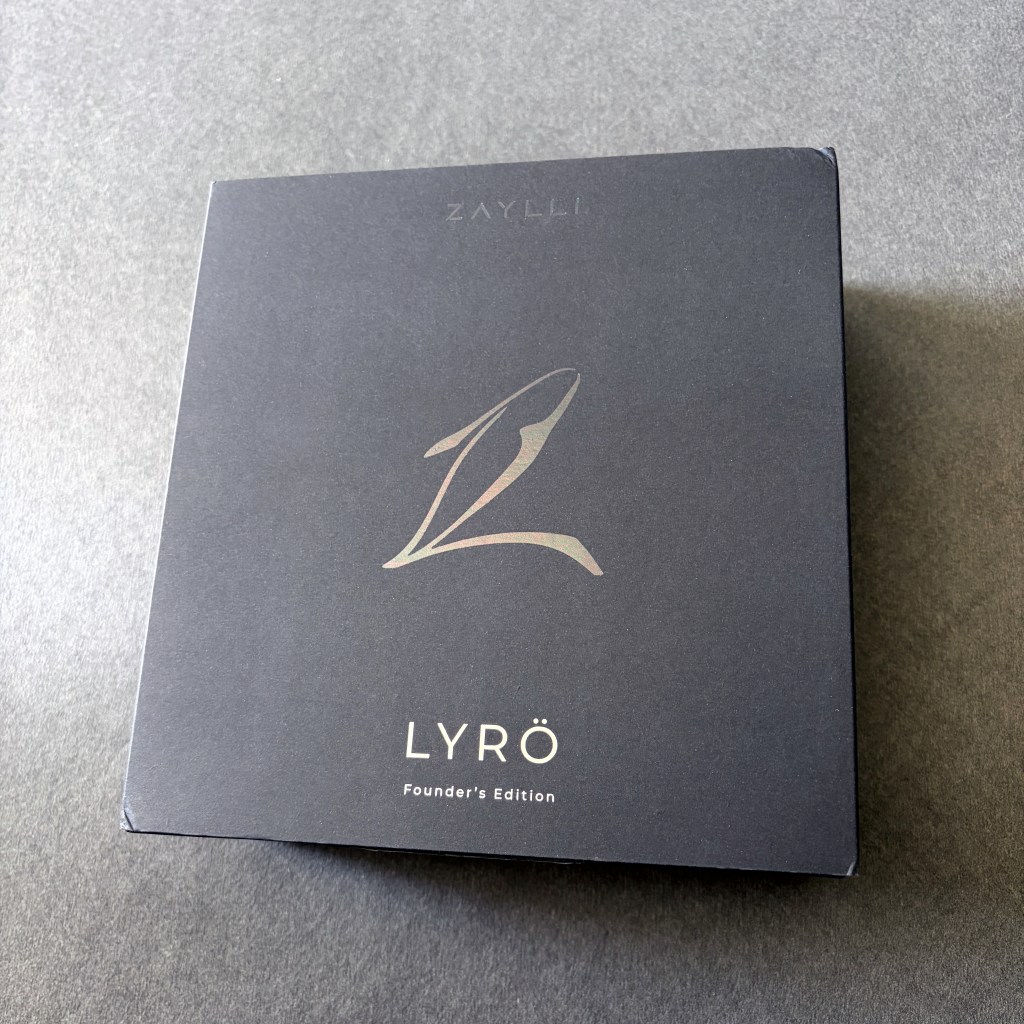
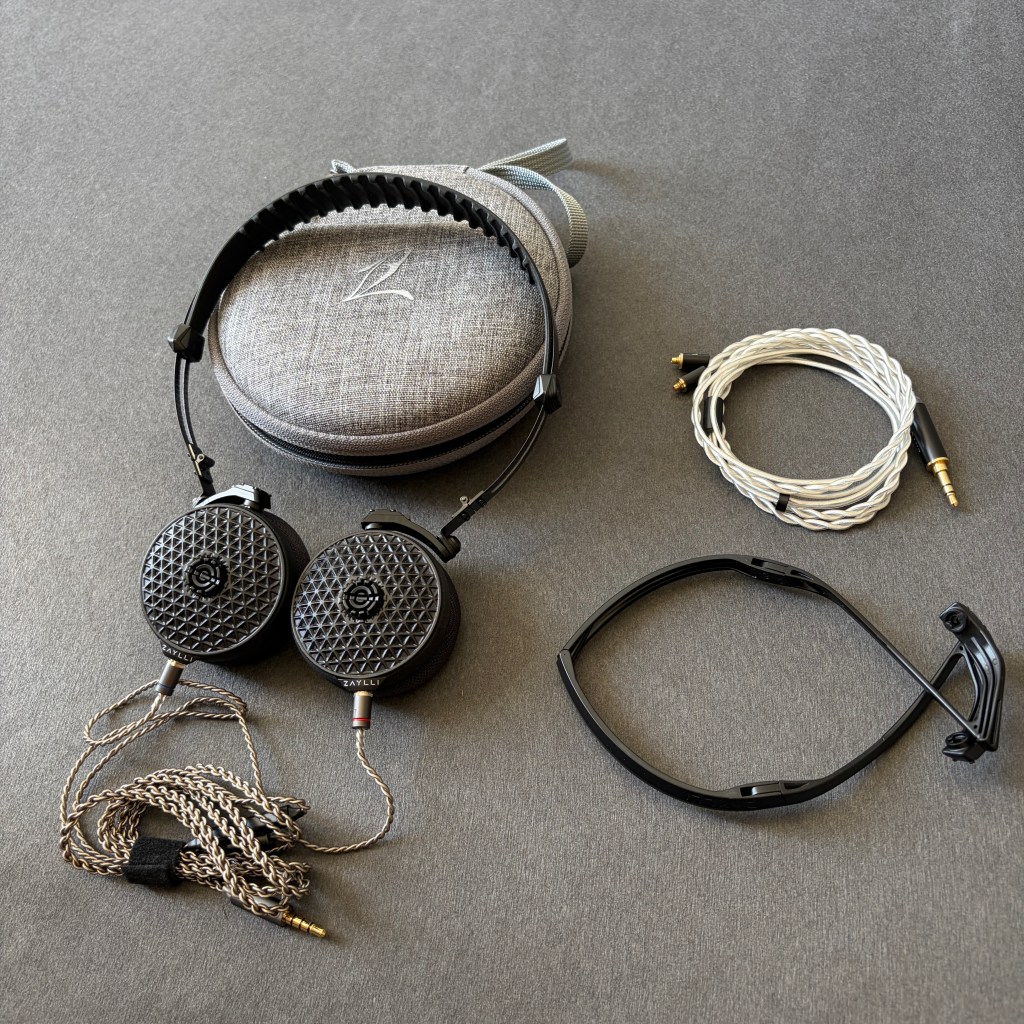
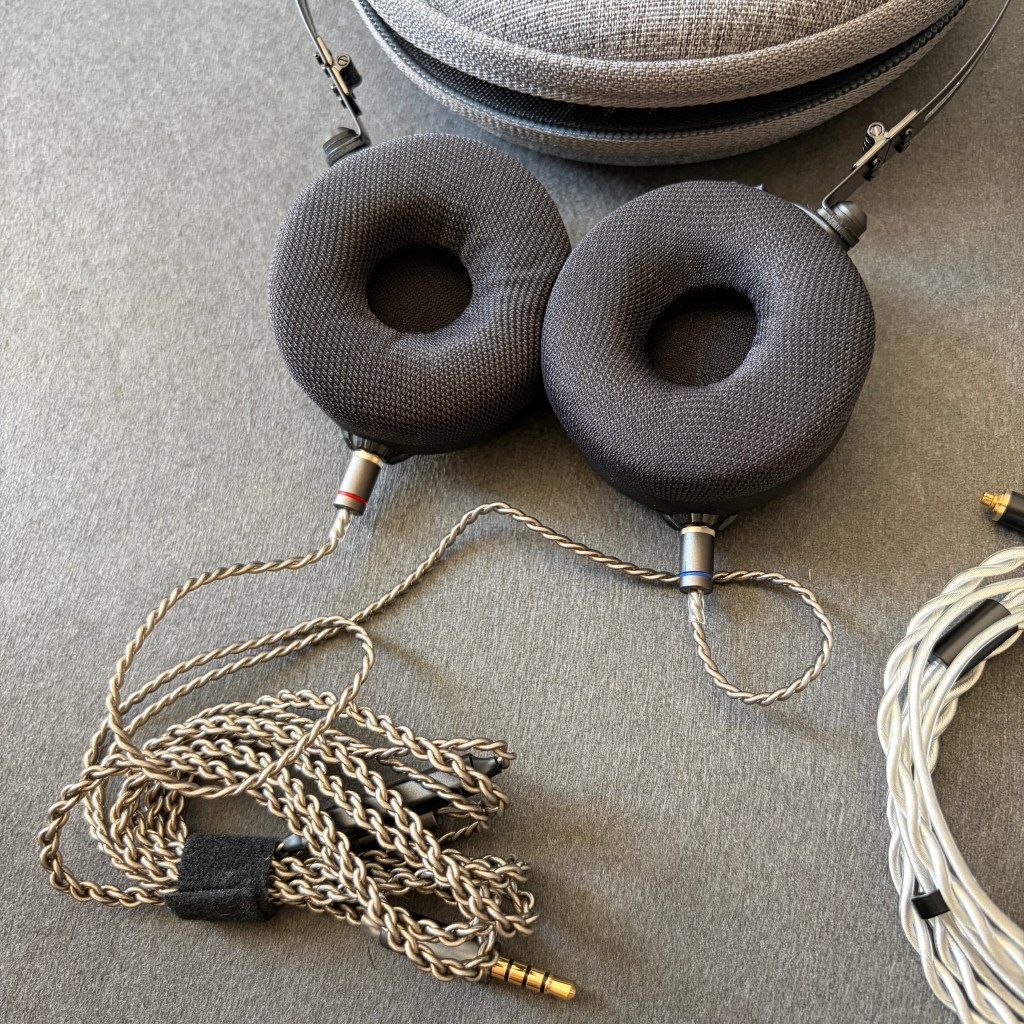
Build: At first glance, the Lyrö/Lyro might seem a bit modest, perhaps flimsy — a common trait among retro on-ear products. Yet, upon closer inspection, the Lyro is actually quite well-built. The chassis is constructed from plastic, but it avoids that plasticky feel. Instead, it has a softer, leather-like texture, which lends it a more premium touch. The headband is highly flexible and shows thoughtful design; the yokes can fold and hinges appear serviceable, and the overall structure feels steady on the head.
Comfort: Overall comfort is excellent. As expected, the headphone is extremely lightweight. The range of adjustments and angulation makes achieving a secure fit effortless. I have no complaints here.
Zaylli also includes an alternative neckband-style attachment in the box. In my testing, I found the fit with the neckband to be less snug than the traditional headband. Personally, I have never been a fan of the neckband fit in general, so your mileage will vary depending on your head shape and preference. However, the fact that Zaylli provides both options is a great touch for those who want to avoid “headband hair” or prefer a more discreet look.
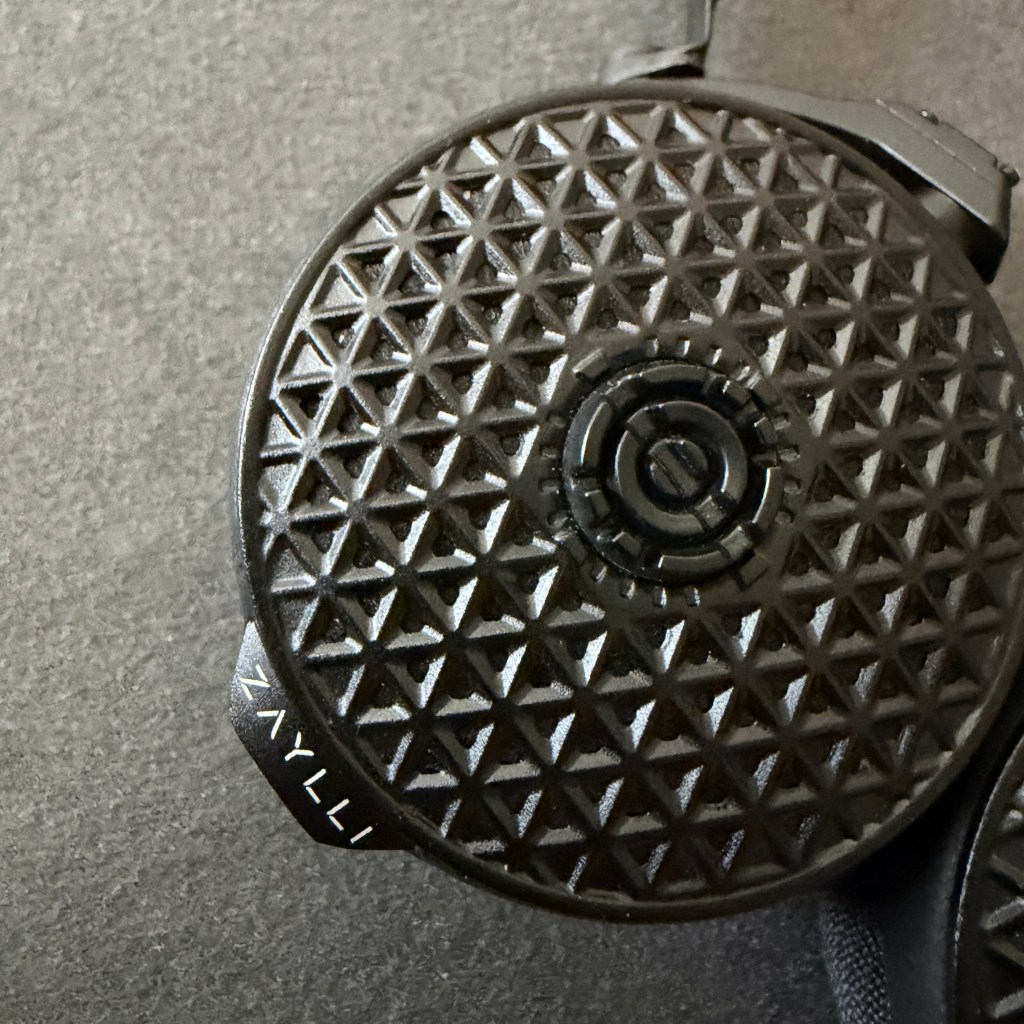
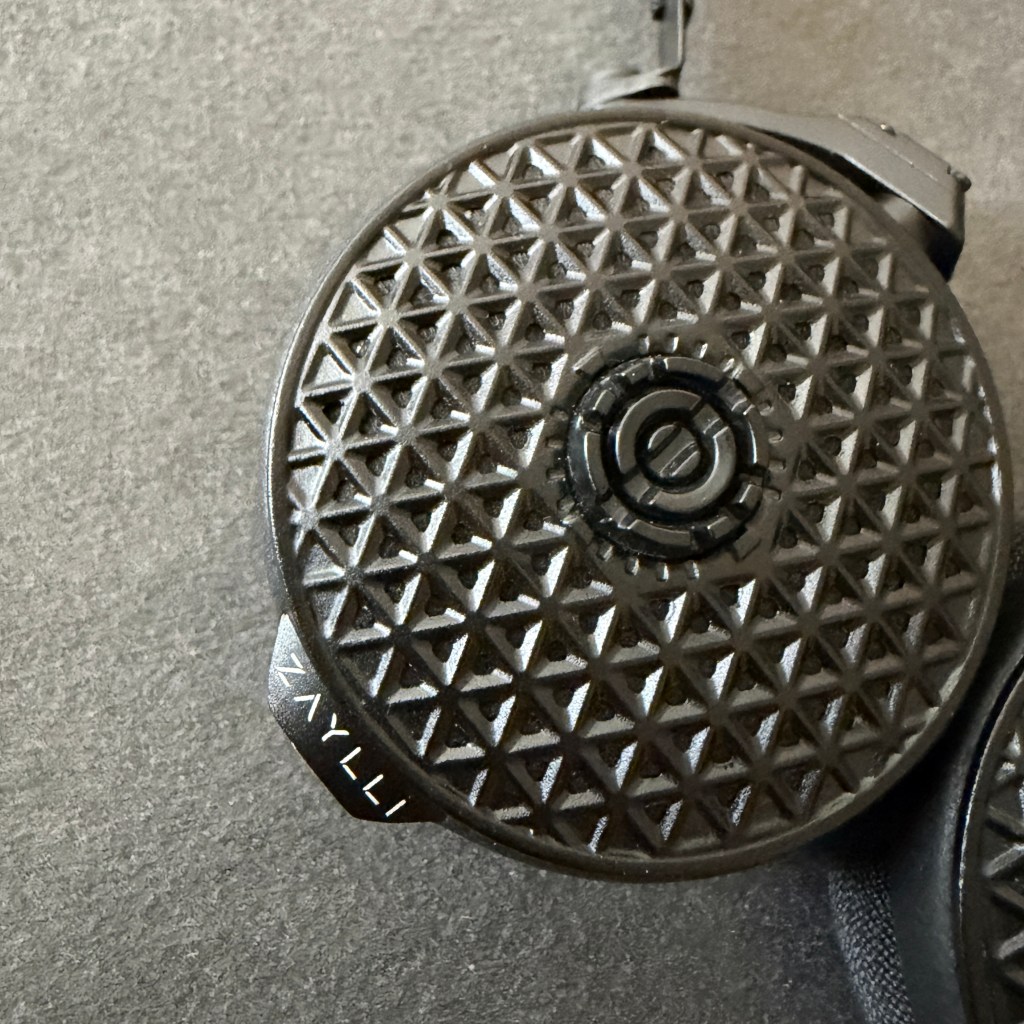
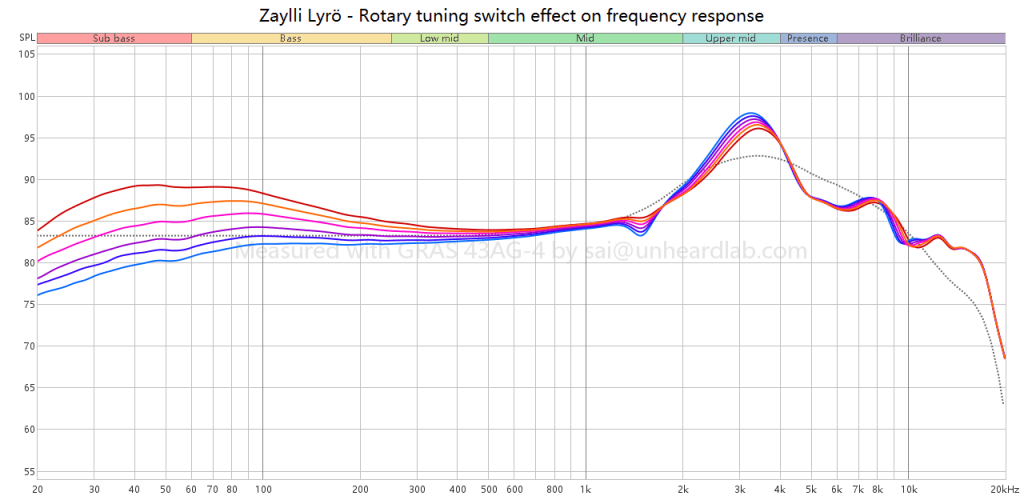
Customisable tuning: As seen in the photos below, each ear cup features a rotary tuning dial that can be easily adjusted with your fingertips. While there are marked positions to help you align left and right channels, the actual rotary system is stepless.
The tuning function is implemented via a fully mechanical and acoustic system rather than an electrical component. By adjusting the dial, the mechanism modifies the acoustic loading (venting and airflow damping) of the driver. This changes the physical resonance of the moving coil system, which in turn alters the bass response.
As the Frequency Response graphs show, it mainly controls a clean bass boost without meddling with the mids or highs. This allows for easy adjustments without relying on software EQ, a big advantage for those who want instant control without fiddling with apps on the go.
Sound
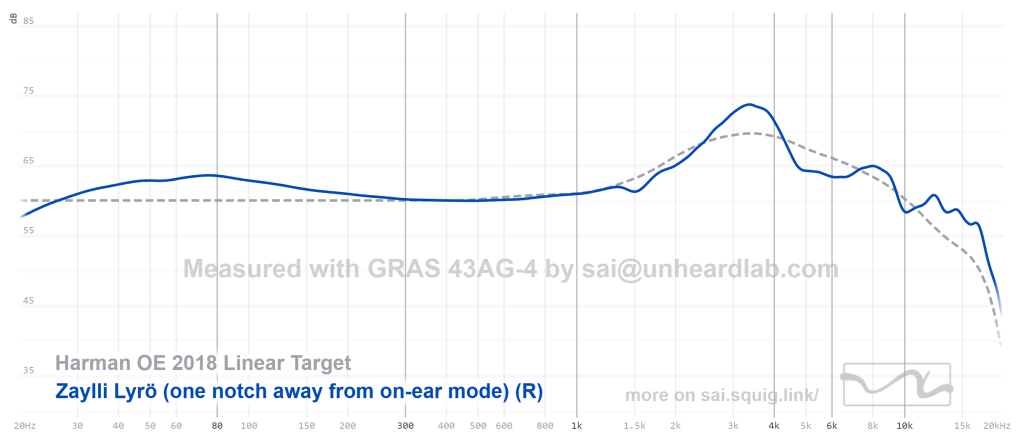
For more comparisons, visit my squiglink database.
Tonal balance:
Overview
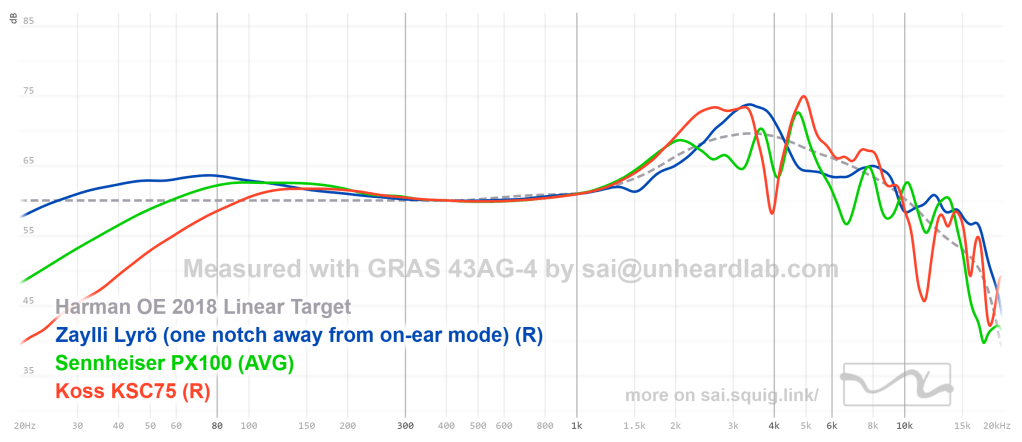
The Lyro presents a very well-balanced and easy-going sound profile. The customisation options make it a versatile player: from an almost dead-flat “Diffuse-Field” style tuning to a warm-neutral “On-ear mode” with a Harman-style bass shelf, you get a range of choices that should satisfy most users.
My personal favourite is one notch down from the maximum bass “On-ear mode.” Unless stated otherwise, all testing below is based on this setting.
Essentially, you get a benchmark on-ear tuning: think Koss but with significantly more refinement in the mids and treble, alongside a more powerful, well-extended bass. Most genres, especially modern pop, rock, vocals, and EDM, sound excellent on these.
Bass
The bass on the Lyro carries a sense of power and warmth that is surprising for its class as a lightweight, retro on-ear. This makes it a meaningful upgrade over the usual suspects in this category, such as the Koss KSC75 or the Sennheiser PX 100.
The Lyro delivers a robust kick and weight for genres that demand it. In terms of pure quantity, it is reminiscent of the powerful low-end on the Koss Porta Pro, but with significantly better quality and definition. The sheer amount of bass this on-ear can produce is impressive, especially given the open-back design. A key advantage here is that the bass response isn’t as seal-dependent. You still get decent low-end presence wearing them casually, without the fuss of ensuring a perfect seal — a common frustration with closed-back on-ears like the Sennheiser HD 25 series.
Midrange
The midrange is slightly warm, offering excellent body and fullness while remaining decently clear. In this regard, it is almost reminiscent of the Sennheiser HD 6X0 series, a testament to how well-tuned the Lyro is.
Compared to the HD 6XX, the Lyro does smooth over some of the grain and texture. While it may not be the final word in timbre or detail, the presentation is cohesive and enjoyable, lending an organic, easy-going presentation to vocals. This makes the Lyro a fantastic set for casually enjoying pop and rock. Even for more demanding tasks like mixing or monitoring, the Lyro is no slouch, offering a decent reference point for a competently tuned, consumer-oriented playback system.
Treble
The treble here is clean and honest. There are no magic tricks or gimmicks. It is present in an inoffensive way, neither grabbing your attention nor sounding too dimmed. As an on-ear, the treble is well-controlled and rolls off naturally in the upper octaves.
You might find the upper treble air and extension a bit wanting, but the Lyro still performs admirably for its class. Many on-ears struggle with peaks and dips in the treble due to inconsistent interaction with the pinna, often resulting in a response that varies wildly depending on fit. The Lyro is far more consistent, likely thanks to its thicker ear cushions and open-back design. In the grand scheme of things, this is definitely the best on-ear treble presentation I’ve heard, avoiding the brittle/plasticky treble timbre often associated with on-ear models.
Other qualities:
- Spatial performance
The sense of spatial presentation is inherently limited by the on-ear form factor. Yet, the Lyro never really feels claustrophobic. This is likely due to its linear frequency response, which ensures that different elements in the mix are handled evenly without masking one another.
The imaging performance is solid, avoiding the muffled sound common in budget portables. For its size, the imaging conveys a more convincing profile than you would imagine. Again, it stands out as the best on-ear I’ve heard in this regard, with the exception of certain Grado models (like the PS500e). However, Grados are bulkier, closer to over-ears, and not truly “portable” in the same sense, not to mention their distinctively brighter tuning makes for an unfair comparison.
- Clarity
Clarity on the Lyro is great. It reminds me of well-established on-ear models like the KSC75 and the Sennheiser PX 100, only better. The midrange is clean and articulate, even if the frequency extremes are naturally more restricted. We cannot ask too much from an on-ear, but this is arguably the top of the class.
- Dynamics
Dynamics are okay. Given the physical limitations of the driver size, you cannot expect thunderous slam, but the quantity is very satisfying. There is a ceiling to the bass if you try to boost it sky-high via EQ, but for most occasions and genres, it is more than enough.
Conclusion:
I am thoroughly impressed with the level of work Zaylli has put into the Lyro. It showcases first-class engineering and a sophisticated, scientific approach to design. For years, people have warned that Kickstarter audio projects tend to turn out entirely different from the initial promise. Luckily, that is completely not the case here.
You get a beautifully finished product that is also customisable — a huge bonus for a wider audience or for those moments when you just want to boost the bass and have fun. Overall, it feels like a polished product from a major brand. As you can see in the measurement reports attached below, the Lyro performs very well across the board, with remarkably low distortion and clean transients.
Koss has long been known for making the best value-for-money on-ears, and for years we have seen few real challengers (shame on the FiiO “Wind” on-ear, by the way). The Lyro has finally emerged not just to challenge that status quo, but to leapfrog it and become the new benchmark in the class.
At the $169 USD early bird price (and at the standard RRP of $249 USD), the Lyro is an easy recommendation if you are in the market for a pair of on-ears for casual enjoyment whether at home, in the office, or out and about. I have a collection of multi-kilobuck headphones, and yet I’ve found myself reaching for the Lyro since receiving it. It is a well-thought-out product that fills a niche—or perhaps an overlooked demand—in today’s highly competitive market.
If there are specific comparisons you would like to see, let me know in the comments.
PROS:
+ rotary bass adjustment is well-engineered and effective without muddying the mids
+ powerful bass and organic, Sennheiser-esque midrange
+ extremely lightweight with a secure, low-fatigue fit
CONS:
– staging inherently limited by the form factor
– safe treble lacking the wow factor
– the retro design is robust but might look flimsy to the uninitiated eye
Value Grade:
Notes on Earpads and EQ
On-ear headphones are inherently more difficult to EQ reliably than over-ear models. Because the pads rest on the ear rather than encircling it, slight changes in positioning can significantly alter the frequency response. Therefore, I recommend sticking to wideband adjustments.
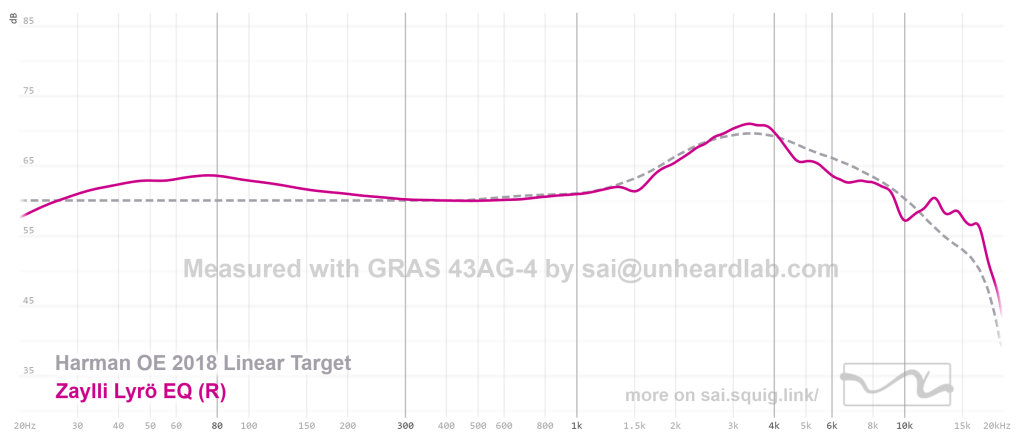
Recommended EQ setting (simply put the below data into a TXT file then import it to EqualizerAPO/PEACE or other apps of your choice):
Preamp: -1.5 dB
Filter 1: ON PK Fc 3400 Hz Gain -3.5 dB Q 1.500
Filter 2: ON PK Fc 5100 Hz Gain 3.0 dB Q 2.500
Filter 3: ON PK Fc 8300 Hz Gain -2.5 dB Q 2.000
Filter 4: ON PK Fc 2200 Hz Gain 1.5 dB Q 2.000
If your goal is to EQ the response to match the Harman Target, consider the AutoEQ function provided by Squiglink as a convenient starting point. I personally recommend customising the filters to better suit your own hearing, especially in the treble. While the AutoEQ provides a useful baseline, individual adjustments can often significantly improve your listening experience.
If you’re new to EQ, I’d recommend checking out this video by Resolve from The Headphone Show — it’s a really solid intro and walks through the basics in a clear, no-nonsense way. Great place to start!
MEASUREMENTS
Frequency Response:
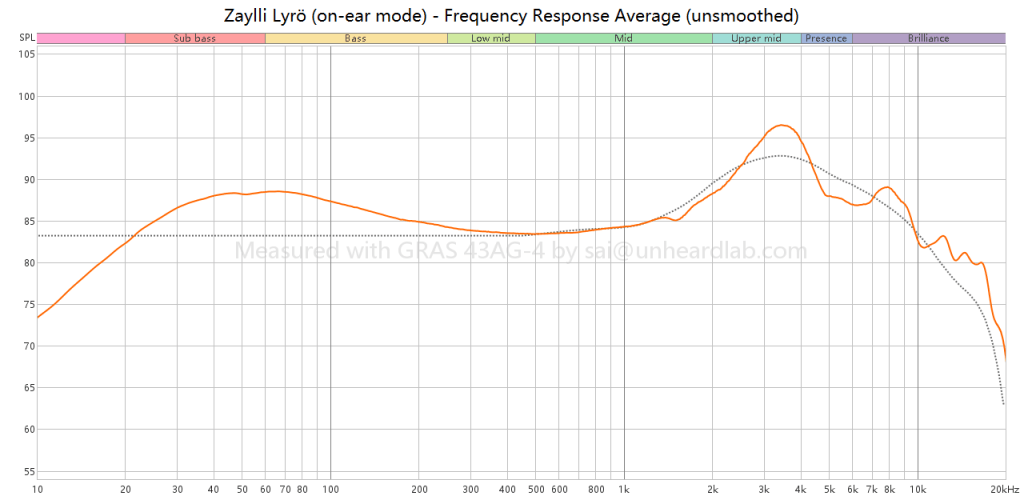
The response is obtained by an average of 5-6 positional variations. The FR shown on the graph is unsmoothed.
Positional Variation:

This graph illustrates how headphone placement on the head affects perceived tonal balance: with the ear positioned at the front (blue), centre (green), and back (red) of the headphone. The FRs shown on the graph are 1/48 octave smoothed.
Comment: While some positional variation is inherent to the on-ear design, the Lyrö is more consistent in this regard than most on-ears I’ve measured. It avoids the drastic response shifts typically seen in closed-back designs, offering a more reliable response across different placements.
Leakage Tolerance:
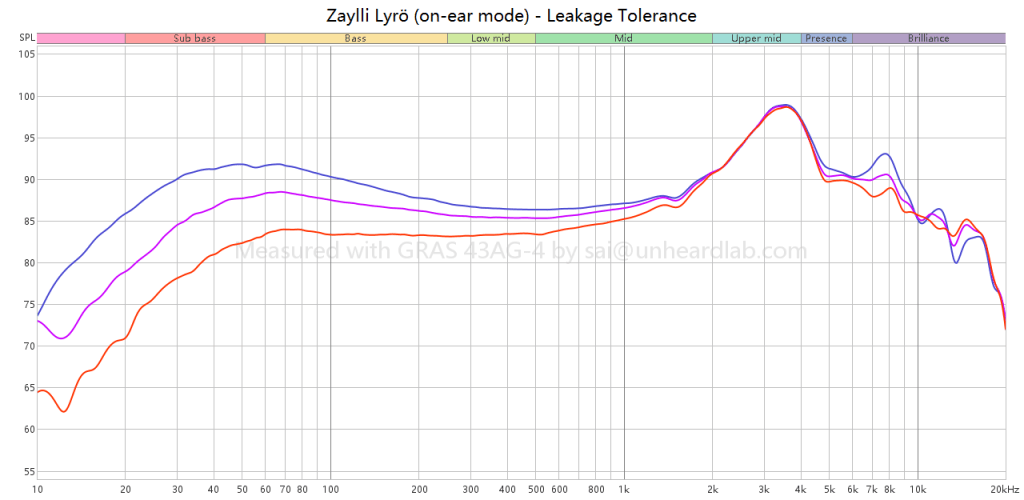
This graph demonstrates how leakages to the front volume can result in FR change: blue (good seal), purple (thin arm glasses), red (thick arm glasses). The FRs shown on the graph is 1/12 octave smoothed.
Comment: Like most open-back dynamic headphones, this headphone shows significant bass loss when the seal is broken.
Linearity and Dynamic Compression:
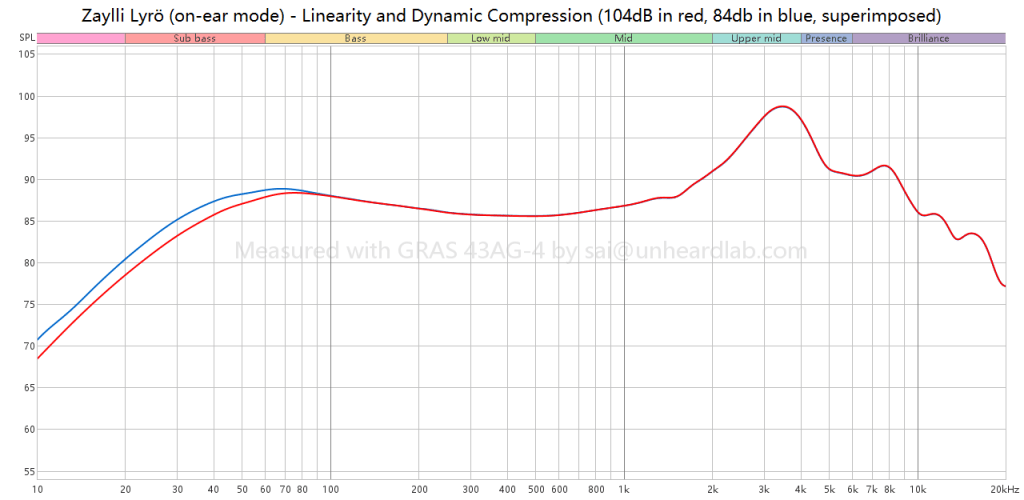
Linearity and dynamic compression testing plots the headphone’s frequency response at two input levels to show how it reproduces signals as loudness changes. Any divergence between the high-level and low-level curves points to where the transducer’s dynamic range begins to compress or distort. Here, the measurements are superimposed to allow direct comparison. The FRs shown on the graph is 1/6 octave smoothed.
Comment: Slight compression below 70Hz (1-2dB) at 104dB SPL, which shouldn’t be a major concern.
Impulse Response:
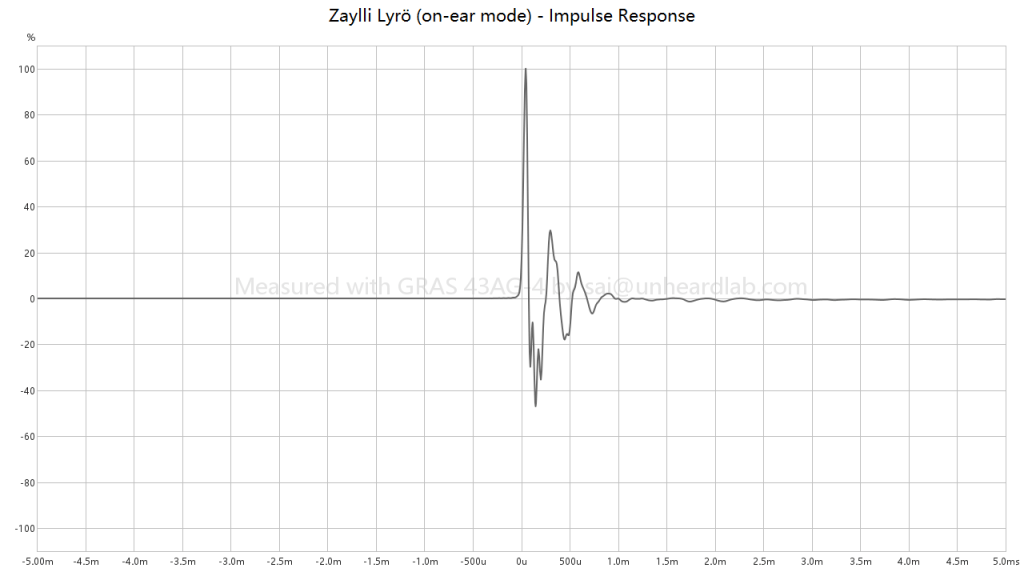
The impulse response test measures the initial response, overshoot, and decay of a transducer upon receiving a signal. An initial upshoot indicates a normal/non-inverted polarity, vice versa.
HpTF Variations:
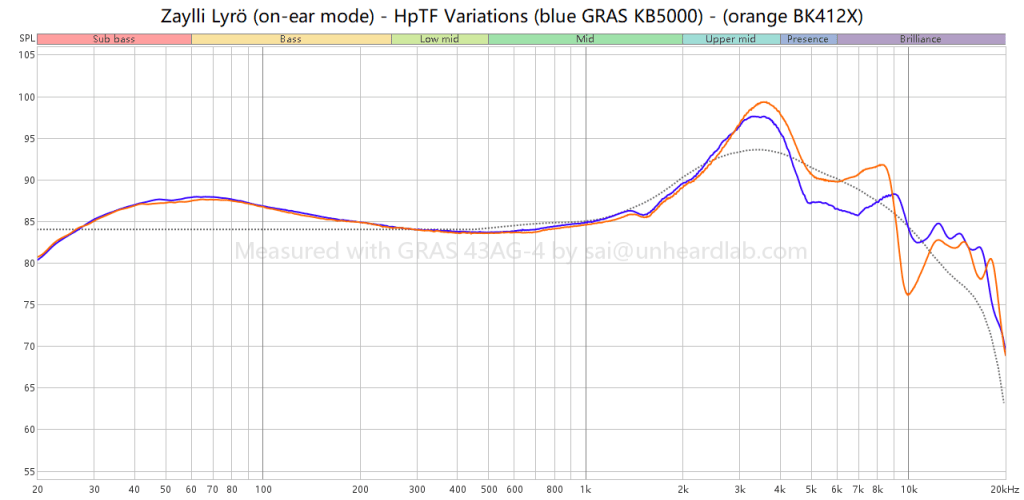
Headphone Transfer Function (HpTF) describes how sound is shaped by headphone design and ear anatomy before reaching the eardrum. Different measurement rigs (with varying pinnae designs) introduce unique reponses/resonances and potential deviations from actual human perception. Understanding HpTF helps translate measured data into real-world listening experiences.
Total Harmonic Distortion (THD% 2nd-9th) & Excess Group Delay (94 dB):
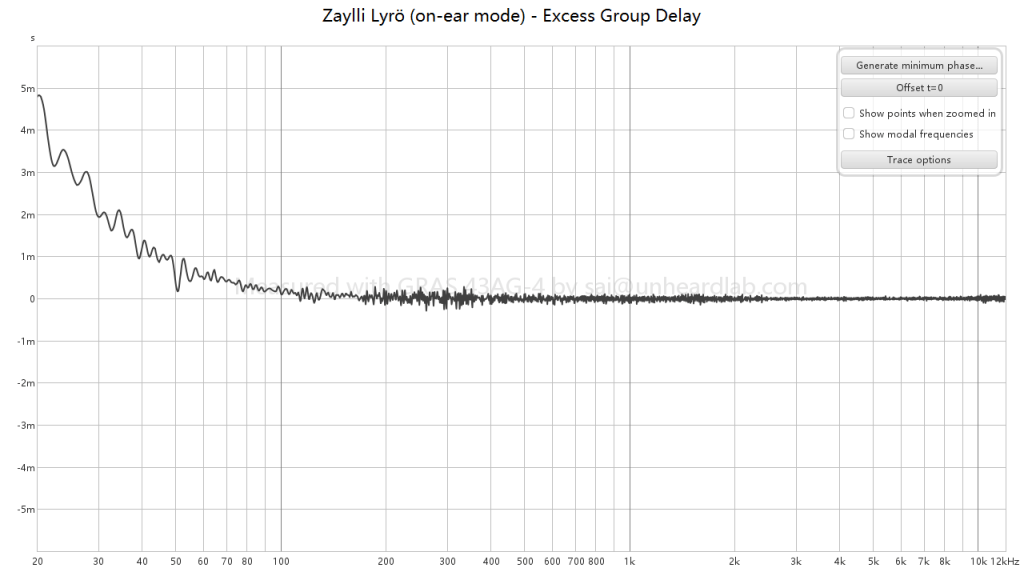
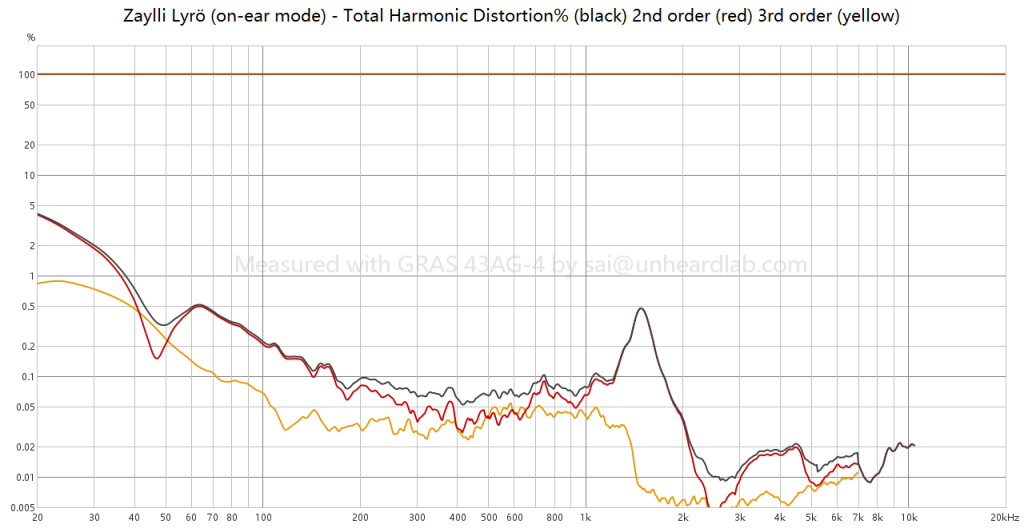
These measurements are conducted in quiet, normal room conditions (as opposed to an anechoic chamber), meaning there may be some influence from ambient room and external noise. These results should be considered a preliminary assessment of performance, primarily for identifying major issues, and do not reflect the best-case performance scenario. Any peaks/dips around 9 kHz are most likely artifacts from pinna interaction/phase cancellation, rather than inherent features of the device under test.
Comment: Remarkable performance. With low THD and a clean group delay, the Lyro outperforms its on-ear peers and holds its own against many larger, more expensive dynamic drivers.
Channel Matching:
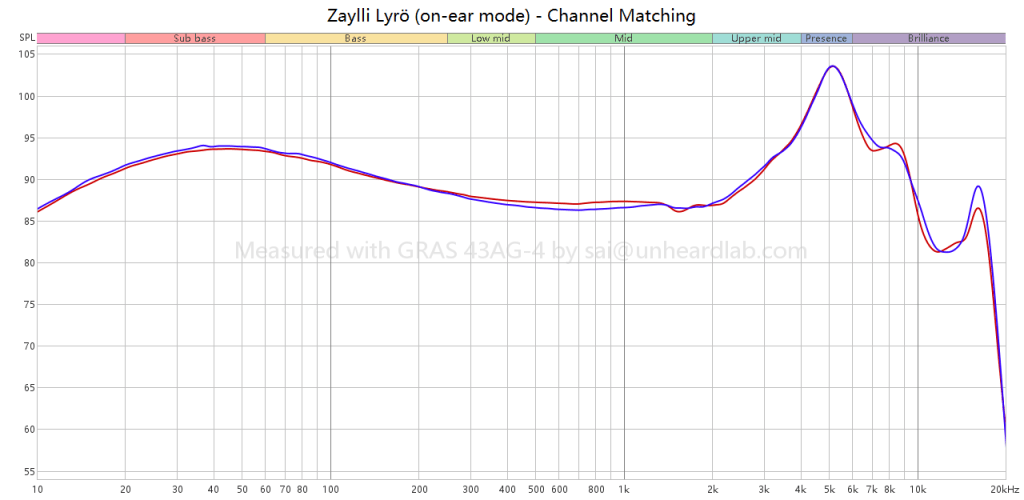
Channel matching graphs are intended for quality control checks and do not relate to the perceived sound profile. A specialised configuration is used in this test to capture differences between channels, mitigating interference from positioning on the rig and the asymmetry in the GRAS pinnae design, a legacy of KEMAR. The left (blue) and right (red) channels are measured using a flat plate coupler with an IEC60318-4 ear simulator.
Comment: Zaylli claims excellent channel matching of 0.5dB tolerance for their products, and indeed they deliver. This is very impressive, even for major established brands.
Electric Phase & Impedance:
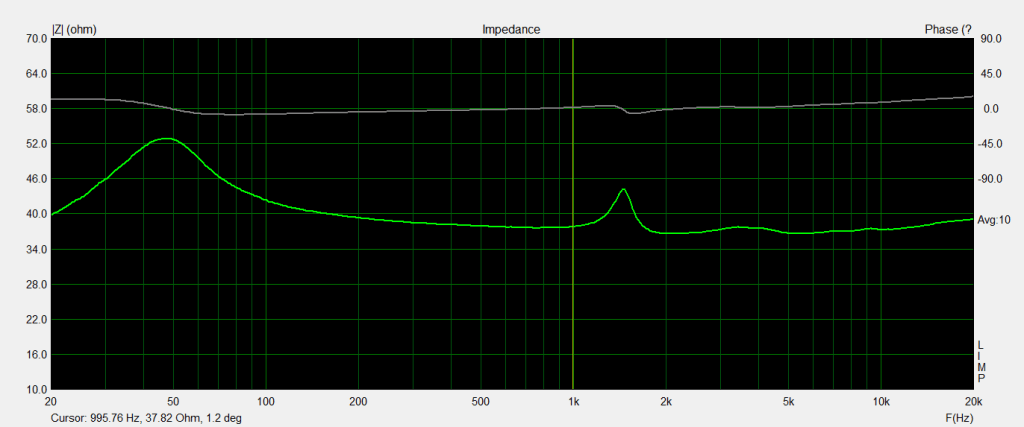
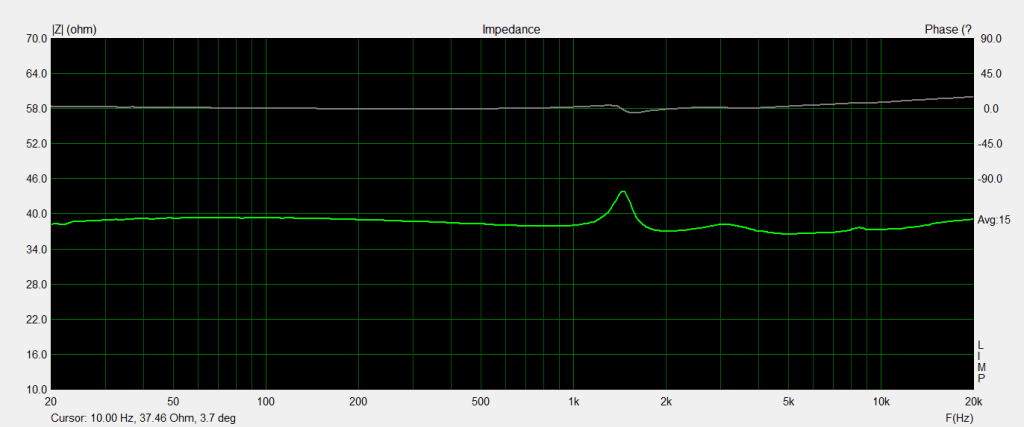
The above graph shows the measured impedance (green) and electric phase (grey), measured under free-air condition (minimal front volume coupling).
Comment: These graphs illustrate the effect of the Lyrö’s acoustic tuning mechanism. We can see a clear change in the bass resonance peak between the two modes.
According to Zaylli, this change is not caused by a variable resistor or electrical component in the signal path. Instead, the dial alters the acoustic loading on the driver. Because the driver is an electro-mechanical system, this change in physical resistance (damping) affects the diaphragm’s motion and back-EMF, which is then reflected as a shift in the electrical impedance curve. This confirms that the tuning is achieved through purely acoustic engineering.
END OF THE ARTICLE
Disclaimer: This review is independent and was not sponsored or endorsed by any company or affiliated entity. All headphones reviewed are purchased for review unless otherwise stated. Any links or product references are provided for informational purposes only and are not associated with any financial compensation or affiliate arrangement.
EDIT 10/01/2026: corrected the description on the mechanism of the rotary tuning dial

This is interesting,. on-ears making a comeback? Moondrop also released a one some say it’s better than Koss
LikeLike
I just got that one in myself (the Moondrop Old Fashioned). To me it feels like a more polished version of the KSC75 but with actual improvements to the fit and build (having a detachable cable is huge). The name is a bit funny but yeah it really does seem like on-ears are having a moment again. Fashion is a circle as they say.
LikeLike
How would you compare Zaylli Lyrö, Koss Porta Pro or Sennheiser PX100 to the AKG K412P? I remember switching from Koss to the AKG and liking it much more. Curious if the Lyrö is really better than the K412P.
LikeLike
Hey, I haven’t tried the K412P unfortunately. How would you describe the sound?
I think a friend of mine used to have one. Let me see if he still got it.
LikeLike
best value headphone under 180 dollars? and maybe the best on ear ever? Cus i really cant seem to find any other that is so well tuned, distortion is so low as well. 1 Eq filter for the unfortunately high pinna gain and this is near reference grade.
cheap stuff is getting good and good stuff is getting cheap. Unreal developments in the headphone world. I just wish more money meant QC/QA were better but that does not seem to be the case either.
An excellent, thorough review my friend, love all the graphs you show. This is porn for audiophiles like me 😹😹
LikeLiked by 1 person
Haha thanks again for the kind words. Yea I think the Lyro makes a really strong case for being the best on-ear ever made… or at least the best that I know of.
The pinna gain is definitely on the higher side, though I find that on the max bass setting, it feels reduced quite a bit or at least the added bass helps balance it out nicely. Personally I don’t mind it at all, but if you’re sensitive to that 3-4kHz region (like if you find the HD600/6XX a bit shouty), then the Lyro might be a bit much for you in that area.
But yeah, we’re seriously lucky right now. the market is getting insanely competitive.
LikeLiked by 1 person
Would you say these would be worth upgrading to over the KSC75, considering they’re $170 vs $20? Can they exceed the KSC75 airy sound with the tuning dial set to open? Thanks
LikeLike
Gotta admit this is definitely still a case of diminishing returns. The KSC75 like a lot of Koss gear is just amazing value. Nothing really beats them when it comes to that.
I think the strength of the Lyro lies more in its balanced tuning and better extension in the bass and upper treble, rather than that specific crisp, airy feel you get from the Koss. It has a lot of air, but in DF mode, the Lyro sounds more like an HD600 to me than a KSC75.
So if you really love that KSC75 sound, I’d suggest just sticking with them and maybe grabbing a headband mod (and some Yaxi PortaPro pads if you want more bass). The Lyro is more of a complete package, a solid all-rounder with better fit, accessories, and tuning options. It’s excellent value, just not as radical as a pair of Koss.
LikeLike
Appreciate your help, thank you.
LikeLiked by 1 person