Intro:
I’ve previously reviewed the original Susvara, and it left a strong impression. It’s one of the few summit-fi headphones that actually feels like it lives up to its reputation. That said, I’m not a fan of the price and the same goes for this one. But I’m sure there are enough of you out there for whom all that matters is sound.
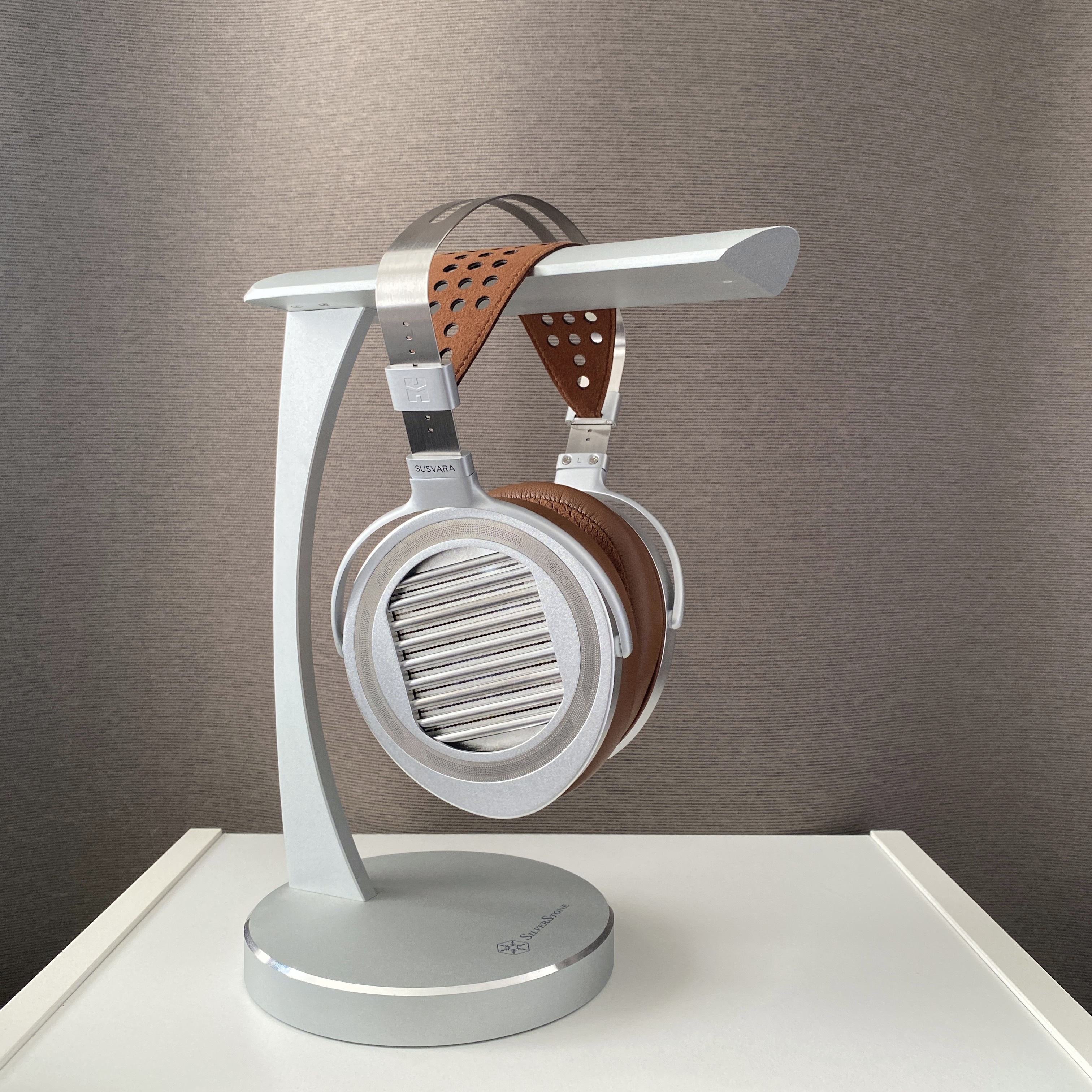
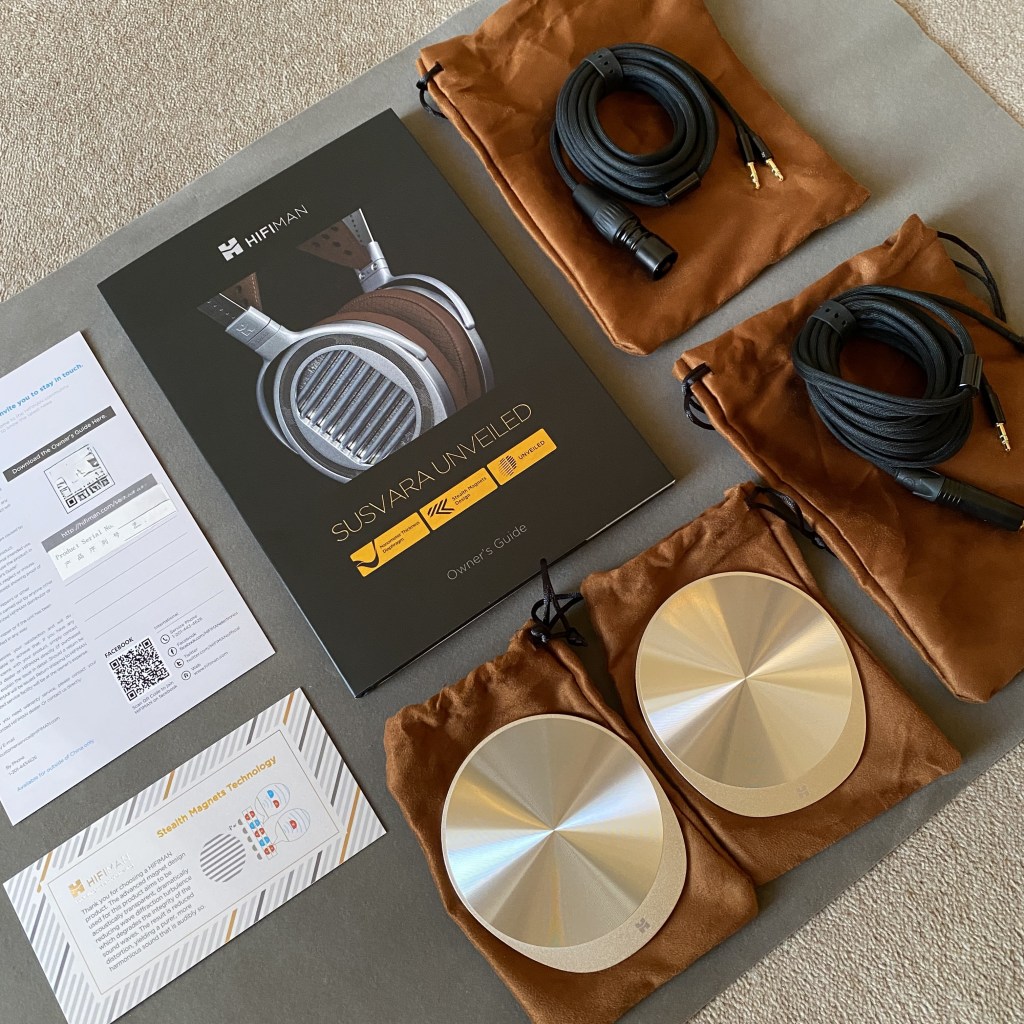
True to its name, the Susvara Unveiled takes a bold design: the protective grille is gone, leaving its planar drivers fully exposed. This “naked driver” concept is meant to eliminate internal reflections and refractions that can colour the sound. Does it pay off? Let’s dig in.
Before you ask: no, these cannot be used as closed-back headphones with the magnetic cover on.
For those who want to jump right into detailed measurements, check out the final section of this article.
Disclaimer: This unit comes from HIFIMAN’s official loaner tour organised on Head-Fi. Kudos to them for offering a demo program for such a high-caliber headphone. There were no strings attached – we simply get to try them out, and all they ask for is an honest review. So here it is.
Specs & Comfort
Price: $7,999 USD / $13,599 AUD
Driver size: 100 mm (frame); 80 mm (effective)
Driver type: Planar Magnetic
Sensitivity: 86 dB/mW @1kHz
Impedance: 40 Ω @1kHz (measured)
Connector: dual 3.5 mm TRS
Weight: 430 grams (excl. cable)
Clamping force: light-medium
Comfort: 7.5/10 (just a bit weighty)
Measurement & Sound
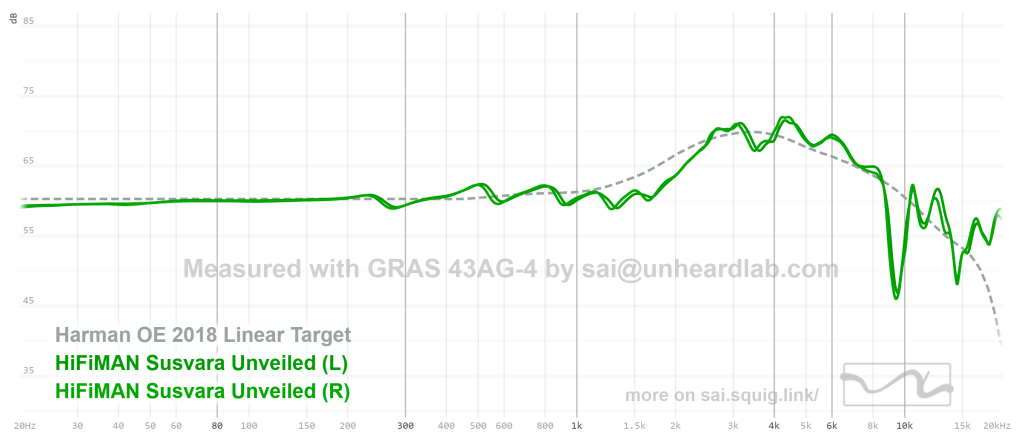
For more comparisons, visit my squiglink database.
Tonal balance:
Overall, the Susvara Unveiled delivers a crisp and clean presentation with a well-balanced tuning. You can still sense the DNA of the original Susvara — excellent tonal balance paired with top-tier resolution. But the Unveiled carves out its own identity in how it presents that information.
Bass
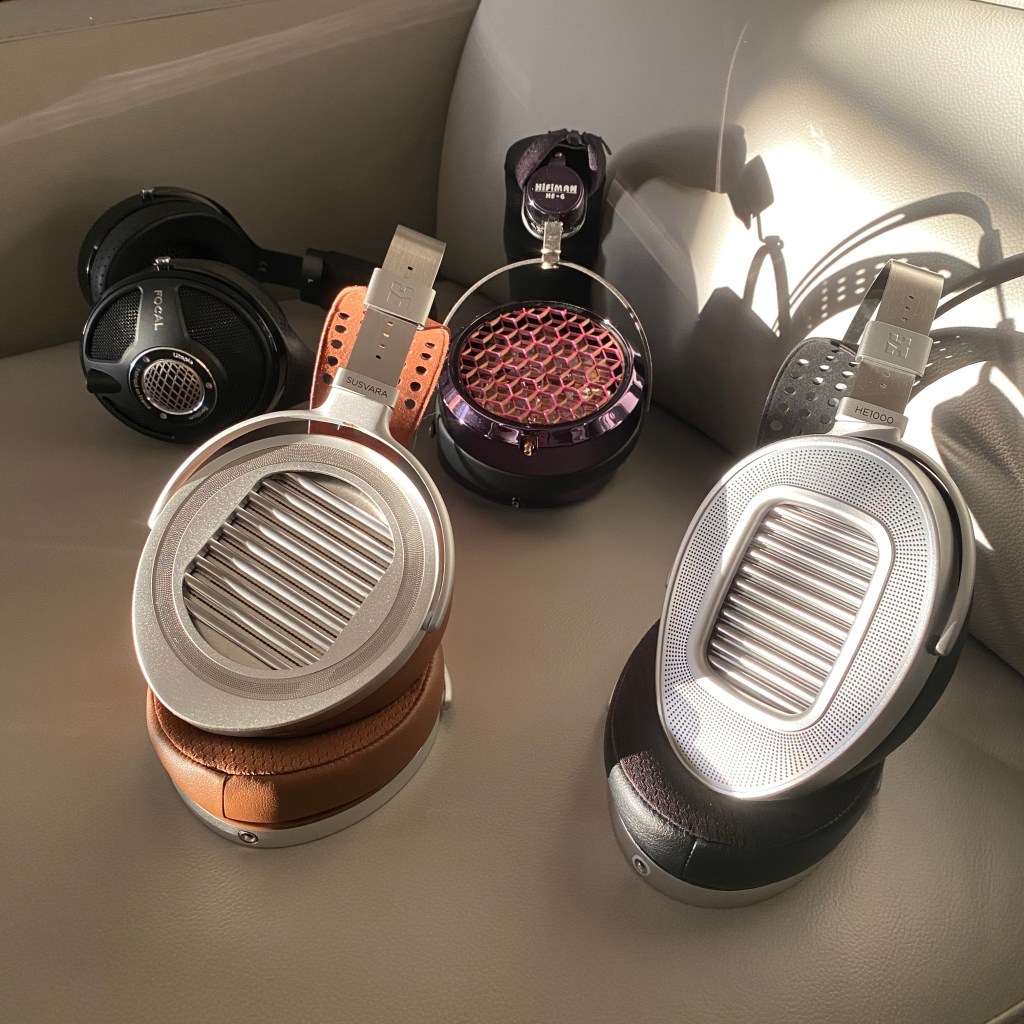
The bass is tight and well-controlled, with a snappy attack and clean decay. It’s a little less impactful than the OG, but more agile — like a more disciplined version of the original. If the OG’s bass felt expansive and lush, the Unveiled packs it into a tighter envelope, yet still delivers plenty of power. It’s somewhat reminiscent of a midpoint between the OG and the HE-6: punchy and defined, but slightly less grand in scale.
It perhaps exemplify what might be described as “typical planar bass” — fast, textured, and precise. While it might lack that mid-bass warmth that immediately grabs attention, it’s far from lacking body or impact. Instead, it shines through its nuance and speed more than brute force.
Midrange
I really ike the mids on the Unveiled. They’re articulate, clear, and more forward than on the OG, offering a presentation that feels cohesive and engaging. One of the OG’s more common critiques was that its midrange could come off as a bit too polite or reserved. That’s no longer the case here.
The Unveiled trades the OG’s more laid-back, relaxed mids for something more immediate and lively. There’s a sense of presence that brings vocals, especially female ones, further forward in the mix. Where the OG might render them with a soft, romantic tint, the Unveiled opts for clarity and definition. In this sense, I appreciate the direction Hifiman is taking with this latest gen of headphones. Both the HE1000 Unveiled and the new Susvara show a clear move toward a more engaging and present midrange.
Overall, the midrange leans toward neutral, but with just enough richness to stay musical and well-balanced. It feels more cohesive across the spectrum, better integrated with the rest of the tuning. That extra energy in the mids gives the Unveiled a fresh, vivid character without sounding thin or harsh.
Treble
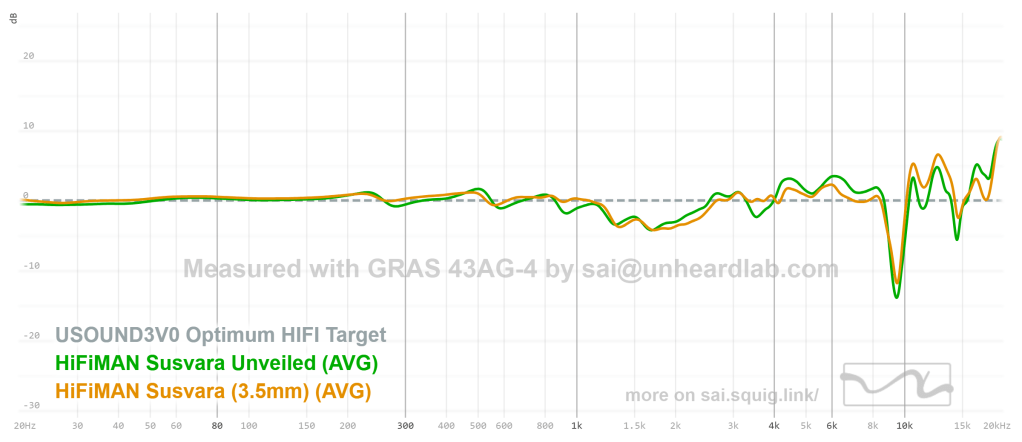
This is where things get interesting. On the one hand, I really enjoy how the Unveiled handles the upper treble: it’s smooth, airy, and exceptionally well-extended. It captures treble nuances with finesse, allowing natural decay and a strong sense of space. The “air” region feels more open than on the OG, contributing to an expansive, holographic presentation. It’s also more refined in this region than both the OG and the HE1000 Unveiled, which can occasionally sound a bit splashy around 10-12kHz.
On the other hand, the mid-treble is a bit more prominent than on the original Susvara. The Unveiled brings out more detail in the lower- and mid-treble region, which makes certain elements like hihats, string harmonics, and upper vocal textures stand out more. It’s not a night-and-day difference, but it’s noticeable, especially if you’re familiar with the OG.
This added presence does come with a trade-off: the Unveiled isn’t quite as smooth or forgiving with poorly mastered material. That extra treble energy can amplify sibilance or sharpness on brighter content — something the OG tends to round off more gracefully. That said, for acoustic and classical music, this added emphasis can be a strength bringing out extra articulation and sparkle where it counts.
Other qualities:
- Soundstage
The soundstage is natural and expansive, among the most realistic in the headphone world. In terms of raw size, it’s comparable to the OG. However, some may find the Unveiled a bit more intimate in its imaging. Indeed, istruments and vocals tend to be placed slightly closer, giving the presentation a slightly more immediate feel.
Where it stands apart is in how it handles spatial cues. Decay feels more natural, with less of that “reverby” trailing effect that the OG shows. As such, the Unveiled gives the stage a clearer sense of shape and dimension. It’s spacious and natural, without leaning into the exaggerated width or artificial openness that some associate with headphones like the HD800 or Abyss 1266. And when the music calls for distance or scale, the Unveiled still stretches wide and deep with impressive realism.
- Clarity
Top-tier. It edges out the OG in this department, which is already one of the most resolving headphones out there. The Unveiled delivers a cleaner, more precise presentation, especially when it comes to imaging distinctiveness and maintaining control during busy passages. The Unveiled has a slightly more transparent quality, making it easier to track nuances across the frequency spectrum. I used to feel the Audeze LCD-5 had an edge over the OG Susvara in midrange resolution, especially for vocals. But with the Unveiled, that gap has effectively closed, and in the bass and treble, the Unveiled pulls ahead by a comfortable margin.
One should avoid treating “detail” as a measurable spec, and the Susvara Unveiled offers a great example of how resolution can coexist with excellent tonal balance. It’s not about hearing more, it’s about hearing things more clearly, without losing coherence.
- Dynamics
The Unveiled feels more agile and lively than the OG. It’s not as visceral or hard-hitting as something like the Focal Utopia or the Abyss 1266. But it still carries commendable impact with more control. Compared to the OG, it has slightly less weight behind macro swings, but gains in immediacy and responsiveness. Notably, the Unveiled shows no signs of dynamic compression. It maintains linearity under demanding bass volume at 104dB, with no audible distortion — an impressive testament to its headroom and engineering. So, if you prefer adding a bit of extra bass punch via EQ, the Susvara Unveiled should handle it with ease.
Microdynamics are also excellent. Subtle shifts in tone and volume come through with nuance. It also sidesteps the slight haziness some listeners associate with the OG’s tone decay. The Unveiled retains a touch of that lingering character but reins it in, providing a more defined decay. This makes it potentially a more compelling choice for those who prioritise clarity and realism.
Conclusion and value:
At $7,999 USD / $13,599 AUD, the Susvara Unveiled sits firmly in ultra high-end territory both sound-wise and price-wise, and with that comes the usual value debate. This isn’t about whether it sounds good (it absolutely does), but whether it offers enough over more affordable models, like Hifiman’s own HE6se or HE1000 series. The diminishing returns are real, and hard to justify unless you’re chasing those very last btis of performance. It’s out of my price league, no doubt. But if you’re in deep enough to be shopping in this range, the Unveiled is a serious contender.
That is not to deny that the Susvara Unveiled is a remarkable headphone. It keeps the core strengths of the OG — excellent balance, refinement, and technical ability, but brings a different flavor. It’s more agile, a bit less full-bodied, but with added energy, clarity and upper-treble extension. Whether it’s better than the OG really depends on what you’re after. The Unveiled feels fresher, more immediate, and more revealing. It’s probably not a replacement, but certainly a compelling alternative to the OG. One that, for some listeners, might just make the OG feel a little too safe.
In a world of summit-fi headphones that often come with esoteric tunings or aim for niche appeal with dramatic presentation styles, the Susvara Unveiled sticks to a carefully honed, reference-style tuning. Its tuning is solid, confident, and versatile, making it a top-tier all-rounder and a thoughtful evolution of the Susvara legacy.
PROS:
+ Well-balanced tuning with exceptional technical performance
+ Improved clarity and treble extension over the OG
+ More immediate and engaging midrange presentation
+ Exceptional microdynamics and detail retrieval
CONS:
– Extremely expensive
– Slightly leaner than the OG
– Can sound a bit sharp on poorly mastered recordings
– Naked driver design may pose durability and fat-finger concerns
Tonal Grade:
Subjective Qualities Grade:
Value Grade:
Notes on Ear Pads and EQ

As an open-back planar, the Susvara Unveiled is very accommodating for pad-rolling, allowing users to fine-tune the sound or replace the stock pads as they wear out.
In my experience, certain denser foam and hybrid-material pads work well. Two standout options are the Dekoni Elite Velour and a set of cooling gel pads originally made for the Sundara/HE6se. Both help to bring forth the midrange and tame some of the treble peaks. The trade-off is slightly smaller stage. But if you’re chasing a smoother, more balanced tonality, it’s a worthwhile compromise. This is generally true across pad types: reducing front volume tends to yield a more linear frequency response.
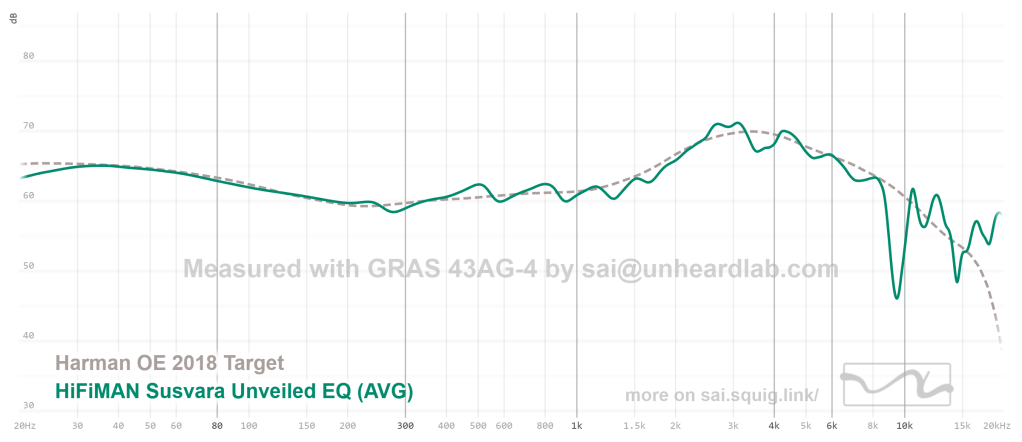
In terms of EQ, this headphone requires little adjustments to sound well-balanced. That said, there’s still room for fine-tuning.
My EQ setting for this headphone:
Preamp: -5.5 dB
Filter 1: ON PK Fc 35 Hz Gain 5.5 dB Q 0.500
Filter 2: ON PK Fc 220 Hz Gain -1.5 dB Q 1.500
Filter 3: ON PK Fc 1800 Hz Gain 2.5 dB Q 1.500
Filter 4: ON PK Fc 4400 Hz Gain -1.5 dB Q 3.000
Filter 5: ON PK Fc 6500 Hz Gain -3.0 dB Q 2.500
If your goal is to EQ the response to match the Harman Target, consider the AutoEQ function provided by Squiglink as a convenient starting point. I personally recommend customising the filters to better suit your own hearing, especially in the treble. While the AutoEQ provides a useful baseline, individual adjustments can opften significantly improve your listening experience.
If you’re new to EQ, I’d recommend checking out this video by Resolve from The Headphone Show — it’s a really solid intro and walks through the basics in a clear, no-nonsense way. Great place to start!
MEASUREMENTS
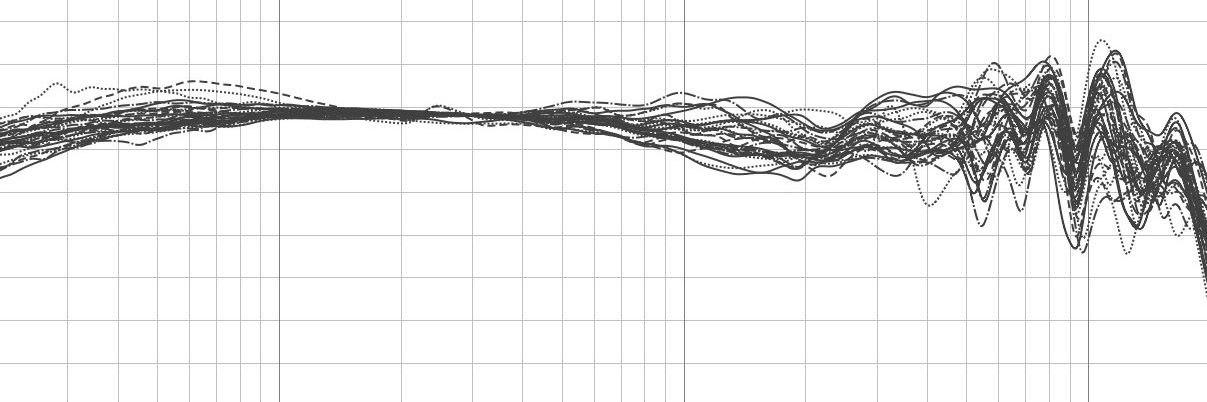
Frequency Response Average (unsmoothed):

The response is obtained by an average of 5-6 positional variations. The FR shown on the graph is unsmoothed.
Positional Variation:
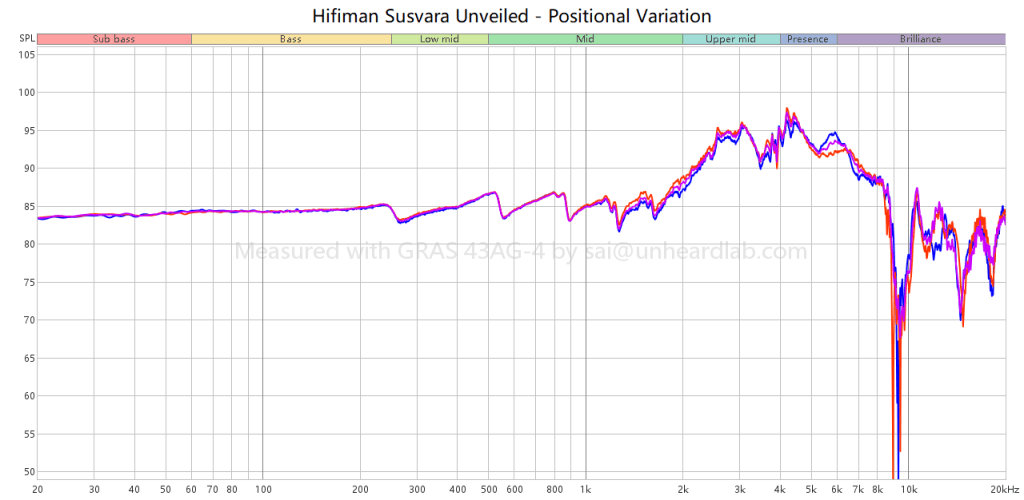
This graph illustrates how headphone placement on the head affects perceived tonal balance: with the ear positioned at the front (blue), centre (purple), and back (red) of the headphone. The FRs shown on the graph are unsmoothed.
Leakage Tolerance:
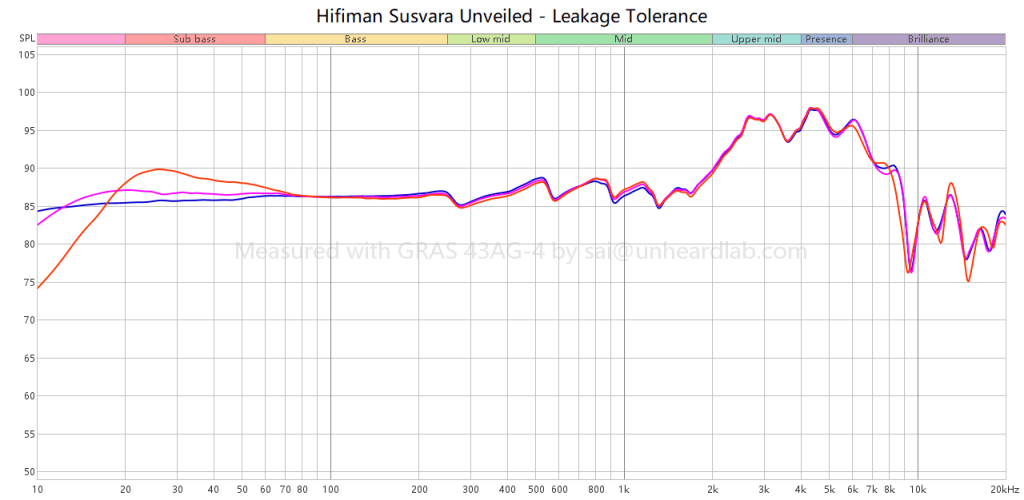
This graph demonstrates how leakages to the front volume can result in FR change: blue (good seal), purple (thin arm glasses), red (thick arm glasses). The FR shown on the graph is 1/12 octave smoothed.
Comment: Like most open-back planars with low diaphragm tension, this headphone shows a slightly bass boost when the seal is compromised. This means that a perfect seal is not required for maximum bass performance. In fact, breaking the seal slightly might increase perceived bass amount.
Linearity and Dynamic Compression:

Linearity and dynamic compression testing plots the headphone’s frequency response at two input levels to show how it reproduces signals as loudness changes. Any divergence between the high-level and low-level curves points to where the transducer’s dynamic range begins to compress or distort. Here, the measurements are superimposed to allow direct comparison.
Impulse Response:
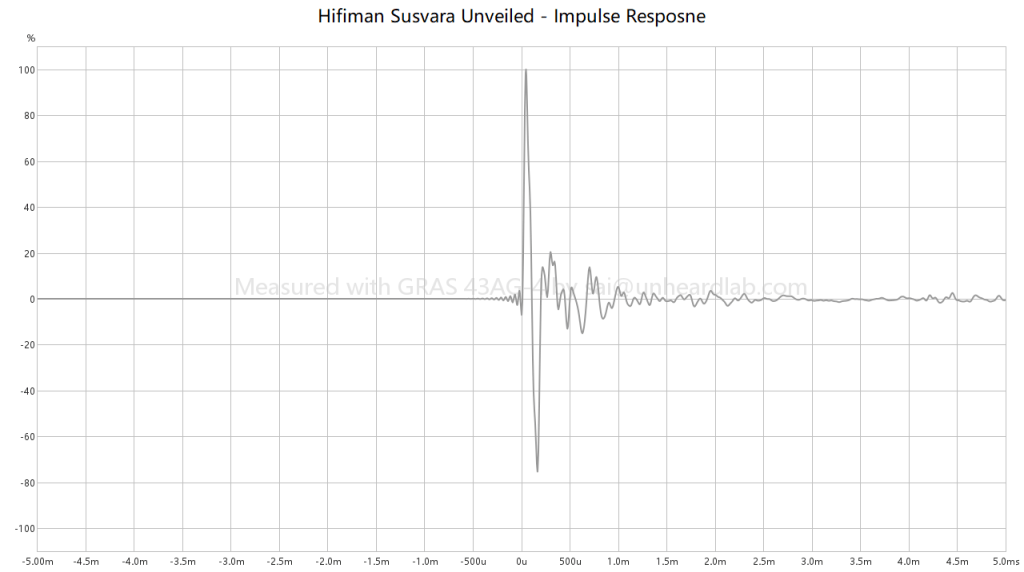
The impulse response test measures the initial response, overshoot, and decay of a transducer upon receiving a signal. An initial upshoot indicates a normal polarity, vice versa.
Total Harmonic Distortion (THD% 2nd-9th) & Excess Group Delay (94 dB):

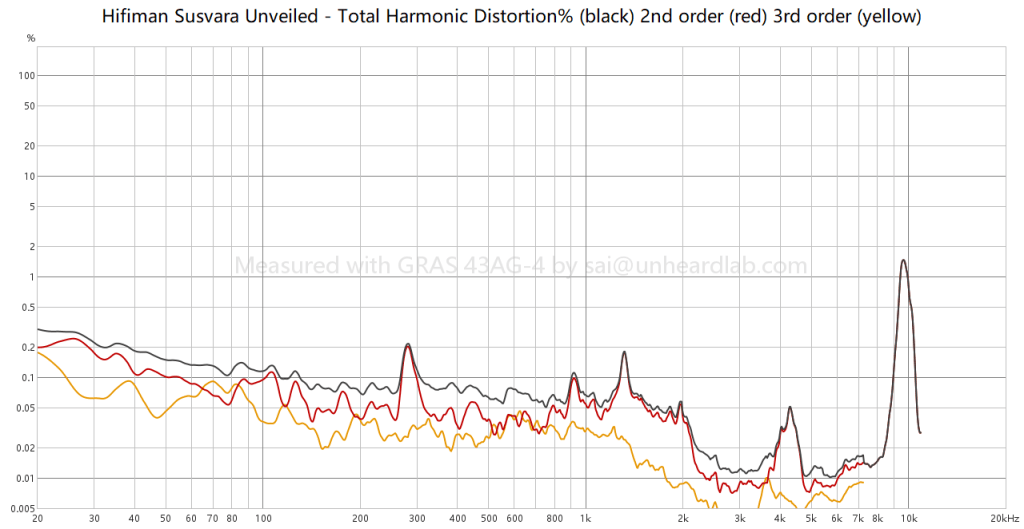
These measurements are conducted in quiet, normal room conditions (as opposed to an anechoic chamber), meaning there may be some influence from ambient room and external noise. These results should be considered a preliminary assessment of performance, primarily for identifying major issues, and do not reflect the best-case performance scenario.
Channel Matching:

Channel matching graphs are intended for quality control checks and do not relate to the perceived sound profile. A specialised configuration is used in this test to capture differences between channels, mitigating interference from positioning on the rig and the asymmetry in the GRAS pinnae design, a legacy of KEMAR. The left (blue) and right (red) channels are measured using a flat plate coupler with an IEC60318-4 ear simulator.
Comment: Channel matching on this particular unit is good, which may contribute to imaging precision and the clarity of spatial cues.
Electric Phase & Impedance:
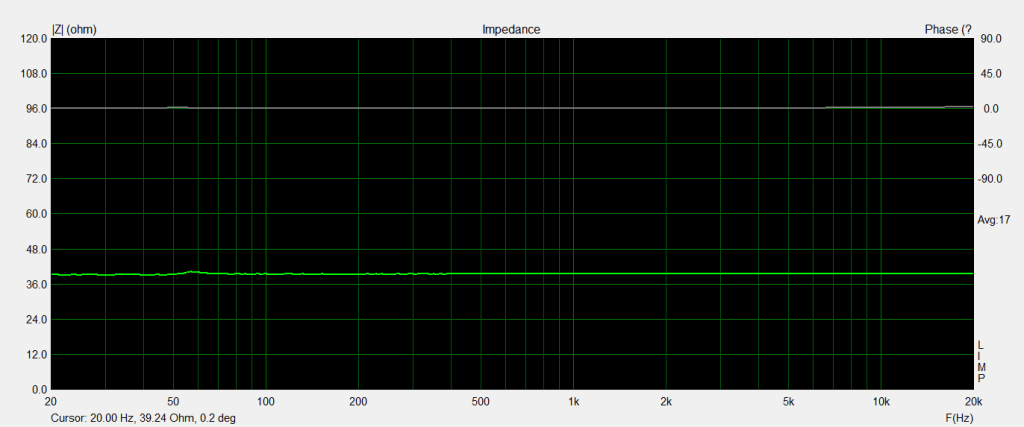
The above graph shows the measured impedance (green) and electric phase (grey), measured under free-air condition (minimal front volume coupling).
Comment: This headphone’s impedance curve is typical of a planar headphone – flat and low.
END OF THE ARTICLE
Disclaimer: This review is not sponsored or endorsed by any business or related entity. The headphones reviewed are my own unless stated otherwise. Any links or recommendations included are purely informational and do not involve any financial affiliation or endorsement on my part.

Love the new graph about dynamic compression. I may be wrong but does that suggest the Susvara unveil is very consistent for loud listening? Also the graph looks almost identical at 84 and 104 db. Is this normal?
LikeLike
Glad you liked it. Yeah they stack almost perfectly because the headphone stays in the exact same position when measured. I simply need to adjust the input level between measurements. So you’re absolutely right, the Susvara Unveiled shows no signs of dynamic compression and stays very consistent at extremely loud volumes.
LikeLike
I thought you are gonna write about headphones that are within the reach of my budgetary capacity 😡
LikeLike
Haha fair enough! I’ll try to keep the next one within humanly possible budget limits.
But you know how it goes… just when you think you’re safe, something shiny and twice the price shows up!
LikeLike
Hey, just wanted to say I really enjoyed reading your thoughts on these.
I’ve been using the OG and it’s still my go to for vocals and pop. There’s something magical about the way it handles voices and layers in modern pop tracks. It just sounds so clean and natural. Have’t had the chance to try the Unveiled yet, but your impressions have got me curious. Removing the grill entirely and changing the diaphragm material sounds like a pretty bold move. If it really open things up even more and brings out extra air and detail, I can imagine vocal sounding even more lifelike
Also interesting to hear it’s a bit easier to drive. That could be a game changer for those who don’t have access to huge speaker amps. Still sounds like it needs a solid chain though.
LikeLike
Appreciate that. Yeah I get what you mean about the OG. The Unveiled keeps a lot of that character but adds this extra layer of clarity. The improved efficiency is definitely noticeable. Still wants a good chain but you’re not fighting it nearly as much as the OG.
LikeLike
Great review as always. Looks extremely good, but price … you know. Hope to see soon a review of the Audeze LCD-S20!
LikeLike
Cheers mate. Yeah this one’s clearly not for everyone’s wallet… I don’t have a direct line to Audeze, and there’s no stock in Australia yet. Hopefully soon!
LikeLike
Hi.
Hifiman Susvara Unveiled FR versus Moondrop COSMO fitted with the Para’s hybrid pads …
Link on head-fi.
https://www.head-fi.org/threads/moondrop-cosmo-new-flagship-planar-headphone.973629/page-4#post-18735648
and https://www.head-fi.org/threads/moondrop-para-para-ii-venus-and-cosmo-fitted-with-the-brainwavz-memory-foam-hybrid-earpads-xl-size-and-zmf-universe-lambskin-perforated-pads-or-zmf-be2-lambskin-perforated-pads-or-zmf-caldera-lambskin-thick-top-and-side-perf-pads-discussion.970569/page-55#post-18735140
PS : Bravo for this excellent review of Susvara Unveiled, as always!
LikeLike
Thanks! The Cosmo is definitely still the value-for-money pick that gets you surprisingly close to top-tier planar SQ without a steep price. Its tonality especially with the PARA hybrid or EP100A pads is still one of its strongest suits. So it holds its own impressively well considering the price difference.
LikeLike
Hi. In the updated measurements ,hd58x and hd660s2,I found new hd600 Aide cooling gel pads with similar fr measurements to the original pads. What brand and model is this? I saw soulwit pads on hd600 with similar fr in other measurements.
LikeLike
Hey. They look just like the Soulwit pads, but I got mine from a 1688 vendor called Aide Dianji – that name’s also printed on the packaging. They’ve got a cooling gel insert and use two different types of fabric on the sides.
LikeLike
Oh I know,that is 爱德电子 (aide dianzi),this factory is near soulwit,both in guangdong dongguan.
Aide has two kind of cooling pads with different cover,one is fabrics,another is artificial leather.The leather one have different sound.
The surface fabric of aide’s pads is different from soulwit’s. The original soulwit used fine synthetic fiber material. However, soulwit will change the material in the future and use a similar hexagonal lattice pattern woven elastic mesh.Both fiber fabrics are very breathable, which may make them have similar acoustic performance.
LikeLike
Oh wow, you really know your stuff – thanks for the info! Yeah I’m aware there are two versions (or three perhaps if you count the purple ones with protein on the outside). The ones I got have that jersey fabric with the hexagonal lattice pattern on the outer wall indeed, and a silky fabric on the part that touches the cheek. Super breathable, for sure. It’s great that we finally have an aftermarket option for the HD6 series that actually sounds close to the stock pads.
LikeLike
Hi, can you provide a link to buy these pads on aliexpress?
LikeLike
Hey, I just checked again and the store is no longer selling them. But they are the same as the Soulwit pads which are available from Amazon. Alternatively, if you are able to buy from China directly, here’s their 1688 factory link.
LikeLike
Thank you very much, so kind! Anyway I didn’t realize that I was reading the wrong post. I need the “HE-series cooling gel pads” you used for HE600 measurement. Exactly the same pads in order to use your measurement for eq. I can’t find anything similar to what you are describing here on aliexpress or amazon (I can’t register on 1688)
LikeLike
Aha I see. Those are actually available on Ebay. But if you come across identical looking ones on Aliexpress, they are most likely the same in terms of build and sound too.
EDIT: wait no, they no longer have the Hifiman version. I’m talking to the store see if they can list it on Ali.
LikeLike
Thank you very much!
LikeLike
Unfortunately they don’t have it listed yet. But if you happen to live in Canada (or can buy from Amazon CA), here’s the link for it.
EDIT: Ok I just found them on Ebay too.
LikeLike
Hey Sai,
Do you plan reviewing the Arya Unveiled as well? IMO, that seems to get more attention from people due to its significantly lower price, but also a lot of debate seeing as the Arya Stealth and the HE1000 Stealth have been massively discounted. I think comparing the Arya Unveiled with the HE1000 Stealth would be quite interesting seeing as they now both directly compete with each other, and I recall you saying the HE1K Stealth was the more ‘balanced’ headphone in the egg-shaped series. I just bought a used unveiled so keen to compare them both but would also love to hear your thoughts if you ever get around to listening to it!
LikeLike
Hi mate, funny thing – I just received the loaner unit for the Arya Unveiled today, so you’re in luck! Totally agree, it’s a super relevant comparison right now, especially with the HE1000 Stealth sitting in the same price bracket after all the discounts. I’ve always thought the HE1000 Stealth was the more balanced of the egg-shaped line, so it’ll be interesting to see how the Unveiled stacks up. Keen to dig in and share some thoughts once I’ve spent some time with it. Would be great to hear your impressions too once yours arrives!
LikeLike
Hell yes! Can’t wait!!
LikeLike