
Intro:
The mid-fi open-back headphone market has long been dominated by Sennheiser—and if you go further back, AKG had its share of influence too (sorry, Beyer fans). But in recent years, competition has intensified with the rise of more well-tuned alternatives, including affordable models by Focal and Hifiman, more recently, Aune. This year, Audio Technica, a heavyweight in the industry, has introduced the R70xa, the successor to the well-regarded R70x.
Right out of the box, the R70xa gives off a rather spartan feel. This is where I feel a bit let down especially in terms of build quality. While the chassis itself is fine, the headband feels like a downgrade. The design is somewhat awkward with limited ear cup articulation (only about 20-30 degrees horizontally), which sometimes prevents a snug fit around my jaw and can cause slight leakage. There’s a hard stop at the top of the ear cup, restricting its movement – a design choice that, in my opinion, wasn’t necessary. It reminds me of the Moondrop Void in this aspect, though thankfully not as extreme.
On the technical side, Audio Technica highlights its “pure open-back design”. But how do these translate into actual sound? Let’s find out.
For those who want to jump right into detailed measurements, check out the final section of this article.
Disclaimer: this unit was purchased and is owned by unheardlab.
Specs & Comfort
Price: US$ 349/ AU$ 499
Driver size: 45 mm dia.
Transducer type: moving coil
Sensitivity: 97 dB/mW @1kHz
Impedance: 480 Ω @1kHz (measured)
Connector: dual 2.5 mm TRS locking
Weight: 199 grams
Clamping force: light
Comfort: 8/10 (not enough articulation/adjustments)


Measurement & Sound
Tonal balance:
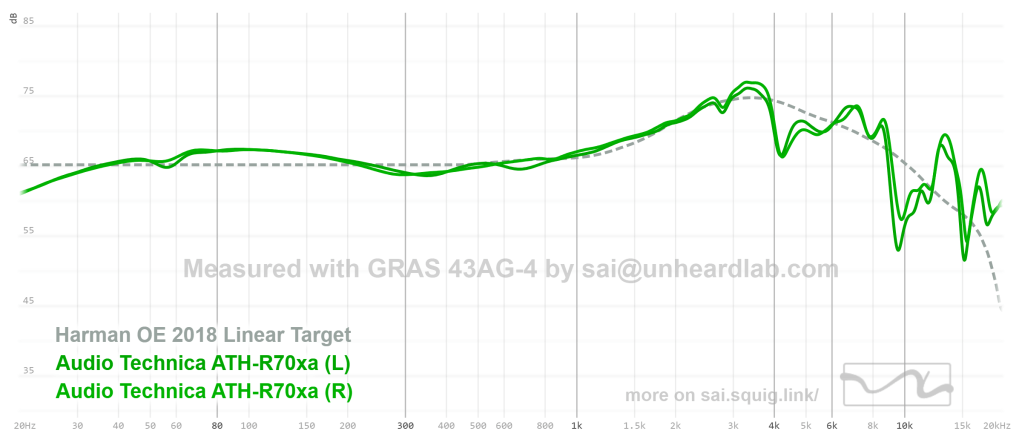
In short, the R70xa delivers a mildly U-shaped sound profile. I was expecting a neutral or warm-neutral tuning based on my experience with the R70x, but the R70xa takes a slightly different approach with its more U-shaped presentation.
The bass has good punch and extension for an open-back, setting it apart from classics like the Sennheiser HD6X0 series. There’s a bass lift below 200Hz, similar to the HD650, but the extension is noticeably better here, lending a livelier and more dynamic character. Kick drum thumps and snare hits carry extra weight and impact. Fortunately, the bass boost is clean, with a cut-off around 200Hz, preventing any midrange bleed that could cause muddiness.
The midrange reproduction is quite linear and realistic, with a forward and articulate presentation suited for studio work. In some ways, it reminds me of the DT770 Pro in terms of midrange linearity, but without the latter’s notorious treble peaks.
The presentation here differs from the HD6X0 series. There’s more grain and attack in the midrange and upper frequencies, making it potentially fatiguing if you’re accustomed to the HD650’s relaxed tuning. In this sense, the R70xa is more reminiscent of the HD580/600, with its more linear mids-to-highs transition. This also distinguishes it from the more rounded presentation of the original R70x.
The treble is generally clear and smooth but has some elevation in certain regions, especially compared to the original R70x and HD650. It still falls within what I’d consider a neutral range, but there are minor peaks in the mid-to-upper treble transition. These can accentuate certain elements in modern mixes, such as percussion and sibilant tones in female vocals, making for a slightly dry presentation. Whether this is preferable depends on your use case and personal preference. In a lot of ways, the R70xa reminds me of the older AKG open-back studio headphones, like the K612 Pro which their elevated treble clarity.
The R70xa’s driver is clearly capable, but for pure musical enjoyment, I think it could benefit from some fine-tuning—whether through PEQ, acoustic damping, or pad swaps. It’s not an overly bright headphone, but a more refined treble transition would defintely improve its tonal coherence.
Other qualities:
- Soundstage
In terms of spatial qualities, the R70xa is a solid performer. It surpasses the HD6X0 series with a more spacious and airy presentation. Imaging, similarly, is sharper and more focused than on the HD6X0 series. That said, it’s still not the widest or most transparent. Compared to the Moondrop Para, for example, it falls slightly short. However, among dynamic driver headphones in the sub-$500 category, the R70xa remains an admirable contender, much like its predecessor.
- Clarity
The R70xa offers good clarity. Compared to the HD6X0 series, it generally has the upper hand. However, the HD600 (alongside the Aune AR5000) might still have a slight edge in midrange instruments and vocals, likely due to a more linear 4-5kHz response. That said, the R70xa is the more resolving headphone at both ends of the spectrum. Still, it’s not a “giant killer”—its slightly uneven treble transition holds it back. If you move up to something like the Aune SR7000, Hifiman HE6se V2, or even the Sundara, the improvements should be noticeable.
- Dynamics
The R70xa delivers commendable dynamic performance for its price. Transients are snappy and well-distinguished, with no hint of muddiness or veil. Among mid-fi neutral headphones, it stands as one of the stronger options—outperforming the HD650 and the Aune AR5000, though it still falls short of the EMU Teak and Focal Clear.
Conclusion and value:
At an MSRP of $349 USD / $499 AUD, the Audio-Technica ATH-R70xa is a welcomed addition to the market. While it doesn’t offer the groundbreaking value of the HD6XX or the Fiio FT1, it delivers a more dynamic, “technical” sound with a decently well-balanced tonality. In some ways, the R70xa fills the gap left by older AKG open-backs, offering a more open sound than the Sennheisers, since AKG’s lineup hasn’t seen an update in quite some time. Compared to the original R70x, it feels more like a variation with improvements in certain areas rather than a direct upgrade: a step away from the Sennheiser style and closer to an AKG-like presentation, if you will.
As such, I can see why those who favor a more “linear” sound—or music producers and audio professionals—would appreciate the R70xa for its extended bass and treble response, along with improved detail clarity. Personally, while I may prefer something more relaxed for casual listening, the main thing holding me back from fully enjoying the R70xa is the comfort. While the new headband design looks promising on paper, its lack of flexibility is somewhat of a letdown despite the feather light weight. As such, I’d recommend trying them before purchasing to ensure a proper fit.
Pros: Clean, well-balanced tuning with a mildly U-shaped response; Tight, well-extended bass with good punch and control; Improved detail retrieval over the original R70x; More open and spacious presentation than the HD6X0 series.
Cons: Somewhat uneven/dry treble presentation; Can be more fatiguing than the original R70x or HD650; Headband design lacks flexibility, affecting comfort and fit.
Value Grade:
Notes on Ear Pads and EQ
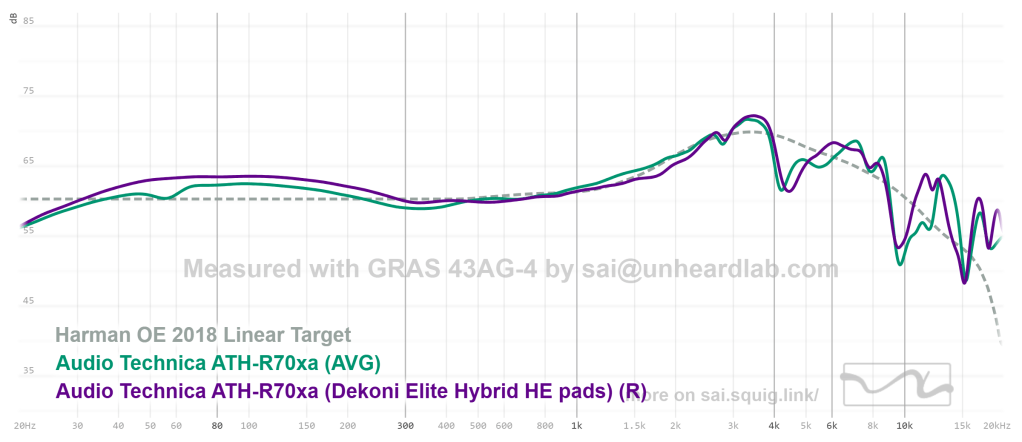
As an open-back headphone, the R70xa is quite accommodating when it comes to pad -rolling, making it easy to fine-tune the sound or replace the stock pads once they wear out. I’ve found that thicker ear pads—particularly those made from velour, suede, or leather/velour hybrids—can sometimes bring positive changes to both the sound and comfort. For example, the Dekoni Elite Hybrid Hifiman HE pads enhance bass presence and midrange warmth, resulting in a presentation that may be more pleasing to some. For me, however, it’s the improvement in comfort that makes the biggest difference, while any further sonic adjustments can be made via EQ.
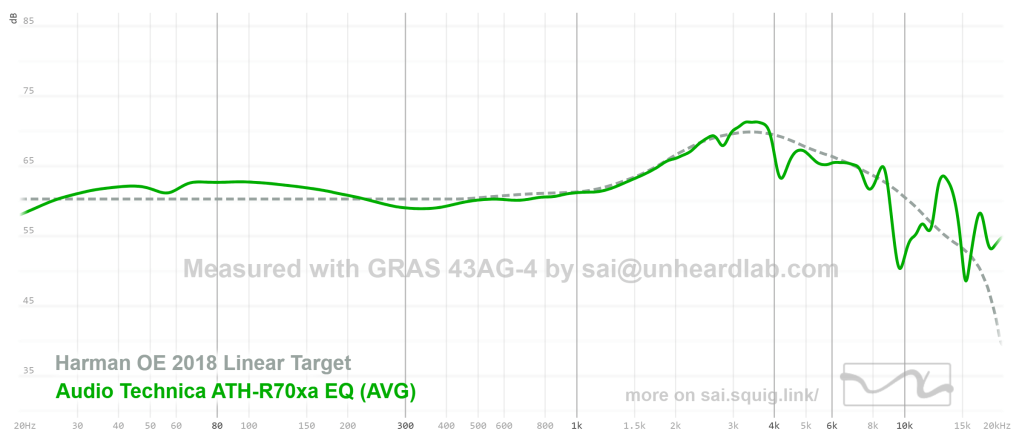
In terms of EQ, this headphone requires little adjustments to sound well-balanced. That said, there’s still room for fine-tuning.
My personal EQ setting for this headphone (with the stock ear pads):
Preamp: -2.5 dB
Filter 1: ON PK Fc 25 Hz Gain 2.0 dB Q 0.700
Filter 2: ON PK Fc 1300 Hz Gain -1.5 dB Q 2.000
Filter 3: ON PK Fc 3500 Hz Gain -1.0 dB Q 3.000
Filter 4: ON PK Fc 4300 Hz Gain 2.0 dB Q 3.000
Filter 5: ON PK Fc 5400 Hz Gain 1.0 dB Q 2.000
Filter 6: ON PK Fc 7200 Hz Gain -4.0 dB Q 3.000
If your goal is to EQ the response to match the Harman Target, consider the AutoEQ function provided by Squiglink as a convenient starting point. I personally recommend customising the filters to better suit your own hearing, especially in the treble. While the AutoEQ provides a useful baseline, individual adjustments can opften significantly improve your listening experience.
MEASUREMENTS
Frequency Response Average (unsmoothed):

The response is obtained by an average of 5-6 positional variations. The FR shown on the graph is unsmoothed.
Comment: The R70xa demonstrates a very good overall tonal balance. The main issue lies in the unevenness between 4kHz and 9kHz, where a series of peaks and dips can be heard. When performing a manual sine sweep, these deviations are quite noticeable to my ears, though the exact frequencies may vary from person to person.
Positional Variation:

This graph illustrates how headphone placement on the head affects perceived tonal balance: with the ear positioned at the front (blue), centre (purple) and back (red) of the headphone. The FRs shown on the graph are unsmoothed.
Comment: The R70xa exhibits a highly consistent response when its positioning is adjusted on the ear simulator, which is generally a preferable design.
Leakage Tolerance:
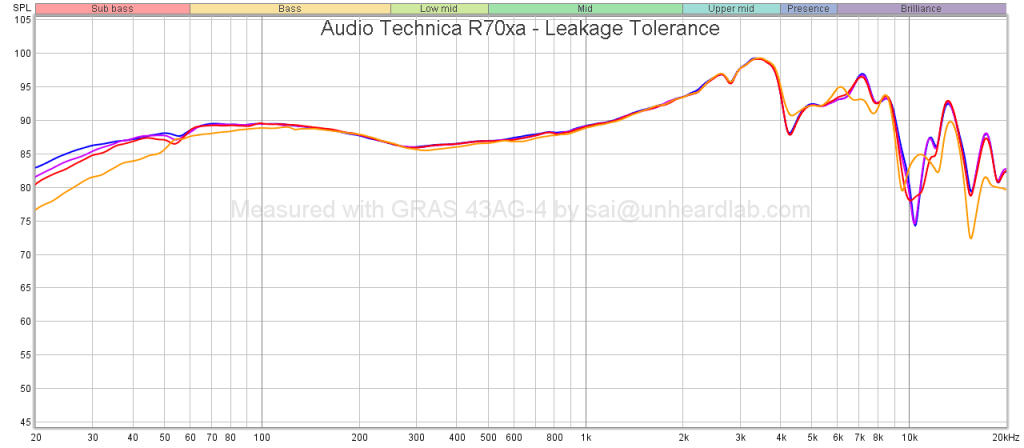
This graph demonstrates how leakages to the front volume can result in FR change: blue (good seal), purple (hair), red (thin arm glasses), yellow (thick arm glasses). The FR shown on the graph is 1/12 octave smoothed.
Comment: As an open-back headphone, the R70xa shows a highly consistent response even when the seal is compromised, which is a positive trait.
Impulse Response:

The impulse response test measures the initial response, overshoot, and decay of a transducer upon receiving a signal. An initial upshoot indicates a normal polarity, vice versa.
Comment: the R70xa displays a normal impulse response – nothing out of the blue here.
Total Harmonic Distortion (2nd-9th)% & Group Delay (94 dBC):

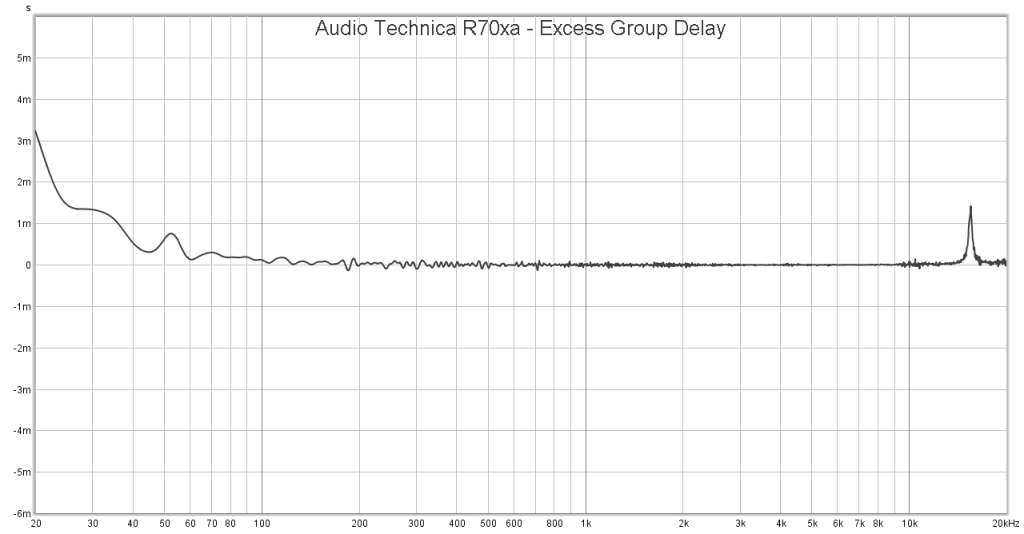
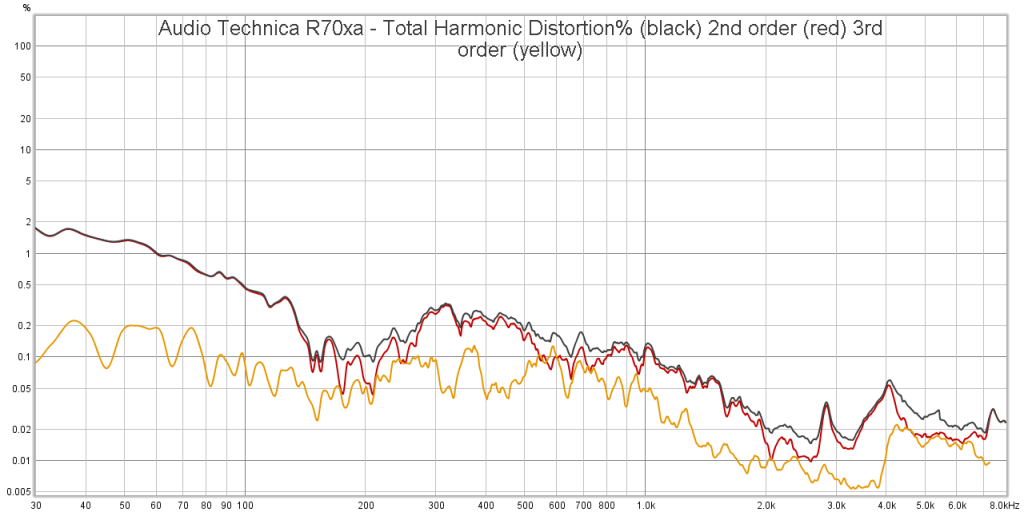
These measurements are conducted in quiet, normal room conditions (as opposed to an anechoic chamber), meaning there may be some influence from ambient room and external noise. These results should be considered a preliminary assessment of performance, primarily for identifying major issues, and do not reflect the best-case performance scenario.
Comment: The R70xa performs well at 94dB, with no unusual behaviour.
Channel Matching:

Channel matching graphs are intended for quality control checks and do not relate to the perceived sound profile. A specialised configuration is used in this test to capture differences between channels, mitigating interference from positioning on the rig and the asymmetry in the GRAS pinnae design, a legacy of KEMAR. The left (blue) and right (red) channels are measured using a flat plate coupler with an IEC60318-4 ear simulator.
Comment: Channel matching on this particular unit is excellent, which may contribute to strong imaging performance and clarity of spatial cues.
HpTF Measurements (experimental):

The Headphone Transfer Function (HpTF) describes how sound is shaped by headphone design and ear anatomy before reaching the eardrum. Different measurement rigs (with varying pinnae designs) introduce unique reponses/resonances and potential deviations from actual human perception. Understanding HpTF helps translate measured data into real-world listening experiences.
Electric Phase & Impedance:
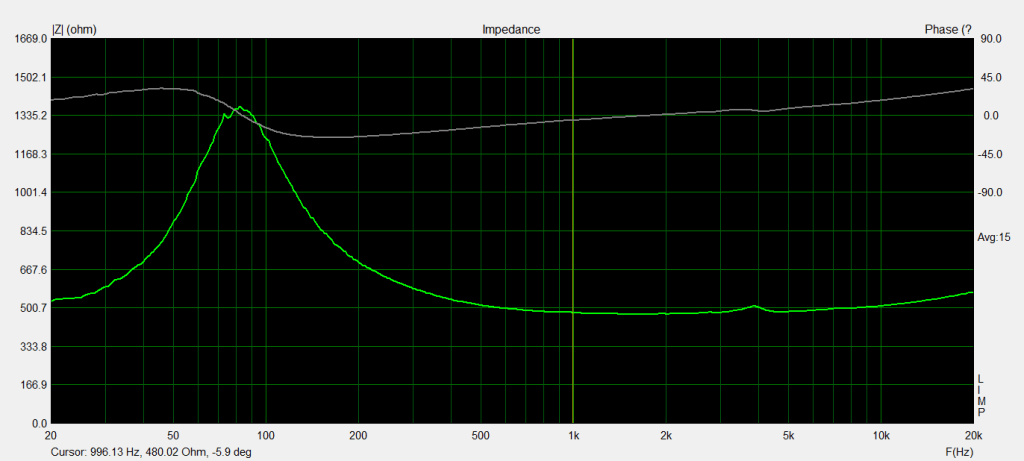
The above graph shows the measured impedance (green) and electric phase (grey).
Comment: The R70xa’s impedance curve is typical of a moving coil headphone but relatively high in magnitude. As a result, an amplifier is likely needed to drive them to higher volumes. Additionally, using an amp with a higher output impedance can shift the frequency response, causing elevations near the impedance peak—something to keep in mind.
END OF THE ARTICLE
Disclaimer: This review is not sponsored or endorsed by any business or related entity. The headphones reviewed are my own unless stated otherwise. Any links or recommendations included are purely informational and do not involve any financial affiliation or endorsement on my part.

Another interesting offering at lowish price.
Especially considering it’s weight or rather lack of 😉
Should be nice for long periods in front of a PC
LikeLike
Hey man! Yeah, overall, it’s not a bad offering. We’re definitely spoiled these days with stuff like the HD6XX, HE400se, and FT1, though I think the R70xa still has its place. But hey, who would say no to an even lower price tag? The light weight is definitely a plus. I just wish they made the headband more adjustable. Hopefully, they tweak that in future versions!
LikeLike
Hello. Great review! How would you compare this to the FT1 Pro. And between this, the FT1 Pro and the AR5000, which one would you pick?
Thanks
LikeLike
Thanks! For general listening, I’d lean toward the FT1 Pro: It may be less “dynamic” but other than that I feel like planars still have the edge in terms of overall SQ. But lately, there have been more reports of QC issues with the driver, so I’m a bit cautious about fully recommending it. Considering everything, I’d say the AR5000 is the safest choice overall. Personally, I also prefer its tuning over the R70xa since it has a more easygoing presentation. But if you’re into a more V-shaped sound, the R70xa might be the better fit for you.
LikeLike
Just to confirm, the Dekoni Elite Hybrid Hifiman HE are compatible with Audio-Technica ATH-R70xa?
LikeLike
Yep they do. They are a bit larger (105mm) than the stock pads (90mm) but they fit snuggly enough.
LikeLike
Another banger of a review as usual.
How much I wish Beyer would send you a DT 1990 Pro MK2, so that you could review and compare it to other “studio” headphones such as the R70XA for its technicalities and the quality of its bass, midrange, and treble presentation.
Thanks for the detailed reviews, Sai.
LikeLike
Cheers mate! I appreciate the kind words.
Yeah, I’d definitely be interested in checking out the DT1990 MK2s. Beyer’s influence in the head-fi space seem to have waned a bit (though they still hold strong in the pro market I suppose), but I’ve always been a fan of some of their stuff, especially the 1st Gen T1. It’d be interesting to see where they’re heading with their newer models.
That said, I don’t have any direct contacts at Beyer. Maybe I’ll reach out at some point to see if they have a review loaner, or I’ll just keep an eye on the used market for a good deal. In the meantime, I do have something from Beyer coming up, the T1 3rd Gen, and I’ve got some interesting findings on that one. So definitely stay tuned!
LikeLike
I found them pretty much identical to a R70 set that broke while I was moving.
Except those stupid bloody wings holding the cups to the band. They would constantly get tangled in my hair, get stuck and rip them out. And I’m not someone with particularly long hair.
A woman, or a headbanger/metalhead will not be able to use these without ripping pieces of their hair out daily. It’s an awful design.
LikeLike
Yeah I get what you mean. The wing design is definitely one of those love-it-or-hate-it things. It works well for comfort (IMO), but if your hair gets caught in it, it can be a nightmare. If only the R70xa had more articulation, it would be a very promising design.
LikeLike
Do you have a review of the original r70x? And do you recommend any pad recommendations for the original?
These are a bit too small much like the FT1. But would be comfortable with bigger height in pads for ears
LikeLike
I don’t have a full review. I do like the R70x though.
For pads, the stock ones are indeed on the small side. If you want more ear room and a touch more stage, the Dekoni Elite Velour Sundara pads work quite well. They add some treble and bass energy, while opening up the presentation a bit.
There may be other cheaper/better options, but I haven’t tested enough pads on the R70x to recommend beyond that.
LikeLike
Thank you. You’re definitely the top reviewer for pad swaps. Such an integral part of actually living with headphones. Probably doesnt matter as much for reviewers or people who just try new things all the time. But for normal people who just want to keep a pair for an extended period of time, this helps so much for deciding whether to keep it or upgrade in the longterm.
LikeLiked by 1 person
Thanks, that means a lot to me. I do think it’s one of the underrated aspects of the hobby. Not only do you need to swap pads eventually, but you can probably do it cheaper and tweak the sound/comfort more to your liking along the way.
LikeLike
What is the meaning of the 4k-6k dip in frequency response?
LikeLike
In this case, it’s actually not that bad since it’s just a small dip and isn’t very wide-band. It tends to take off some of the grain and texture in the upper mids, which can actually be more enjoyable if you prefer a smoother, more laid-back sound. But yea if you prefer a more linear sound, this might be a small issue.
LikeLike
Thanks for the review, Sai!
The lack of horizontal swivel on the R70xa is one of the deal breakers for me – the pad creates seal by touching the back of my ear instead of going around it. Weird feeling, even though the bass doesn’t seem to be affected. In this aspect, R70x’ 3D-wing design and fully rotating cups are more comfortable.
You can always bend R70x to make its 3D-wings work for your head, but you can’t really fix the swivel of R70xa.
Both are very light though (both in weight and clamp force), they really float on my head.
I do prefer the sound of R70x, warm and natural, but a bit bland. Throwing money at it (~buying source gears) 🤣 seems to give more return than doing the same for the R70xa. However the XA does have a lower floor – it sounds nice and exciting out of the box, if only a bit dry for weeb stuffs. 👍
LikeLike
Yeah, that lack of swivel on the XA is definitely a dealbreaker for a lot of people. It’s such a shame because they’re super light, so the fit could’ve been amazing if they just had that flexibility.
While I consider them sidegrades to the R70x, I personally prefer the OG too. Genre pairing gets overlooked way too often. There’s this idea floating around that genre pairing is nonsense because ‘it’s already in the mix’ meaning the music is already optimised for how it should sound, but I think that paints with way too broad a brush. Production styles and personal tastes vary so wildly that having gear that specifically complements the genre really does make a difference.
LikeLike