
Cut from the same cloth?
Intro:
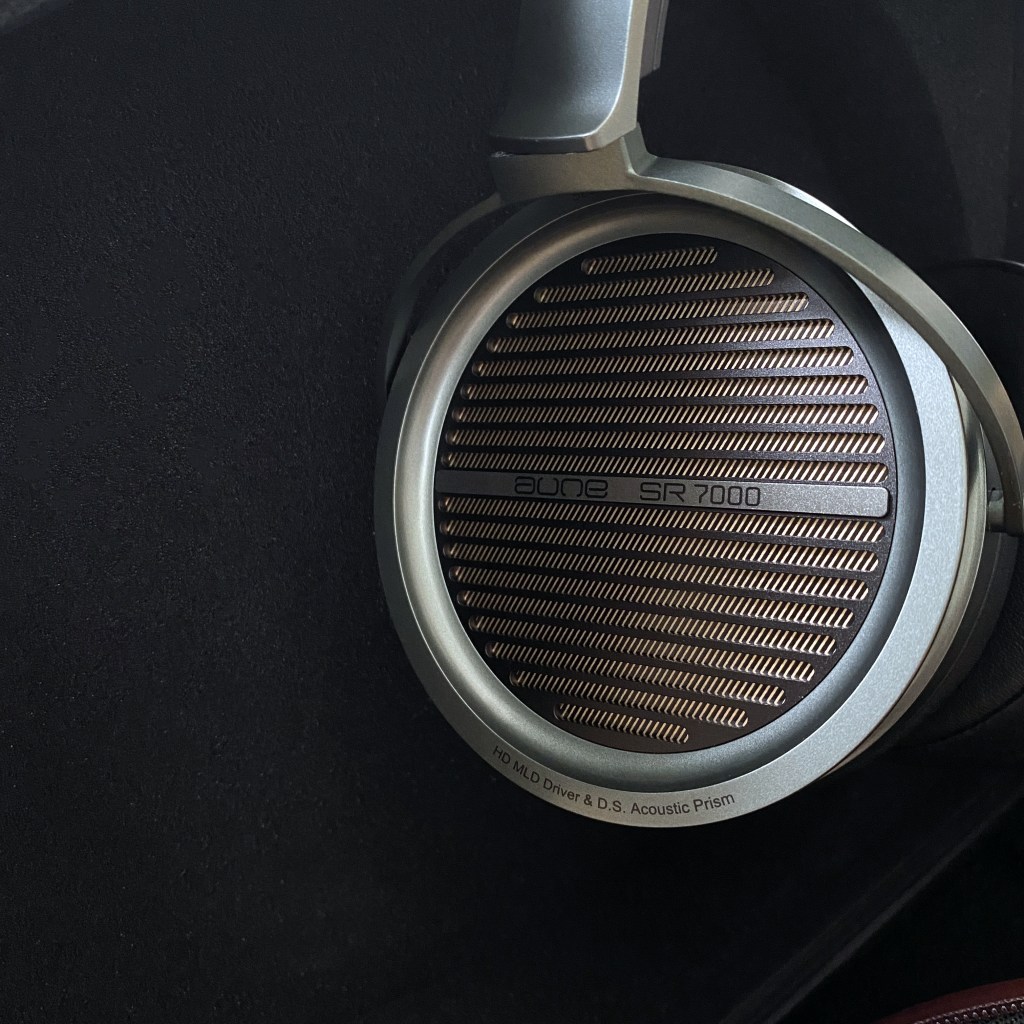
I previously reviewed Aune’s first over-ear headphone, the AR5000, which I found to be a strong entry into the market with its well-balanced tuning and solid overall value. Now, Aune is back with its second headphone: the SR7000, a closed-back model priced at almost double the AR5000.
Right out of the box, the SR7000 makes a strong first impression with its sleek design and a more premium set of accessories—including a well-crafted carrying case and two high-quality cables.
On the technical side, Aune highlights its “innovative dragon scale acoustic prism” and updated “W-shaped ceramic polymer diaphragm.” But how do these translate into actual sound? Closed-back headphones tend to be trickier to tune. What does the SR7000 bring to the table? Let’s find out.
For those who want to jump right into detailed measurements, check out the final section of this article.
Disclaimer: Aune sent this unit for testing with no strings attached: no input, no expectations. That’s the only way I accept review requests, and I appreciate brands that uphold this standard.
Specs & Comfort
Price (RRP): US$ 599 / AU$ 999
Driver size: 50 mm ø
Transducer type: moving coil
Sensitivity: 106 dB/ 1Vrms @1kHz
Impedance: 57 Ω @1kHz (measured)
Connector: dual 3.5mm TRS
Clamping force: light
Weight: 389 grams
Comfort: 9/10 (no complaints, but could be even lighter)


Measurement & Sound
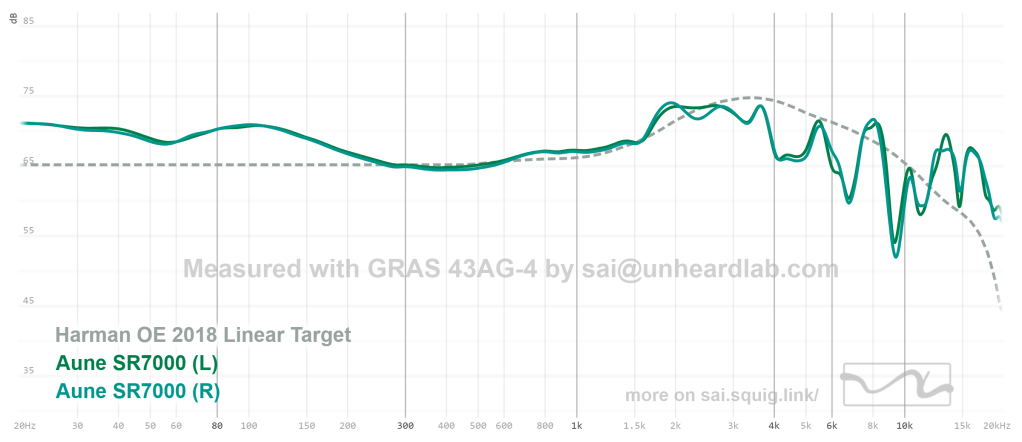
link to the frequency response measurement & more comparisons
Tonal balance:
In short, the Aune SR7000 delivers a clean, articulate, well-balanced sound profile. Despite being a closed-back headphone, it avoids the boomy or congested sound often associated with them.
The bass has a satisfying punch—fast, clean, and well-controlled. Unlike many closed-back dynamic headphones, the SR7000 steers clear of excessive boominess and muddiness. The bass quantity and extension are well-judged for a balanced presentation. Compared to the Harman 2018 Over-Ear Target, the SR7000 offers slightly more mid-bass impact (with a good seal) while largely avoiding any bleed into the lower mids.
Overall, the bass is tastefully tuned, striking a good balance between quantity and quality. If you’re a basshead, the SR7000 might not deliver the most hard-hitting slam, but its natural, well-integrated bass presentation is something I appreciate—especially for those used to studio monitors or open-back headphones.
The midrange is clean, articulate, and slightly forward. It steers clear of the hollowness or honkiness that can be a pitfall for closed-backs. Vocals have a good sense of body, rendering both male and female voices with “correct” timbre. It stands out as one of the most natural midrange tunings among closed-backs, even when compared to higher-priced options like the Focal Radiance or the Fostex TH900 MK2.
In terms of midrange presentation, the SR7000 is a bit more forward than the Sennheiser HD620S, but also warmer and fuller. Compared to the DT770 Pro, a studio staple, the SR7000 reproduces vocals with a more “correct” timbre, avoiding the DT770 Pro’s characteristic sibilance in favour of a smoother yet still highly articulate sound. While some may argue that the DT770 Pro offers better analytical capabilities for spotting issues in the mix, the SR7000 delivers a more natural reproduction—arguably closer to what you’d get from typical studio monitors.
The treble is crisp and well-extended, with an overall balance that leans slightly toward the upper octaves. Most instruments are reproduced with excellent fidelity, and sibilance remains well-controlled, making for a non-fatiguing listen. It is worth noting, however, there is a slight unevenness in the harmonic balance, which can make tracks with heavy percussive elements sound a bit splashy at times. That said, this effect is far less pronounced than the sharp treble edges found on models like the Moondrop Para or the Hifiman HE1000se.
The boosted frequencies are mostly confined to the last octave (above 12kHz), which enhances the sense of air and transparency, which may be seen as an advantage for a closed-back design to avoid the kind of claustrophobic feel. Compared to the Focal Radiance, the SR7000 dials back some of the treble aggressiveness in favour of a more natural yet still open and airy sound.
Other qualities:
- Soundstage
For a closed-back, the SR7000’s soundstage is impressively wide. It never feels congested or claustrophobic, outperforming both the HD620S and even the Focal Radiance in this regard. Thanks to its angled driver design, imaging is sharp and focused, allowing for precise placement of sound elements and a convincing sense of stage depth.
While it doesn’t quite match the expansive openness of the TH900 MK2 (which isn’t strictly a closed-back), but that’s a somewhat unfair comparison. While the SR7000, like most closed-back headphones—including studio classics like the DT770 Pro—has some venting, it doesn’t leak sound nearly as much as the TH900 series. The only true closed-back that comes to mind with a more spacious stage is the Sennheiser HD820, though its sense of space comes at the cost of a more “artificial” presentation due to its wonky frequency response.
- Clarity
The SR7000 has excellent clarity. Midrange vocals and instruments are rendered with impressive detail, thanks to its clean and articulate tuning. Though frequency response measurements show a dip around 4–5kHz, this doesn’t seem to perceptually impact timbre or introduce distortion—likely due to the SR7000’s tolerance for minor leakage when worn, as seen in leakage-related measurement variations.
Treble nuances, particularly in percussive elements, are cleanly rendered, contributing to a detailed and layered presentation. Overall, the SR7000 edges out the Focal Radiance in clarity slightly, though it falls just short of the TH900 MK2 in sheer resolution.
- Dynamics
The SR7000’s dynamic performance is okay for its price category, though not quite at the level of top-tier closed-backs like Focal’s higher-end models or Fostex’s biodynamic headphones. It delivers satisfactory punch and impact, matching the HD620S while surpassing it in tightness and microdynamic detail. That said, if your priority is a hard-hitting, slamy bass response, you might be better off with the aforementioned Focal or Fostex options.
Conclusion and value:
Aune’s first headphone, the AR5000, proved that the company knows how to tune headphones well, and the SR7000 continues that trend.
Overall, the SR7000 seems to follow a clear vision in its tuning: clean, articulate, and open-sounding, which is uncommon for closed-back headphones. It strikes a good balance between clarity and body, avoiding the typical pitfalls of congestion or excessive warmth. Compared to the TH900 MK2, the SR7000 has a more natural and linear tuning out of the box. Even with the TH610 pads, I still prefer the SR7000’s tonal balance, though the TH900 MK2 has the edge in dynamics and soundstage.
Compared to the similarly priced Fostex TH610 and E-MU Teak, the SR7000 sounds notably more natural in the midrange. Vocals are fuller and less edgy, and while the bass isn’t as hard-hitting, the treble remains smooth, making for a relaxed listen. That said, this could also be seen as a drawback. The SR7000 isn’t a headphone that immediately wows you—it prioritises balance and neutrality, offering whatsome might call a “plain water” sound. Whether that’s a strength or a weakness depends on your preferences and use case, but I find it commendable that the SR7000 achieves such an open and natural presentation for a closed-back headphone.
The elephant in the room is how the SR7000 stacks up against the current market favorite, the Fiio FT1. Both are exceptionally well-tuned headphones, and their frequency responses share notable similarities, particularly in midrange linearity. The key difference lies in their overall presentation. Some may prefer the FT1’s more exciting, forward character. The SR7000 is less V-shaped, offering less bass rumble and treble spice compared to the FT1. As a result, it comes across as the more ‘refined’ option, with a notably more spacious soundstage and greater overall clarity.
At an MSRP of $599 USD / $999 AUD, the Aune SR7000 is a solid performer in the closed-back headphone market. It may not be as aggressive an entry as the AR5000, but still, IMO, fills an important niche. For those who are accustomed to speakers and open-back headphones, the SR7000 makes for a compelling choice with its tuning and the extra isolation factor. Some have pointed out that the SR7000 costs twice as much as the AR5000 while sharing a similar chassis, but well-tuned closed-back headphones are far rarer. The SR7000 also comes with a more premium set of accessories and a newly designed driver, making the price increase more justifiable.
Pros: Clean, well-balanced tuning; Tight, controlled bass with good punch; Natural, engaging midrange; Wide soundstage for a closed-back; Excellent imaging and clarity.
Cons: Lacks an immediate “wow” factor; Less dynamic than some rivals; Slight treble unevenness;
Value Grade:
Notes on Ear Pads and EQ

As a closed-back headphone, pad-rolling is a little more restricted for the SR7000. However, with the right pad design, its tuning can be subtly adjusted to better suit personal preferences. In my experience, full leather ear pads tend to refine the sound in ways that align more closely with my taste, providing slight but noticeable improvements.
In terms of EQ, the SR7000 requires little adjustments to sound well-balanced. That said, there’s still room for fine-tuning.
My personal EQ setting for this headphone:
Preamp: -2.7 dB
Filter 1: ON PK Fc 30 Hz Gain 2.7 dB Q 0.700
Filter 2: ON PK Fc 410 Hz Gain 1.0 dB Q 2.000
Filter 3: ON PK Fc 1400 Hz Gain -1.5 dB Q 1.000
Filter 4: ON PK Fc 1800 Hz Gain -1.5 dB Q 3.000
Filter 5: ON PK Fc 4200 Hz Gain 3.0 dB Q 2.000
Filter 6: ON PK Fc 8300 Hz Gain -2.0 dB Q 3.000
Filter 7: ON PK Fc 13000 Hz Gain -1.5 dB Q 3.000
If your goal is to EQ the response to match the Harman Target, consider the AutoEQ function provided by Squiglink as a convenient starting point. I personally recommend customising the filters to better suit your own hearing, especially in the treble. While the AutoEQ provides a useful baseline, individual adjustments can opften significantly improve your listening experience.

MEASUREMENTS
Frequency Response Average (unsmoothed):

The response is obtained by an average of 5-6 positional variations. No smoothing has been applied to the FR shown here.
Comment: The SR7000 maintains a well-balanced frequency response across the audible spectrum. While there are some peaks and dips in the treble, they remain generally unproblematic.
Positional Variation:

This graph illustrates how headphone placement on the head affects perceived tonal balance: with the ear positioned at the front (blue), centre (green) and back (red) of the front volume of the headphone. The FRs shown on the graph are 1/48 octave smoothed.
Comment: The SR7000 exhibits noticeable positional variation in the upper mids and highs, which is common for headphones with angled driver designs. The center position appears to deliver the most neutral response, which is good.
Leakage Tolerance:
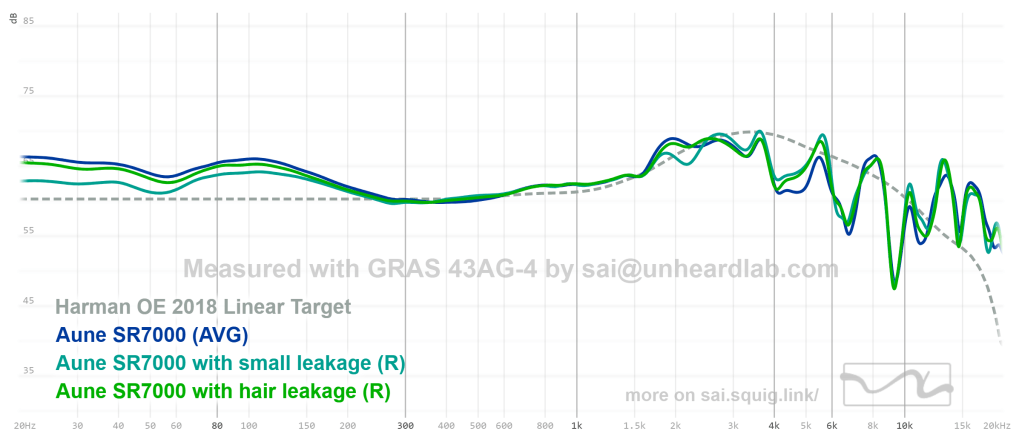
This graph demonstrates how leakages to the front volume can result in FR change.
Comment: A notable aspect of the SR7000’s design is how it accounts for imperfect sealing when worn. Measurements indicate that when fully sealed, the ear gain peak occurs just above 2kHz—slightly lower than the usual 3kHz. With minor leakage, this peak shifts to a more conventional 3kHz, while the 4-5kHz dip also becomes less pronounced. Additionally, the bass remains well-extended even with slight leakage, avoiding excessive roll-off. Aune’s own measurements likely reflect this real-world wearing condition, possibly done using full-size HATS systems like the GRAS 45BB or the Brüel & Kjær 4128 or 5128, where head curvature naturally introduces minor leakage.
Impulse Response:

The impulse response test shows the initial response, overshoot, and decay of a transducer upon receiving a signal.
Comment: the SR7000 displays normal polarity in its impulse response – nothing out of the blue here.
Total Harmonic Distortion (THD 2nd-9th)% & Group Delay (94 dBC):


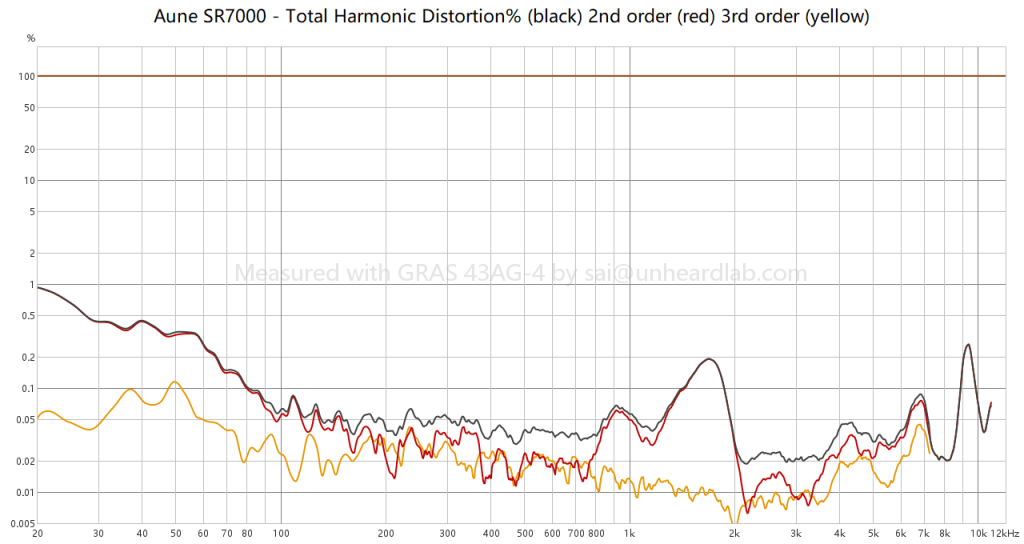
These measurements are conducted in quiet, normal room conditions (as opposed to an anechoic chamber), meaning there may be some influence from ambient room and external noise. These results should be considered a preliminary assessment of performance, primarily for identifying major issues, and do not reflect the best-case performance scenario.
Comment: The SR7000 performs well at 94dB.
Channel Matching:

Channel matching graphs here do not relate to the perceived sound profile. A specialised configuration is used in this test to capture differences between channels, mitigating interference from positioning on the rig and the asymmetry in the GRAS pinnae design, a legacy of KEMAR. The left (blue) and right (red) channels are measured using a flat plate coupler with an IEC60318-4 ear simulator.
Comment: Channel matching on this particular unit is excellent, which may contribute to its strong imaging performance and clarity of spatial cues.
Electric Phase & Impedance:

The above graph shows the measured impedance (green) and electric phase (grey).
Comment: The SR7000’s impedance curve is quite flat for a typical moving coil headphone. This means that its frequency response remains relatively stable against the amplifier’s output impedance, leading to more consistent performance across different setups, especially with OTL tube amps.
END OF THE ARTICLE
Disclaimer: This review is not sponsored or endorsed by any business or related entity. The headphones reviewed are my own unless stated otherwise. Any links or recommendations included are purely informational and do not involve any financial affiliation or endorsement on my part.

Great review of the SR7000, Sai.
Would you say that the SR7000 is better than the AR5000 in terms of technicalities and the quality of its midrange, bass, and treble?
LikeLike
Hey thanks mate!
Yeah, I’d say so. Some of that likely comes from the advantages of being a closed-back, but the bass impact is clearly in a different league. Mids are more of a preference thing: both are well-tuned, but the AR5000, being open-back, has a more natural presentation, while the SR7000 comes across as a bit more articulate. This trend continues into the treble, though I think the SR7000 has a clearer advantage in terms of clarity and detail retrieval. The fact that it achieves all this while being a closed-back is a nice bonus for those who need isolation.
LikeLike
Have you measured the GD and THD before? Can u update please ^^
And how can I buy the ECOS pad for D5000 in the graph? Thank you so much!
LikeLike
No worries – just added.
Those can be purchased from here.
LikeLike
Thanks a lot for the graph!
I see 2 options sheepskin and protein leather.. What should I buy?
LikeLike
Pleasure! It’s the sheepskin version.
LikeLike
Im debating getting the Aune SR7000 or the Fiio ft1. It seems Aune is the better headphone, but i wonder if they are 450$ better? Nice review also!
LikeLike
Thanks! Yeah, that’s a tough one. In this hobby, price rarely scales proportionally with performance, especially as you move up the ladder, diminishing returns hit hard, and it only gets worse with higher-end gear.
That said, it really comes down to what kind of sound you’re after. The FT1 has a more exciting, V-shaped tuning, and if you like that, your upgrade path would be something like the EMU Teak or Fostex cans. The SR7000, on the other hand, is more of a daily driver: an easygoing, balanced, and clean listen.
So, if you’re looking for fun and energy, go for the FT1. If you want something more relaxed and refined, the SR7000 might be worth the extra cost.
LikeLike
Cool, thanks for the reply! In terms of comfort, which one did you prefer?
LikeLike
I’d say about on par. The FT1 is a bit lighter but I prefer the strap on the SR7000. But both are very comfortable.
LikeLike
Oh, thought i’d add that im looking for some headphones that portray vocals really nicely!
LikeLike
Ah, I see! In that case, the SR7000 is definitely the better choice. The FT1, with its V-shaped tuning, can make certain vocals sound a bit aggressive, whereas the SR7000 offers a more natural and balanced vocal presentation. Not many closed-backs do vocals particularly well. The Sennheiser HD620S sits somewhere in between the two, though not as impressive as the SR7000 when it comes to vocal realism.
LikeLike
I see. Is it possible to EQ the Fiio FT1 to sound more like the Aune SR7000? And save some money lol!
LikeLike
It can get close, but never entirely! There are too many variables due to design differences, like how the bass and treble behave when worn and the fit, which affects the overall sound perception.
That said, these EQ filters can help roughly align the FT1 to a similar sound profile as the SR7000:
Filter 1: OFF PK Fc 24 Hz Gain -2.7 dB Q 0.600
Filter 5: ON PK Fc 4900 Hz Gain -8.0 dB Q 3.000
Filter 6: OFF PK Fc 7800 Hz Gain 3.0 dB Q 4.000
LikeLike
Is it possible to EQ the SR7000 for a more bass heavy or V tuned sound like the Fiio? Is it mostly about further increasing 30 Hz like in your recommended EQ settings in the review or is there more to it? What about increasing 90 Hz etc?
LikeLike
Yep, that’s exactly what the bass filter is doing. The low Q-factor of 0.7 means it’s a broad, wide-band boost. If you’re after a more V-shaped or bass-heavy sound like the FT1, feel free to push it even further e.g. +5dB at 30Hz.
You can also try adding a secondary, mild boost around 80–100Hz if you want more warmth and body in the upper bass, althought that might introduce some muddiness/boominess.
LikeLike
How would you compare these to the best regarded closed backs at $1000, like the dan clark aeon closed x / noire x / aeon 2 ?
thinking of getting SR7000 new or buying a used pair of either of those models
LikeLike
Sadly I don’t have much experiences with the newer DCA headphones. The Aeon Closed X wasn’t bad, but I prefer the SR7000 by quite a bit. They sound more natural and coherent to me, and less peaky in the treble.
LikeLike
Ah ok i see. So what are your top 5 or top 3 closed back headphones at the moment? Where would SR7000 land? 🙂
LikeLike
I’d probably say the DCA Stealth/E3 (though I haven’t tested them in as much detail), the TH900mk2 Ltd Edition with TH610 pads (my go-to closed-back), and then either the Aune SR7000 (for a more neutral sound) or the Focal Stellia/Radiance (if you’re after a V-shaped tuning).
LikeLike
You’ve tried the E3? What did you find good/bad about them? I’ve tried them numerous times and I’ve always thought it was pretty great but the dip in the mid-bass and the extra upper mids made them sound lean/cold and potentially fatiguing on certain tracks.
LikeLike
Yeah I’d say that is my main issue with DCA headphones in general. I have not tested the E3 in detail, but my impression of the Aeon series and the Expanse is that they tend to sound that way.
LikeLike