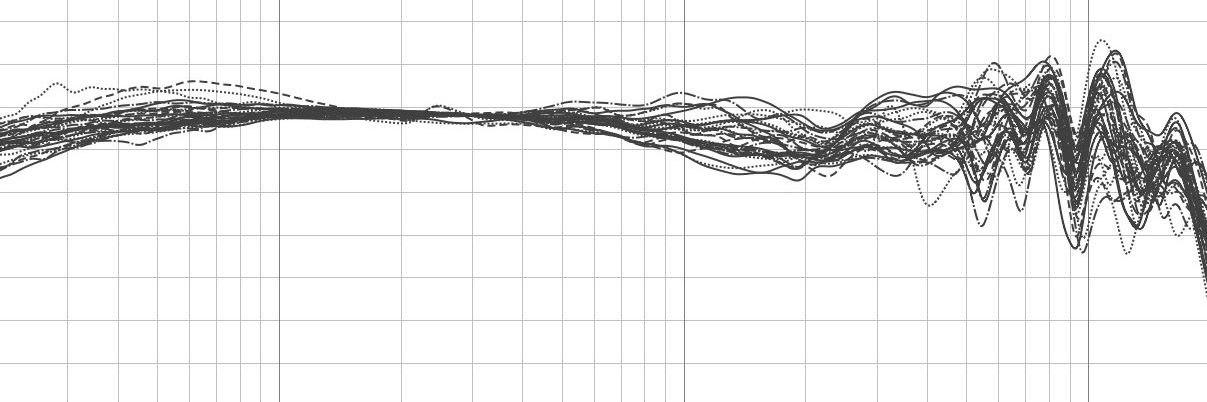

Legendary headphone engineer teams up with Drop
Intro:
The Drop x Grell OAE1 headphones are a collaboration between Drop and Axel Grell, one of the most respected figure in the industry, best known for his work on acclaimed models like the Sennheiser HD 580, HD 600 and HD 650. Let’s also not forget the HD 800 series, often praised for having one of the largest soundstages among headphones.
The OAE1 adopts an unusual design, placing the drivers at the very front of the ear cups and angling them toward the listener’s ears. This is meant to boost the sense of space in the sound. While other models, like the Beyerdynamic T1, also use angled drivers, the OAE1 takes it a step further with an even sharper angle.
Now, let’s dive into how they sound.
For the full suite of measurements, see the final section of the article.
Specs & Comfort
Price: US$ 350
Transducer size: 40 mm ø
Transducer type: dynamic
Sensitivity: 106 dB/Vrms @1kHz
Impedance: 45Ω @1kHz
Connector: dual 2.5 mm TRRS
Plug(s): 1*3.5 mm TRS, 1*4.4 mm TRRS
Weight: 275 grams
Clamping force: strong
Comfort: 5/10. Clamp force is too strong for long listening sessions. Also, not a lot of room for adjusting the headband: with the HD800 the optimal spot for me is about 4-5 notches, but I need to extend all the way down to the maximum with the OAE1 so that it won’t crush my skull.


Measurement & Sound

link to the frequency response measurement & more comparisons
Tonal balance:
Overall, the presentation come across as unnatural, both in terms of the timbre of instruments and also the way that the soundstage is presented. The thick, V-shaped tuning might suit genres like pop, rock, or simpler arrangements like country and folk. But with complex genres like post-rock or metal, it often sounds grainy and fatiguing.
The bass is generously boosted, with plenty of rumble and ample subbass presence. While it avoids being overly warm or muddy, the bass feels somewhat congested and lacks resolution, making bass lines harder to distinguish in busier tracks. Overall, the bass quantity is satisfying, but its quality could be better.
The biggest issue is in the mids. The OAE1 leans towards a thick, somewhat honky tone, especially with vocals in the higher registers. This could be due to the elevated upper mids contrasting sharply with a dip in the lower treble. This imbalance pushes mid-range instruments forward, adding a grainy quality to the timbre. In many ways, they remind me of an inferior version of the Ultrasone Edition 11.
In the highs, the OAE1 is not bright in general but noticeably uneven, giving certain instruments an unnatural tone. Violins, for example, can sound a bit flat, while snare drums and cymbals often come with some excessive glare, overpowering other elements in the mix. While the treble presentation might not come across as offensive or piercing, it lacks refinement and smoothness.
Other qualities:
Now, does the OAE1 deliver when it comes to soundstaging? I actually think it does, but unfortunately not in the most natural way. The extreme driver angling requires precise positioning on the head, and even slight misalignment can cause the imaging to tilt significantly to one side.
When properly worn, the imaging—especially with centre vocals—feels holographic, projected front and centre with a sense of space and directionality. However, it isn’t as realistic as you’d experience with speakers. There’s a somewhat artificial “three-blob” effect, where the front image is sharply defined, while sounds on the sides tend to blur together, lacking clear separation and layering.
In terms of clarity, the OAE1 also falls short. The timbre often come across as slightly “forced” lacking fine texture. This is the case when compared to headphones of similar price like the Hifiman Sundara or the Senneheiser HD600, which offer a much more coherent and detailed presentation across the spectrum.
Conclusion and value:
Priced at US$ 350 / AU$ ~530, the OAE1 falls short of expectations as a mature product. While I respect the effort to bring innovation to headphone design and taking risks with such a distinctive model, the OAE1’s overall sound quality leaves me wanting. In fact, I’ve held off on reviewing this personal unit of mine for some time, which speaks for my disappointment.
Though the OAE1 might appeal to collectors as a limited edition model with unique designs, the current market offers better options in both sound and build at its price. While future demand for a discontinued product may boost its appeal, my review focuses on what’s available today. At present, I find it difficult to recommend the OAE1 based on what it offers.
Pros: Unique driver design offers a front-and-centred vocal image; Bass-heavy and mid-focused tuning may suit certain modern genres
Cons: Underwhelming technical performance overall; Imbalance in tuning causes distorted instrumental timbre; Finicky fit; precise positioning needed for optimal sound
Value Grade
Notes on EQ
While EQ adjustments can often help to address a headphone’s tuning issues, achieving effective EQ with the OAE1 is particularly challenging due to its sensitivity to head positioning, which causes noticeable frequency response (FR) variations. For this reason, it’s best to create an EQ profile based on your own listening impressions.
For those interested in a starting point, I’ve found that reducing the 4-5kHz range and slightly lowering mid-bass frequencies yield the most improvement. Adding a small boost in the mid-treble around 6-7.5kHz can also help balance out the highs.
MEASUREMENTS
Frequency Response Average (unsmoothed):
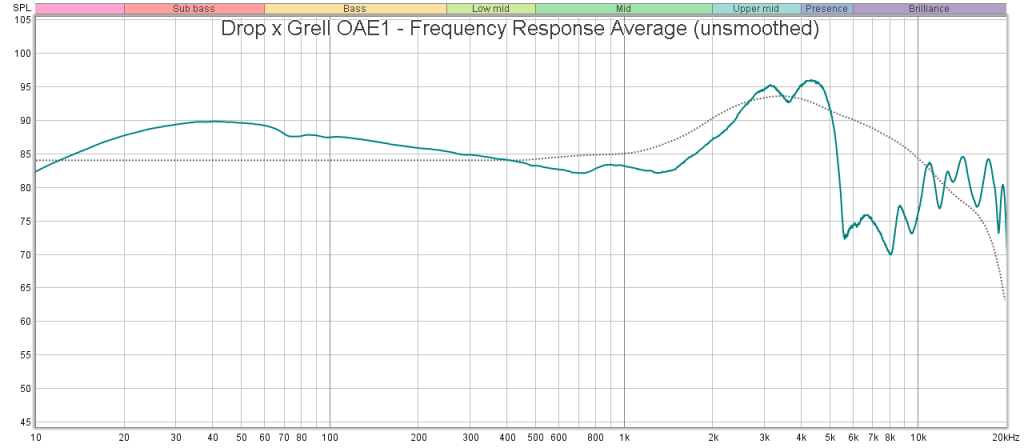
The response is obtained by an average of 5-6 positional variations. The FR shown on the graph is unsmoothed.
Positional Variation:

This graph illustrates how headphone placement on the head affects perceived tonal balance: with the ear positioned at the front (blue), centre (green), and back (red) of the driver. The FRs shown on the graph are unsmoothed.
Note: it is no surprise that given the extreme driver angle design of the OAE1, the perceived sound can vary significantly when you wear it at different positions. Personally, I prefer to wear it with my ears sitting at the back side of the ear pads.
Leakage Tolerance:

This graph demonstrates how leakages to the front volume can result in FR change. The FR shown on the graph is 1/12 octave smoothed.
Impulse Response:

The impulse response test measures the initial response, overshoot, and decay of a transducer upon receiving a signal.
Channel Matching:
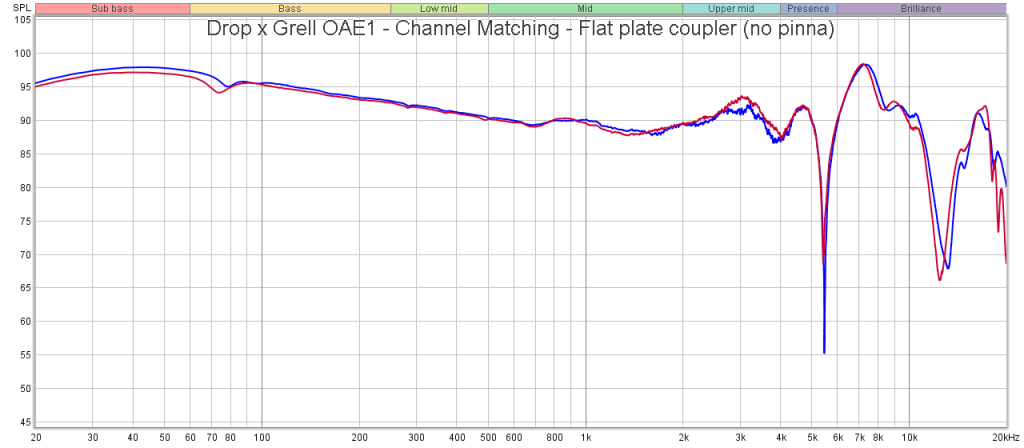
Channel matching graphs do not relate to the perceived sound profile. A specialised configuration is used in this test to capture differences between channels, mitigating interference from positioning on the rig and the asymmetry in the GRAS pinnae design, a legacy of KEMAR. The left (blue) and right (red) channels are measured using a flat plate coupler with an IEC60318-4 ear simulator.
Electric Phase & Impedance:
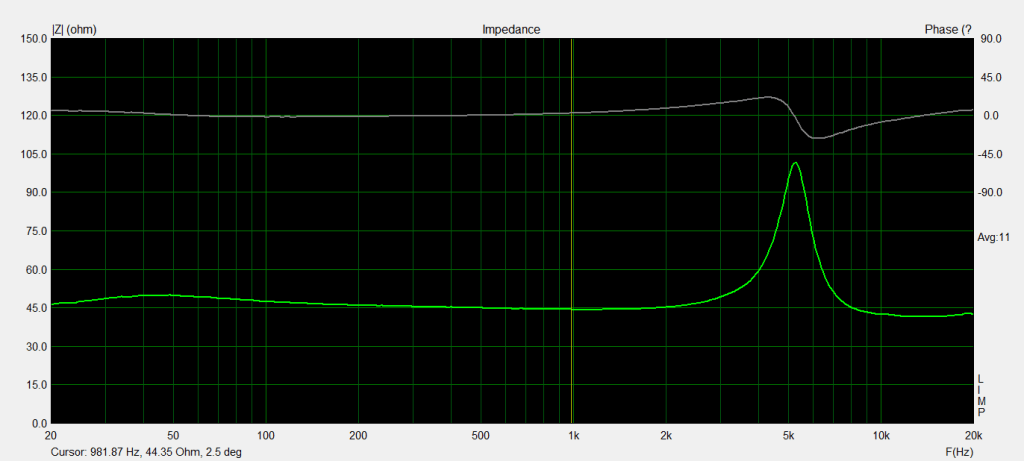
The above graph shows the measured impedance (green) and electric phase (grey).
Note: The OAE1 displays an unusual impedance peak around 5.5 kHz, meaning this frequency range will experience a noticeable boost when paired with high output impedance sources. Due to this, it is not recommended to use the OAE1 with traditional OTL tube amps or other high-output impedance amplifiers.
END OF THE ARTICLE
Disclaimer: This review is not sponsored or endorsed by any business or related entity. The headphones reviewed are my own unless stated otherwise. Any links or recommendations included are purely informational and do not involve any financial affiliation or endorsement on my part.

Drop does it again
LikeLike