
Intro:
I’ve heard about the Sennheiser HD820 for quite some time. But, perhaps like many of you, I have been shying away from them due to most reviews seeming to bash these for having one of the wonkiest tonalities. The consensus seems to be that Sennheiser dropped the ball with this closed-back high-end offering.
Fate intervened when a generous reader reached out and offered me the opportunity to test the Sennheiser HD820 for myself. I seized the chance to see what all the fuss was about, whether these are truly a misstep or perhaps a misunderstood masterpiece.
So, shout out to this gentleman, who made this review possible. With a mix of excitement and skepticism, I began on my listening of the HD820.
Overall impression:
To be honest, the default tuning of the HD820 is not to my taste.
Bascially, you have a wild bass boost that often result in a congested low-end. Yes, the sense of punch and impact is great, but with most types of music, it’s a bit too much to take. The midrange, while seemingly quite neutral on FR, has a distinctive ‘honky’ feel to it. This can be explained by a tonal imbalance – there’s a relative lack of lower-mids and lower treble, which causes the chesty and nasal tones (800-1500Hz) to stand out. The treble timbre is mostly fine – not overly forward or withdrawn, while being smooth and generally not peaky.
But there’s a catch… Now, I don’t normally evaluate headphones with EQ, but I think it does make sense in some cases. Compared to open-back headphones, it seems that manufacturers often struggle to tune closed-backs nearly as well. Luckily, the HD820 are technically proficient headphones with an exceptionally wide soundstage and decent clarity across the board. So, with a bit of EQing (well, maybe more than a bit), the HD820 can be transformed into a great-sounding pair of closed-back headphones that can suit certain use scenarios.
Let’s find out more.

link to the frequency response measurement & more comparisons
Tonal balance
Bass:
Without EQ, the bass on the HD820 sounds outright bloated, overpowering the other frequencies. Moreover, even though there is a large dip at around 300Hz, it’s so swollen that midrange images can often sound ‘bigger’ than it should. The kick drum always come across as overly accentuated and tinted with extra reverbs, resulting in a wonky bass tone balance.
By comparison, the Fostex TH900, sharing an abundance in bass quantity, has a tighter and punchier stock tuning. The bass boost tapers off gradually from the sub-bass to the upper-bass, so the overall presentation is cleaner and less boomy.
However, things do improve considerably with EQ. All you need to do is tweak the bass boost so that it’s tighter. I’ve found that reducing 140Hz by 7db with a Q factor of 1.0 does the job nicely. After EQ, the bass sounds fast, punchy, and very dynamic. It still may not beat the Focals or the Fostex, but it’s getting very close.
Mids:
The midrange on the HD820 is a bit of a mixed bag. On the one hand, female vocals mostly sound enjoyable, if a bit forward leaning. On the other hand, some tracks where vocalists frequently use their chest and nasal resonance may come across as overly ‘thick’. At times, it almost feels as if the vocalist is singing with a cold.
EQ once again plays a significant role in salvaging the midrange tone, but there’s a caveat: the dip around 3-4kHz can be very difficult to get rid of entirely. This type of dip is commonly seen in closed-back headphones and is often associated with phase cancellation of sound waves by the back enclosure. Using a steep filter might elevate it somewhat, but the dip tends to linger despite significant gain.
The good news is that by reducing the 800-1500kHz range, you can mostly eliminate the nasal quality found in vocals. The end result is a generally smooth midrange, albeit with a slightly ‘softened’ sense of grain and attack due to the effects of the 4kHz dip.
Treble:
Speaking of the treble in isolation, it is perhaps the strongest aspect of the HD820. Generally clear and smooth, there’s no significant peaks and dips. Unlike its open-back counterparts, the HD820 doesn’t suffer from the infamous 6kHz peak. Instead, it is well-controlled in the sibilance range, which is a bonus for listening to pop and rock genres. The upper treble might be slightly emphasised in the sparkle and air region, but it’s not pronounced enough to be labelled artificial or piercing. However, percussion instruments do tend to stand out a bit in the mix, given the bass boost and the relative emphasis on upper treble.
The bottom line is, I can listen to the HD820’s treble without EQ, although it would still benefit from some adjustment. As the perception of treble varies a lot among individuals, it’s advisable to apply EQ where you feel adjustments might be needed, using familiar tracks as a guide. Personally, I apply one steep filter to remove about 3dB of excess energy at 10kHz, and that’s all that’s about it. Even with the peak at 10kHz, it’s far less jarring than what I experienced with the Sony MDR-Z1R.
Other qualities:
- Soundstage and Imaging:
- The soundstage of the HD820 is very good, even without EQ, a quality that is perhaps anticipated since the HD820 uses the same construction as the legendary HD800. Despite being a sealed headphone, its large front volume still imparts the feeling of a vast and open acoustic space.
- Horizontal stage, in particular, is very wide and open, allowing sound images to come across as expansive and diffused. In this regard, the HD820 outperforms the average closed-back headphone, like the Radiance or the Z1R.
- The sense of airiness and the natural feel of the stage is not quite on par with its open-back counterparts, something that is perhaps expected due to the enclosure.
- Stage depth, similar to the HD800, is acceptable but not outstanding. There is a clear sense of layering between instruments within the space, but the sound images can sometimes appear ‘larger’ than they usually are with other headphones.
- Clarity:
- Despite the uneven tonal balance, the HD820 offers a decent sense of clarity even before EQ. However, the boomy bass can be quite distracting, and the imbalance between the lower and upper mids can adversely affect the vocal texture.
- While it may not surpass headphones like the Fostex TH900 or its own open-back counterpart, the HD800S, the overall resolution and clarity of instruments are still a cut above mid-fi dynamic driver headphones (e.g., Beyer DT700 ProX, Denon D5200, EMU Teak).
- With EQ, clarity improves notably, elevating the HD820 to a level where it might rival mid-fi planars such as the Audeze LCD-2. The persistent 4kHz dip remains an issue. Consequently, some instruments and vocals may at times lack the fine textures.
- Dynamics and Impact:
- Despite the abundance of bass, the sense of impact on the HD820 is average. Granted, it provides a more tangible sense of punch than typical open-back dynamic headphones like the HD800S or the Beyerdynamic T1.
- However, in terms of dynamic contrast, I still feel that something like the TH900 and the Focal Clear are on another level. The HD820’s performance in this aspect is roughly on par with the Focal Radiance.
- With EQ, both the bass texture and the sense of dynamic contrast see a improvement. This is understandable, as the default tuning emphasises the upper bass portion, which often translate into muddiness and a congested bass.
Conclusion and value:
With an RRP of US$1699, I find it difficult to recommend the HD820 without reservations. But, there are exceptions. If you understand what the HD820 aims to achieve, it may be the right fit. In my opinion, these headphones are designed to fill a niche – appealing to those who are proficient with EQ and in search of a high-quality closed-back set with exceptional soundstaging capabilities. The overall level of technical performance is respectable, particularly after some simple EQ adjustments.
If you are not one of the EQ crowd, I suggest looking elsewhere, as the default tuning is… simply too weird. If sound leakage isn’t a major concern for you, the Fostex TH900 or the EMU Teak might be more well-rounded options with excellent punchy bass. If passive isolation is a priority, consider the Sony MDR-Z7M2, often available at significantly discounted prices, though the soundstage and clarity of the HD820 remain superior.
That said, it’s worth mentioning that the HD820 is very well constructed, as one would expect from a high-end Sennheiser product. Its comfort is also outstanding, thanks to the lightweight design (360g) and well-thought-out ergonomics.
So there you have it. If you have a penchant for massive soundstage, are in the market for a pair of closed-back headphones with great technical performance, and you’re willing to tinker with EQ, the HD820 might be exactly what you’re looking for.
Pros: excellent soundstage despite being a closed-back; decent treble tone and clarity even without EQ; overall sound profile is easy to EQ; passive isolation;
Cons: imbalanced stock tuning that require adjustments; skewed mid-range tone; bass tends to overpower lower-mids making it sound congested; pricey;
MEASUREMENTS
Frequency Response Average:

note: bass extension cutoff is 10hz instead of 20hz on the extende frequency response measurement, so as to fully capture frequencies which though may not outside of ‘audible range’, may be felt by our ears, bones and muscles and enhance the sense of ‘impact’.
Positional Variation:
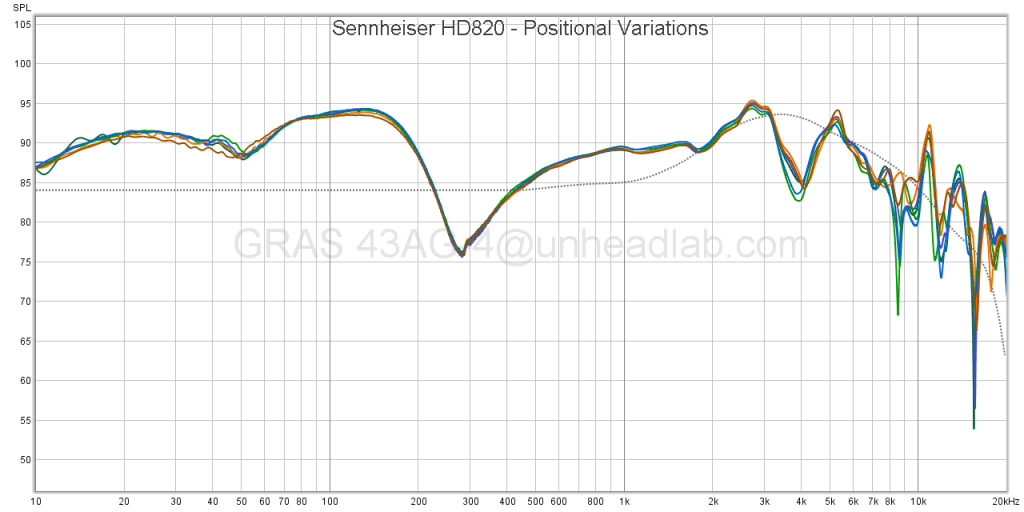
note: this graph shows how the tonality might be affected when you wear the headphones differently on the head.
Leakage Test:

note: this graph demonstrates how a small leakage (simulated using thin-armed glasses) can result in FR change.
Impulse Response:

note: impulse response contains information about transducer movement when a test tone is played.
Channel Matching:

note: channel matching graphs DOES NOT RELATE TO SOUND PROFILE.
a specialised configuration is used to capture channel differences to mitigate the interference from positioning on rig and the asymmetricity in GRAS pinnae design (legacy of KEMAR).
the Left (blue) and Right (red) channels are measured on a flat plate coupler with an IEC60318-4 ear simulator.
END OF THE ARTICLE
Disclaimer: all the headphones tested here are my personal units unless otherwise stated. All the links and recommendations provided are not associated with me in any financial manner.

Can you share your EQ settings?
LikeLike
Hi mate, sure! This is what I used with EqualizerAPO with the Peace GUI. It’s pretty preliminary but IMO improves the tonality by a lot already. So if you want, use it as a starting point and fine tune it to your liking:
Preamp: -6.0 dB
Filter 1: ON PK Fc 50 Hz Gain 2.0 dB Q 2.000
Filter 2: ON PK Fc 140 Hz Gain -7.0 dB Q 1.000
Filter 3: ON PK Fc 300 Hz Gain 5.5 dB Q 2.000
Filter 4: ON PK Fc 900 Hz Gain -3.0 dB Q 1.300
Filter 5: ON PK Fc 3900 Hz Gain 5.0 dB Q 3.000
You can simply copy and paste it into a txt file then import it via Peace.
LikeLike