
Intro:
The Sundara, as with the HD6XX reviewed earlier, is another headphone so popular in the community that it can serve as a good reference point for the reader to understand the reviewer – if the reviewer hears similarly to you, or if the reviewer holds different position to the assessment/value of the headphone. For this reason, the Sundara is reviewed ahead of many other exciting products like the Venus and the Nan-7.
Overall impression:
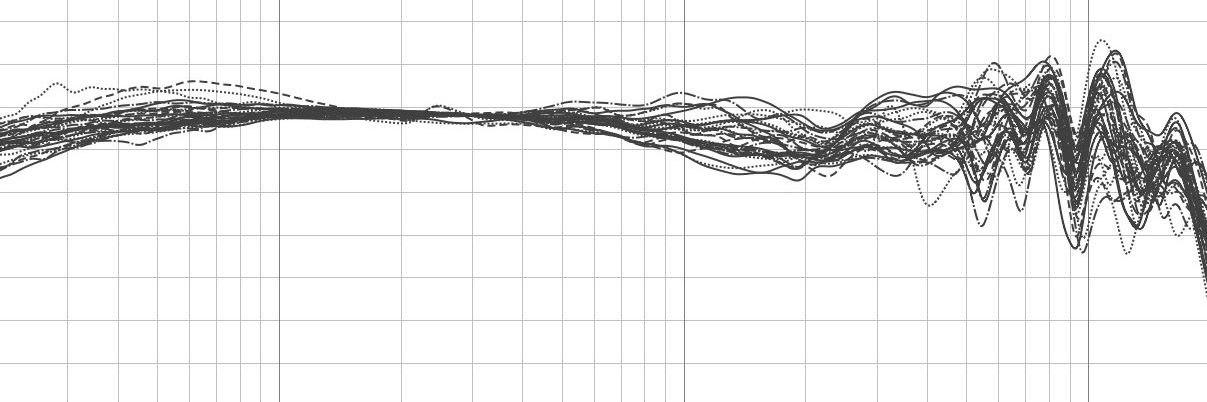
Balanced sound signature with a clean presentation that may occasionally come across as just a little dry. Comparing to other neutral references like the HD600/650, the Sundara sits more on the ‘clinical’ side of neutrality than the fuller and warmer version on the former. A sine sweep on the head reveals no major treble peaks aside from that at the last octave. Small peaks are audible at around 6.2khz and 8.3khz.

Tonal balance
Bass:
Nimble bass with great speed but mediocre punch. More like ‘whips’ than ‘thumps’. Subbass extension or rumbles in the bass is not the most impressive where many planars go all the way down to 10hz. Slam is not as hard as typical dynamic headphones even those with more roll-off in the subbass. Maybe this has to do with the single-ended magnet design where the control of the diaphragm is relatively weaker comparing to double-sided ones. There is howver a slightest hump around 50hz which gives the Sundara bass a structural emphasis, similar to the effect of a very small air-gap resonance on planar drivers.
Mids:
Clean and neutral if slightly on the clinical side. Reproduction of mid-range instruments like the oboe or the viola are exemplary. A little more bass may help to enhance the body of these instruments, if one had to nitpick. Hifiman planars typically lack 1-3khz energy but the Sundara 2020 only shows a minor scope in this region. As such, vocals and electric guitars do not sound distanced nor overly polite.
Balance between the body and the clarity of vocals is good. Male vocals generally have enough body, but if you’re used to the dynamic headphones where there is often some degrees of mid-bass hump, you may feel the Sundara renders vocal in slightly leaner fashion. Consonant tones in female vocals are mostly clear but not grating, though tracks like Adele’s ‘Chasing Pavements’ may come across as a little dry due to having more 2-5khz energy therefore ‘bite’ and ‘attack’ in her voices in this song.
Treble:
Leaning to the brighter side in subtle ways. Upper treble may offend some depending on your personal HRTF and taste (music genre). Not sure if it is caused by the series of small peaks in its treble response, the effect of the 14khz upper treble peak, or a hidden 9khz peak concealed by the interaction with the measurement rig’s pinna (which means if your pinna shape is vastly different to the GRAS pinna, you may hear a peak in this region). It could be a combination of the factors too. Instruments are mostly authentic. Triangles and ride cymbals, for example, have just the right amount of energy without becoming irratating.
Vocals is another story. Sibilance with female vocals are generally inoffensive, but it could be the case if the recording is mastered poorly. It is not uncommon pop recordings have accentuated upper treble as music producers may compensate for consumer-grade headphones/speakers where there is a lack of treble extension. An analogy is when there’s a strong sibilance peak (especially those centred around 10-12khz), the Sundara tends to give you a ‘paper cut’ – not as substantial but still clearly perceptible.
Other qualities:
- space and stage: near-field presentation of vocals and midrange instruments, not claustrophobic, but certainly not wide and open like the Ananda/HD800 level. Stage width or horizontal boundaries can be pushed quite far away. Depth of field (ie. positioning of instruments in an orchestra) is mediocre. One complain may be that they do not sound very expansive or grand, but this is arguably a harsh criticism given its excellent tonality not exaggerating any frequencies.
- clarity and imaging: decently resolving in the sense that instruments are well separated without being fuzzy. Imaging is a seldom mentioned strong point. Perhaps this has to do with the advantage of being single-sided where there is less interference with the sound waves from the magnets. However this is often overshadowed by its merits in FR, which I think is a bit of a shame.
- dynamics and impact: middling performance. Kick drums have decent speed, but slam is not particularly impressive. Contrast between strong and weak notes isn’t scarily realistic but nor is it compressed either. Just enough to be ok.
Conclusion and value:
The Sundara may be referred to as an example of ‘planar neutral’ where there is discernibly more upper treble and air than typical dynamic driver headphones. In the case of the latter, there is usually more internal damping along with much thicker diaphragm that tend to inhibit a linear reproduction of the higher octaves. Note however this does not mean dynamic headphones neccessarily lack upper treble. Instead, it has more to do a natural and smooth reproduction of higher notes without annoying peaks. Comparing to Hifiman’s more expensive models like the HE6SE or the HE1000, the Sundara treble isn’t as sharp, and as a result, some may complain, ‘less detailed’.
At an RRP of $300USD, the Hifiman Sundara are of great value. There is no serious flaws or drawbacks whether in tonality or technicalities.
Pros: clean and resolving with excellent midrange tone and nimble bass; great value.
Cons: some may find the highs a little dry; overall presentation a bit on the clinical side; lacking serious punch or the wow factor.
Extended Frequency Response:

Positional Variation:

Impulse Response:

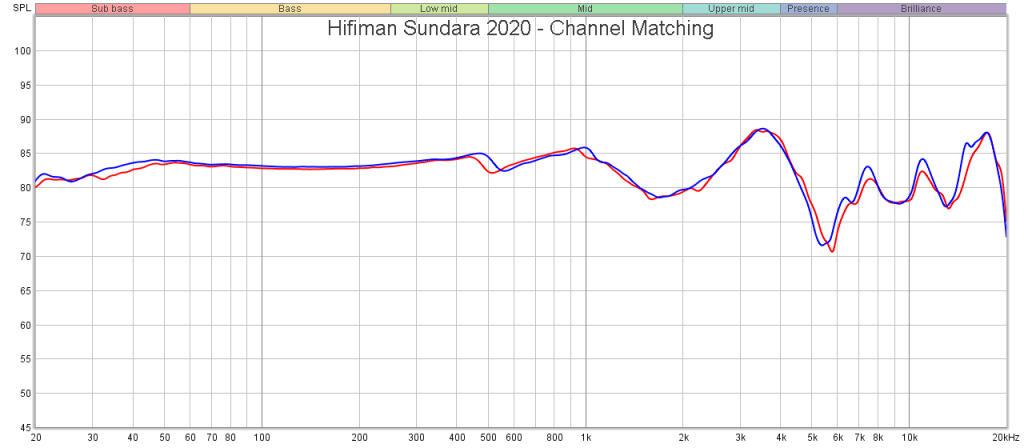
Channel Matching:
Upcoming:
The Sundara review goes first for a few reasons. Most importantly it sets a good benchmark for what is to be expected from mid-fi planars and up, in terms of both sound and value.
In the articles to follow, we will talk about how the Moondrop Venus and the Nan-7 headphones fare against the Sundara.

