
First electrostatic headphone here. The ESP95X is the Drop version of Koss flagship ESP950 at a much more affordable cost, not least amonst estats which can easily cost you a few grands a pair. This is not to mention the 95X comes with an amp as part of the package. Given the cost the build of the 95X is a bit flimsy and cheap feeling, although our main concern here is, do they sound good?

Overall Impression::
Liquidly smooth mids with fast bass and airy treble although vocals can sound honky at times. Great for relaxed listening given its non-fatiguing sound profile.
Tonality:
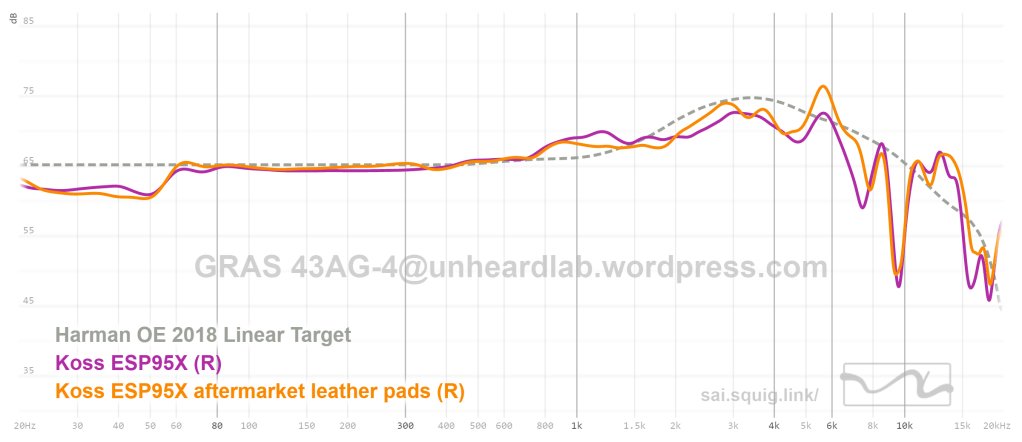
Dark-ish neutral, but still not quite dark in the usual sense. Not exactly ‘warm’ either as bass is on the light side and there is no excess in upper bass amount that would otherwise make headphones sound wooly and warm. Most of the colouration is with the mids: there is a relatively large bump between 500-1500hz that generally make vocals a bit ‘honky’ and ‘boxy’ sounding as this is the frequency range that contributes to the nasal cavity resonance. The upside is that vocal texture is extremely clear and pronounced. Above that upper mids and treble dip down a bit so that midrange vocal and instruments are slightly laid-back and ‘romanticised’, like there is less grain or attack. Mid-treble and upper treble energy are spot on with enough sparkle and air. Bass while is quite linear overall is a bit light in amout. These do not have the hefty bass that Harman target lovers…love. The roll-off below 60hz sounds somehow earlier than that which might have been caused by less than optimal seal when actually worn.
Technicality:
Defintely much better than their price class for less than $500. Lightning fast response not only in the treble but also the bass. They may not slam the hardest but there is a good sense of impact thanks to tight and precise presentation. Macro contrast is not class leading but far better than some overly damped planar headphones. Layering and separation is another strong point where I can comfortably say they outclass the Focal Elear/Clear or similar mid-fi cans. With planars it is however a tough call: Hifiman planars tend to be much brighter than these so there may be the influence of ‘fake detail’. The Audeze LCD2 also comes to mind, but as is well known the potential of this headphone is severely limited by the default tuning/pads. Soundstage may be the weak point here: these are slightly better than the HD6XX but not by far. Images are quite closed-in and there isn’t a very clear sense of depth. But while the stage size isn’t the biggest there’s nonetheless a natural sense of air and transparency, perhaps due to driver tech and its very linear treble response.
Verdict:
Reasonably neutral tuning plus solid technicalities. Awesome price-performance ratio makes the ESP95X one of the best options in the sub $500 catergory, not to mention they come with a dedicated amp so you don’t need to worry about pairing. A safe choice when one wants to dabble in the electrostats scene.
Pros:
Smooth mids; vocal texture; easy to listen; air; speed; solid technicalities
Cons:
Colouration in the mids; bass weight; not the widest stage
Pads:
Stock pads are made of velour and non-memory foam. There are cheap aftermarket protein pads for these one can easily find on Aliexpress and Taobao.:

Obviously a step up in terms of compliance to the target (basically Harman Over-Ear 2018 target curve without bass shelf). I like how these ameliorated the 1khz bump colouration. Vocals are clearer, but slightly leaner and less laid-back. They do however take away some of the romanticised feeling, so that the mids are more linear and perhaps more faithful to the recording. The rest is pretty similar to the stock sound. Basically, this is a more linear and slightly brighter version. Subtle differences in the bass is mostly due to coupling differences between velour and protein construction.
Decay is also faster with the protein pads, which is kind of expected. As a result there’s less of a ‘fuzzy’ character to the bass and mids, although it’s not night and day. The sense of space and stage is also a little more distinct with the protein pads, also perhaps due to the more linear treble response. Classical music like symphony pieces come across as clearer and more open with the protein pads, whereas the stock velour pads tend to create a more ‘in the room’ feeling with slower decays.
17/Apr/2023 update: aftermarket leather pads