Intro:
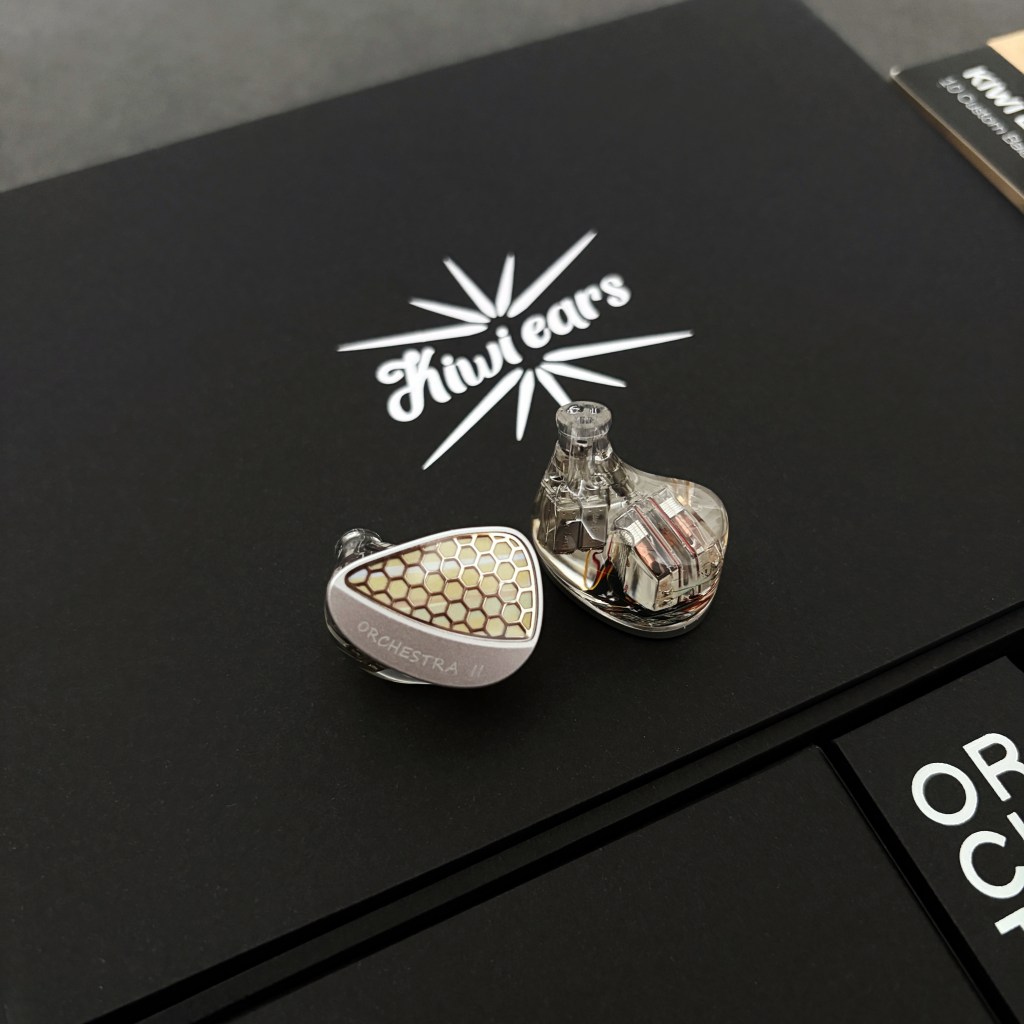
Kiwi Ears sent the Orchestra II over for review, and it was one of those IEMs that caught my attention before I even plugged it in. Part of that is simple enough: I think it looks good. Part of it is that Kiwi Ears has generally been pretty solid when it comes to tuning. But mostly, it was the name. ‘Orchestra’ is a bold label for an IEM.
After spending time with it, I can say the name is not just there for show. This is not really a do-everything all-rounder. It has a clear point of view, and with the right music, it works very well.
Detailed measurements can be found in the final section of this article.
Disclaimer: This unit was kindly provided by Kiwi Ears for review. There are, however, no strings attached to the content.
Specs & Comfort
RRP: $349 USD
Driver(s): 10 balanced armatures, 4-way passive crossover
Nozzle size: 6.1 mm (tip)
Sensitivity: 114 dB/mW @1kHz
Impedance: 15 Ω at 1kHz
Weight: 7 grams ea.
Connector: 0.78 mm 2-pin
Cable: 1.2m modular (3.5mm & 4.4mm)
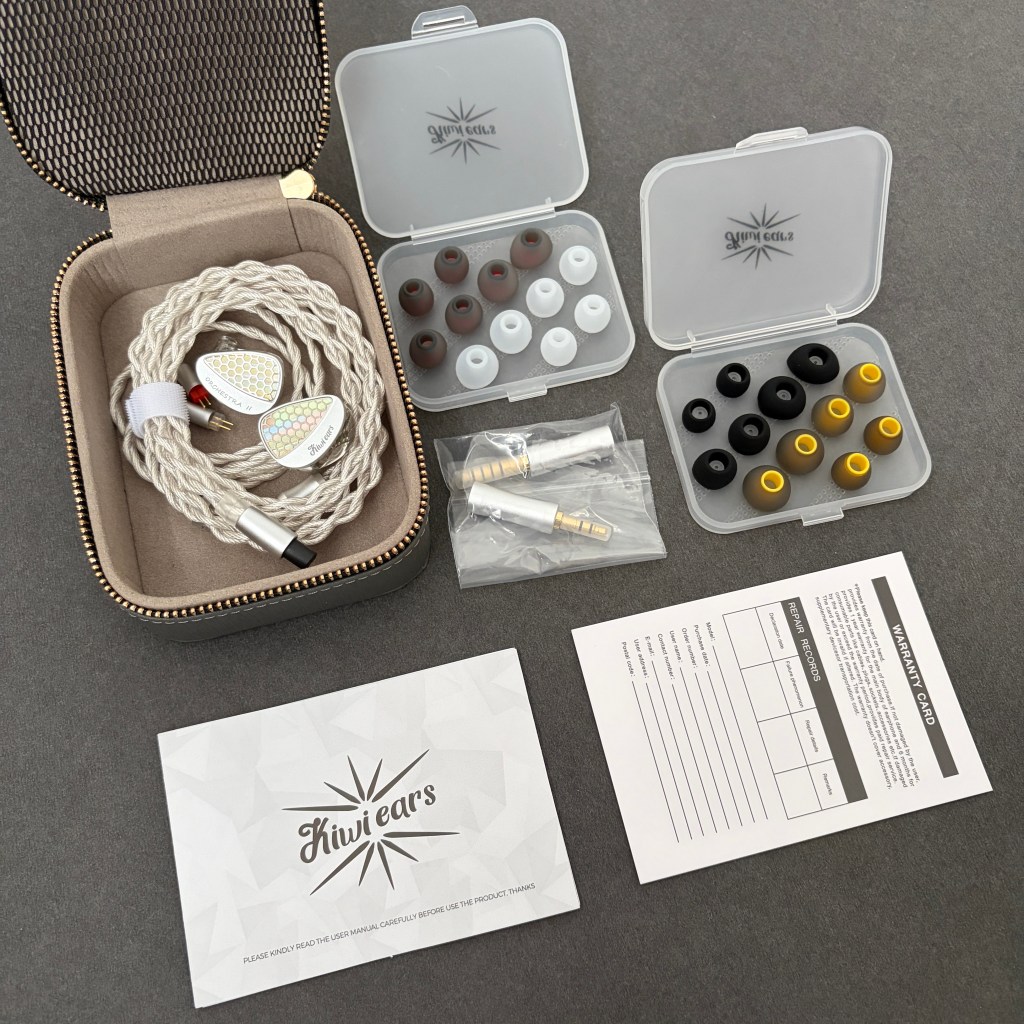
Accessories: carrying case, multiple ear tips
Build and Comfort:
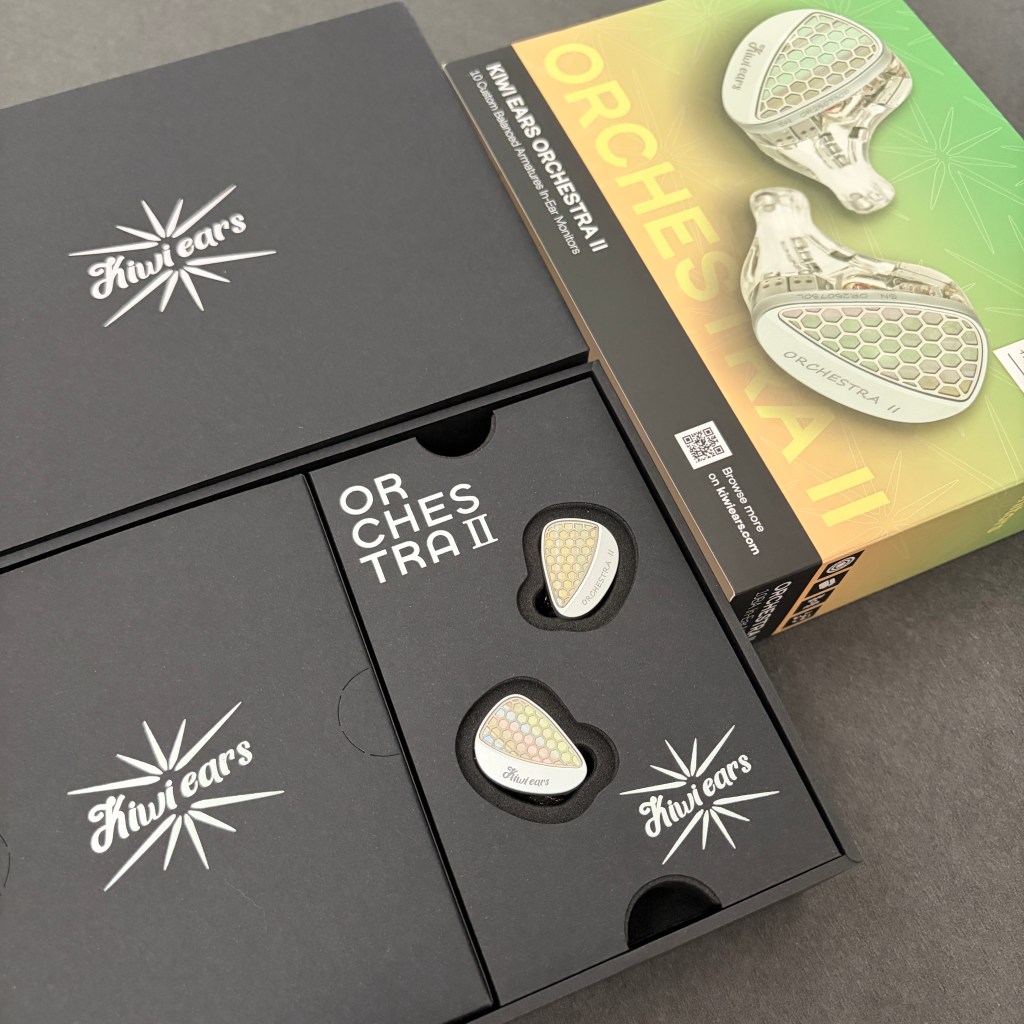
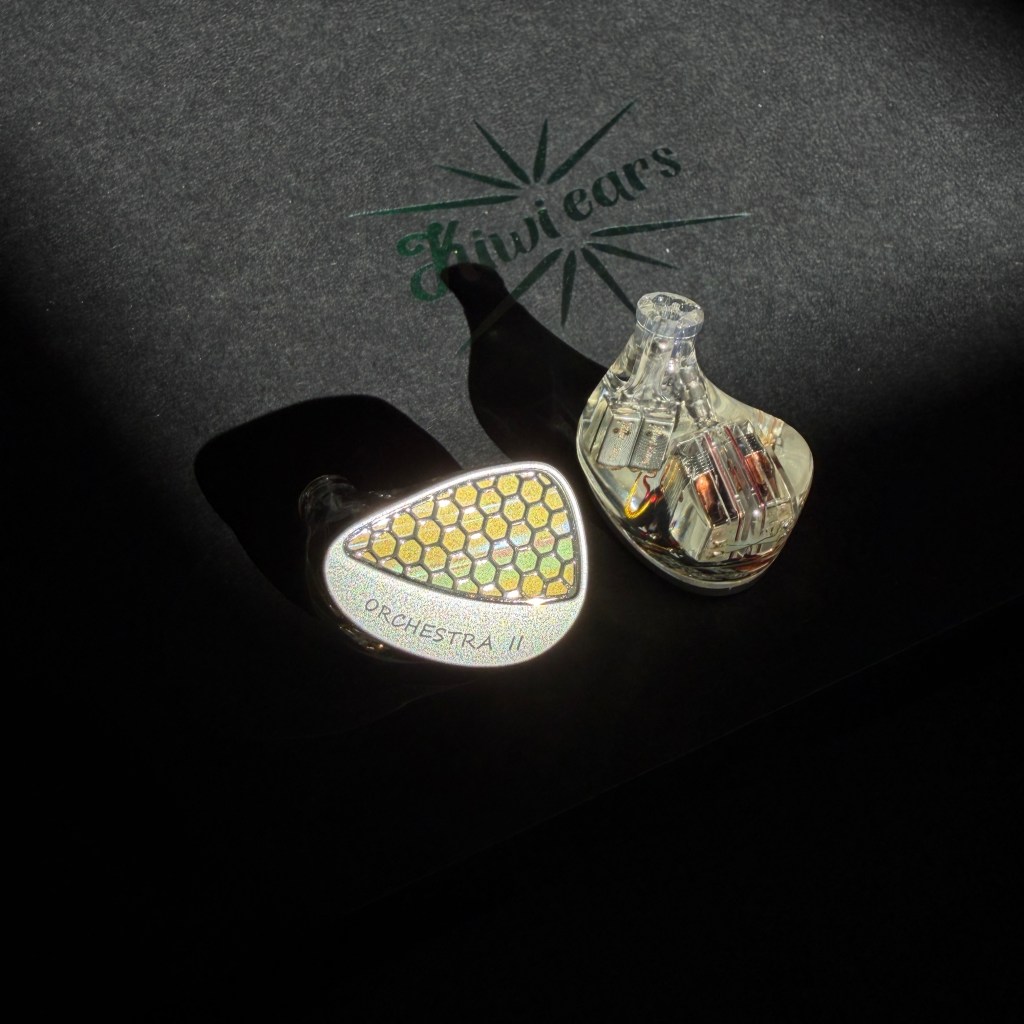
Build quality is very good. The shell manages to come across as clean and premium rather than overly flashy. If anything, I would have preferred a more refined font choice on the faceplate, as it feels a bit out of step with the more polished typography used elsewhere in the packaging. The stock cable also deserves a mention, as the modular plug system is useful and helps the overall package feel more complete.
Comfort is average. The shells are on the larger side, even though the ergonomic shaping helps. They sit securely enough and feel well-made, but if you prefer very compact shells, these may stick out a bit more than ideal.
Sound
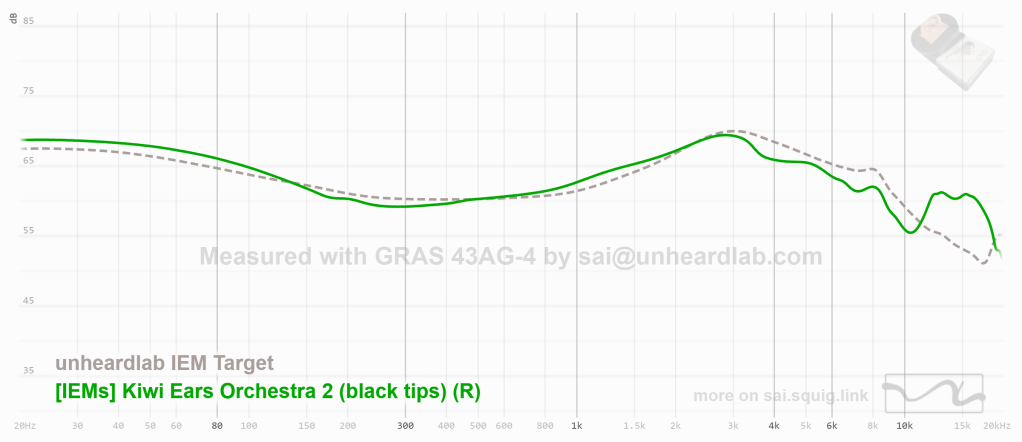
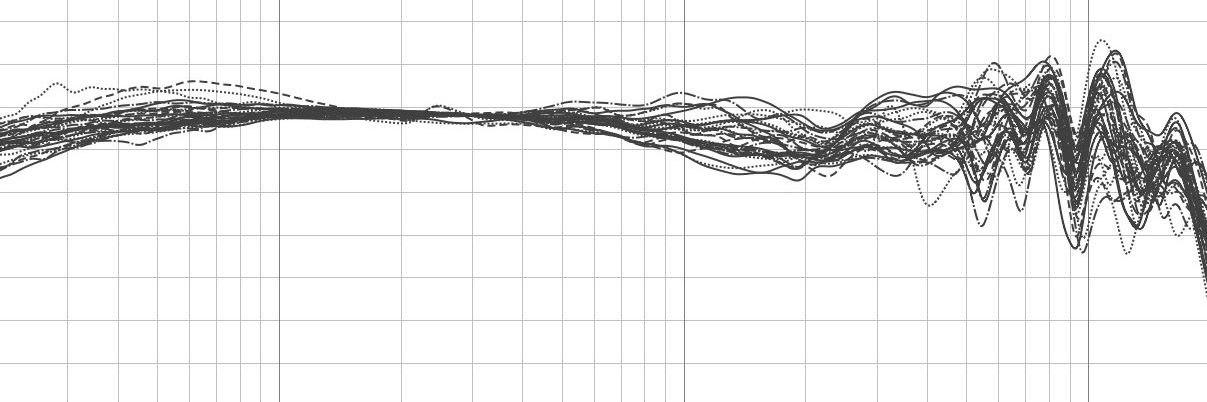
For more comparisons, visit my squiglink database.
Impression:
The Orchestra 2 has a crisp, clean, and airy presentation. The treble lift is concentrated in the upper treble roughly 10kHz, which gives the sound extra air and sparkle. That added brilliance can sound appealing with the right material, but it also brings a slightly unnatural, shiny quality to the presentation at times.
The 6-8kHz mid-treble itself does not sound overcooked. Instead, it feels fairly well judged, and to my ears sits more or less where it should. So while the Orchestra 2 can come across as bright, it is not really because of an aggressive lower or mid-treble peak. The sense of brightness is more about that uppermost treble lift, which adds openness and sheen rather than outright sharpness.
This also means vocals are handled better than the overall tuning might suggest. Despite the added air up top, sibilance is generally kept in check, and vocals come through clean and natural without sounding overly sharp or forced.
The overall tuning choice gives the Orchestra 2 a breathy, airy, somewhat ethereal quality. Cymbal rides have a crisp, lively shimmer, and there is a nice sense of space around strings and other upper-register instruments. Violins in particular come through focused and well-defined, with clear positional cues and strong separation that suit acoustic recordings very nicely.
The upper mids are also a little forward, which is hardly unusual for modern IEMs. In some cases, this can make the timbre sound tinny and thin, but here it works quite well. It gives midrange instruments a more immediate presence, helping them step forward in the mix with better articulation. Brass instruments especially benefit from this. They sound energetic, vivid, and well outlined, without tipping into harshness or fatigue.
The low end is quite respectable for an all-BA set. Timpani has decent rumble and impact, and lower-register instruments like cello and double bass carry enough body and texture to avoid sounding thin. It is not a bass-heavy presentation, and quality of bass is average, but it does enough to support the rest of the tuning.
Separation is one of the Orchestra 2’s stronger points. Complex passages remain easy to follow, and individual lines are presented with good precision. Staging is a bit better than average for an IEM, but still not especially wide or deep. Despite the airy and open presentation, the forward upper mids and emphasis on clarity tend to keep the image more compact and IEM-like rather than expansive.
This has some consequences for how it presents larger-scale music. While it can handle orchestral works reasonably well, and arguably much better than a lot of IEMs. Still, it does not quite convey the full sense of space and layering you might expect from headphones or speakers. In that sense, it feels more at home with smaller-scale classical pieces. Chamber works, string quartets, and more intimate arrangements come through especially well, as do concertos with a tighter focus such as violin or piano concertos, where separation and articulation matter more than sheer scale.
Conclusion:
At its $350 USD list price, the Kiwi Ears Orchestra 2 lands in a very crowded part of the IEM market, up against sets like the Moondrop Blessing 3 at $360, Softears Volume S at $320, not to mention more aggressively priced options like the CrinEar Daybreak at $170, which compete in a similar space sonically.
That means the Orchestra 2 does not really win by being the safest or most broadly tuned option. Instead, its appeal is that it sounds deliberate.
The crisp, airy presentation, the extra upper-treble brilliance, and the strong separation give it a clear identity, and one that works especially well for instrument-focused music. The shiny edge up top means it will not be for everyone. But for those who look for a more focused sense of clarity, the Orchestra 2 holds its own very well as a coherent and purposeful tuning.
PROS:
+ Crisp, airy, highly articulate sound
+ Excellent imaging and instrument separation
+ Good bass texture and rumble for an all-BA IEM
CONS:
– Boosted upper treble can drive some away
– Not the most versatile tuning
– Price bracket is highly competitive
Value Grade:
MEASUREMENTS
Frequency Response (measured on IEC 60318-4 coupler):
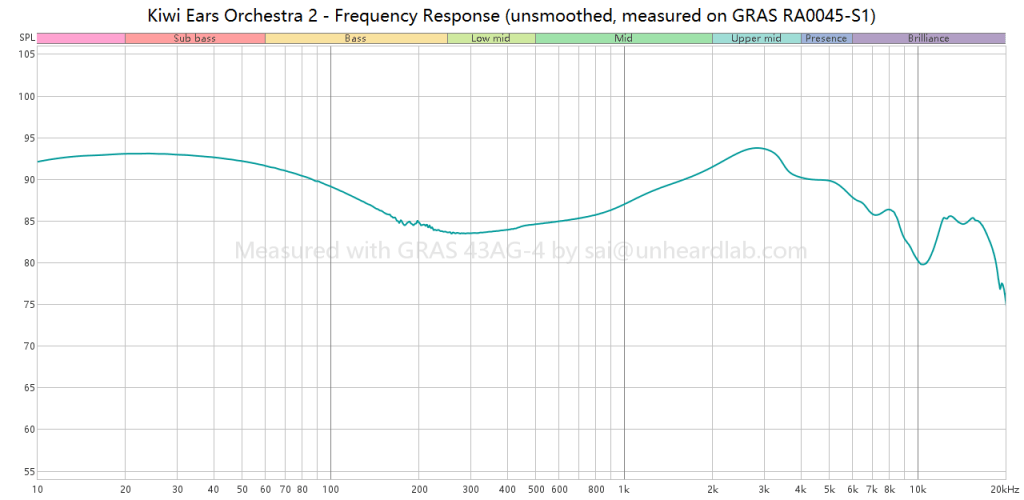
The measurement was made with a GRAS RA0045-S1 ear simulator fitted with the stainless steel ear canal extension (GRAS GR0408). Insertion depth was controlled so the length mode resonance appears at approximately 8 kHz.
Bore Size on Frequency Response:
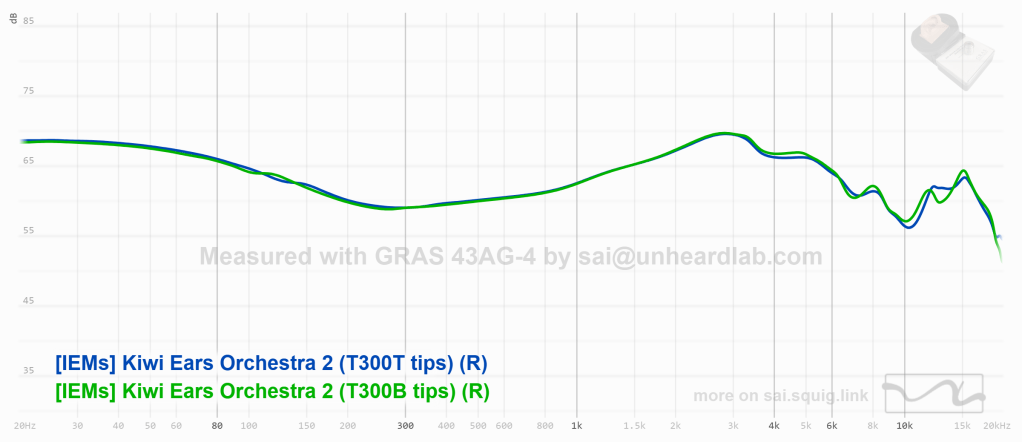
This graph illustrates the effect of ear tip bore size on the measured frequency response. Measurements are taken with Tanchjim T300 series tips, where T300T represents the wide bore variant and T300B represents the narrow bore variant.
Comment: The effect of bore size is relatively small compared to a lot of IEMs. This might suggest the Orchestra 2 is not particularly sensitive to changes in front acoustic loading, at least with respect to tip bore variation.
Frequency Response (measured on coupler vs. on anthropometric pinna):
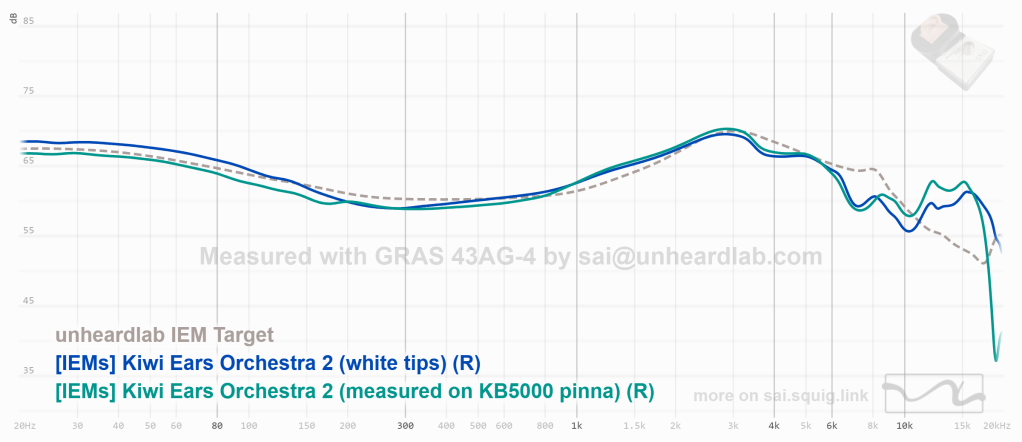
This graph illustrates how the earphone measures on the GRAS RA0045-S1 with the KB5000 anthropometric pinna and ear canal, compared with the straight cylindrical GR0408 canal extension. The KB5000’s softness and anatomically shaped concha and canal provide a more realistic coupling, which might yield a response closer to the perceived listening experience.
Insertion Depth on Frequency Response:
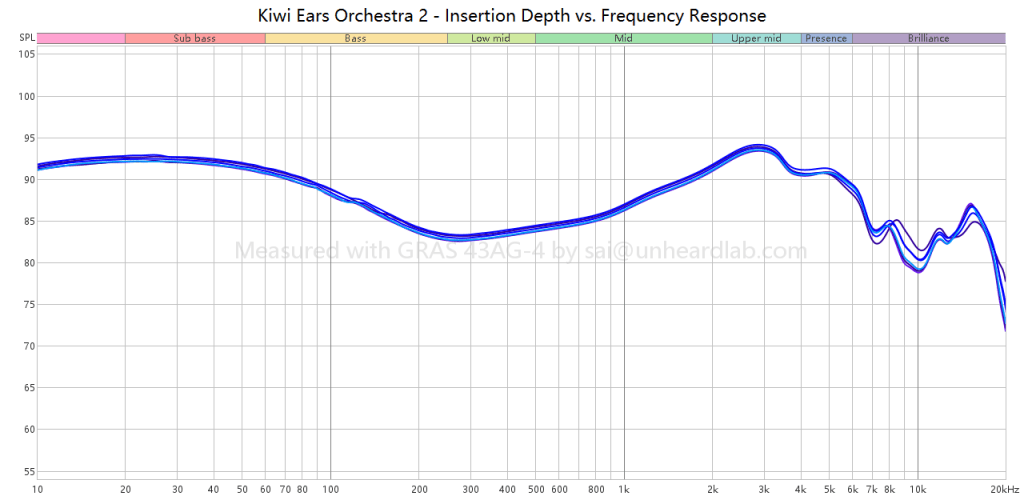
This graph illustrates how varying the insertion depth of the earphone into the GRAS RA0045-S1 ear simulator with the GR0408 canal extension alters the measured frequency response. Shallow versus deep fits shift the ear canal resonance, most notably moving the 7–9 kHz peak, which explains why insertion depth strongly affects perceived treble balance.
Comment: This is very good. The Orchestra 2 remains relatively consistent with changes in insertion depth, with no major shifts or sharp resonance peaks, indicating stable coupling behaviour.
Linearity and Compression:
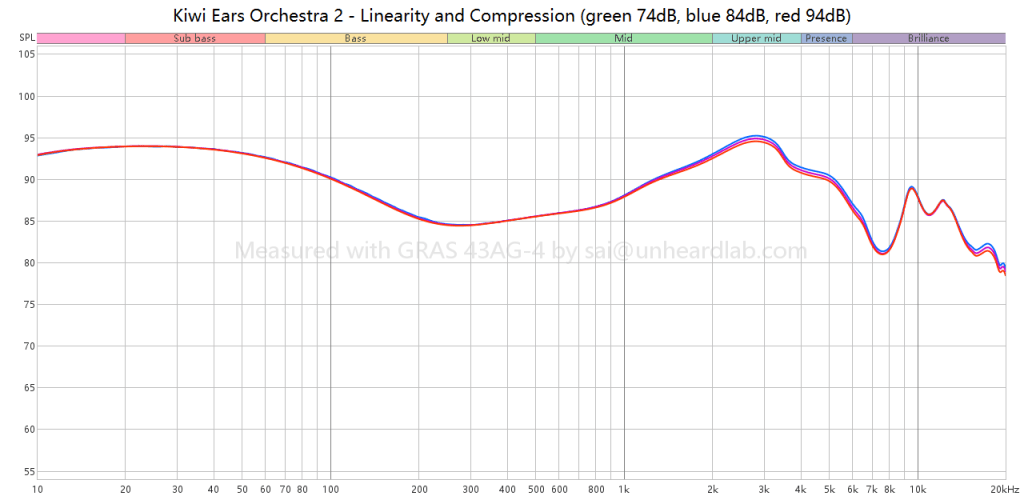
This graph illustrates how the earphone responds at different playback levels (green: 74 dB, blue: 84 dB, red: 94 dB, superimposed). Overlapping traces indicate that the frequency response remains stable with increasing level, with no signs of compression or non-linear behaviour across the tested range.
Comment: This is excellent. Unlike many hybrid IEMs (due to crossover of driver units with different linearity and sensitivity specs), the Orchestra 2 remains highly consistent across different SPLs, maintaining a stable tonal balance as volume increases/decreases.
Impulse Response:
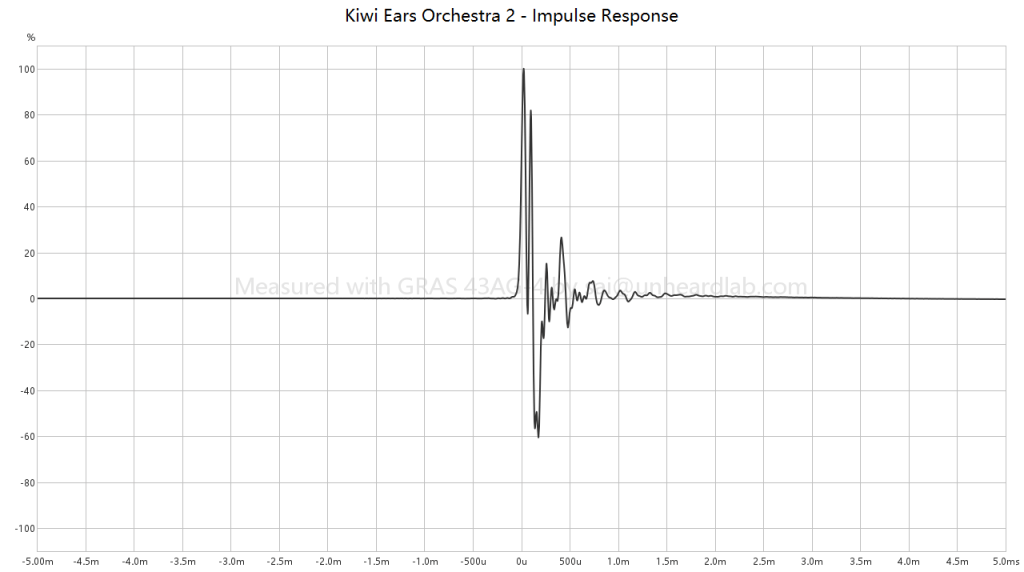
The impulse response test measures the initial response, overshoot, and decay of a transducer upon receiving a signal. An initial upshoot indicates a normal/non-inverted polarity, vice versa.
Total Harmonic Distortion (THD% 2nd-9th, 94dB@500Hz):
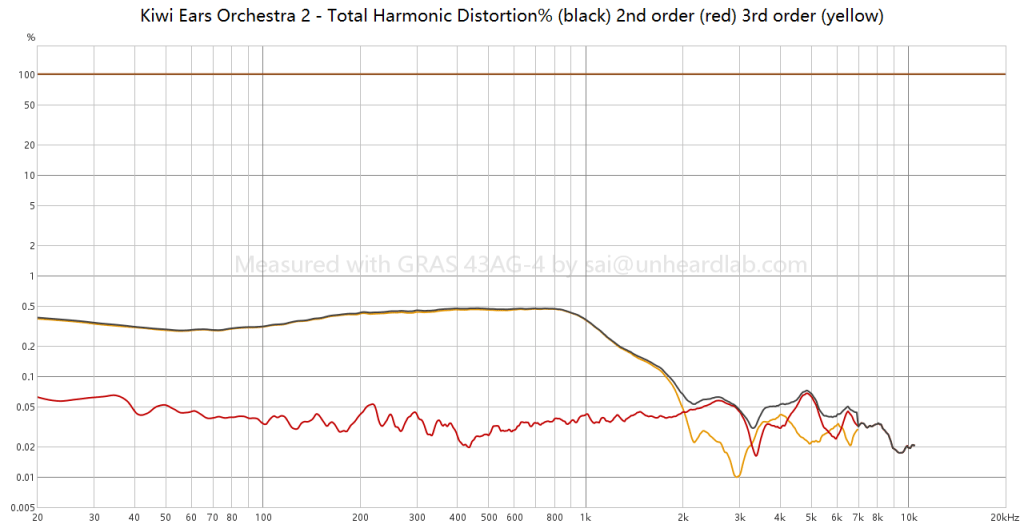
This graph illustrates the total harmonic distortion, with black showing overall THD, red the 2nd harmonic, and yellow the 3rd. THD represents additional harmonic components generated by the transducer when reproducing a signal.
Comment: This is fairly typical for a BA-based design. Distortion remains low overall, but the mild rise through the midrange is consistent with what is often seen in BA drivers, especially full-range BA units.
Channel Matching:
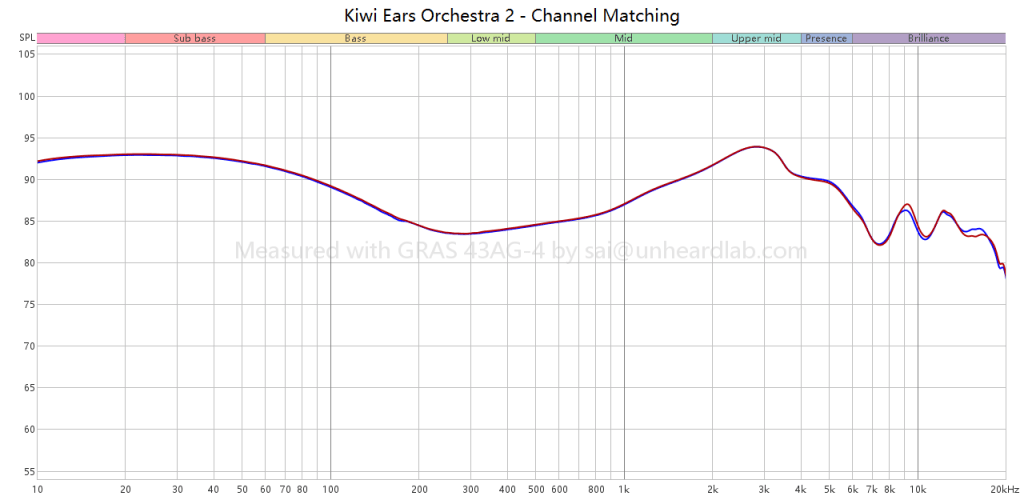
This graph illustrates the left (blue) and right (red) channel frequency responses of the earphone. Close overlap indicates excellent channel matching, which supports accurate imaging and stable spatial presentation.
Electric Phase & Impedance:
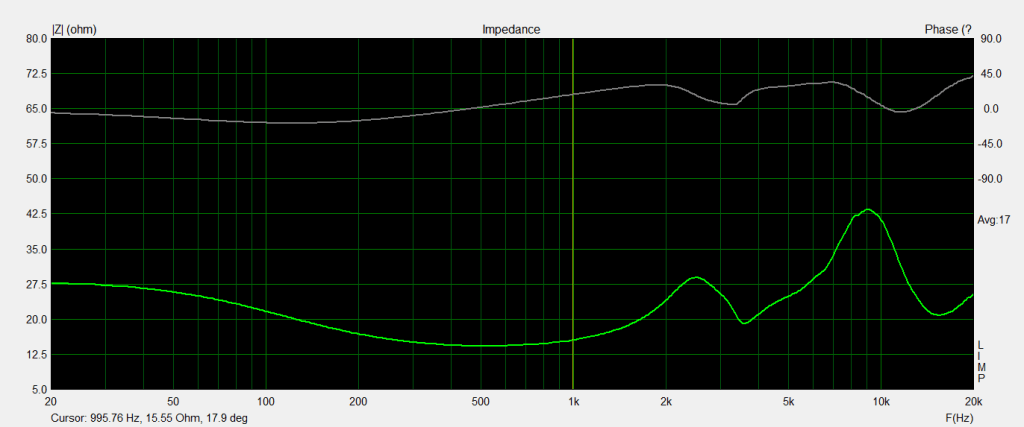
This graph illustrates an earphone’s electrical impedance (in ohms) and phase (in degrees) across frequency. Impedance indicates how the load presented to an amplifier varies with frequency.
Comment: Impedance shows some variation, otherwise fairly well behaved overall. As with most BA IEMs, higher output impedance sources may slightly affect the frequency response, something to keep in mind.
END OF THE ARTICLE
Disclaimer: This review is independent and was not sponsored or endorsed by any company or affiliated entity. All headphones reviewed are purchased for review unless otherwise stated. Any links or product references are provided for informational purposes only and are not associated with any financial compensation or affiliate arrangement.
